Veteran Volunteers Free Centuries-Old Barricade From Alien Invaders
Allens Pond Wildlife Sanctuary kept up by “The Trailblazers”
April 2, 2026
Share


WESTPORT, Mass. — The enemy, or, more accurately, enemies, were entrenched among the rocks of centuries-old stone walls. A skid-steer loader with a brush-clearing attachment had already cleared the bulk of the invasive biomass in the area.
But Oriental bittersweet, honeysuckle, multiflora rose, porcelain berry, autumn olive, Japanese knotweed, and privet are deeply embedded in southern New England. These invasive intruders smother and strangle native plants and one, bittersweet, can uproot trees due to its weight. They offer little to native wildlife. Outside of their native ranges, these intruders cause immense damage to ecosystems.
Under the direction of Ally Lague, property manager for Mass Audubon’s Allens Pond Wildlife Sanctuary, five of her seven dedicated volunteers gathered, as they routinely do, on a recent Friday morning. That day’s main chore was to battle another snarl of invasives — this particular tangle had swallowed stone walls boarding the property’s hayfields.
This late-March effort was designed to improve the grassland habitat for native birds and restore the classic New England aesthetic of the stone walls.
“Invasive plants bog down coastal space and take over grasslands,” said Lague, explaining that centuries of agricultural on the property had degraded the land. “We’re fixing agricultural mistakes from the past.”
Those long-ago mistakes included filling salt marsh with debris, rocks, and animal waste. The cleanup continues.
Besides tearing up and chopping down invasive plants, the volunteers also help restore salt marsh, blaze trails, and install boardwalks. Weather permitting, they meet at 9 a.m. in one of the three Allens Pond Wildlife Sanctuary parking lots on Horseneck Road. They then spend the next 3 hours working on the tasks planned by Lague. Their Friday instructions are emailed to them on Wednesday.
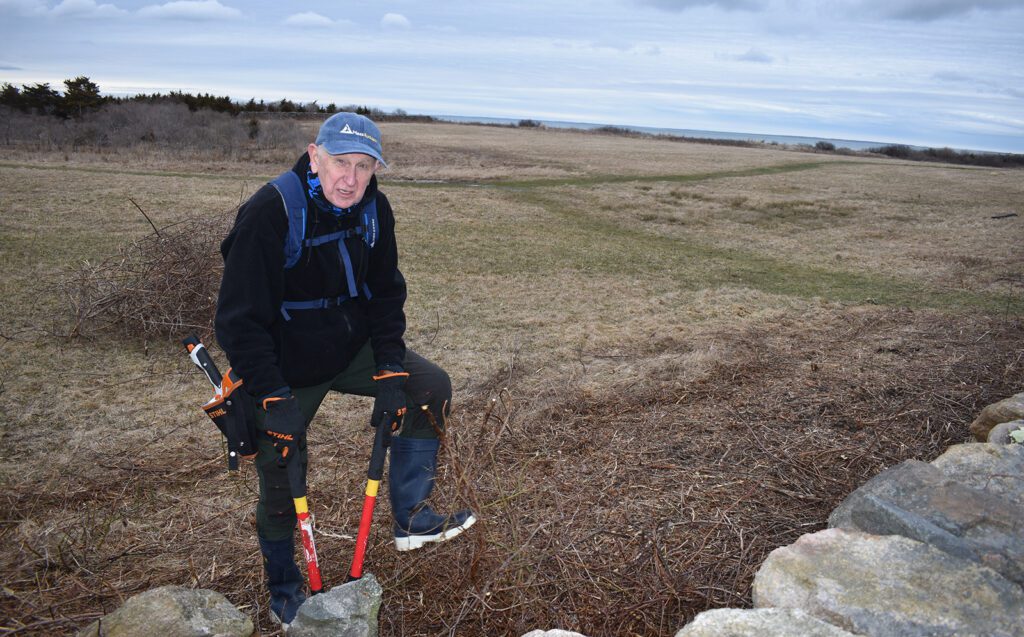
On this day, “The Trailblazers,” as they are called, included Rick Tedoldi, 80, of Norfolk; Ken Nordstrom, 81, of Providence; Annie Maguire, 76, of Westport; Ken Piva, 69, of Dartmouth; and Richard Ilgen, 72, of Westport.
Ilgen is the longest-serving Trailblazer, having joined the volunteer group as an original member more than a decade ago. He had originally stopped by the sanctuary to ask if an osprey stand could be named in memory of his good friend Michael Viens who had recently passed. One was named in honor of his friend, and Ilgen would later anchor the creation of The Trailblazers.
Tedoldi is relatively new to the group, having joined in September, but not new to volunteering his time to help protect and conserve the natural world. He’s volunteered with different organizations in Oregon, Vermont, and western Massachusetts.
He became an Allens Pond volunteer regular after noticing, as he drove past on his way to see two granddaughters who live in Westport, Lague and a few Trailblazers getting their hands dirty. He stopped, asked some questions, and joined the weekly effort.
“I love it,” Tedoldi told me before the morning work started. “Ally always has something different going on.”
The retired information technology professional spoke about watching Audubon staffers band monarch butterflies and gathering wild seed for replanting. They both volunteer and learn.
After his weekly Allens Pond chores are completed, Tedoldi visits with his daughter and two granddaughters.
A natural oasis along the shores of Buzzards Bay, the Allens Pond Wildlife Sanctuary features hundreds of acres of beaches, fields, forests, freshwater wetlands, and maple swamps. It’s a popular spot for birding, and with 9 miles of trails, the Mass Audubon sanctuary is also enjoyed by hikers.
The property is also home to one of the last wild salt marshes in southeastern Massachusetts, according to Lague. It’s also home to one of the largest populations of saltmarsh sparrows in New England, she added. This endangered sparrow is the only species of breeding bird endemic to the salt marshes of the Northeast.
The 600-acre property protects a coastal ecosystem where thousands of birds flock throughout the year. Some 300 species of birds have been recorded here, including willets and endangered piping plovers. Egrets and herons feed and shelter in the salt marsh, osprey nest and hunt on the property, and least terns and American oystercatchers can be found around Allens Pond throughout the breeding season.
Butterflies and other pollinators dart and flutter through the meadows.
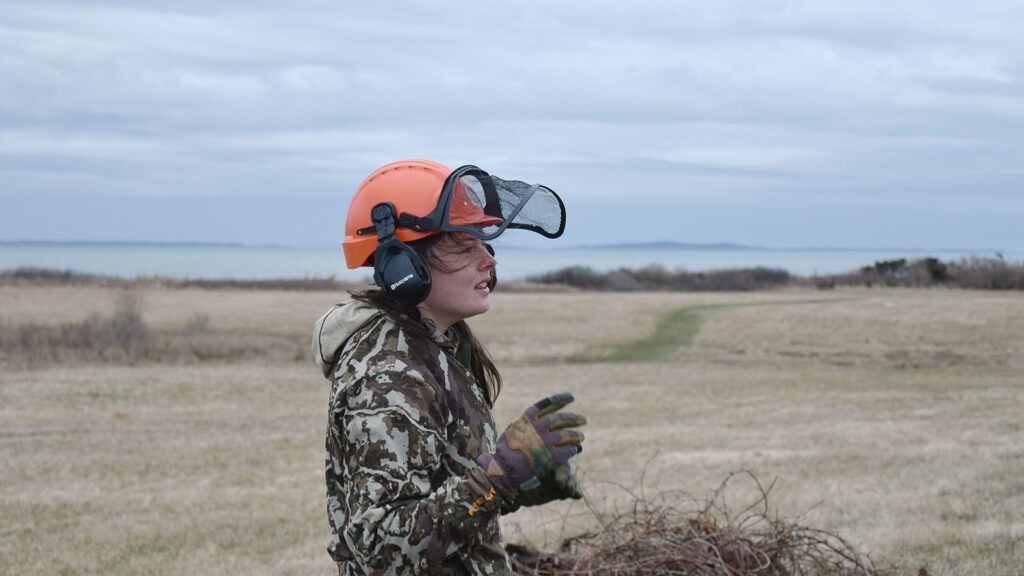
Lague has been employed at the Horseneck Road property since 2019, including the past four as manager. In high school, she volunteered here monitoring nest boxes.
On this particular Friday, it was a gray, overcast morning with temperatures in the high 40s. The roar of the ocean could be heard in the background. Lague unlocked the weapons that would be used to dislodge the invasive intruders — battery- and muscle-powered tools such as weed wackers and loppers. Everyone but Tedoldi chose an implement. The Norfolk resident arrived with his own battery-powered mini-chainsaw. It was holstered to his hip as The Trailblazers followed Lague to the first skirmish.
Mass Audubon hosts a variety of educational programs at its Allens Pond property, from guided walks and annual butterfly counts to events at the sanctuary’s 1860s-era Stone Barn Farm.
The southeastern Massachusetts sanctuary was created by generous families who chose to conserve their properties. The sanctuary’s sandy, windswept shores and rocky coastline, salt marshes, meadows, and upland forest attract an abundance of wildlife.
Mass Audubon staff and The Trailblazers are restoring the property’s salt marsh habitat and preparing the sanctuary’s coastline for the impacts of climate change. The work is intended to improve the health of critical wetlands, to protect wildlife, and strengthen natural defenses against rising waters.
The sanctuary is part of a project to protect Buzzards Bay salt marsh from sea level rise. The effort is designed to enhance the ability of coastal communities to better project themselves from the climate crisis, improve ecosystem function, and increase biodiversity by addressing historical human impacts and leveraging partnerships to ascertain and share knowledge.
Salt marshes consist of vegetation that grows along parts of the shoreline regularly impacted by tides. About 5,000 acres of salt marsh grow around Buzzards Bay. This vital ecosystem protects homes and human-made infrastructure from storm surge and flooding; provides habitat for 32 state-listed species of “greatest conservation need,” including northern diamondback terrapins and saltmarsh sparrows, fish, and shellfish; sequesters a large amount of carbon dioxide; and filters pollutants from stormwater runoff.
The South Coast of Massachusetts is losing salt marsh faster than these wetlands can naturally adapt, as coastal development has limited their ability to relocate. Rising seas are drowning vegetation at the edges of salt marshes, and higher tides, as they wash over low-lying marsh and leave puddles of salt water pooled on the surface, are suffocating interior vegetation. It’s a deadly combination.
It has been estimated that Buzzards Bay lost some 200 acres of salt marsh to sea level rise between 2001 and 2019. Local waters are projected to rise about foot over 2000 levels by 2050. That could result in losses of up to a quarter of the bay’s remaining salt marsh.
Mass Audubon is working with the Dartmouth Natural Resources Trust, the Buzzards Bay Coalition, and other partners to help Allens Pond salt marshes migrate upland.
Runnel networks have been built. The work requires digging shallow channels that connect flooded portions of low marsh to natural drainage areas such as streams. Runnels help drain salt water from marsh die-off areas, which allows vegetation to regenerate. Also, tidal restrictions, such as invasive brush and stone berms from former agricultural fields upland of Allens Pond, have been removed.
Last year some 200 pounds of native seeds were spread to help restore the wildlife sanctuary’s natural landscape and 10 truckloads of marine debris were removed from the salt marsh and tidal creeks.
By boosting native plant communities and reestablishing natural water flow, Mass Audubon officials said these project strengthen the sanctuary’s resilience to climate impacts and safeguards habitat for priority species.
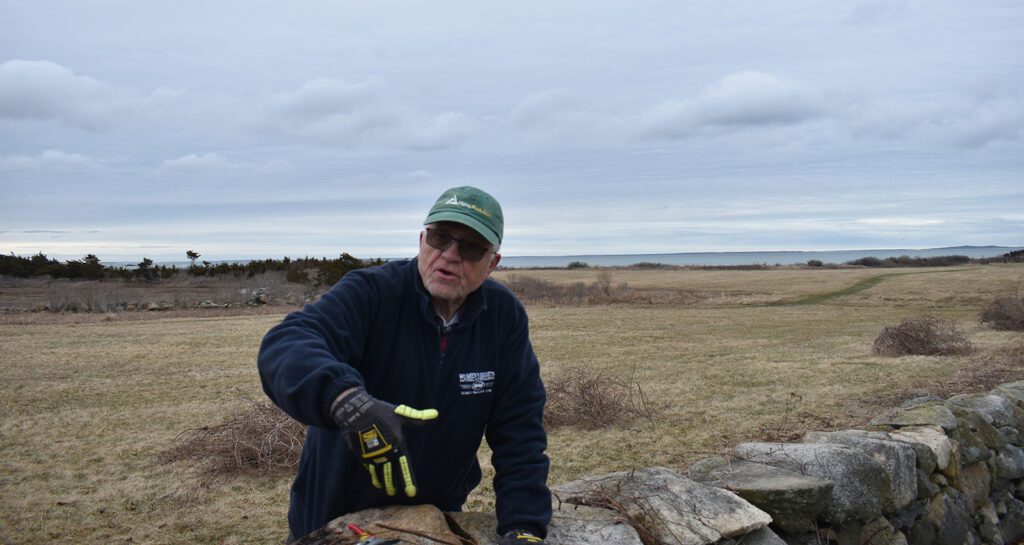
The day after my visit to Allens Pond I received this email from Nordstrom. It was titled “Not Scalable”:
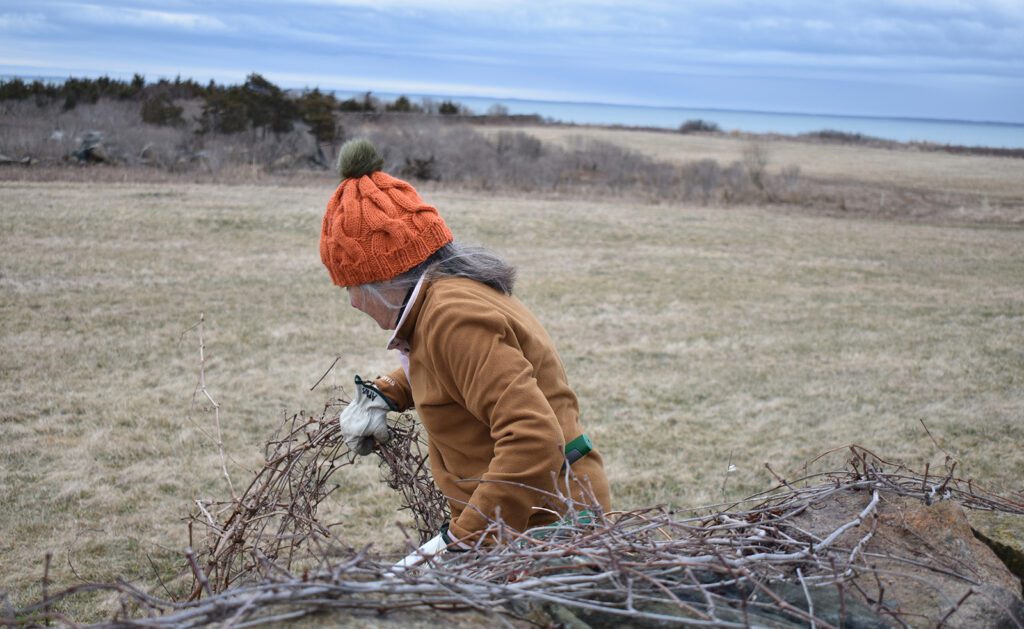
“I began by flexing my muscles to rip away the vines deeply wedged inside the stone wall. A quick jerk of my shoulders freed the stubborn, stringy growth from the rocks’ crevices. Then I’d clip, clip, clip, and haul an armful over to the burn pile in the grasslands behind me. And do it all again. This week’s target, according to our Audubon leader, was Virginia Creeper. I think I like that name. Better than Multiflora Rose with its thorns that bite.
“Gradually, a rhythm set in. In my younger days, I never imagined that an activity involving such tedious repetition could be so therapeutic. The cadence of my work, with the chill March air, breezes rippling the grass at my back, and storm-exiting clouds swirling across the skies above, combined to remind me again that there’s no other place on earth I’d rather be on a Friday morning than at Allens Pond with my fellow Trailblazers.
“It was so exhilarating. Almost hypnotic. But it was, of course, also highly inefficient. Though there were seven of us, we barely finished cleaning up the walls surrounding the trailhead fields. As I switched from hand clippers to longer loppers, I flashed back to my business days and heard a different kind of leader inside my head, babbling on about a new project, tossing terms like ‘size’ and ‘scope.’ He often ended with a cliche about making our new business venture ‘scalable.’ I acknowledged to myself that what I was doing today was anything but that.
“But then, as my boots squished in a muddy trough running between a burn pile and the wall, my mind suddenly lurched forward to the future. To an age of homo virtualis, when little AI-powered Artoo-detoo ‘volunteers’ might be buzzing around these same stone walls, shaving them perfectly clean and probably twice as fast, without needing water breaks. You might even call it ‘scalable.’
“Sadly, I thought of how that would steal from my grandchildren the bliss of tedious but tactile work routines resulting in beautiful scenes their own hands had directly shaped. Instead, they’d sit at their screens, directing a robotic workforce trimming the stone walls of their invasive growths. Never knowing the thrill of actually touching a gnarly plant, smelling the reedy wetlands, or feeling the joy of being an inefficient human.”
Note: Anyone interested in volunteering at Mass Audubon’s Allens Pond Wildlife Sanctuary should email Ally Lague at [email protected].