Drowning Saltmarsh Sparrows Provide Anxious Glimpse Into Nature’s Future
May 12, 2025
Share


Series note: The region’s collection of native species is under threat on several fronts, most notably from humanity’s shortsightedness. Humans aren’t giving the natural world the space it needs and deserves. We’re crowding out nonhuman life, which, in turn, makes nature less productive and us less healthy. Wild New England examines the animals and insects most at risk.
This sparrow is the only species of breeding bird endemic to the salt marshes of the Northeast. It’s also in deep trouble.
The saltmarsh sparrow is predicted to go extinct in the next few decades, as rising sea levels flood tidal wetlands throughout their range along the East Coast, the only place these birds are found in the world.
This nondescript, hard-to-spot sparrow ekes out an existence in these coastal ecosystems. In Rhode Island, at a 36-acre salt marsh at Jacob’s Point in Warren, volunteers have kept careful watch on the saltmarsh sparrows that nest there. They and their habitat are drowning. By 2050, the sea is expected to rise 13 to 18 inches across the sparrow’s range, according to the U.S. Fish & Wildlife Service (USFWS).
These tiny songbirds, with dappled feathers, a white breast streaked with brown, and a radiant orange face, nest in high-marsh grasses just above the mean high-tide line. The species has naturally adapted to occasional flooding, as their eggs can survive short periods of inundation and chicks often climb to safety in the grass above the nest.
Even under the conditions saltmarsh sparrows have evolved with — the species has built nests only an inch above the ground for thousands of years — nesting in an area that floods monthly at high tide is a risky move. To deal with breeding in an environment that habitually floods, the breeding season for saltmarsh sparrows is short, 28 days (a tide cycle) from eggs to vacating the nest.
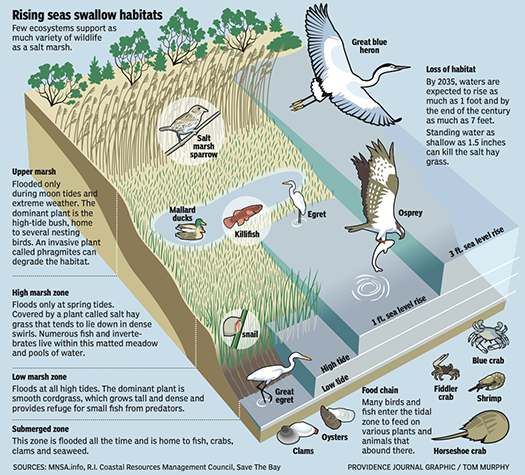
But increasing storm surge and sea level rise being fueled by an intensifying climate crisis, combined with development and pollution, have saltmarsh sparrows on the run.
The USFWS has noted roads, buildings, beachside homes, and other coastal development “greatly reduce the natural habitat that the saltmarsh sparrows rely on for survival.”
They are hardly the only species human activity is squeezing out.
A recent analysis of 495 bird species in North America has found that three-quarters are declining across their ranges, with two-thirds of that total shrinking significantly.
The study, published May 1, found bird populations across the continent are falling most quickly in areas where they are most abundant, prompting concerns of ecological collapse in previously protected areas.
The authors noted that former strongholds for bird species, including grasslands, drylands, and the Arctic, are no longer safe. Of the species they examined, 83% are losing a larger percentage of their population where they are most plentiful.
Their research adds to a recent series of work that has documented severe declines of birds in nature reserves and protected areas.
Paul R. Ehrich, professor of population studies and president of the Center for Conservation Biology at Stanford University, has repeatedly warned humankind of its negative impact on the natural world, the biodiversity it holds, and the free ecological services it provides.
“Not only has most of the terrestrial surface been directly modified by building, paving, plowing, grazing, drilling, mining, clear-cutting, logging, draining, pumping, or damming, but all of it has been affected by poisoning,” Ehrich wrote in the forward to the 1997 book “The Work of Nature: How the Diversity of Life Sustains Us.”
As the book’s author, Yvonne Baskin, noted risks to “our own species incurs when we impoverish the rest of the life of the planet.”
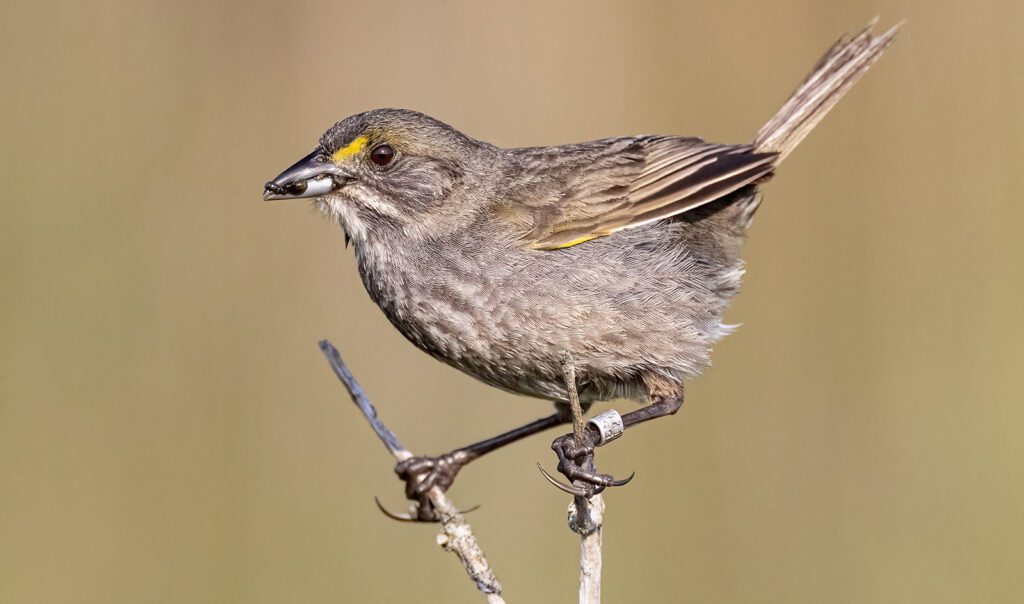
The following is a look at sparrows in southern New England listed as a species of concern, threatened or endangered:
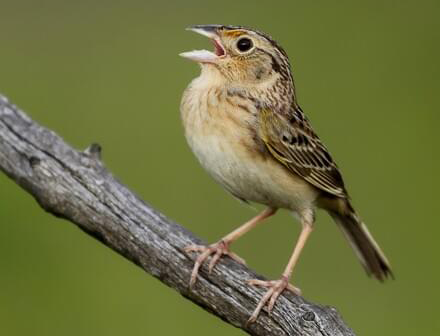
Grasshopper sparrow: Listed as threatened in both Rhode Island and Massachusetts and endangered in Connecticut. They eat, sleep, and nest on the ground. This species is largely insectivorous. Patches of bare ground are critical to this sparrow’s foraging behavior as grasshoppers, a primary food item, are most often pursued on or near the ground. They also feed on spiders, snails, earthworms, and weed and grass seeds.
They arrive in the area in late May. Males lay claim to an exclusive non-overlapping territory by singing the grasshopper song all day from a tall weed, fence post, or haystack. During the non-breeding season both the male and female sing. They migrate to wintering grounds by mid-September.
They have historically been called the yellow-winged sparrow because of the yellow feathers found at the bend in their wings.
This species has steadily declined as dry, grassy uplands and farms have been developed or reverted to forests. As with other ground-nesting birds, high populations of predators such as raccoons, skunks, and feral or free-roaming cats have also contributed to the bird’s decline.
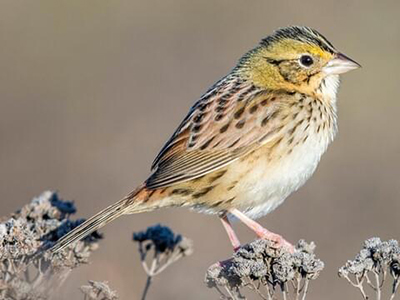
Henslow’s sparrow: Listed as state historical in Rhode Island — last seen there in 1940. They inhabit open fields where vegetation is comprised of a dense growth of grass, weeds, or clover. Some scattered shrubs may be present but extensive shrubby growth makes fields unsuitable. Wet meadows are most often the preferred habitat, although drier areas may be selected. The nests are built of woven grass on the ground, usually in a clump.
This sparrow has the simplest and shortest song of any North American songbird, a thin “tze-lick” that has been described as a “feeble hiccup.” They sing most actively at dawn and dusk, but sometimes sing all night long.
They were named by John James Audubon for his friend John Stevens Henslow, a botanist, a minister, and a teacher of Charles Darwin.
Historically, populations of this bird were concentrated in two areas: the central prairies of the United States and coastal marshes along the Atlantic Coast. As land was cleared between these two regions, they moved into newly created grassland and largely disappeared from coastal marshes.
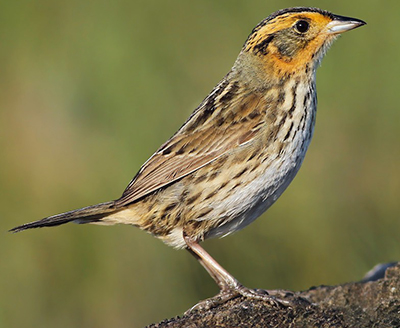
Saltmarsh sparrow: Listed as a species of concern in Massachusetts. This bird is a short-distance migrant and obligate tidal salt marsh specialist. This species arrives to the area’s breeding grounds in early/mid-May and begins nesting by late May or early June. Fall migrants occur in coastal salt marshes from late summer through October.
Their primary vocalization is a buzzing hiss, preceded or followed by several sharp notes of “tuptup sheeeeee.” They are a non-territorial species where males occupy large and typically overlapping home ranges.
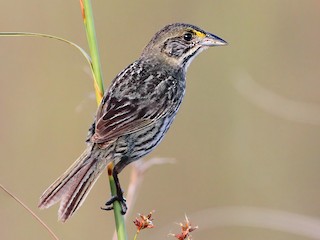
Seaside sparrow: Listed as a species of concern in Rhode Island. They are hefty birds with large, long, pointed bills, long, rounded tails, long legs, and short, rounded wings. They cling to marsh grasses to strip seeds and glean insects. They run through mud, seizing invertebrates and picking up fallen seeds.
These sparrows are near the northern limit of their breeding range in Massachusetts. The species is rare and locally distributed in salt marshes in the vicinity of Plum Island and Parker River in Essex County, at Sandy Neck and Monomoy on Cape Cod, and at South Dartmouth in Bristol County.
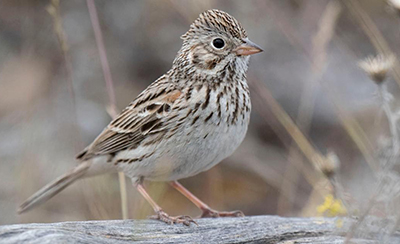
Vesper sparrow: Listed as state historical in Rhode Island — last seen there in 1984 — threatened in Massachusetts and endangered in Connecticut. This bird is considered more of a habitat generalist than other grassland sparrows because their territories often include taller woody vegetation interspersed within the grassland, rather than being completely open. They prefer habitats that are typically dry, well-drained with a mixture of short grass, bare ground, and shrubs, trees, or other high structures, including telephone poles and lines, from which males can sing.
There are few published specific arrival and nesting dates in Massachusetts, but most vesper sparrows likely arrive in April and breed during May-August. The nest is built on the ground by the female.
They are a host of the parasitic brown-headed cowbird, which lays its eggs in the sparrows’ nests. The “host” vesper sparrows end up raising the larger cowbird young, while their own young usually perish.

White-throated sparrow: Listed as a species of concern in Rhode Island. These birds breed mostly across Canada, but they’re familiar winter birds across most of eastern and southern North America and California. They come in two color forms: white-striped and tan-striped. The two forms are genetically determined, and they persist because individuals almost always mate with a bird of the opposite morph.
In Massachusetts, they are fairly common breeders from Worcester County west, but are considered rare and local breeders in the eastern part of the state. They are absent as breeders on Cape Cod and the islands. They are especially found in the higher elevations of Worcester County and throughout the Berkshires.
Although they look nothing alike and aren’t particularly closely related, the white-throated sparrow and the dark-eyed junco occasionally mate and produce hybrids. The resulting offspring look like grayish, dully marked white-throated sparrows with white outer tail feathers.
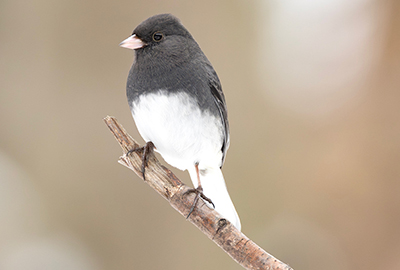
Dark-eyed junco: Listed as a species of concern in Rhode Island. They vary across the country, but in general they are dark gray or brown birds brightened up by a pink bill and white outer tail feathers that periodically flash open, particularly in flight. They hop around the bases of trees and shrubs in forests or venture out onto lawns looking for fallen seeds.
Over most of the eastern United States, they appear as winter sets in, and then retreat northward each spring. Other juncos are year-round residents, retreating into woodlands during the breeding season, or, like those of the Appalachian Mountains, moving to higher elevations during the warmer months.
They are one of the most common birds in North America and can be found across the continent.
Note: Some of the species listed in each state overlap, and how often the lists are updated varies — the Rhode Island list was last updated in March 2006, Massachusetts last August, and Connecticut in January 2023. For species listed as state historical — essentially extirpated — in Rhode Island, they were included in the endangered category.