
As Populations of Wild Brook Trout Decline, Conversation Around Practice of Stocking Changes
June 25, 2026
Share


UPPER WOOD RIVER, R.I. — Wild eastern brook trout is the only species of freshwater trout native to Rhode Island, and their numbers are shrinking due to factors including climate change and habitat loss.
Organizations such as Trout Unlimited and the state Department of Environmental Management believe they speak for the trout, but that doesn’t mean they agree on what the fish have to say — especially when it comes to the question of stocking Rhode Island ponds, lakes, and rivers with brook trout raised in hatcheries.
“The fish, they don’t have a voice. Nobody knows these brook trout exist here. [People] don’t see them, they aren’t like rabbits or deer, they’re invisible,” said Richard Benson, a longtime member of Rhode Island Trout Unlimited (RITU), a nonprofit that supports freshwater and fishery conservation.
Wild brook trout used to be found in waters from Maine to Georgia, but their footprint is about 5% of what it once was. Opponents of the practice of stocking fish — the process of releasing fish raised in hatcheries into waterways for anglers to catch — which has been a Rhode Island practice since the late 1800s, say the stocked brook, brown, and rainbow trout compete with wild native trout.
Rhode Island has four trout hatcheries — Arcadia Warmwater Trout Hatchery, Carolina Trout Hatchery, Lafayette Trout Hatchery, and Perryville Trout Hatchery. Annually, DEM releases about 80,000 fish into locations around Rhode Island.
In 2013, the RITU chapter chose to reject the national Trout Unlimited organization’s stance against trout stocking and reluctantly support DEM’s practice of stocking fish; but today, more than 10 years later, although they work alongside each other, the RITU chapter and DEM still don’t see eye to eye on the issue.
Brook trout survive in only the coldest and cleanest water, and serve as indicators of the health of the watersheds they inhabit. Strong wild brook trout populations demonstrate that a stream or river ecosystem is healthy and that water quality is excellent. A decline in brook trout populations can serve as an early warning that the health of an entire system is at risk, according to the Eastern Brook Trout Joint Venture. The Wood River contains the healthiest known wild brook trout populations in the state.
The story of the wild brook trout is not unique; many fish species have faced population decline as their habitats continue to be impacted, and conservation organizations such as RITU believe that trout stocking is one of the many reasons why.
“[This] chapter was still pretty much ensconced in stocking and helping DEM in stocking to put those big fish into the river so our members could have something to catch,” said Glen Place, president of the RITU chapter.
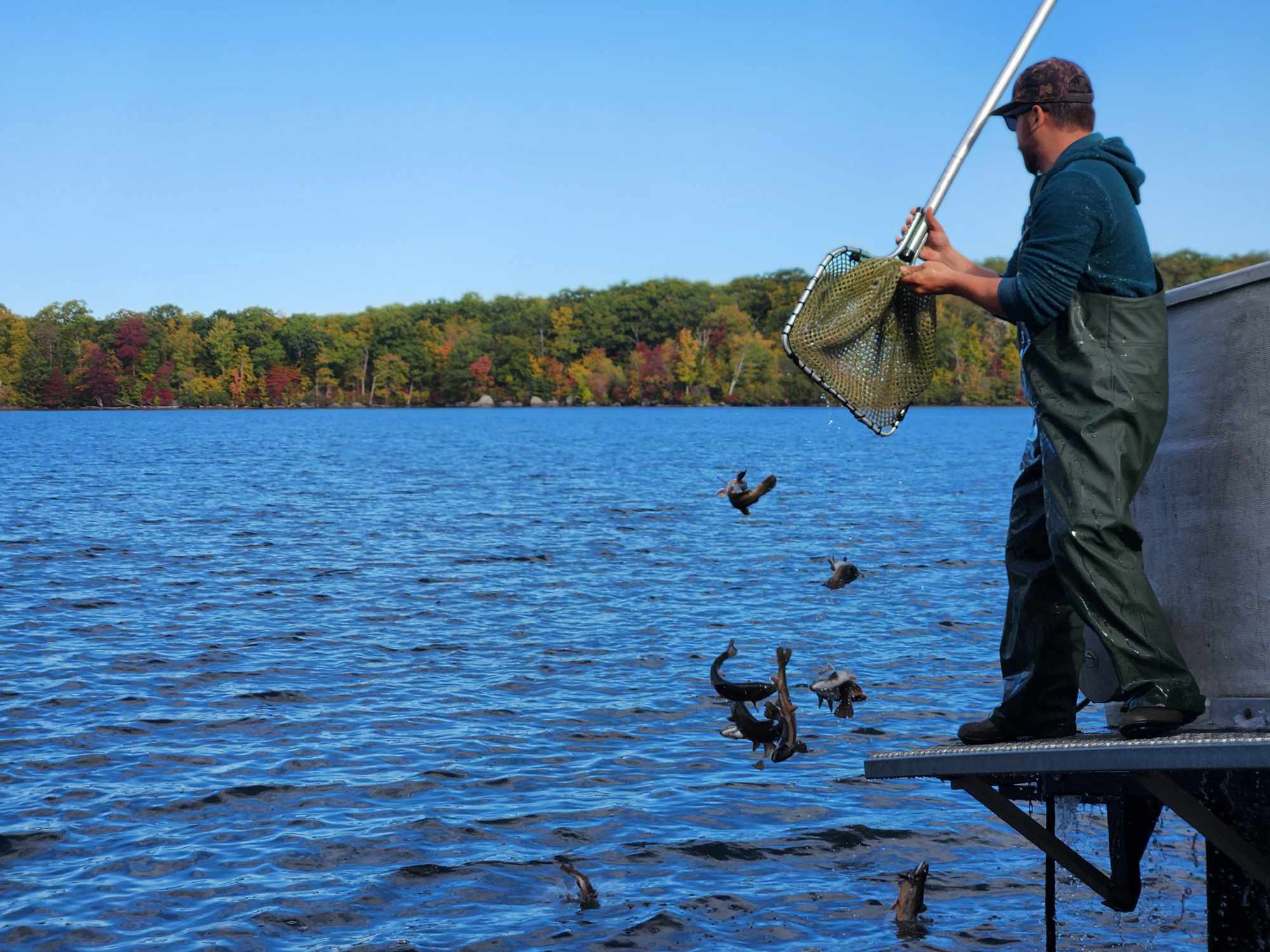
Stocking serves not only to supplement a form of recreation for anglers; it also provides an opportunity for subsistence fishing and a revenue stream for DEM through the purchase of fishing licenses. Freshwater fishing licenses are $24 for state residents and $41 for nonresidents.
In 2025 DEM sold 26,981 fishing licenses totaling $600,000 and, according to the agency, the funds are funneled back into hatchery and conservation efforts.
Although stocking provides many benefits for both DEM and anglers, it also could present some challenges to the native fish population.
The national chapter of TU, using scientific data that found stocking hatchery-raised over native fish could have a detrimental impact on local salmonid populations — a fish classification including salmon, trout, and char — opposed the practice of stocking. The national TU chapter aired this opinion as early as 1998 with its North American Salmonid Policies, but its stance became much more firm following 2011’s Document for (National Leadership Council) NLC Resolution on Stocking Non-Native Hatchery Trout Over Native Trout Populations.
“It is scientifically well established that the stocking of hatchery trout over a native trout population is harmful to that native trout population,” according to the national chapter. “The NLC passed the resolution, which was endorsed by the Board, with the purpose of ensuring that TU Chapters and Councils are not participating in or supporting such stocking activities in furtherance of TU’s mission to protect and restore wild and native trout.”
The RITU chapter chose to forgo this guidance in 2013 to maintain a relationship with DEM and continue partnering with other conservation efforts. “We were tiptoeing around and yes, we didn’t want to do any stocking with DEM, but we also wanted to maintain our relationship with them,” Place said.
Stocking increases competition between the stocked and native fish, according to the national TU chapter. Even when the species of trout stocked is the same as the native population, stocked fish are on average much larger and more ruthless, leading to the stocked fish outcompeting for space and food.
With the increase of anglers in response to a waterway being stocked, the banks of the waterways can be dispersed, leading to more sediment in the water, which could in turn mean that wild brook trout have a harder time finding and building their nests. The RITU chapter has been working with DEM on conservation efforts specifically addressing the increase of sediment in Rhode Island waterways.
When she is ready to breed, a female brook trout will make a depression, called a redd, or nest, in the gravel or sediment in the river using her tail. She will defend her redd during construction and pair up with a dominant male, who will also defend the nest. When she has completed the nest, the male and female release eggs and sperm simultaneously. The free-floating eggs fall into the depression in the substrate and are fertilized. The female will then move slightly upstream and begin the process all over again, continuing to build nests until she is empty of eggs, each time moving upstream so the sediment from nest-building falls onto the previously built nest and affords those eggs protection.
As climate change warms the rivers and streams in which brook trout live, populations move to colder waters, which are better oxygenated. These refuges are getting rarer as water temperatures rise. Stocking waterways with hatchery trout forces the native trout to deal with both warming water and more fish competing for resources, according to opponents of stocking.
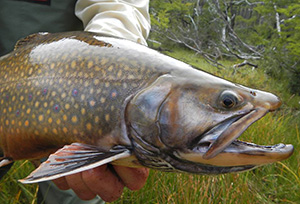
Although the practice of stocking has been well researched on a large scale, there is still little science covering its effects on specific Rhode Island waterways. The impacts of stocking tend to be species-specific and highly dependent on geographic location. Stocking creates pressure on the native trout populations, especially when invasive trout species are added, but the actual impacts are specific to certain environments.
While conservation organizations such as RITU believe that native fish populations are detrimentally impacted by stocking, DEM believes its data shows no sign of that impact.
“Irrespective of studies in other states, Rhode Island scientific data compiled, analyzed, and continued through many years has determined that the population of wild brook trout in our state is successful in self-sustaining populations and not at risk by hatchery stocking,” Christine Dudley, DEM’s deputy chief of freshwater and diadromous fisheries, said.
Dudley noted the native population of brook trout is at risk due to other environmental factors.
“Their numbers are not in jeopardy due to stocking, but rather due to siltation, development, water withdrawals, and connectivity issues of dams and non-passable culverts,” she said. “Populations so isolated do not have the ability to mix with other wild trout populations.”
In response to the criticism that stocking increases competition between native and stocked trout, Dudley said DEM believes that it doesn’t make a huge difference. Since the stocked fish are on average much larger than the native population, they are more likely to be caught and removed and therefore don’t survive long enough to make an impact on native populations. Dudley said while hatchery fish do increase competition, “so does every other fish that lives in the stream.”
In 2022, the R.I. Trout Unlimited chapter released a statement rescinding its original support of DEM’s practice of stocking, noting that watersheds such as the Upper Wood River are at risk. According to Place, part of the hesitancy in rescinding RITU’s support of stocking not only came from the organization’s relationship with DEM, but also because the chapter was unsure as to the way to refer to the state’s brook trout population, saying there wasn’t a strong definition of a “native” population.
“The thought was that there’s so many brook trout that have been stocked in here in the past 100 years that you cannot really ascertain whether the brook trout that live in the population are truly native,” Place said.
The organization has since clarified the wording and defined Rhode Island brook trout as a “native” species.
Although DEM still stocks the Upper Wood River watershed, it has a “handshake agreement” with RITU that it won’t stock invasive species of trout in the area, Place said. RITU will continue to work with DEM to move away from stocking hatchery fish over natives, and he described their current relationship as a “great” one, despite these challenges.
As part of the partnership, DEM has continued to assess its stocking practices to align with increases in brook trout conservation efforts. According to DEM, less than 8% of Rhode Island’s freshwater systems are stocked with trout. Working alongside RITU, DEM has established catch-and-release regulations for some unstocked waters, mandating that brook trout be released back into the wild. Additionally, DEM has implemented an 8-inch minimum rule for taking trout from the rivers. Because it’s rare that native trout grows larger than 8 inches and the average size of stocked fish is much larger, the thinking is that the size limit protects native brook trout from anglers.
Place believes the efforts to conserve the Beaver River, a watershed similar to the Upper Wood River one, show the benefits of the partnership between RITU and DEM. The two organizations worked on temperature logging, surveying, and gathering waterway-specific data that led to the state agency choosing to end its practice of stocking the Beaver River.
But other conservation groups are worried that these efforts won’t be enough to protect native brook trout.
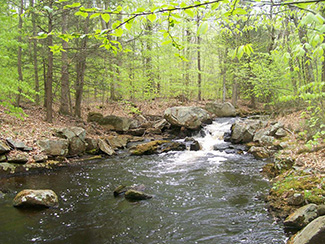
When the RITU chapter chose to support DEM, four Rhode Island anglers against that decision formed Protect Rhode Island Brook Trout in 2013. Founding member Brian O’Connor said they were “the most hated fishermen in all of Rhode Island” then, and he still believes that’s the case today.
PRIBT has been firm on its stance opposing stocking for the past 13 years, citing both data that the group collected itself and the evidence that the national TU chapter has presented. The organization believes DEM is in favor of stocking not because of the science the agency has collected, but rather because of the economic boon that local anglers provide.
Recreational fishing is an economic revenue source for the state, according to the Rhode Island Wildlife Action Plan. Residents and tourists spend nearly $38 million annually in Rhode Island on trip- and equipment-related expenditures for freshwater fishing, according to an American Sportfish Association report. Black bass and trout are the top two fish sought by freshwater anglers.
PRIBT’s criticisms of the practice of stocking fall in line with what the national TU chapter believes. As O’Connor said, “A single fish is competition, it’s affecting the carrying capacity; a thousand fish is insane.”
While PRIBT acknowledged the steps DEM has taken to reduce the impacts of trout stocking on Rhode Island’s wild brook trout, it also believes that the underlying issues aren’t addressed. Paul Pezza, another PRIBT founding member, said, “All of this in the interest of protecting those brook trout, yet [it fails] to address the very well documented detrimental impacts, direct and indirect, of stocking hatchery fish in waters that support wild fish.”
In 2022, PRIBT sent a letter to DEM director Terry Gray reaffirming its proposal to suspend stocking of the Upper Wood River and its tributaries and apply catch-and-release regulations instead. This proposal was supported by conservation organizations, including Trout Unlimited and the Eastern Brook Trout Joint Venture. DEM never responded to the letter, according to Pezza.
Benson, of RITU, notes how the meaning of conservation has changed since he first joined the organization, before stocking was as controversial as it is today.
“Stocking was the main thing for everybody; that was trout fishing. People were not aware that we had wild trout here,” he said.
Benson said he believes that before climate change became a burgeoning concern there was less worry about the state of the trout’s habitat, but now with rivers warming and waterways flooding, there is more emphasis on how to best conserve habitat. His views fall in line with how RITU believes the general public is responding to the conversation surrounding stocking.
“I think the general public is now starting to return a bit more toward conservation. There are people that want to come down here that are aware [of the impacts] because of the publicity from us and from PRIBT,” Place said.
PRIBT’s O’Connor is also hopeful for the future of Rhode Island brook trout. He would like to believe that over the next year or two the combined efforts of multiple different organizations fighting on behalf of trout will get DEM to reconsider its stance on stocking.
Rhode Island Trout Unlimited has recently applied for three conservation grants in partnership with DEM. One grant, through the state’s climate resilience fund, would repair roadway erosion and stormwater runoff to strengthen the wild brook trout’s habitat. A second grant would mitigate sediment in the Wood River and its tributaries to improve water quality by doing rapid road assessment monitoring during storms to identify sediment convergence pathways. A third would create a brook trout preserve in the Queens River watershed to restore and maintain brook trout populations by utilizing new and historic data of the local brook trout population.


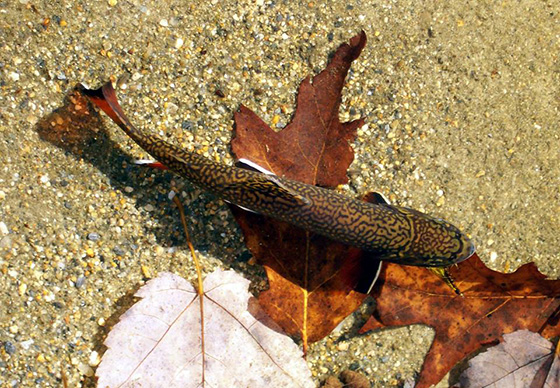
The formative goal of Protect RI Brook Trout (PRIBT) was to inform and to act as a catalyst to get existing conservation orgs and the state to become aware of threats to native brook trout populations and to shift emphasis away from recreation to conservation.
This led to our group making a formal proposal for a refuge at the upper Wood River. If one were to choose to do what’s best for a threatened species it would be best to secure as a refuge the best habitat and population available. There is limited funding for these actions. Why waste them on populations destined to fail? This is why the upper Wood was chosen.
The state does not have baseline survey numbers for the upper Wood because surveys were not performed. With the hiring of a new biologist in 2016 surveys of brook trout populations in the Wood Pawcatuck Watershed have increased but since then the upper Wood has only been surveyed six times. This paucity of data has led the biologist to state that he cannot make any determination as to trends in Brook Trout population numbers.
The state of Connecticut has done many surveys in their portion of our shared watershed and can supply hard data. Starting in 1990 and continuing until today two rivers in the Wood Pawcatuck that empty into the Pawcatuck have been continually surveyed. Their findings are that over the roughly thirty year period brook trout populations have decreased by eighty percent in one stream and eighty five percent in the other. This falls in line with long time RI angler logs. This decrease in populations is what caused the formation of PRIBT in 2013.
Christine Dudley shares beliefs and opinions, not data. She speaks of years of data collection and analysis leading her to believe that there is no negative impact of stocking on native trout populations. This flies in the face of fifty years of peer reviewed science compiled in other states. She states that RI waters are only stocked three times per year but fails to report that the exception to this is the upper Wood which has been receiving nine stockings per year insuring that there is always a large number of hatchery fish available to anglers. These hatchery fish a far larger than the limited resources of the river could ever produce. Their presence insures that large numbers of anglers are lured there and that the river has suffered from crushed banks and a resulting level of sediment deposition not found anywhere else in the watershed. The cause of the deposition of sediments has been attributed to “angler trampling” by both a former RIDEM biologist and by the former Chief of Arcadia Management Area. And does anyone believe that ravenous huge hatchery fish do not eat young brook trout?
The article fails to mention that PRIBTs proposal in 2022 was also supported by the Wood-Pawcatuck Wild and Scenic Rivers Stewardship Council and the Wood-Pawcatuck Watershed Association.
Great article. Thanks for helping raise awareness on the need to pay attention and protect wild native brook trout.
Stopping stocking of all trout in native trout areas is paramount.
“DEM did not respond “. Oh, what a familiar line. DEM seems quite selective to what it chooses to respond to.
Thank you to ecoRInews for revisiting the issues surrounding the stocking of trout in Rhode island and the opportunity to sit with your writer. As noted in his article, I am one of the Founding Fathers of PRIBT. I am also a scientist (PhD,MAT,MPH), now retired. The PRIBT Facebook page addresses at length the contrarian views expressed by opponents of our proposal for a brook trout refuge in the upper Wod River watershed. So, my commentary here will be sharply focused and limited.
The journalism student interning for ecoRInew this summer did a fine job but the outcome of his work is flawed because of his reliance on RIDEM’s Christine Dudley. She is not a trusted source. Several illusrations will support my statement. 1) Despite the importance Ms. Dudley attaches to fishing license sales, when asked how many are sold annually she has variously said: “40,000”, 30,000″, “26,981”, & “I don’t know”. The state has not sold 40,000 since 1988. RIDEM’s annual report for 2025 puts the figure at 17,575. 2) Ms. Dudley maintains that trout management in RI is governed by “the science”. She has often referenced the electro-shocking results from the 1990s as the scientific data employed. Almost all the streams visited were sampled only once. Like a snapshot, this tells only what was at the moment it was taken. No inferences can be made about the past or the future. This is not the conduct of science. It is data collection only and it is now very old stuff. 3) PRIBT asked Ms. Dudley why roaring Brook had not been sampled. She stated that was unnecessary as the water was too warm for trout there. We went there afterwards and in five minutes found two wild trout. Ms. Dudley’s circular reasoning is not science. 4) RIDEM did suspend stocking at the Beaver River and dubbed it a wild trout refuge. This required ignoring existin scientific assessments of the river. Over 20 years ago EBTJV selected the Wood River over the Beaver River (and Queens River) for protecting brook trout. More recently, computer modelling done at URI circa 2016 predicted that anticipated effects of climate change would eliminate the small population at the beaver. 5) The article states that TU/RIDEM are considering the Queens River for a refuge. There is no public access anywhere in the Queens watershed. It is all private property. One can visit those properties owned by the nature Conservency but fishing is prohibited. Additionally, over 20 years ago the USGS spent over a year in that watershed and concluded that it was alreading tipping over due to warming. Today the relative abundance of fallfish to brooktrout there is about 20/1. We are left to wonder who came up with the riduculous idea for a refuge at the queens.
RIDEM director Terry Gray tells us he relies on his “experts” to advise him on the Wood River stocking issue. Sadly, PRIBT has had to conclude that there is no in-house expertise relevant to this issue.