
This Snake Rattled by Human Paranoia
June 9, 2025
Share


Series note: The region’s collection of native species is under threat on several fronts, most notably from humanity’s shortsightedness. Humans aren’t giving the natural world the space it needs and deserves. We’re crowding out nonhuman life, which, in turn, makes nature less productive and us less healthy. Wild New England examines the animals and insects most at risk.
Roger Williams Park Zoo, 14 years ago, partnered with New England biologists and conservationists in an effort to save the region’s remaining timber rattlesnake populations.
The project aligned perfectly with Lou Perrotti’s passion and experience. The zoo’s director of conservation programs believes it is the responsibility of state wildlife agencies and other stakeholders, such as zoos and aquariums, to protect every species considered to be threatened or endangered, no matter how big or small. They all, even venomous snakes, play a role in ecosystem health.
For example, research has shown that timber rattlesnakes help keep the occurrence of Lyme disease down by preying on deer mice, a popular host of the Lyme-carrying deer tick.
The Northeast’s population of timber rattlesnakes, however, remains in serious decline, because of habitat loss, road mortality, and indiscriminate killing. Perrotti has noted this species historically has had a bounty on its head, which was a significant cause of its extirpation from Rhode Island in the late 1960s.
Timber rattlesnakes are protected at the state level by all six New England states. A handful of native populations still exist in the region, including in the Berkshires in Massachusetts.
The conservation efforts of the Timber Rattlesnake Recovery Program, established in 2011, included the planned establishment of a timber rattlesnake population in Massachusetts, on an island in the Quabbin Reservoir, to help ensure the survival of this native species.
The plan, announced in early 2016, called for the endangered snakes to be bred on Mount Zion. The idea, however, proved controversial, generating opposition from nearby residents and local politicians. The plan was scrapped in April 2017.
Perrotti has noted “some of the moronic reasons” given in opposition to the project included: “How do we keep the snakes on the island when the reservoir freezes.” “If the snakes swim in the reservoir, their venom will leak into the water supply?” “It’s tied to a terrorist plot to easily obtain poison.”
“Human fear is the greatest threat to the timber rattlesnake,” according to the Timber Rattlesnake Recovery Program.
The species’ territory has declined from 31 states to 27, and its populations have been extirpated from Rhode Island, Maine, central New Hampshire, and most of Vermont.
Historically, this species was widespread throughout Massachusetts. Today, timber rattlesnakes can only be found in Berkshire County, the Connecticut River valley, and the Boston area. Their presence in the Bay State is imperiled by destruction of rocky and woodland habitats, excessive removal by collectors, and mortality and persecution at the hands of snake hunters and the general public, according to the Massachusetts Division of Fisheries & Wildlife.
In Connecticut, the timber rattlesnake was also once widespread, but some municipalities put out bounties that encouraged people to kill them. Many dens were repeatedly decimated, according to the Connecticut Department of Energy & Environmental Protection.
Once documented in some 20 Connecticut municipalities, this snake is now limited to isolated populations in about 10 places in the central and western parts of the state.
Environment officials have said the state’s populations have declined mainly because of “human activity and persecution,” including the illegal pet trade, intentional killing, habitat degradation and fragmentation, and development.
Timber rattlesnakes are distinguished from other North American species of rattlesnakes by a lack of stripes or bands on their heads and faces and by a solid black tail.

The following is a look at the snakes in southern New England listed as a species of concern, threatened or endangered:
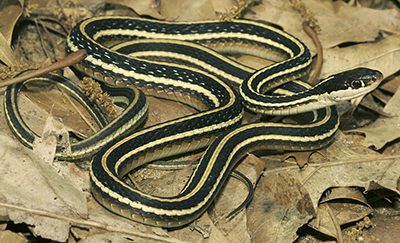
Common ribbonsnake: Listed as a species of concern in both Rhode Island and Connecticut. The slimmest and thinnest member of the Thamnophis genus (gartersnake group), this species is less common than its relative, the common gartersnake. It grows to be 20-32 inches in length.
This snake can be found in southern New England down the Atlantic Coast to mid-Georgia, west to Mississippi, and a short range up the river valley into lower Indiana.
The species is uncommon or localized in southern New England, where it appears to have declined or become extirpated in many areas. In Connecticut, it has been documented throughout the state in wetland habitats, except in Fairfield County. Some of the largest concentrations have been found in the Central Connecticut Lowland, in and near wetlands associated with basalt (trap rock) ridges.
Ribbonsnakes, like gartersnakes, are more tolerant of cooler temperatures than other snake species. Both are Connecticut’s earliest emerging snakes in spring. Comfortable both in and out of water, the ribbonsnake is an adept swimmer that prefers shallow water.
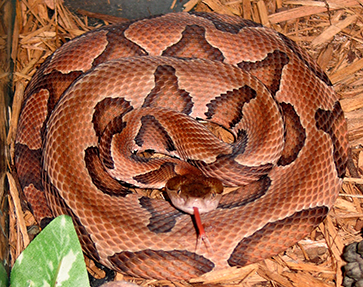
Copperhead: Listed as endangered in Massachusetts. They get their name due to their solid, relatively unmarked, coppery-colored head resembling the color of an old copper coin. As with all pit vipers, they have broad, triangularly shaped heads, with a distinct narrowing just behind the head. Adults usually measure 2-3 feet in length.
Timber rattlesnakes are the only other pit viper in Massachusetts, but they are generally yellow or brown with black, brown, or rust-colored blotches separated by crossbands rather than the hourglass pattern of copperheads.
Copperheads have never been documented in Rhode Island, according to the Department of Environmental Management.
In Massachusetts, the copperhead is usually associated with deciduous forest and shows a preference for traprock (basalt) ledges with extensive rock slides below. It is a relative of the eastern cottonmouth and, like that species, is fond of moist, damp habitats. Some copperhead wintering dens are on the fringes of swamps, reservoirs, rivers, and streams.
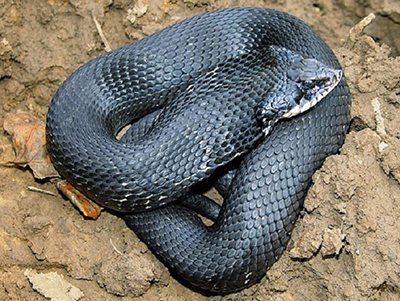
Eastern hog-nosed snake: Listed as a species of concern in Rhode Island, Massachusetts, and Connecticut. In Massachusetts, they can be found in Barnstable, Bristol, Franklin, Hampden, Hampshire, Middlesex, Norfolk, Plymouth, and Worcester counties below 1,000 feet of elevation. They haven’t been recorded on any Bay State islands. There are also no records from Essex County, although the species is well-documented in portions of the Nashua River watershed in Middlesex County.
These snakes prefer loose, sandy, gravely soils that are well drained. They travel underground using enlarged passages created by small mammals. These passages are found in fields, open grassy areas adjacent to woods, and open forests. More adapted to inhabiting edge habitats, these snakes are seldom found in dense wooded areas.
The major threats to this species — and most medium-to-large snakes in general — are increasing habitat loss and road mortality.
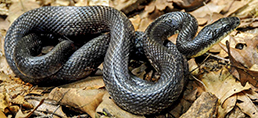
Eastern ratsnake: Listed as a species of concern in Rhode Island and endangered in Massachusetts. This species is a wide-ranging eastern snake that is represented by five recognized subspecies: the black ratsnake, the gray ratsnake, the yellow ratsnake, the Texas ratsnake, and the Everglades ratsnake. The black ratsnake is the most widespread of the subspecies and is found from central Georgia north to Vermont and southern Ontario, and west to Illinois and Louisiana. All of the eastern ratsnakes in the Northeast are black.
In Massachusetts, this snake’s distribution is restricted by the availability of suitable hibernating sites. Since New England is the northern limit of its range, hibernacula must be situated in areas with southern exposures to receive the maximum thermal benefit from the winter sun and provide basking areas in the early spring and late fall.
It is the largest snake in Massachusetts. Adults commonly grow to 6.5 feet in length.
The snakes’ populations are threatened by habitat alteration and roads, both as barriers to migration and as sources of vehicular mortality. Increasingly, houses are being built along ridgelines and rock outcrops that historically served as refuges for these animals. These snakes are also popular in the pet trade, in part because of their relatively docile nature and large size.
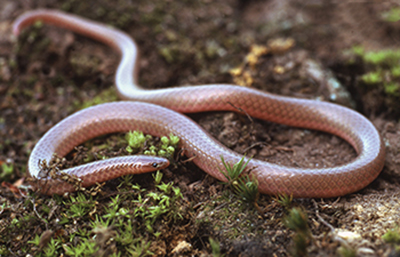
Eastern wormsnake: Listed as a species of concern in Rhode Island and threatened in Massachusetts. They are small, glossy, thin snakes, and range from 7 to 14.5 inches in length. Their bodies are unpatterned, gray or tan to dark brown. Distinguishing characteristics include a slightly flattened and pointed nose, small eyes, and a pink venter.
This species is a fossorial snake, spending most of the year underground. They are nonaggressive and have a natural instinct to burrow when in danger. They are often encountered in gardens, compost piles, and weedy areas.

Timber rattlesnake: Listed as state historic in Rhode Island — last seen there in 1972 — and endangered in in both Massachusetts and Connecticut. They range throughout the eastern United States, west to central Texas and Wisconsin. In the Northeast, populations are small, declining or extirpated.
These snakes are known to mate both in the spring and autumn. After mating, snakes move an average of about a mile away from the den. In the summer, males use woods where the forest canopy is closed and females stay in open forest or edges of fields where temperatures are higher.
Adults typically grow to be 3-5 feet long.
Note: Some of the species listed in each state overlap, and how often the lists are updated varies — the Rhode Island list was last updated in March 2006, Massachusetts last August, and Connecticut in January 2023. For species listed as state historical — essentially extirpated — in Rhode Island, they were included in the endangered category.
You should be aware that there is an abundance of Timber Rattlesnakes in and around the stone built dam at Pulaski State Park in North Western Rhode Island. A man found one had crawled into his bait bucket he left on the ground unattended while fishing.
Others have been seen preying on frogs along the shore. Rattlesnakes and people are not a good mix.