
Shifting Tides: Horseshoe Crab Population Shows Mixed Trends Across Rhode Island Waters
June 25, 2026
Share


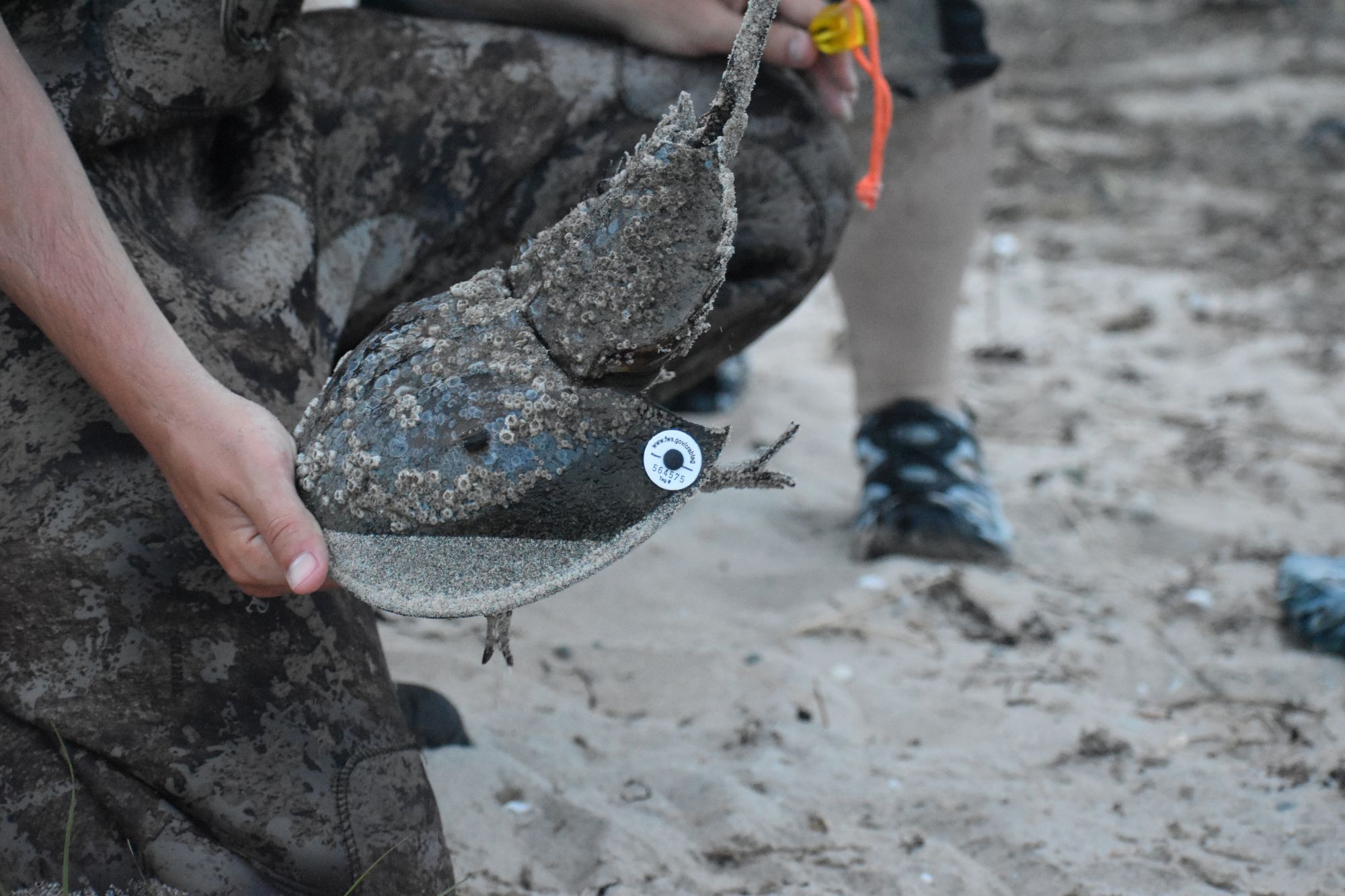
WESTERLY, R.I. — Tag No. 445308 surfaced once again at Napatree Point as a group of 14 surveyors headed back to their cars.
“This one has been out here for a couple of years now,” one surveyor said.
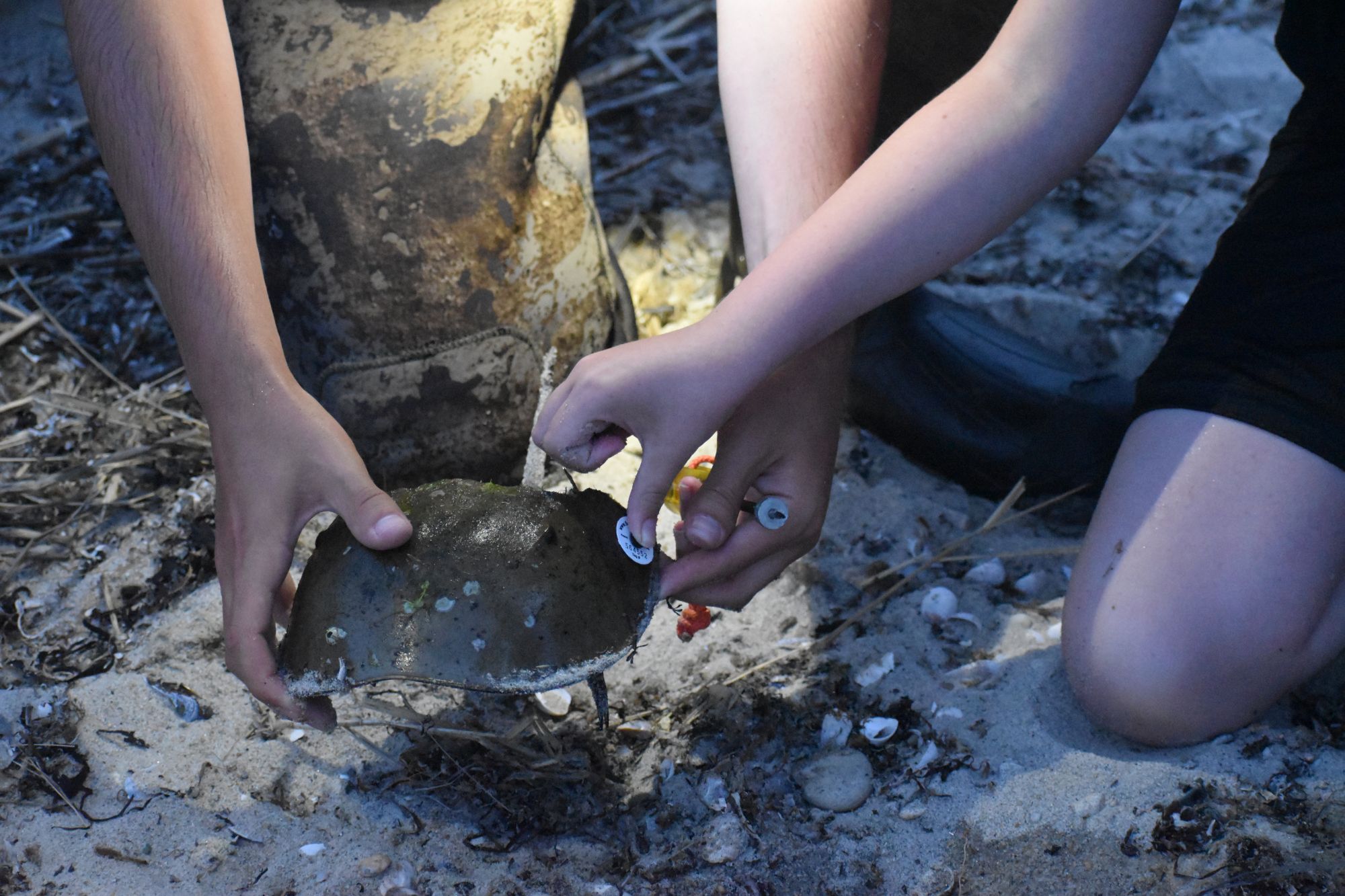
The 7-inch male horseshoe crab had been tagged on its right side at Napatree in 2020 on behalf of Sacred Heart University in Connecticut, according to the U.S. Fish and Wildlife Service, which oversees the horseshoe crab cooperative tagging program.
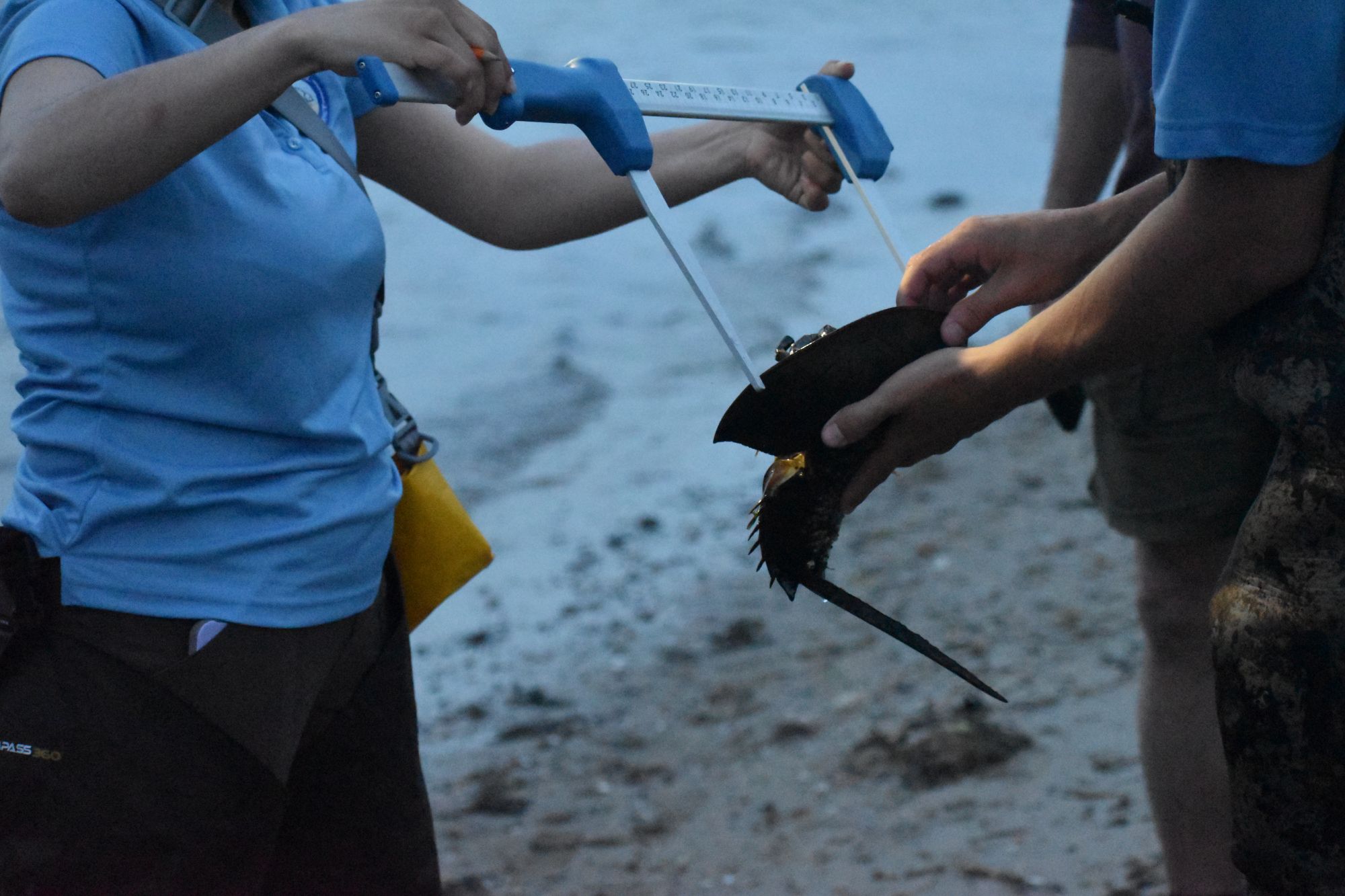
One volunteer who had never seen a horseshoe crab before watched 547 of them crawl along the shoreline June 12 during the survey with the Watch Hill Conservancy, which has tracked the population for 20 years.
Surveys take place during the full and new moons each late spring and early summer when the crabs come ashore to lay eggs. The data helps the Rhode Island Department of Environmental Management track populations that have declined along the Atlantic Coast after decades of harvest pressure.
Debates remain about how much protection the species still needs in neighboring states and at the federal level. DEM is taking a measured approach by weighing whether additional rule changes are necessary, as survey data show a mixed picture of abundance.
“Our job as managers is to balance the multiple needs while ensuring that the population is sustainable,” DEM principal marine biologist Katie Rodrigue said.
A big bang
It was the horseshoe crab’s 10 eyes that made it more than bait or something children swung by the tail along Rhode Island shores.
Fishermen who harvested 10,000 crabs in one season for eel bait at Conimicut Point in Warwick were surprised to learn what scientists had discovered about the crab’s eyes.
The federal government even studied whether its ability to see polarized light could help pilots navigate across the North Pole.
But it was the species’ blood that transformed the creature’s status.
Scientist Fredrick Bang began studying the crab’s blue blood around the same time researchers were examining its vision. He noticed that a dying crab’s blood had turned into a gel-like substance and determined that it clotted in response to Gram-negative bacteria, which can cause infections such as pneumonia.
Bang and another scientist discovered that blood cells called amoebocytes acted like a primitive immune system and could be used to test drugs for endotoxins, which are toxic compounds found in the cell walls of Gram-negative bacteria.
From that research came the Limulus amebocyte lysate (LAL) test, named for the crab’s scientific genus Limulus. The U.S. Food and Drug Administration accepted the LAL test in lieu of the rabbit test, which injectable drugs had been required to pass before approval.
The move helped spur a small biomedical industry in Rhode Island.
A 24-year-old marine biologist in Narragansett later opened a laboratory to buy locally caught horseshoe crabs to extract and process their blood into serum for medical use, according to The Providence Journal. He planned to return the species to the harbor afterward, as federal regulations require them to be returned within 72 hours of capture.
Undeniable decline
Fishermen at Conimicut Point were talking about the days when thousands of horseshoe crabs spawned along the shoreline by the early 2000s.
One May, Wenley Ferguson, director of habitat restoration at Save The Bay, counted just 20 crabs while surveying the area. She watched a fisherman scoop them up before the crabs had a chance to lay their eggs, The Journal reported.
The population decline, driven by commercial fishing and biomedical bleeding, rippled through the Atlantic.
The red knot, which relies on the crabs’ eggs as their primary food source during migration, plummeted as crabs disappeared. The bird was later listed as a threatened species under the Endangered Species Act.
The National Audubon Society and the American Bird Conservancy pushed the Atlantic States Marine Fisheries Commission to protect the horseshoe crab in response to the decline in shorebirds. The commission issued a management plan for the crab in 1998 and noted that the populations were poorly understood because of limited data.
Five states had harvest regulations by the time the plan came out, but Rhode Island didn’t. It only had a $200 commercial harvesting license and a moratorium on new ones.
The commission called on states to establish seasonal harvest closures, monitor harvests, and survey spawning activity and egg density. It also urged states to study the survival rates of crabs used by the biomedical industry, reduce commercial harvests by 25%, and establish harvest caps.
The Ocean State began monitoring the horseshoe crab fishery in response. It later adopted quotas for bait and biomedical harvesting, requirements for harvest permits, seasonal spawning closures, and recreational limits, according to a stock status report.
The state’s first horseshoe crab stock assessment found that the population was at low abundance and overfished.
Associates of Cape Cod, the state’s largest biomedical harvester, has harvested crabs in Rhode Island since 1985. A stock status report shows that its annual harvest fluctuated over the years, but never exceeded 60,000 crabs from Rhode Island waters.
The company releases the crabs a day after they arrive at its facility, according to a letter manager of sustainability initiatives Brett Hoffmeister wrote to the Rhode Island Marine Fisheries Council.
Hoffmeister added that the company has an excellent crab survival rate. That data isn’t public record, but regulators estimate that about 15% of the crabs die during the bleeding process.
Ferguson said there are still unanswered questions about what happens after bleeding.
“I haven’t seen any studies on actually assessing the behavior of the crabs that are bled and survive,” Ferguson said. “I don’t know if anyone has done that type of study or is in the process of doing that study. It’s easier to assess the mortality rate, but the behavior post-bleeding, I think, is a big question.”
Associates of Cape Cod maintain that horseshoe crabs are not endangered and have raised juvenile crabs to release them into Massachusetts waters. The company also introduced an endotoxin test that doesn’t include horseshoe crab blood in 2021, as federal guidelines have recognized non-blood-based alternatives as safe for detecting contaminants in drugs and vaccines.
Hoffmeister told ecoRI News that changes to the process will be slow and meticulous by design, as recombinant assays do not work for every product.
“You simply do not flip a switch when it comes to public health,” Hoffmeister wrote in an email.
Stricter regulations
Regulators looked for ways to reduce harvest pressure as horseshoe crab recovery slowed.
Rhode Island participated in an alternative bait study that found processed blue crab bait was easier to store and handle, but price and availability were barriers for fishermen, according to a quarterly DEM publication.
A stock assessment found that the state’s population was still low. One trawl survey showed a slight increase over 12 years, but the gains were small compared to long-term trends and stalled two years later.
DEM had already reduced the quota for both bait and biomedical harvesting. But in 2017, it tightened horseshoe crab regulations again as recovery stalled.
New restrictions followed: penalties for reporting violations; a May closure for the bait fishery; a 60-crab-per-day limit; and size restrictions. Biomedical companies were also required to return the crabs to the same waters where they were collected within 72 hours of bleeding.
Concerns remained in coastal salt ponds, where horseshoe crab populations are smaller and less studied than those in Narragansett Bay.
Associates of Cape Cod told the Rhode Island Marine Fishery Council that none of the crabs used for bleeding are taken from the ponds of concern.
Still, Rodrigue said the data collected from the ponds doesn’t show a clear trend.
Awaiting results
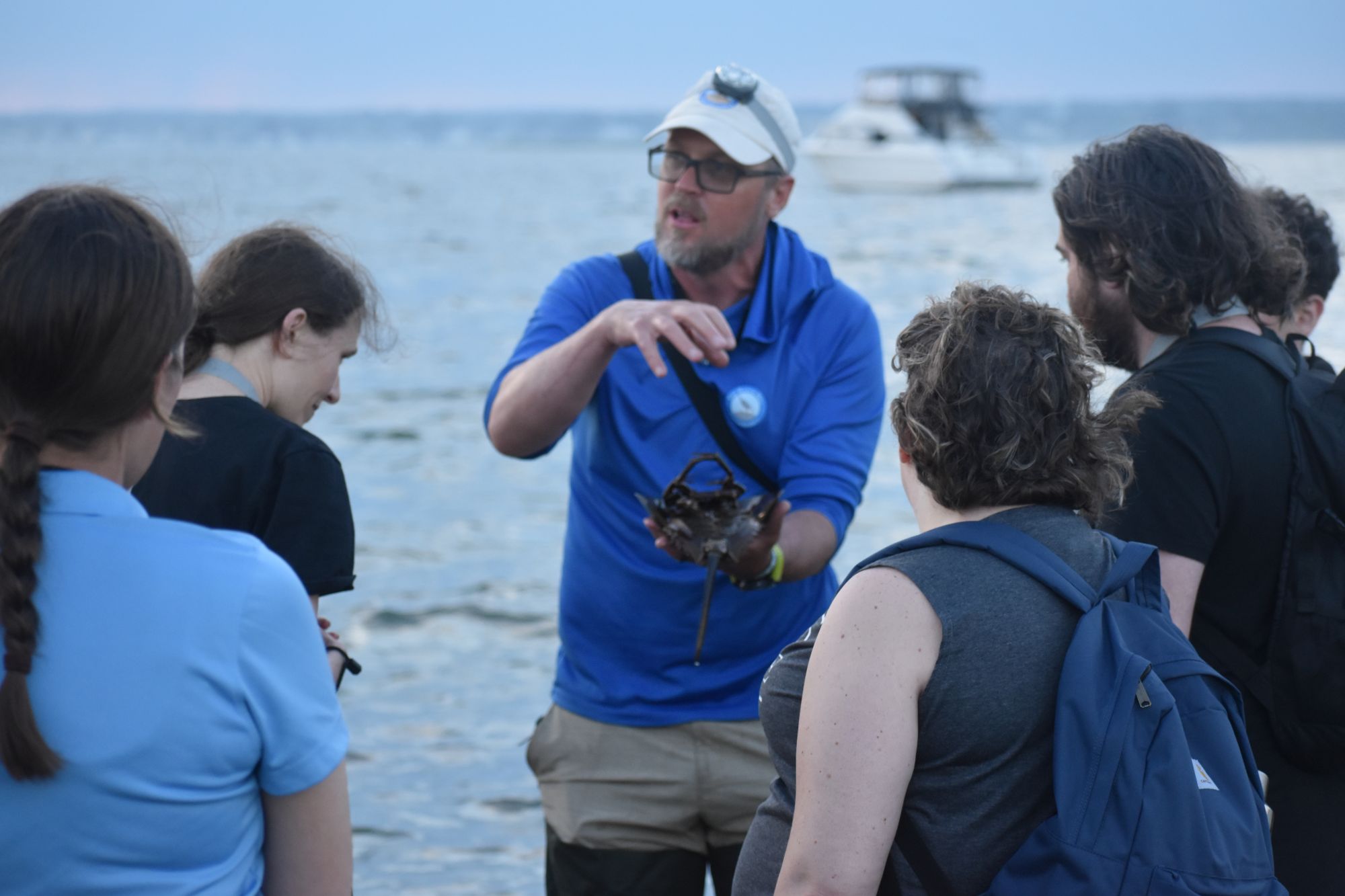
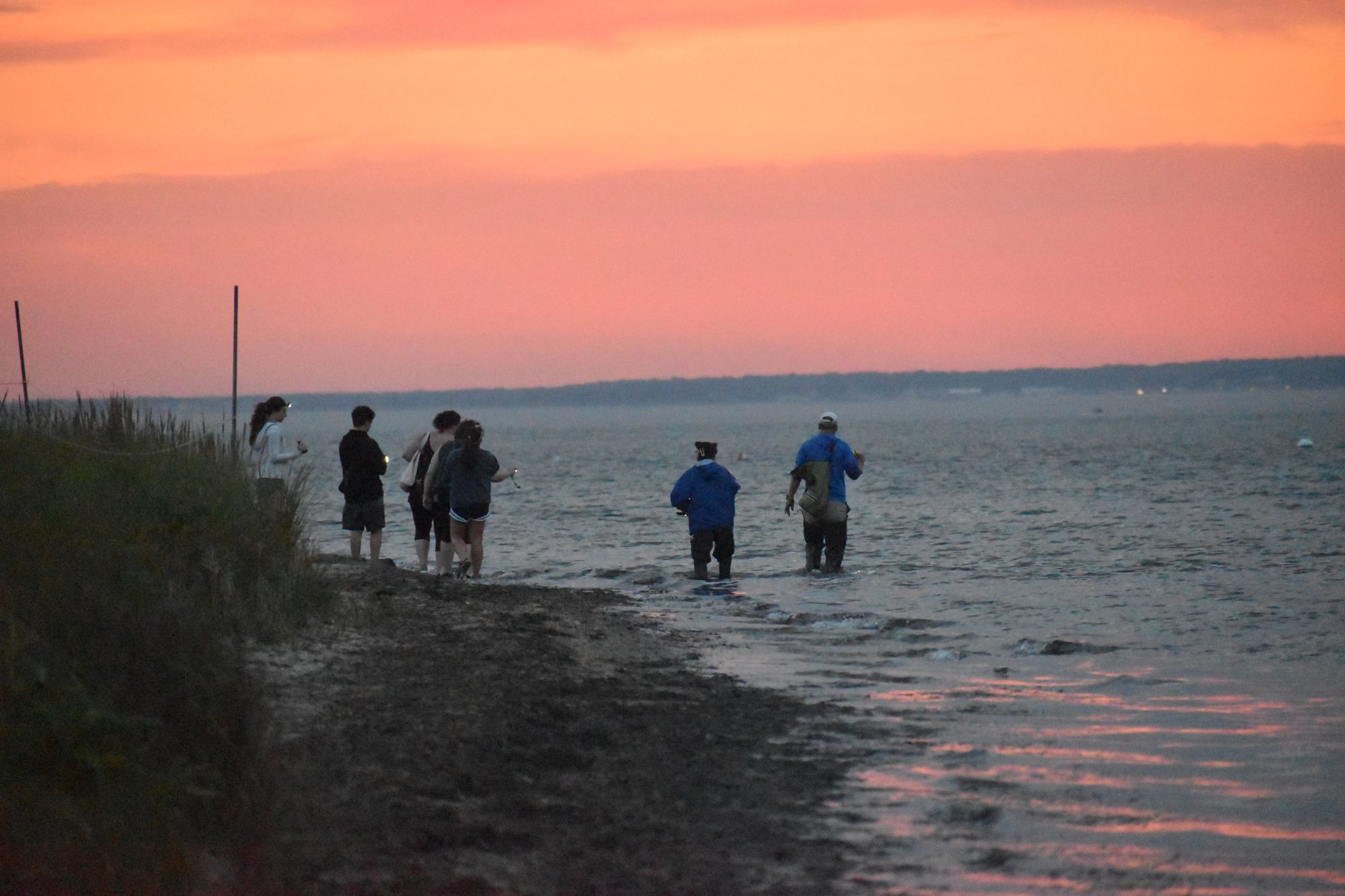
First-time horseshoe crab survey volunteers followed Watch Hill Conservancy staff in a line on the evening of June 12.
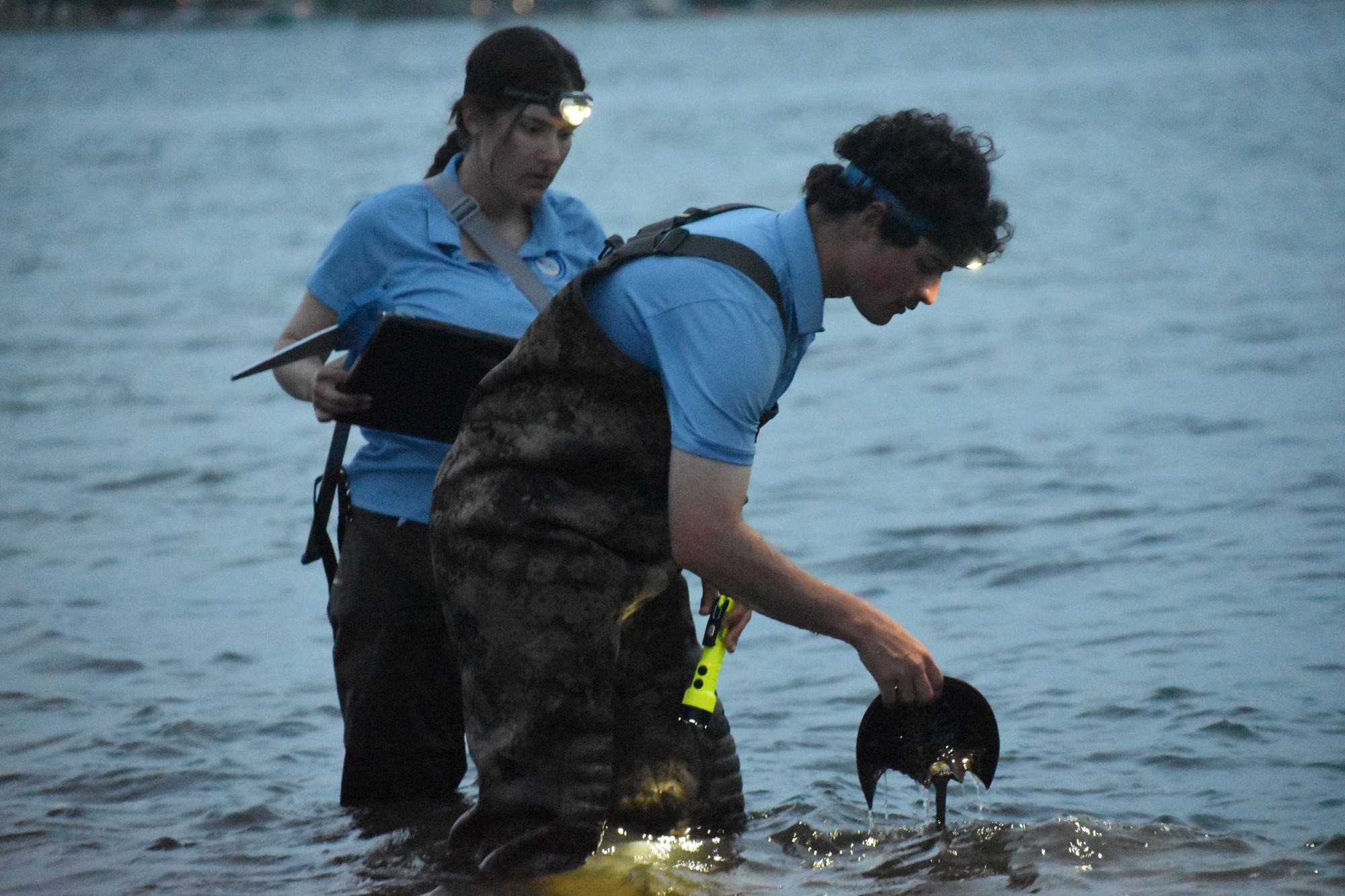
With headlamps and flashlights sweeping the water, they called out “single male,” “single female,” “pair,” “two on one,” and so forth as a scientist tallied the numbers until the seaweed in the lagoon made counting difficult.
A Watch Hill Conservancy Project Limulus 2024 report noted that a shifting spit surrounding the lagoon at Napatree Point has restricted tidal flow and trapped more seaweed, which makes it harder for surveyors to spot crabs.
Napatree Point is one of the longest-running horseshoe crab survey sites.
The conservancy began surveying the site in 2006 as part of Project Limulus, a community-based research program that was founded in 1997 at Sacred Heart University in Connecticut.
Its findings helped lead the state to ban harvesting in 2023, which added momentum to regional conservation debates.
DEM’s Rodrigue said a similar ban in Rhode Island isn’t needed at this time. The state’s monitoring data paints a mixed picture, with some populations stabilizing or improving, while others show declines.
Two decades of surveys show that the Napatree population has been steady without any dramatic increases or declines, Alan Desbonnet, one of the science advisors, said.
“There’s no harvest really of horseshoe crabs in this area, and there hasn’t been for several years,” said Desbonnet, adding that the population is so small that neither the commercial nor biomedical industries probably find it worth harvesting.
Still, the future management of the species remains contested.
Save The Bay petitioned the state to implement stricter regulations in 2024, which included expanding the bait spawn closure in case of a warm spell, establishing a biomedical spawning closure and adding a spawner sanctuary at Napatree Point, Sandy Point, and Quonochontaug Pond.
Fishermen and the Associates of Cape Cod pushed back.
One fisherman who has been fishing in Quonochontaug Pond for 50 years told regulators that stricter regulations would force him to travel to Massachusetts to buy bait, cutting into his profits.
The biomedical company added that its use of the crab has minimal impact on the populations.
The council rejected Save The Bay’s petition, but prohibited biomedical harvesting in all coastal ponds and Little Narragansett Bay. Regulators found no evidence that any additional restrictions would have population-level effects, according to Rodrigue.
Officials also said that it was too early to evaluate the 2017 management changes.
Horseshoe crabs take at least 10 years to reach reproductive maturity, which makes short-term population shifts difficult to measure.
“We’re hoping we’ll start to really see those signals,” Rodrigue said.
Still, DEM data shows that bait harvest dropped by 85% under the current regulations, and biomedical harvest has been below 70% since 2017.
Commercial harvest permits have fallen, too.
DEM issued 60 permits in 2023, and the number dropped to a little more than 30 in the following two years, the agency’s data shows.
As monitoring continues, the Watch Hill Conservancy is turning its attention to the eggs, Desbonnet said.
A former science director for the Atlantic States Marine Fisheries Commission has begun studying a troubling sign in Rhode Island: eggs that appear yellow instead of the healthy green color scientists typically expect.
Ban all hartvesting of horseshoe crabs. tyhere is no need for this commercial fishery
It is sad to think that a species that has lived for over 250 million years might not outlive humans. They have survived several mass extinctions including the one that killed the dinosaurs and the ice ages. They might not survive the extinction of greed which is the hallmark of humans. There is simply no need for them to be used as bait anymore. They are also used for medical research which most certainly is of greater value to us.