
Study of Block Island’s Migrating Songbirds Finds Some Positive News
September 15, 2025
Share


KINGSTON, R.I. — A University of Rhode Island graduate has good news to share about the long-term health of the migrating songbirds that flock to Block Island in the fall, after the summer visitors are gone.
Lauren Michael, who received her master’s of science degree in biological and environmental sciences in May, analyzed 66,288 birds from 22 species, which visited the island between 1970 and 2021.
Michael’s paper, which she co-authored with URI professors of natural resources science Scott McWilliams and Steve Reinert, with her findings on songbird levels on Block Island is scheduled to be published in the November issue of Ornithological Applications.
Most of the songbirds captured on Block Island are young. That’s because when young birds undertake their first migrations south in the fall, they are frequently pushed by something known as the southern New England “coastal effect” out over the water and end up on Block Island. The exhausted and inexperienced young birds take respite in the shrubs that cover the island, eating berries and resting before going on.
Michael’s paper found that although 18 of the songbird species studied at the Block Island Banding Station saw a sharp decline in the 1970s and ’80s, that has been followed by periods of stabilization, recovery, or slower decline. Michael’s findings will help scientists determine which species are at the greatest risk, since bird populations in North America have declined at an alarming rate, with an estimated loss of 3 billion birds since the ’70s.
The team used novel “breakpoint” models to identify changes in abundance trends over time. Although applying this kind of model to bird banding data is new, these models have been used in ecological research and in other disciplines. A breakpoint model can be used whenever an abrupt change in response to something — a stock market crash or a response to a medical treatment, for example — takes place. In wildlife biology, they are used to identify changes in physiology, find ecological thresholds, or detect sudden changes in abundance.
While the songbirds analyzed on Block Island haven’t fully rebounded to their 1970 abundance, their sustained recovery since the declines in the ’70s and ’80s indicates that environmental conditions may be adequately supporting these smaller current populations.
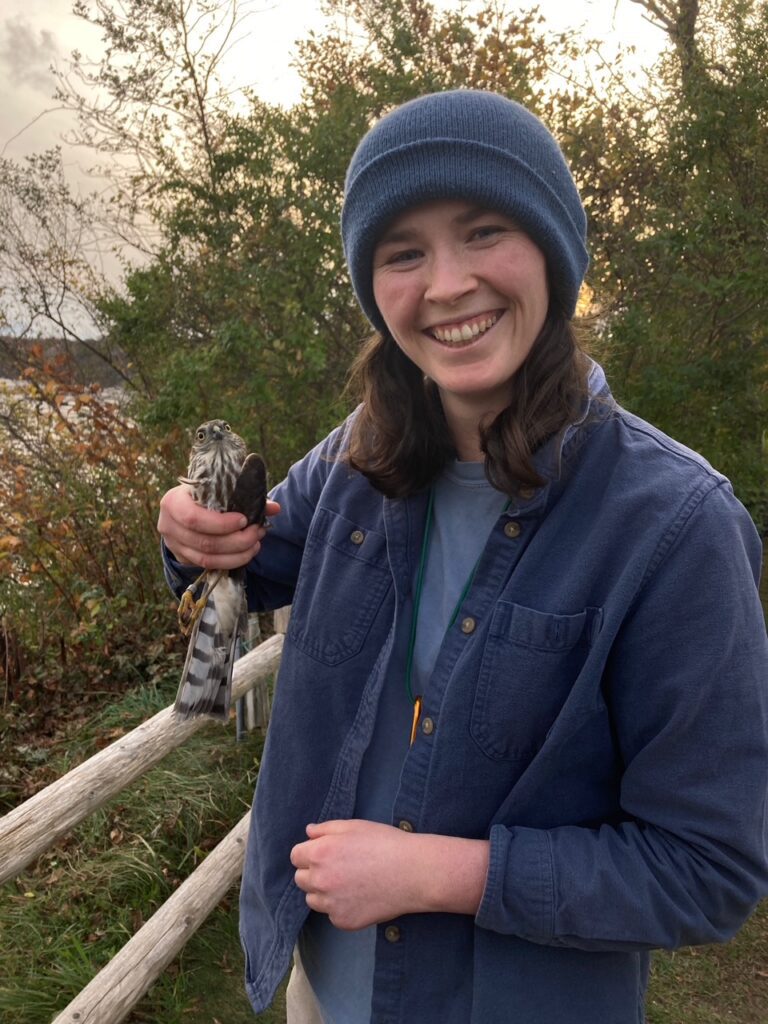
“Had we interpreted these trends using the entire 52-year time series, outside of a breakpoint model, as other studies have, we would have concluded that these species had simply declined,” Michael said, “rather than acknowledging that though they may have dramatically declined in the 1970s and 1980s, they have been recovering over the last several decades.”
Michael found that 18 species with breakpoints exhibited a consistent pattern: a steep decline in abundance within the first two decades of the study, followed by stabilization, recovery, or a more gradual decline. After the breakpoint, most species were stable; many even showed increases. Fourteen of the 18 species recovered relative to 1970 levels, and two — the blue-headed vireo and the eastern phoebe — even made a full return. Only gray catbirds continued to decline after their breakpoint in the late ’70s, though at a much slower rate.
The bird monitoring station on Block Island was established by Elise Lapham in 1967. She operated the station along with her daughter Helen Lapham and Kim Gaffett, who joined in 1981. Gaffett, now a naturalist at the Block Island office of The Nature Conservancy, continues the banding operation.
Michael said stepping into a project started before she was even born was a humbling experience and she praised the Laphams and Gaffett for their decades of commitment to the study of birds on Block Island.
“Without their dedication, this project would not have been possible,” she said. “The Block Island Banding Station is one of the longest continuously running bird banding stations in the country. All of these women were volunteers and dedicated decades of their lives to this study.”
What a great story ! Excellent work !
We live in West Greenwich, every summer we get a group of nesting Cat birds and Eastern Phoebe on our property, unfortunately we have a red shouldered hawk hunting as well
Good news I suppose. It will be interesting to see the article once published.
The level of recovery would seem to be the most important information here, but that is obviously missing from this article aside from the two species which have recovered entirely. Of course one species has continued to decline.
I agree that the banding station on Block Island is fantastic and the dedication of the anyone who volunteers there should be applauded and recognized. It is interesting that with the large increase in the number of windmills thoughout New England there appears to be no corresponding decline in birds which visit block. I would imagine that these researchers have investigated the reason for the declines and ‘recoveries”?