
Road Salt Runoff from RIDOT Facility Continues to Plague Residents’ Wells
June 13, 2025
Share


NORTH SCITUATE, R.I. — Both families moved into the area around the same time, and neither knew their well water was polluted.
“The water tasted like salt,” Amanda DeStafeno told a group of troubled residents May 21 at the North Scituate Public Library.
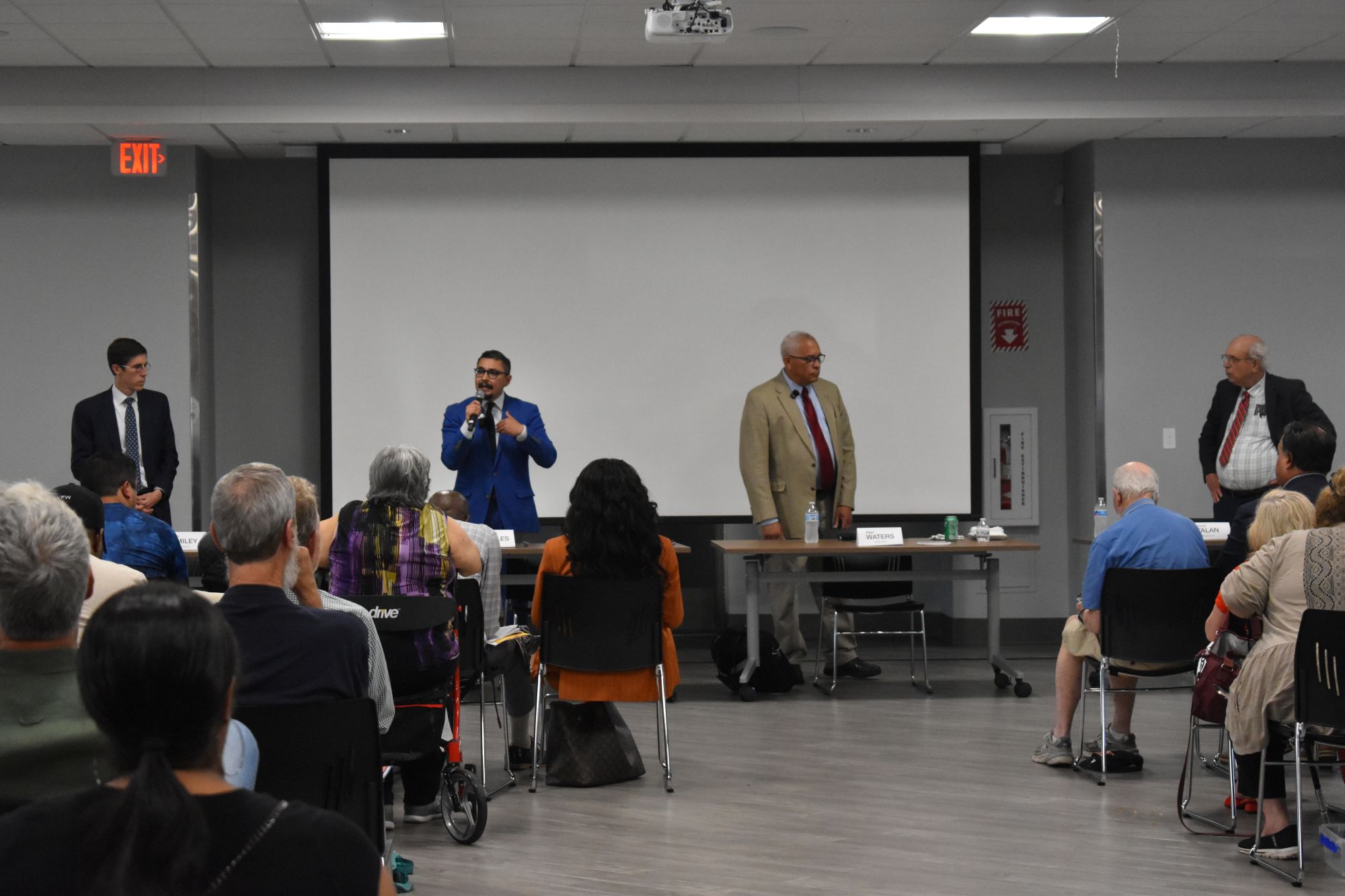
The 11 neighbors from Foster and Clayville — a Census-designated place mostly within the town of Foster, with a slice in Scituate — had gathered that evening to discuss their concerns about what they believe is the state’s failure to properly and fairly address a problem that resulted in contaminated drinking water wells. It was the second such meeting of local residents. The first was held in March, also at the village library, and about 20 people attended.
The issue is high sodium and chloride levels in some of their wells, which made water undrinkable, corroded plumbing, and ruined appliances. The situation was created nearly two decades ago when a crack in the foundation of a state-owned facility allowed road salt to seep into the ground. It eventually made its way into residential wells.
At the March meeting, Lisa Caledonia said “residents have reported elevated levels of sodium and chloride in their well water, affecting its taste, usability, and posing health risks, particularly for individuals with hypertension and other cardiovascular conditions.”
She noted some homes “have an appliance graveyard in their basements.”
Sen. Gordon Rogers, R-Foster; Rep. Robert Quattrocchi, R-Scituate; Rep. Mike Chippendale, R-Foster; Rhode Island Department of Transportation director Peter Alviti; and Department of Environmental Management director Terry Gray were all invited to the first meeting but none attended.
In 2012, RIDOT and DEM entered into a consent agreement concerning the Clayville salt barn. In summer 2006, DEM had issued a notice of violation to RIDOT for violations of the state’s Water Pollution Act. RIDOT requested an administrative hearing, and the matter dragged on for more than five years.
The Jan. 26, 2012, consent agreement remained in effect for 10 years. It required, among other things, RIDOT to annually collect samples from all drinking water wells in the impacted area and replace any well or provide treatment should sampling show elevated levels of sodium. RIDOT was also fined $125,000.
One longtime Clayville resident received a letter dated March 14, 2012, from RIDOT notifying her that her drinking water well was “potentially impacted by sodium chloride (salt) intrusion due to the activities of the Rhode Island Department of Transportation.” The letter noted RIDOT would be collecting water samples annually between April 1 and Nov. 30. (A handwritten note on the letter says the document was sent March 24, 2012.)
For nearly six years, from July 28, 2006, when DEM issued its notice of violation, to late March 2012, when RIDOT letters were mailed, residents with impacted wells had no idea their drinking water supplies could be contaminated.

The Clayville salt barn is one of 20 such facilities operated by RIDOT around the state. It sits about a third of a mile from the Scituate Reservoir. Another salt barn in the area, on Spring Brook Road in Scituate, is about 7.5 miles to the northeast.
Since 2010, this Foster facility is the only salt barn to receive a notice of violation and/or enter into a consent agreement with DEM, according to Kim Keough, the agency’s chief public affairs officer.
Rhode Island Pollutant Discharge Elimination System permits require RIDOT to cover or enclose road salt stockpiles to prevent exposure to rain, snow, snowmelt, and/or runoff.
To address the violation the salt barn’s cracked concrete foundation caused, RIDOT paid to install reverse osmosis water treatment systems in some homes. The systems run on electricity and require water filters, softeners, and maintenance.
DeStafeno noted her water treatment system, which includes four 200-gallon tanks, takes up most of the room in the home’s basement. She said they have paid about $800 a month in electricity since the system was installed. She said they have had to replace most of the home’s copper pipes, because they had been corroded and were leaking. She said real estate professionals have told her the home’s value has decreased by 30%.
DeStafeno and other affected neighbors said they experienced elevated blood pressure when consuming the tainted well water.
Local residents believe they deserve compensation for the depreciation of their homes; for the impact on their wells, plumbing, and appliances; for potential health issues; and to pay for the upkeep of the treatment systems.
RIDOT had informed residents that the systems’ maintenance and power costs would be the homeowners’ responsibility.
DeStafeno has filed a complaint in Rhode Island Superior Court against RIDOT and the state seeking compensatory damages for “significant property damage, including but not limited to corroded plumbing and resulting water leaks within her residence, corroded plumbing fixtures, a damaged septic system, past and ongoing remediation costs and expenses associated with operating the water filtration system, diminished property value.”
State drinking water quality standards for chloride is a maximum of 250 parts per million and 100 ppm for sodium. Private wells of Foster and Clayville residents have reached at least 280 for chloride and 160 for sodium.
RIDOT’s salt barn in Clayville is on Plainfield Pike, across from Isthmus Road. DeStafeno’s family lives across the street from the facility. They moved into their Isthmus Road home in November 2016.
In summer 2018, water samples taken from DeStafeno’s well showed chloride and sodium levels that “far exceeded acceptable levels” and required remediation. RIDOT paid to have a water treatment system installed.
That’s when DeStafeno said she came to realize the numerous plumbing problems in the house resulted from the excess pollutants in the well water. She also learned that concrete within her septic system had significantly deteriorated because of the excessive chloride and sodium levels.
“Salt stored in a watershed caused the contamination of our wells,” DeStafeno said. “My home is what I’ll be leaving to my children.”
Kate Gallogly Lowell and her family moved into their Clayville home on Pleasant Lane about a year after DeStafeno’s family moved to Isthmus Road. They eventually discovered their water had “super elevated levels” of sodium and chloride.
About three years ago, around the time RIDOT’s consent agreement with DEM was set to expire, the state transportation agency paid to have a water treatment system installed at Gallogly Lowell’s home. She said the “huge” reverse osmosis system includes a 500-gallon holding tank.
“The state had to put it in and they should have to pay for its maintenance and filters,” Gallogly Lowell said. “They should also be continuing to test residents’ well water, but the case is now closed. No one is doing anything to help us out.”
She noted one of the residents who needed a reverse osmosis system now has a broken system and the state is refusing to repair it. “None of us signed any documentation for our reverse osmosis systems so they are technically owned by the state,” Gallogly Lowell claimed. “We are asking that they are maintained and that they do annual mailings still as contamination is still moving.”
Many residents who live in the impacted area drink bottled water, even if their wells haven’t tested high for chloride and/or sodium levels.
The old Clayville salt barn was razed this spring. It was “identified for reconstruction as part of our asset management planning process for our facilities, along with a salt facility at the Route 6/I-295 interchange in Johnston,” according to Charles St. Martin, RIDOT’s chief of public affairs.
“Both locations will have new buildings with covered loading areas and paved parking lots,” he wrote in a email to ecoRI News. “The Clayville replacement barn will be larger.”
The ecoRI News media request also included several other questions, such as: How many wells was RIDOT required to sample annually? How many wells were replaced or treatment systems installed? How much did the state pay to replace wells and/or install treatment systems? Is RIDOT required to maintain these fixes beyond the 10-year period?
St. Martin said RIDOT couldn’t respond to the other questions because they relate to matters that are the subject of pending litigation.
Salting roads as a method of preventing ice from forming began in 1938 in New Hampshire. From 2005 to 2013, Rhode Island roads received an average of 516 pounds of salt per lane mile annually. Nationwide, an estimated 10 million to 20 million tons of salt is dumped on roads annually.
While road salt is an effective method for safer winter driving, throwing tons of it down also contaminates freshwater wetlands.
Note: ecoRI News didn’t cover the residents’ first meeting in March, but Lisa Caledonia provided a copy of her comments.

Excessive road salt use is also why so many RI bridges are falling apart. The environmental costs, health costs, repair costs, and product costs absolutely do not justify the use of road salt, considering the alternatives are significantly less detrimental and are just as adequate.
What a mess. DOT should buy the properties. $800 /month for electricity on the homeowners, you ‘ve got to be kidding. A two year old could have predicted this problem.
road salt use is also contributing to the salt in the Scituate reservoir creeping up albeit at much lower levels. Now sodium there is 15 ppm, decades ago it was only about 10. But motorists want to go full speed immediately after snow storms and woe to politicians who fail to ensure that (but forget the sidewalks!)
NYC radio personality Don Imus started a movement called MESS (movement to eradicate senseless salting.) many years ago. The vendors have too many politicians in their back pockets.
Salt should only be used on bridges, elevated roadways, and on/off ramps. Period.
This treatment of citizens by the state is typical. The state admits it is responsible for the damage to the wells, and by extension, that should include damages to the plumbing of the homes and appliances. The consent agreement requires “replace any well or provide treatment” if a well tests high for chloride. Providing treatment should certainly include the costs for electricity and associated maintenance. Drilling a new well would be pointless as the aquifer in the area is now contaminated. These homeowners did not ask for this to happen and no intelligent person will want to buy these properties now. That being the case the state should make a fair offer and purchase these properties that its negligence has devalued. The new and larger Clayville replacement barn will not give these homeowners a warm fuzzy feeling either. The damage has been done and will likely take years to clear up, if ever.