Rhode Island Sea Grant’s Aquaculture Business Course Covers Industry from ‘Soup to Nuts’
December 4, 2025
Share


When Rob Hudson agreed to teach an inaugural course last spring on the business of aquaculture with Rhode Island Sea Grant, he expected a fair amount of regional interest in the subject.
What he didn’t expect was attendees from 15 states and 10 countries, including Australia and Scotland.
“That’s the part that shocked me about this course; right off the bat it kind of took off real, real fast to a huge audience,” said Hudson, a marine associate and aquaculture expert at the University of Rhode Island’s Coastal Resource Center (CRC), now part of the school’s Graduate School of Oceanography, and R.I. Sea Grant.
The first 12-week course, which was free to participants thanks to a $234,000 NOAA grant, had 65 attendees. It was taught in person at the Coastal Institute at URI’s Narragansett Bay campus and online. It will be offered again in 2026 at the Coastal Institute and online.
“It shows the demand and the need for programs like this,” said Hudson, who taught the class with Azure Cygler, a kelp farmer and fisheries and aquaculture expert at CRC and Sea Grant, which is also based at the Graduate School of Oceanography and supports environmental stewardship and the long-term economic development and responsible use of coastal and marine resources.
Prior to joining URI and Sea Grant, Hudson was a shellfish hatchery manager for five years and oversaw the hatchery at Roger Williams University, where he was also an adjunct professor. He was also the restoration ecologist for Save The Bay for 12 years.
The course, “Beyond the Basics for Businesses and Practitioners,” which is being offered again this April, is tailored to those with a basic knowledge of aquaculture and ocean farming who want to learn more about business practices in a growing industry.
“It’s soup to nuts,” Hudson said. “How to start an aquaculture farm … the species concerns, the biology of them, the gear types that you might use, the site selection, predators that you may encounter, pests you may encounter. A lot of risk management.”
“There were definitely people in the course who could have been teaching it,” Cygler said, with “so much deep aquaculture knowledge and experience. But that’s the draw: You may know a ton about growing shellfish or seaweed, but running a successful, profitable, diverse activity business is another beast entirely. We aim to build their business robustness in these ways.”
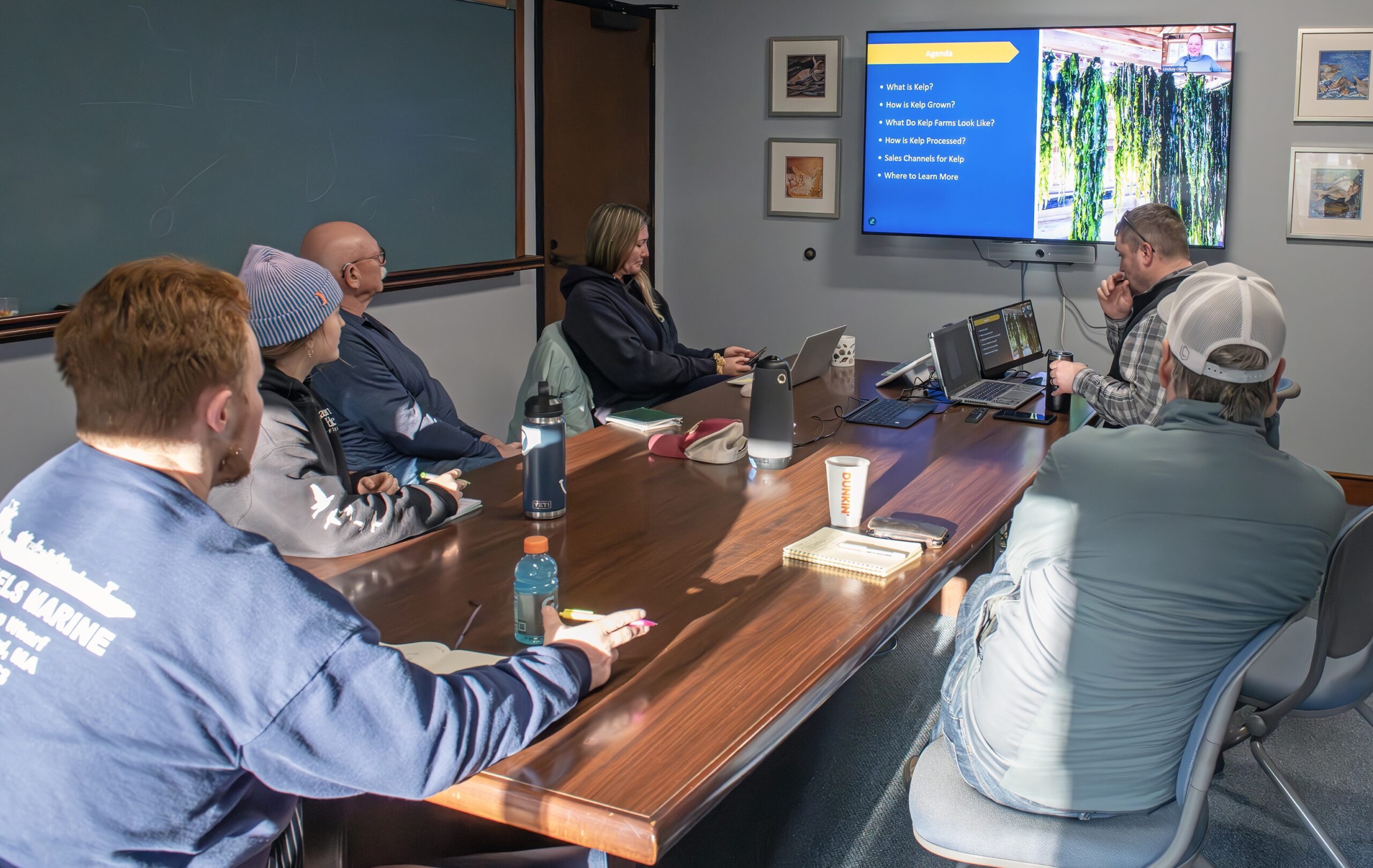
Since 1995, the growth of aquaculture production in the Ocean State has averaged about 18% annually, according to URI’s Cooperative Extension, making it one of the state’s fastest growing industries and a key contributor to Rhode Island’s growing local food economy.
According to a 2023 report on the state’s aquaculture business by the Coastal Resources Management Council:
The overall number of individual aquaculture sites in Rhode Island increased by one for a total of 84 sites.
The total area now under cultivation increased by 10.33 acres for a total of 384.32.
Oysters remained the No. 1 aquaculture product, with 10,648,321 pieces sold for consumption.
The farm gate value of aquaculture products for consumption was $7,279,234. Combined farm gate value of aquaculture products for consumption and seed sales was $8,041,359.
Oyster seed sales from local aquaculturists were valued at $770,000.
The total number of aquaculture farm workers employed in 2023 was 228.
The idea for the course stemmed partially from misunderstandings surrounding the industry, which leads to pushback when farmers apply for leases in local waters. One such example is the case of John and Patrick Bowen of Tiverton, who in 2020 sought permission from the Coastal Resources Management Council, which oversees aquaculture permit applications, to install up to 200 oyster cages in an area totaling less than an acre 285 feet offshore in the Sakonnet River. The proposal, which would have sited the brothers’ farm close to Sapowet Marsh, a state-managed area in Tiverton, set off years of opposition from anglers, residents, and others who said it would interfere with other uses of the water and intrude on the public trust. CRMC still hasn’t ruled on the application.
Other complaints about shellfish farms say the equipment gets in the way of recreation on the water and can ruin the views of homeowners who pay high prices to live on or near the water.
“Everybody has a connection to Rhode Island’s bodies of waters, right?” Hudson said. “NIMBYism is a problem, you know, but if you poll those same people, they want fresh seafood, they just don’t want it in front of their house.”
The course, he said, teaches aquaculture farmers how to start communicating with homeowners and others prior to filing an application that could pave the way to farm acceptance.
“In Rhode Island, you’re probably paying a very premium price for that coastal home. So I totally understand that aspect of it, but keeping the peace, opening that dialogue, it’s just two-way communication,” Hudson said.
He said presenters discussed some basic strategies to help aquaculture farmers start those conversations with stakeholders.
“We really dug in on how they can communicate with their coastal neighbors, [and] not just the neighbors on land, but even other farmers,” Hudson said.
The topics covered in the course are Aquaculture Business 201: Economics of Shellfish Farming; Staying Healthy in Aquaculture; Women and Minorities in Aquaculture; Keeping the Peace in Aquaculture; Effective Communication in Aquaculture; and Aquaculture Beyond Oysters: 21st Century Farming Principles and Practice.
In Rhode Island, Hudson said, there’s something known as the 5% rule, which regulates the threshold of aquaculture use in each of the state’s salt ponds. The CRMC adopted the rule in 2009 after studying the carrying capacity — the maximum amount of shellfish aquaculture that can occur in a given water body without unacceptable ecological impact — in salt ponds and in Narragansett Bay.
Most people, Hudson said, are unaware of the rule and the resulting limitations on the size and location of aquaculture farms in state waters.
“People say, ‘Hey, I’m OK with 30%, 40%, 50% of the body of water of our coastal ponds to be used for aquaculture,’” he said. “They don’t ask what percentage of the ponds are actually being used for farming.”
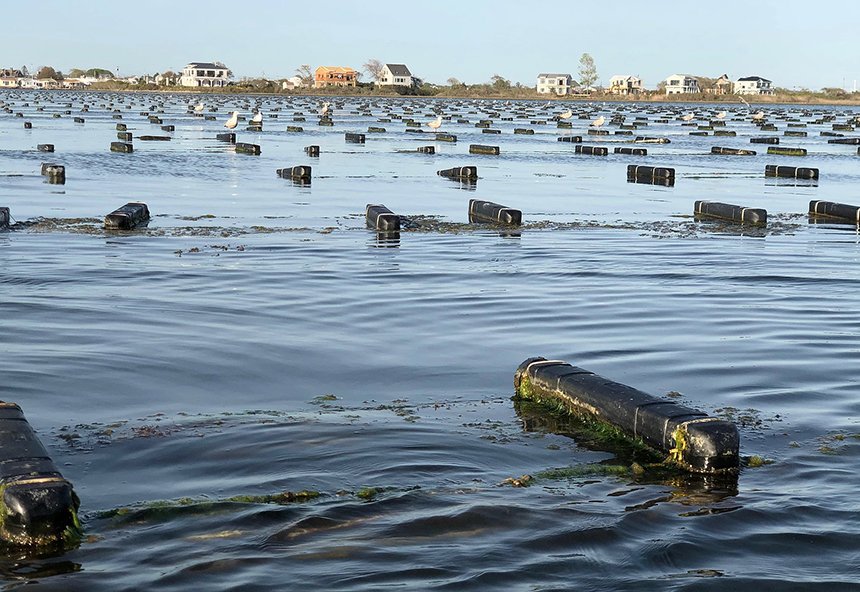
In most cases, Hudson said, the farms are underwater and mostly invisible, except for their markers, from the shoreline. Unlike Massachusetts, which allows intertidal aquaculture — basically on tidal and mud flats — Rhode Island only allows subtidal farming, Hudson said. The farmers sign 15-year leases which cover the bottom of the farming acreage, usually capped at 3 acres. Although CRMC oversees the permitting process, individual municipalities can weigh in on what type of surface markers they prefer and work with the CRMC to make it part of the agreement.
“The gear is, for the most part, underneath” the water, Hudson said. “Not every community does that or allows just that. Some of them want a buoy. It depends on the gear. If it’s the shallow waters of the ponds, you may just do the corner markers. There’s no need for you to have an up-down line. If you’re in Narragansett Bay and you’re in like 20 feet of water and you drop a cage down, you’re going to want to know where that cage is. So some of those farmers do have up-down lines with a float at the top, like a lobster buoy or something.”
While aquaculture regulations in Rhode Island are largely designed to keep the farming equipment as out of sight as possible, that’s not the case in other countries, Hudson said. He had recently returned with Cygler from a trip to Southern France and Norway to check out the aquaculture farm setups there.
He described a lagoon in France “basically the size of Narragansett Bay” that had farming structures “wall to wall, totally visible” above the water. “This is how they produce oysters in that part of France,” he said.
In addition to getting guidance about permitting, aquaculture leases, the various state and federal regulations regarding shellfish farming (Rhode Island has one of the most streamlined processes, Hudson said), class attendees also learn about safety and staying physically healthy on the job.
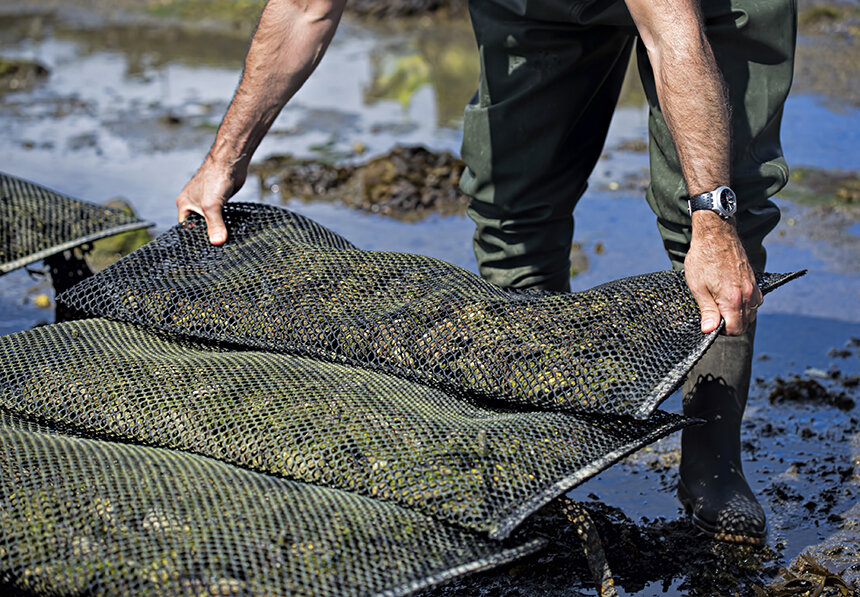
“This is a physically demanding job,” Hudson said. “There is a lot of picking things up and putting things down. So there are concerns about how to lift properly, lifting with your legs. How to support your back, thinking about what gear you might have and how you might make it easier for you to go throughout the day, stay physically safe and healthy on the water.”
Hudson said the course also touches on mental health. “You know, as a small business owner, as even a farm worker, you do run into this stress. It can be stressful at times, right? You’re dealing with the weather and the elements while you’re out there working.”
“We want to make sure that the farm owners, the farm workers, everybody was mentally healthy to maintain the grind, to get the product onto the market,” Hudson added.
Participants in last April’s course said it offered valuable knowledge on a range of aquaculture-related topics.
Travis Beckman of Pawtucket told R.I. Sea Grant he enrolled in the course because he is interested in working on an oyster or kelp farm and maybe owning his own farm one day.
“Shellfish aquaculture and other regenerative aquaculture practices, such as kelp farming, are critical to conserving and restoring the ocean,” Beckman said. “We need resilient coastal resources for protecting biodiversity, recreation, and robust food systems.”
Victoria Lundin, a retiree from East Hampton, N.Y., who has an oyster garden, took the course to learn about new gardening techniques and share her knowledge with others.
“Our environment is constantly changing. It’s important to listen to how others tackle a problem,” she said. “I met so many passionate gardeners from the East and West coasts. Also, each guest speaker opened my eyes to new opportunities and experiences.”
Cygler and Hudson are excited about the upcoming course, which will run from Jan. 20 to April 28 and is open for registration from now through Jan. 10.
“I hope people leave the course in April 2026 with a strong cohort of fellow ocean farming business owners to bounce ideas around, share innovations, network, maybe even partner in some way,” Cygler said.