
Just as Rich Area E to Open, Quahoggers Frozen Out
February 9, 2026
Share


This story was originally published in the Warwick Beacon.
Area E, the most productive area for quahogging these days, was scheduled to open to shellfishermen Feb. 9.
The question raised by Michael McGiveney, president of the Rhode Island Shellfisherman’s Association, is: Will any of the more than 150 quahoggers who make a good portion of their living on Narragansett Bay be able to get to Area E, which stretches north from Conimicut Point to a line running east from Gaspee Point to East Providence?
McGiveney said Warwick Cove, Apponaug Cove, East Greenwich Cove, and much of Greenwich Bay, where many quahoggers on this side of the bay moor their boats, was frozen.
“Even if they do get out,” he said, “where are they going to go?”
Jody King, who keeps his boat “Black Gold” in Warwick Cove, believes it could be three weeks before he’s back on the water. When forecasters called for low temperatures and heavy snow on Jan. 25, King moved his boat to an outer dock with the expectation that temperatures would climb and he’d be back quahogging. That didn’t happen and the boat is now iced in.
But King hasn’t been idle. He owns a truck and has put in nearly 40 hours of plowing since the storm hit. His big frustration is that his recently acquired salt/sander unit has frozen up. He parked the truck in a heated garage, but that didn’t loosen it up. He ended up shoveling more than two tons of salt and sand from the spreader to no avail.
McGiveney believes King’s estimate of a three-week freeze-out is optimistic. He recalls the winters of 1977-78 and 78-79 when not just the sheltered coves froze but also large portions of Narragansett Bay. McGiveney bought his first boat in 1979 and he’s put in countless days when ice has coated his gear and caused equipment failures, even snapping steering gear. Some of those days ended up costing more than he made.
King has had similar days. Even when Warwick Cove was accessible and Area E was open, as was the case in early January, high winds and low temperatures put a damper on quahogging. Usually between 50 and 70 quahoggers can be found working the area. The area, which opened for the first time in 75 years in 2021, yields about 60% of the state’s annual harvest of 17 million to 20 million quahogs. It is open for only three hours a day — two hours in the winter — for about 28 days a year. With wind gusts of more than 30 mph and temperatures in the teens, King found he was among fewer than a dozen shellfishermen to venture out. He took breaks from raking to thaw in the heat of the cabin.
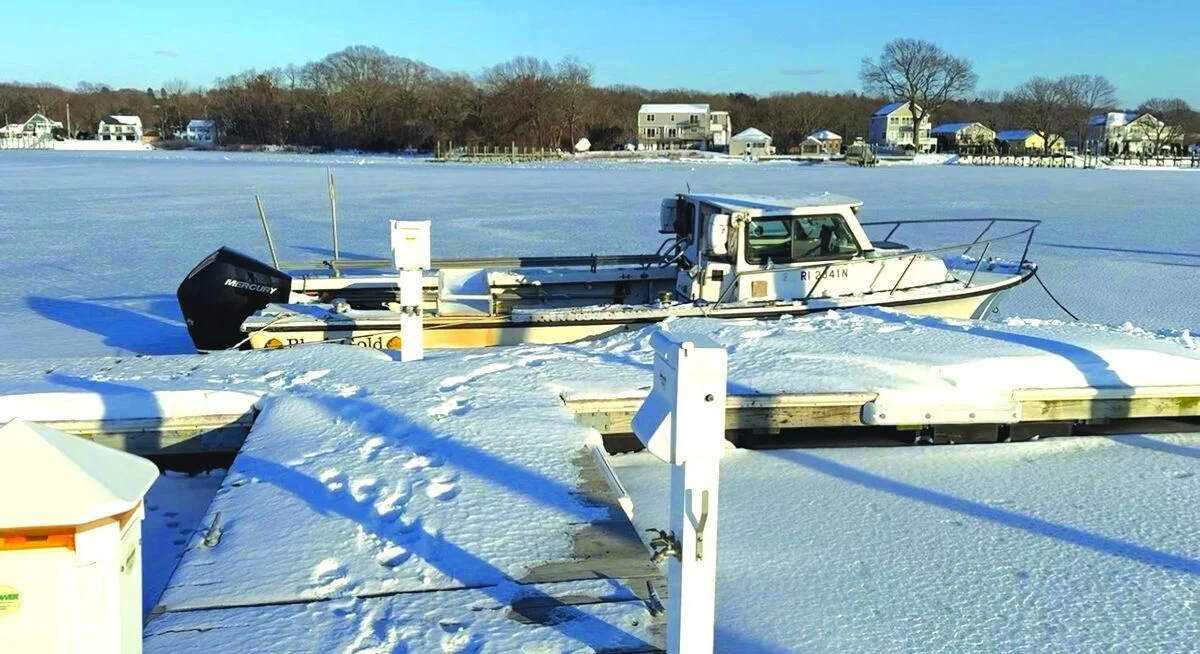
McGiveney keeps his boat in Allen’s Cove in Wickford. It was still open recently, but with Greenwich Bay, a productive area but not as rich as Area E, basically frozen there wasn’t any place to go.
In winters past, quahoggers came together to use their boats to break out of the covers. As McGiveney pointed out, the Rhode Island Department of Environmental Management is not built to deal with ice. Compounding the problem is the snow — fresh water that freezes at higher temperatures than salt water. That ice is especially hard to break, according to McGiveney.
On another matter affecting the industry, McGiveney said the association will be represented when planning resumes for the dredging of the Providence River Channel to the Port of Providence to be undertaken by the Army Corps of Engineers. That plan, which involves the identification of two CAD (confined aquatic disposal) cells off Port Edgewood, is being followed by the DEM, Edgewood Yacht Club in Cranston, Save The Bay, and shellfishermen.
According to surveys of the two relatively shallow disposal sites, they are rich in shellfish and seen as spawning grounds seeding lower parts of the river and the bay. The association has proposed having quahoggers paid to work the sites, estimated to have 3 million quahogs, and transplant them to areas safe from dredging.
Meanwhile, this cold winter has frozen out quahoggers and raised the price of shellfish. King estimated the wholesale cost of littlenecks at 50 cents “if you can find them.” With freezing temperatures blanketing so much of the East Coast, he believes the closest place where clams are being harvested is Virginia.


Great reporting, John. And the photos are top notch, as well! I am traveling through the Mid-Atlantic presently and the Delaware River is frozen! Trenton looked the portrait of Washington crossing it during the Revolution. Better get used to eating chicken for a while.