
URI Study Examines Impacts of Farming Practices, Water Quality on Oysters
January 19, 2026
Share


KINGSTON, R.I. — A University of Rhode Island graduate student is studying the impacts of water quality and farming practices on oysters, a crucial part of the state’s aqualture industry.
According to a report by the Coastal Resources Management Council, the agency that oversees the state’s 400-plus miles of coastline, the value of aquaculture products was $8,795,493 in 2024, and 89 active aquaculture farms covered 392.5 acres in the water.
Eastern oysters, which account for 99% of Rhode Island’s production, grow in Narragansett Bay and Rhode Island’s salt ponds. Jacqueline Rosa, a master’s degree student in oceanography from the URI Graduate School of Oceanography (GSO), spent 18 months studying how water quality and farming practices impact the oysters in the lower west passage of Narragansett Bay, an area that hosts 48 acres of oyster farms.
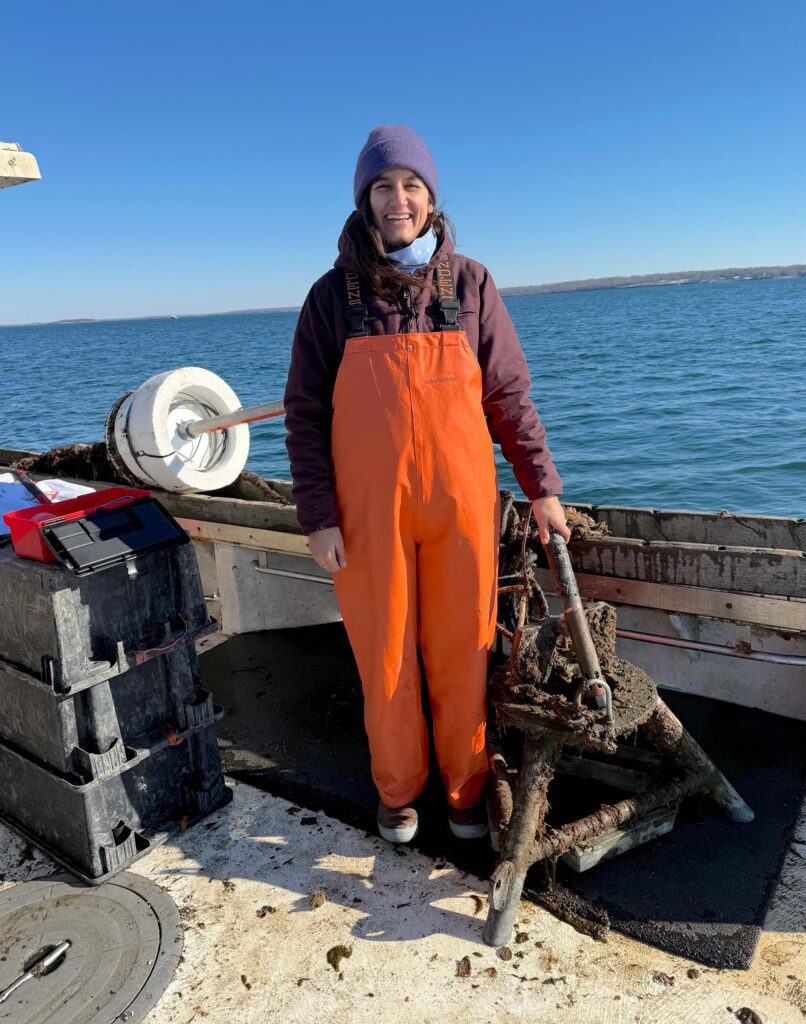
To examine the environmental conditions, Rosa set up two sensors at Wickford Oyster Company’s 4-acre farm in May 2024, one at the surface of the water and one at the bottom of the water column. Each week she collected water samples from the surface and the bottom — a total of 127 in all — and analyzed them at the Ocean Carbon Laboratory at the GSO.
“I tested the samples for pH, salinity, alkalinity, and dissolved inorganic carbon,” said Rosa, who is from Newtown, Conn. “These carbonate chemistry parameters help us understand trends in ocean acidification and how changing conditions may impact calcifying organisms. Shifts in carbonate chemistry can influence shell formation, growth rates, and survival, particularly during early-life stages, making these measurements critical for understanding potential stressors for farmed oysters.”
Rose’s research helped establish baseline water quality conditions in areas where oysters are farmed, said URI assistant professor Hongjie Wang, who leads the Ocean Carbon Laboratory, where seawater and sediments are studied to help understand how carbon and oxygen cycles are affected by climate change and stressors in ocean systems.
“Our hypothesis is that oyster mortality is linked to specific, abnormal environmental conditions, such as low dissolved oxygen and/or pH,” Wang said. “This project provides the foundation needed to evaluate whether observed mortality events are environmentally driven.”
A second aspect of Rosa’s work involved studying the equipment and methods used for oyster farming. To study the impact of gear type on oyster growth, Rosa placed some 2,700 young oysters across three types of gear at Rome Point Oyster Farm in August 2025: traditional surface gear; traditional bottom gear; and a newly developed surface gear called FlipFarm.
“Aquaculture gear is rapidly evolving, making it critical for farmers to select equipment that is most effective for their operations,” Rosa said. “Traditional grow-out methods are highly susceptible to biofouling, which can reduce growth rates, restrict water flow, and increase mortality. Surface and bottom gear are also labor and time intensive to maintain.”
The FlipFarm system, in which baskets containing the oysters can be mechanically flipped using a shuttle attached to a vessel, produced less biofouling, according to Rosa.
After Rosa graduates in May, she wants to work in Rhode Island as a research scientist.
“I’m interested in conducting research and community outreach that supports local, sustainable seafood,” Rosa said.
Categories
Join the Discussion
View CommentsRecent Comments
Leave a Reply


Your support keeps our reporters on the environmental beat.
Reader support is at the core of our nonprofit news model. Together, we can keep the environment in the headlines.
I do support these programs. My issue is: I don’t find the beds very well marked. They should all be clearly marked so boaters can avoid them even at high tide!