
Proposed 43-Unit Housing Complex in East Greenwich Concerns Nearby Property Owners
Audubon Society worried about effects on pileated woodpeckers; neighbors worry about quality of life
March 10, 2025
Share


EAST GREENWICH — In between a horse farm and a municipal land trust property, a developer is proposing a 43-unit housing complex which, if approved, will include 11 affordable condominiums.
The debate over the proposed complex off Division Road has stretched over several Planning Board meetings, where local interests are asking whether the property is the right place for such a project.
That criticism includes a range of arguments, from the project’s environmental impact to how it will affect the quality of life for neighbors.
The Audubon Society of Rhode Island wrote to the Planning Board about the complex, which would sit on about 33 acres of land, explaining its concern over how the project may affect pileated woodpeckers in the area.
The organization “opposes any plan that would disrupt foraging, nesting or overwintering habitat for the Pileated Woodpecker,” Charles Clarkson, Audubon’s director of avian research, wrote in the letter. He noted the bird is listed as a “Species of Greatest Conservation Need” in the Rhode Island Wildlife Action Plan.
The pileated woodpecker experiences low populations and is vulnerable to development, according to Clarkson. “The Audubon Society of Rhode Island recommends that a thorough accounting of potential impacts of the development to state-listed species such as the Pileated Woodpecker be identified and addressed prior to any removal or alteration of habitat,” he wrote.
Although the pileated woodpecker is listed in the state’s wildlife plan, the document itself doesn’t have substantial regulatory power to prevent development where the birds exist.
The birds are, however, protected under the federal Migratory Bird Treaty Act, which “prohibits the take (including killing, capturing, selling, trading, and transport) of protected migratory bird species without prior authorization,” according to the U.S. Fish & Wildlife Service.
But beyond that, they “are not afforded additional protections,” state Department of Environmental Management spokesperson Evan LaCross said in an email to ecoRI News.
DEM has issued DeSimone Development, the developer of the project, a freshwater wetland permit after the agency reviewed soil erosion and stormwater management plans.
“This completed DEM’s regulatory role in reviewing this proposed development, which is now an entirely local decision of the Town of East Greenwich to provide final approval of the project,” LacCross wrote.
Douglas DeSimone of DeSimone Development said he wouldn’t comment on the project when reached by phone.
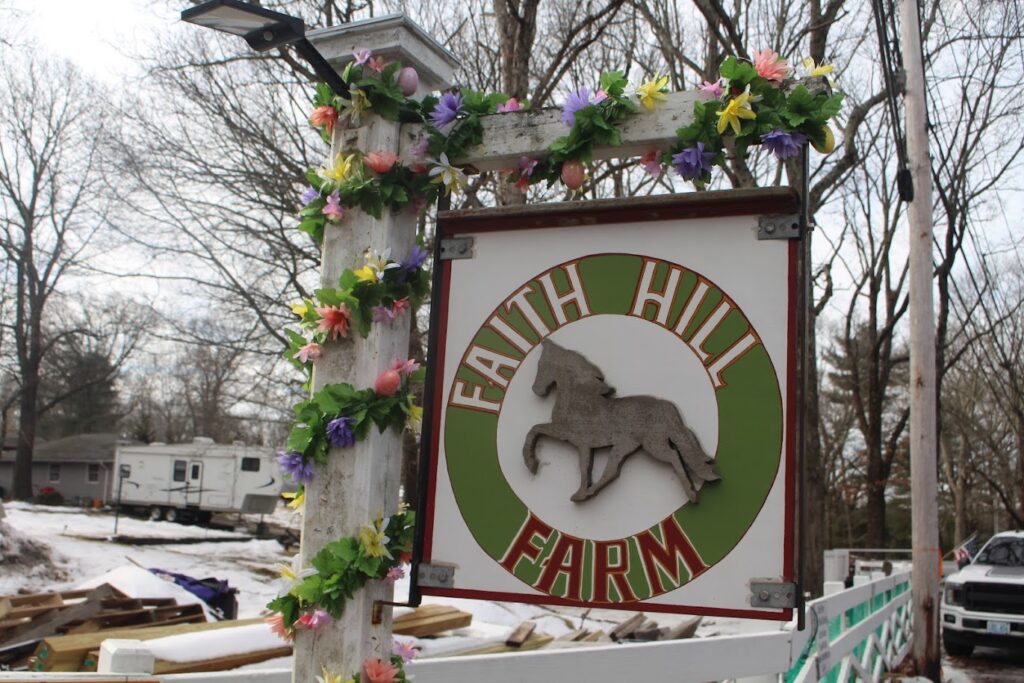
Pamela Maloof, the owner of Faith Hill Farm, which would abut the proposed complex, said she is deeply concerned about how the project will impact her business and life.

Maloof boards horses and offers riding lessons and equine therapy at her farm, activities that will be threatened, she said, by construction and loud noises next door.
“We work with many, many different worlds in Rhode Island, for Rhode Island’s most traumatized, abused people,” she said. “If this goes through, during this development, we won’t be able to do any of that,” because the construction noise will make the horses jumpy and could put riders and clients in danger.
Walking around her farm, Maloof pointed to paddocks on the property line and the horses she’ll have to move and tranquilize during construction hours.
Several boarders have already terminated their leases because they don’t want to deal with the potential noise, she said.
The developer has agreed to install a fence around the property with sound-dampening material.
On top of her concerns about her farm and business, Maloof also said she’s worried about how the development will impact the surrounding area.
“It just breaks my heart. There’s so much wildlife back there, you know, such a special place,” she said. While showing ecoRI News the farm, a fisher tramped through the vegetation on the other side of Maloof’s fence.
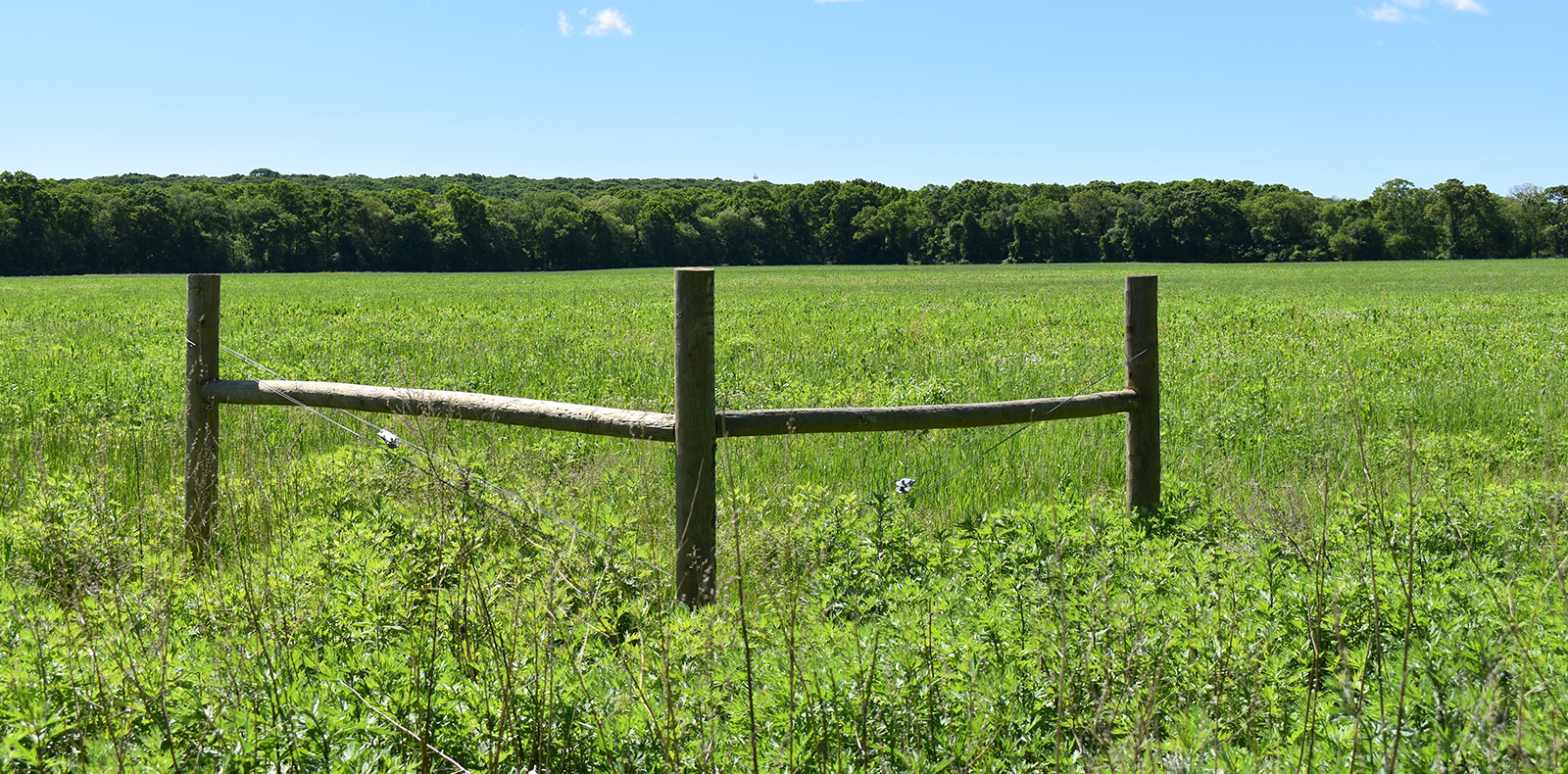
Folger’s Woods, a municipal land trust property, is on the other side of the proposed development site, and Maloof said she wished there was a way to conserve the land in between instead of development.
The developer has agreed to create a path to Folger’s, which is currently difficult to access for the public because it is surrounded by other properties.
With abandoned storefronts in other, more densely developed parts of town, “Are there better places,” to build a development?” Mallof asked. “It does not fit the world character up here.”
For housing advocates, such as HousingWorks RI director Brenda Clement, projects like the one proposed in East Greenwich are making up for years of under-building that have led to the state’s affordable housing crisis.
“If you are making $100,000 or less, you can’t afford to buy anywhere in Rhode Island,” Clement said. That figure is “significantly higher in East Greenwich,” she said.
“We’ve got people at all income levels who are struggling,” she added.
“The problem is that no site is perfect,” said Clement, speaking generally and not commenting on the Division Road proposal specifically. “We’ve got to always find places to allow growth and development that make sense, particularly for affordable units.”
With new laws put in place recently to encourage affordable housing and streamline the process, some have expressed frustration over the speed and lack of control over developments.
The streamlining can help reduce costs for the developer, Clement noted. “Time is money, right? And if it takes you five years to get my project completely permitted and zoned, that adds to the cost of the project.”
The state rules also leave room for local say, Clement said. Housing plans, required for each municipality, should outline “a plan for growth and development in their community that makes sense.”
Having those plans can encourage developments in more desirable and suitable areas, and closer to transit and public amenities such as municipal water or sewer.
“There’s still a lot of local review,” Clement said. “There’s still a lot of environmental review processes, even with the legislation that was passed the last couple of years. At the end of the day, these units need to be built and they need to be built somewhere.”
We need to protect the natural state of our woods and wetlands and take into consideration how the surrounding areas are to be used. I’m sure when ms aloof started her business she never imagined such a country setting would be developed in this way. With so many abandoned properties wasting away your going to tell me a more appropriate setting could be found. Near business and shopping which these tenants will need. Why must wildlife and decent tax paying people be put out and their lives changed to keep the few happy and wealthy. This is not a good fit in my opinion and my heart goes out to the families it affects. It will eventually touch us all and that is so sad and unexceptable
So the horse farm owner has her piece, but wants to deny others from having theirs. How many Pileated woodpeckers were displaced by the farm?
I always find it rich and ironic how NIMBY rears its head in these situations.
Yes, I would love to see the forest preserved, and it can be done by buying up the development rights, but who’s going to put up the money?
I am all for increasing housing, but this does seem like a tough case. I can’t imagine how the horse business will operate during construction, and we all know how long that takes. Horses are jumpy critters; they get nervous over everything, in my experience. Of course these owners have every right to sell. It’s a shame the town can’t buy this land to connect it to the inaccessible Folger’s Woods that is already public. It’s also a shame that with thousands of empty acres in the gigantic town of Coventry next door — look at a map and you’ll be astonished at how big Coventry is and covered with forests — developers aren’t eyeing that kind of easy pickings.
Audubon continues its haphazard and enigmatic opinions regarding Rhode Island land use issues. Most people don’t remember how Audubon equivocated during the long review of the Clear River Energy Center that was proposed for one of Rhode Island’s largest tracts of forest in Burrillville. At one press conference, an Audubon representative said the organization was not opposed to development of the site, “we just don’t believe it should be a gas-fired power plant”. And this was after the biological assessment had documented the presence of 40+ “Species of Greatest Conservation Need”, including the State Endangered cerulean warbler, State Threatened black-throated blue warbler, and state concern pileated woodpecker.
Less than 10 years later, Audubon now thinks the presence of pileated woodpecker is an important issue. According to their bird guru, Charles Clarkson, Audubon “opposes any plan that would disrupt foraging, nesting, or overwintering habitat for the pileated woodpecker”, adding that “the pileated woodpecker experiences low populations and is vulnerable to development.”
The Natural Heritage Program initially listed the pileated woodpecker as a Species of Concern in 1980 when the bird was exceedingly rare with no current nesting locations known in the state. Since then, the pileated has increased dramatically. The first breeding bird atlas in the 80s recorded the pileated in only 2 blocks. The second breeding bird atlas (2023) recorded the species in 69 blocks. The Atlas publication states:
“Pileated woodpeckers are widespread in Rhode Island now that forests have matured. Populations will continue to increase as forests in the region mature, and so the species IS NOT CURRENTLY A CONSERVATION CONCERN.” (Charles Clarkson is the coordinator and coauthor of the 2023 Atlas).
The ecoRI article states: “Although the pileated woodpecker is listed in the state’s wildlife (action) plan, the document itself doesn’t have substantial regulatory power to prevent development where the birds exist.”
And it’s a damn good thing the Wildlife Action Plan does not have any regulatory authority. A document that lists the gray catbird, one of RI’s top three most common breeding birds, as a Species of Greatest Conservation Need has no credibility in guiding land use.
The Natural Heritage Program was a credible guide. The program’s function was not to prevent development, but to guide development from impacting species that were truly conservation concerns. Sometimes that meant opposing development projects, and sometimes that meant opposing groups and individuals who erroneously claimed endangered species impacts.
The Natural Heritage Program based its decisions on the best available science, not unlike DEM’s wetlands biologists, air quality specialists, and water quality specialists. Using the best available science concerning the population status of the pileated woodpecker, this species no longer qualifies as a species of concern. The 2025 update of the Wildlife Action Plan should remove the pileated as a Species of Greatest Conservation Need. Time will tell if the Division of Fish and Wildlife adopts a more scientifically rigorous process in listing organisms as SGCN, or if they continue to list species simply for programmatic benefits.
This is a difficult situation, and anyone who has horses can sympathize with Ms. Maloof, but stopping development that includes affordable housing is next to impossible, as developers well know. It also sounds like the developer is offering plenty of concessions to limit impact on the horses.
Mr. DeSimone has acted revengeful by stating that he would add 18 more units to the development after Ms. Maloof would file suit.
Clear cutting the woods is and outright act of aggression showing regard for only money.
Developments that start with clear cutting, to the discerning eye, look like cheap cookie cutter dwellings.
It should be an embarrassment for the Town of East Greenwich to allow clear cutting of trees without consideration for a buffer zone and beauty! A further embarrassment to allow such barrack like buildings to be built, which can only enrich a few individuals.
I stand with the horse owners and the nature preserve..
Maintain open spaces.
“Progress” has a new paradigm and her name is Long Term Sustainability!
Shifting from short term gains, to a legacy of green and healthy environs for All…
Not enough consessions
It seems like this spot is destined to earn the moniker “where Faith Hill Farm used to be”, like so many other places in RI where things “used to be.”
We all know where “Benny’s used to be”. “Where the farm used to be” has a significantly sadder ring to it, no?
Let’s ask ourselves how much more land can be reasonably cleared for development. Once it’s built it’s not going away.