
CRMC Approves Additional Work at Pawtucket’s Tidewater Landing Project
June 26, 2026
Share


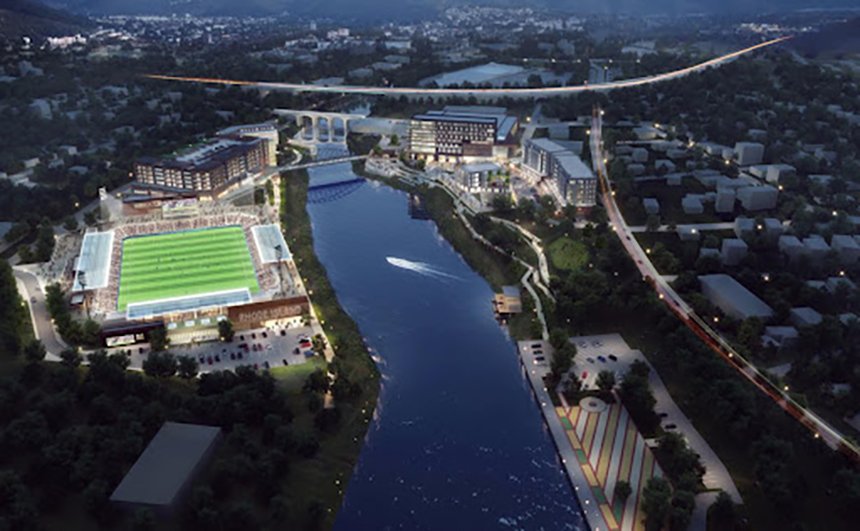
PROVIDENCE — Coastal regulators signed off on the second phase of developments for Pawtucket’s Tidewater Landing project, approving new riverwalk pathways, new stormwater infrastructure, and a new plaza.
Developers behind the project were last before the Coastal Resources Management Council in October 2021, when coastal regulators gave the green light to remediate the land and build a new riverfront soccer stadium, both of which have long since been completed.
The projects proposed for the second phase of the Tidewater stadium development aren’t actually near the stadium, but across the river on four consecutive properties. The work will ready the sites for a pedestrian bridge that would stretch across the Seekonk River linking both projects. The pedestrian bridge itself, among other future improvements, will be considered in a future CRMC assent.
“This is a major economic development project for the city of Pawtucket,” said Lance Hill, vice president and director of business development for the Pare Corporation, an engineering firm.
The project is a public-private partnership, and Hill told CRMC council members at a June 23 meeting that the city’s share for the riverwalk and stormwater management was $30 million, obtained via a loan from the Rhode Island Infrastructure Bank.
“The city will be funding the pedestrian bridge, the riverwalk, and the stormwater park within that limit,” Hill sadi. “If it exceeds that limit, they’ll have to make a decision about it.”
In a bid to improve water quality in the river, project developers proposed new measures to control runoff, including a stormwater infiltration basin large enough to treat more than 27,000 cubic feet of water. A second, underground infiltration chamber at the northern end of the site, would provide another 16,439 cubic feet of water quality treatment.
The main knot tying up the council centered on improvements to nearby river wetlands. Part of the proposal, as noted by CRMC staff in its report, involved improving wetlands on the eastern bank of the river by removing invasive species such as Japanese knotweed. Project developers would then expand the wetland, from around 1,200 square feet to more than 10,000 square feet, and revegetate it.
The wetlands close to the project site require a special exception to a CRMC assent, hence the proposal to expand the wetlands. But council member Scott Rabideau, a retired wetlands biologist and former consultant, said the plan for the wetlands had less detail than he had expected.
“All I found on the sheet was this little inset of wetland mitigation area with some grading. I didn’t see any details that you would normally expect to find for a quarter acre of restoration,” Rabideau said. “My concern is this wetland mitigation area, they’re using it as an integral part of their reasoning for the special exception. But I want to make sure that it is properly designed.”
Kevin Aguiar, a lead designer on the project from BETA Group Inc., an engineering firm, said he was under the impression there would be agency stipulations to the wetlands.
“From my position as the designer, I will comply with what is necessary from CRMC,” Aguiar said.
“I have a private sector career, and they never would have accepted plans from me without this detail,” Rabideau responded. “That was why I was taken aback.“
Rabideau wasn’t the only one raising concerns about a lack of details in the public planning documents. Chris Dodge, Narragansett baykeeper for Save The Bay, wrote in comments submitted to CRMC that the cumulative impacts to the Seekonk River’s water quality must be considered for all present and future projects associated with Tidewater stadium.
“Current disturbed and developed conditions at and adjacent to the site already pose threats to the water quality of the Seekonk River and the adjoining undeveloped riverbank,” Dodge wrote. “Unfortunately, the currently proposed project in this notice depicts only a portion of the overall planned development of this site, making a full and informed evaluation of the cumulative impacts to the coastal buffer and the Seekonk River nearly impossible.”
Dodge noted the project area is home to 7.7 acres of undeveloped forest, more than one-fourth of the remaining forestland along the banks of the Seekonk River left in the city. Forest and forest edges, like the ones on the banks of the river, wrote Dodge, provide valuable erosion control, water filtration, and critical habitats.
CRMC voted to approve the second phase of the Tidewater stadium project, unanimously.
Categories
Join the Discussion
View Comments
Your support keeps our reporters on the environmental beat.
Reader support is at the core of our nonprofit news model. Together, we can keep the environment in the headlines.