
Plenty of Space to Flex on Mussel Beach
More than half of southern New England’s native species are in trouble
February 10, 2025
Share


Series note: The region’s collection of native species is under threat on several fronts, most notably from humanity’s shortsightedness. Humans aren’t giving the natural world the space it needs and deserves. We’re crowding out nonhuman life, which, in turn, makes nature less productive and us less healthy. Wild New England examines the animals and insects most at risk.
The presence of freshwater mussels is indicative of high water quality and a healthy ecosystem. Their absence tells a different story, and the latter is the more-familiar tale in southern New England. Their populations in this three-state region have been degraded by a long history of damming and pollution.
University of Rhode Island research associate Elizabeth Herron noted these overlooked creatures are a critical part of the region’s aquatic systems.
“They help reduce nutrients and algae by filtering out things. They can reduce things like bacteria, so they’re important,” said the program coordinator for URI Watershed Watch. “They’re an important food source. I have a dock on a pond, and I can tell you every spring, when we put the dock back out, there’s a giant pile of empty, freshwater mussel clams that the muskrats feasted on over the winter.”
These bivalves are sometimes called “livers of the river,” because they filter particles such as algae, E.coli, and fungi out of the water. They also provide habitat for other invertebrates and fish, and they deposit nutrients into the benthic layer for other creatures to eat.
Freshwater mussels are sensitive to changes in the environment, which puts them at substantial risk. Since they are sedentary filter feeders, they are unable to flee from degraded environments — nutrient enrichment, sedimentation, point-source pollution, alteration of natural flows, water withdrawal, development encroachment, invasive species, habitat fragmentation — and are vulnerable to alterations of waterways.
They and the habitat they require are disappearing at a disturbing rate.
“We tend to think we’ve got these keystone species and that without them everything collapses, and we kind of ignore everything else,” Herron said. “So many organisms have complex life cycles that we just don’t know what happens if we eliminate part of the system.”
We could soon find out.
In Rhode Island, lake populations of mussels have largely been eliminated by basin reconfiguration, pollution, and urban development, according to a 2006 study.
The introduction of “The Status of Freshwater Mussels in Rhode Island” noted North America contains a high proportion of the world’s freshwater mussels, but “several mussel extinctions have already occurred and many other species are imperiled.”
There are eight native mussel species in Rhode Island and six are of greatest conservation need.
Little has improved since the 2006 study was published, regionally or even globally. Freshwater mussels are among the world’s most biodiverse but imperiled taxa, according to a 2020 study. The paper noted recent mass mortality events around the world threaten “ecosystem services such as water filtration, nutrient cycling, habitat stabilization, and food web enhancement.”
Corey Pelletier, a fisheries biologist for the state Department of Environmental Management, told ecoRI News last year that freshwater mussels are “one of the most imperiled group of animals in the United States.”
“Pollution in the form of roadway runoff, agricultural runoff, and other chemicals and metals that are discharged into waterways are the primary threats to freshwater mussels,” he said.
In the Bay State, most freshwater mussels in rivers are in danger of disappearing, according to the Massachusetts Division of Fisheries & Wildlife. Despite their filtering prowess, they remain sensitive to certain chemicals and other human pollutants.
Freshwater mussels also depend on anadromous, or migrating, fish to survive. At the beginning of their rather long lives — some can live 70 to 100 years, but most live between 8 and 20 — freshwater mussels begin life parasitizing fish. Larval mussels attach to gills or fins of fish for about three weeks to a month. The fish, who aren’t harmed, act as a source of nutrients, and transportation, until the hitchhikers fall to the bottom and begin their lives of filtering.
While mussels can live a long time, they don’t venture far once their free ride ends. Some adult mussels may only travel a few feet in their lifetime.
Of the 12 freshwater mussel species in Massachusetts, six are protected under the Massachusetts Endangered Species Act. MassWildlife’s Natural Heritage and Endangered Species Program works with partners such as the University of Massachusetts Amherst to study the life history of protected mussels to better aid in their conservation.
Of the 12 freshwater mussel species in Connecticut, three are listed as a species of concern and three as endangered.
There are some 300 native freshwater mussel species in North America, according the U.S. Fish & Wildlife Service. Of those, about 70% are in decline, 40% are listed as threatened, 21% are listed as endangered, and 7% are extinct.
Their numbers took a beating in the early 1900s, when big-river dam building exploded. Thousands of river miles were flooded, the flow of water slowed, and river bottoms were buried in layers of muck. Mussels, which need to siphon moving water to breathe, suffocated.
During that time period, freshwater mussels were also harvested so that their shells could be used to make buttons.
Today, the familiar stressors are at play: the climate crisis and development.
Freshwater mussels are members of a large group of animals called mollusks, which includes saltwater mussels, clams, snails, squid, slugs, and octopuses. They are part of the benthos, which is the community of fauna and flora that occupies the bottom of a waterbody.
Mussels play many important roles in freshwater ecosystems, especially in cool, flowing streams. They feed by filtering water through their siphons. In fact, they are one of nature’s greatest natural filtration systems. Not only do they stabilize freshwater ecosystems, but they also continually protect and improve water quality. A single mussel can filter 5-15 gallons of water daily.
They can be tricky to identify.
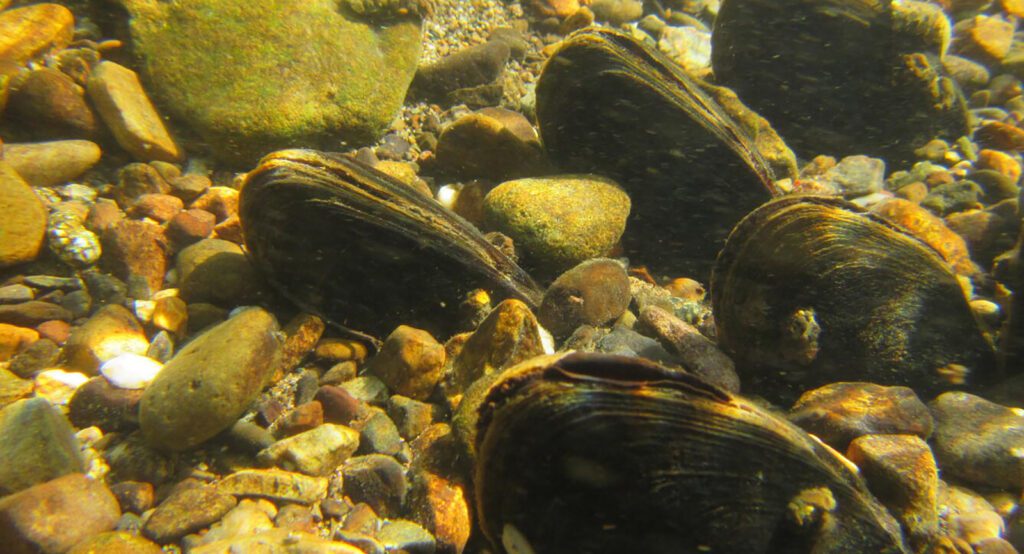
The following is a look at the freshwater mussels in southern New England listed as species of concern, threatened or endangered:
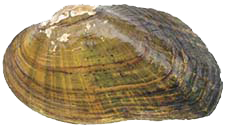
Brook floater: Listed as state historic in Rhode Island — last observed there in 1897 — and listed as endangered in both Massachusetts and Connecticut.
A small mussel that rarely exceeds 3 inches in length. They inhabit streams and rivers of varying sizes, but ones that usually have low to moderate flow velocities. In fast water, they often will be found clustered in protected areas such as behind boulders and near banks. They spend most of their lives partially burrowed into the bottoms of rivers and streams.
This species is one of the most endangered mussels in the Northeast, according to the Massachusetts Division of Fisheries & Wildlife. Recent studies indicate that the extant populations in Massachusetts are significantly fragmented, low in density, and prone to mortality due to old age and poor condition. This mussel can be found in fewer than a dozen streams in the Connecticut and Thames river watersheds. In 2010, it was found in the Housatonic River watershed, where it hadn’t been documented in about 90 years. It’s also listed as endangered in New Hampshire and threatened in Vermont and Maine.
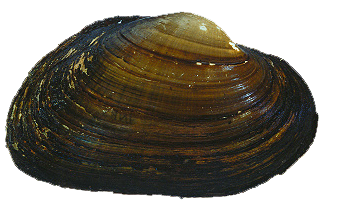
Creeper (squawfoot or strange floater): Listed as a species of concern in both Rhode Island and Massachusetts.
This mussel only inhabits streams and rivers, and prefers sand and gravel bottoms. Streams and rivers with cool- to warm-water environments and a diverse fish population are most likely to support this species. They are generally sparse or absent in headwater streams and high-gradient river reaches.
Although the species appears to be doing well in Connecticut, it shares habitat with other listed species, such as the brook floater and dwarf wedgemussel, and experiences many of the same environmental threats. Can grow up to 3 inches in length.
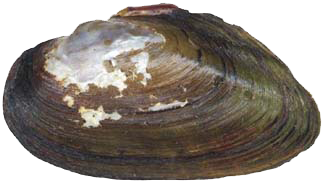
Dwarf wedgemussel: Listed as endangered in both Massachusetts and Connecticut. It is the only federally endangered freshwater mussel in New England.
Historically, it was found in nearly 70 locations in 15 watersheds along the Atlantic Seaboard, but its range and population sizes have dramatically decreased in the past century. It inhabits small streams less than 16 feet wide to large rivers more than 325 feet wide. It is found in a variety of substrate types, including clay, sand, gravel, and pebble, and often in areas of rivers with large amounts of silt.
Though once distributed throughout parts of the Connecticut River and Quinnipiac River watersheds, it is now thought to exist in only a few Connecticut River tributaries. Can grow up to 1.5 inches, though usually around 1 inch.
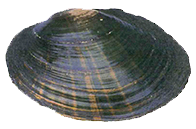
Eastern lampmussel: Listed as a species of concern in Rhode Island. This mussel is a habitat generalist, occupying a variety of waterbody types including large and medium-sized rivers, small streams, lakes, and ponds. In rivers, they can be found in a variety of substrate types from slack waters with fine depositional sediments to high velocity currents with gravel and boulder substrates.
This species is a medium- to large-bodied mussel that rarely exceeds 5 inches in length.

Eastern pearlshell: Listed as endangered in Rhode Island and as a species of concern in Connecticut. It is found in streams and small rivers that support trout or salmon populations.
This mussel isn’t found in lakes or ponds. The best populations occur in small streams with intact riparian canopy, high dissolved oxygen, and excellent water quality.
The scarcity and continual loss of cold-water habitats in Connecticut contribute to its rarity, according to the state Department of Energy & Environment Protection. It’s more common in northern New England where there are more cold-water streams and rivers. “Climate change may negatively affect this species if rivers become too warm to support trout or salmon.”
The species is sensitive to nutrient pollution and eutrophication. Can grow up to 6 inches long.
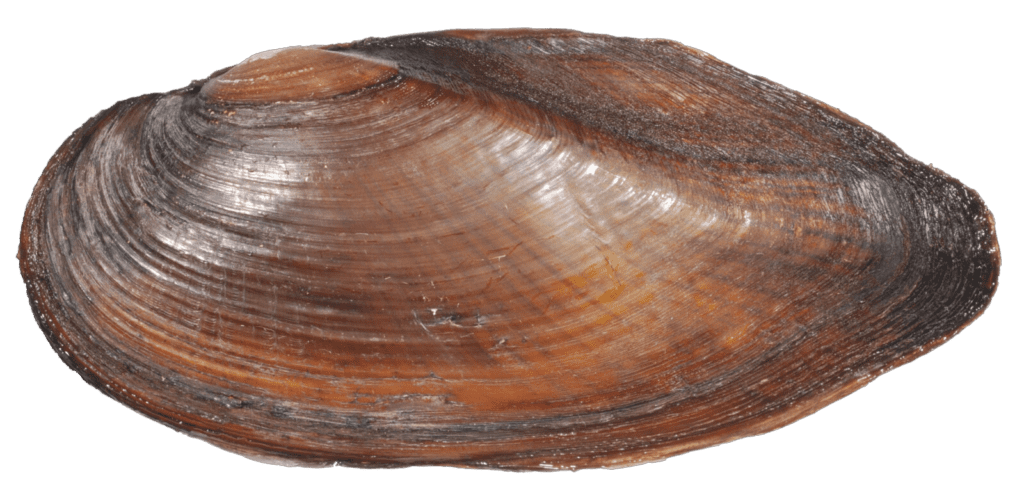
Eastern pondmussel: Listed as a species of concern in all three states. Found in a variety of habitats such as coastal ponds, streams, and rivers.
In Connecticut, many of its historic populations are thought to be extirpated or in decline, and there are few remaining populations that are considered healthy and stable. Environmental pollution and habitat degradation are considered the primary reasons for the species’ decline. Can grow up to 6 inches long.
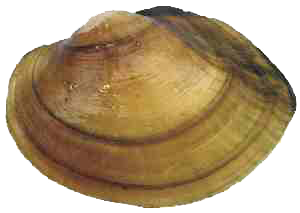
Tidewater mucket: Listed as a species of concern in both Massachusetts and Connecticut. It is usually found in medium- to large-sized rivers and coastal ponds, and inhabits a variety of substrates.
In Connecticut, the mussel can be found throughout the Connecticut River and its tributaries. It hasn’t been found in the Housatonic River watershed since the 1800s. Some recent evidence suggests that its range may be expanding, presumably due to river restoration and recovery of anadromous fish runs. Can grow up to 3 inches in length.
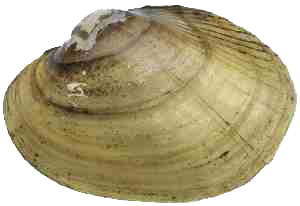
Yellow lampmussel: Listed as a species of concern in Rhode Island and endangered in Massachusetts and Connecticut. It is a medium-sized to large mussel that is usually less than 5.25 inches in length. The species was rediscovered in 2006 in the Connecticut River.
Though historically known to be in the Housatonic River watershed, this mussel hasn’t been documented in there since the 1960s. Within the limited range of the species in the Connecticut River, it has been found in shallow sandbars less than 3 feet deep and in areas more than 30 feet deep, usually in slow to moderate flow conditions.
Primary threats to the main stem of the Connecticut River, where the species occurs, include bank erosion and sedimentation; pollution, especially stormwater runoff and combined sewer overflows; alteration of natural flow regimes; encroachment of river corridors by development; and habitat fragmentation caused by dams.
“There is reason to be optimistic about the potential for recovery of the Yellow Lampmussel in the Connecticut River,” according to the Massachusetts Division of Fisheries & Wildlife. “Nevertheless, it will remain critically imperiled in coming decades because it exists in a relatively small area and it is vulnerable to catastrophic events.”
The following are things you can do to protect freshwater mussels, which are sensitive to changes in water quality and quantity, and their habitats:
If you live next to a waterbody, preserve a native vegetation buffer zone along its border to reduce sedimentation.
Thoroughly clean your boat, waders, and fishing gear after visiting an area infested with invasive zebra mussels, quagga mussels, or Asian clams. Herron noted these nonnative interlopers live in the same spaces as the region’s native populations and eat the same food.
“When we have lots of invasive species that are directly in the niche that our native species are and they are very prolific and able to out-compete them, that creates a problem for our native species,” Herron said.
Volunteer and support restoration and infrastructure projects that improve aquatic habitat, such as the removal of defunct dams and the restoration of floodplain, riparian, and in-stream habitats.
Ask whether mussels are present at project sites during aquatic restoration or construction impacting streams, rivers, or lakes. If so, help ensure they are being considered and protected from possible impacts.
“We as human beings want to see the water, whether it’s a river or a lake, and we have this desire to have this perfectly framed, lush-green lawn going right to the edge of the water, and that’s just horrible for water quality, for the habitat of the critters that we want to survive and be in those systems,” Herron said.
Note: Some of the species listed in each state overlap, and how often the lists are updated varies — the Rhode Island list was last updated in March 2006, Massachusetts last August, and Connecticut in January 2023. For species listed as state historical — essentially extirpated — in Rhode Island, they were included in the endangered category.
How many of Rhode Islands mussels are listed as threatened or endangered? I missed that part in the article.
The eastern pearlshell is endangered, eastern lampmussel, eastern pondmussel and creeper are special concern, and brook floater is extirpated. There are no Federally Protected species in Rhode Island.
This article missed eastern lampmussel, Lampsilis radiata, which is special concern in Rhode Island.
Jay, thanks for heads-up. Eastern lampmussel added. — Frank Carini, ecoRI News