
Myths, Make-Believe and Sorcery: Human Portrayal of Owls All Over the Place
May 5, 2025
Share


Series note: The region’s collection of native species is under threat on several fronts, most notably from humanity’s shortsightedness. Humans aren’t giving the natural world the space it needs and deserves. We’re crowding out nonhuman life, which, in turn, makes nature less productive and us less healthy. Wild New England examines the animals and insects most at risk.
Few other birds — or creatures, for that matter — have so many varied and contradictory beliefs swirling around them. Owls are both feared and revered, scorned and adored. They are regarded as both wise and foolish, and they have been linked to birth, death, medicine, potato chips, and Tootsie Pops.
One, Woodsy Owl, has been around since 1970 helping children form healthy, lasting relationships with Mother Nature. Woodsy’s original catchphrase “Give a hoot! Don’t pollute” has been updated to “Lend a hand — care for the land!”
In mythology across various cultures, owls are portrayed as symbols of wisdom, dullness, or wizardry. In Indigenous folklore owls represent knowledge and helpfulness, and have powers of prophecy. During the Middle Ages, these birds of prey became associated with witches, and were seen as a foolish but feared specter. Athena, the Greek Goddess of Wisdom, was so impressed by their great eyes and solemn appearance that, after banishing the crow, she honored the owl as her favorite feathered creature.
Owls also play a significant role in literature. They are omnipresent in “Harry Potter” and belittled, even if inadvertently, by a rabbit in “Winnie The Pooh.” Glimfeather is a wise owl, and Plop, a barn owl, is afraid of the dark.
Their striking physical appearances, their quirky behaviors, and amazing adaptations — 14 different neck bones allow them to turn their heads nearly three-quarters of the way around and their eyes are adapted to see in nearly complete darkness — and the fact most are nocturnal and hide during the day make it easy to understand why humans have given owls so many different personas.
Despite what most of us might think, all owls don’t live in trees. Short-eared owls nest on the ground, and burrowing owls, as their name suggests, live predominantly underground.
Greater human devotion to both of Woodsy Owl’s sensible mottos would go a long way in helping them, and us.
“Owls provide myriad ecosystem services and are sentinels for ecosystem health,” according to the authors of a 2023 research paper. “However, they are at continued risk from anthropogenic threats such as vehicle collisions, entanglement with human-made materials, and exposure to anticoagulant rodenticides, a widespread pesticide known to affect owls.”
Like most of the creatures being highlighted in this series, habitat loss and fragmentation, human disturbance, climate change, and invasive species are taking a toll on owls. Outdoor lights, including holiday displays, can confuse owls and impact their ability to catch prey.
There are at least 225 species of owls in the world, according to the Audubon Society of Rhode Island. Eight species can be found in southern New England — in forests, wood lots, swamps, marshes, grasslands, and backyards. Those eight species are: barn; barred; eastern screech; great horned; long-eared; northern saw-whet; short-eared; and snowy.
Of the eight, half are state listed in Rhode Island, Massachusetts, and/or Connecticut.
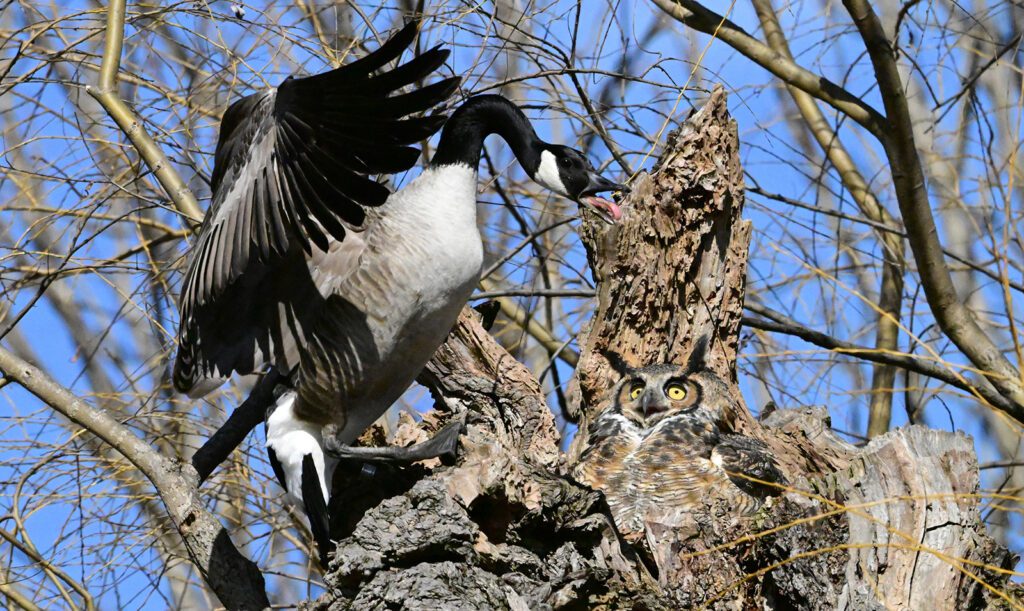
The following is a look at owls in southern New England listed as a species of concern, threatened or endangered:
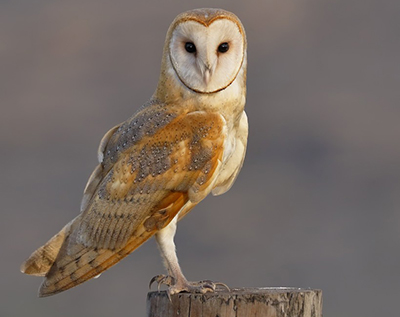
Barn: Listed as endangered in Rhode Island and as a species of concern in Massachusetts. This bird, also known as the monkey-faced owl, is quite different in appearance from other owls because of its distinctive heart-shaped face and dark eyes.
These raptors require grassy habitats for foraging, such as freshwater and saltwater marshes and agricultural fields. They rarely occur apart from populations of the meadow vole, a primary food source, and avoid areas of deep snow and prolonged cold. This owl is resourceful in making use of such nesting sites as hollow trees, cavities in cliffs or riverbanks, and artificial structures such as nest boxes, bridges, and, of course, old barns.
In Massachusetts, this species is found mainly along the coastal plain from Newburyport south to Cape Cod and the surrounding islands. They also turn up occasionally in the Connecticut and Housatonic river valleys.
While they are nocturnal and secretive, they are also extremely curious and investigate holes and crevices. They are, for the most part, monogamous and mate for life. Their short lifespans average about two years, so most breed only once or twice. Unlike other owls, they don’t hoot. Instead, both sexes utter a short, harsh note when returning to the nest. Their alarm call is a loud, piercing screech.
Common threats include starvation due to severe winter or drought, collisions with vehicles, and electrocution from power lines. Also, as inhabitants of farmsteads, they are potentially exposed to a variety of insecticides and rodenticides.
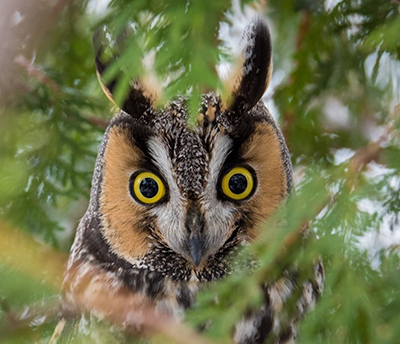
Long-eared: Listed as a species of concern in both Rhode Island and Massachusetts and endangered in Connecticut. For nesting, they generally prefer dense coniferous or mixed forests or groves close to fields or other open areas suitable for foraging. The diet of these raptors is comprised primarily of meadow voles, shrews, white-footed mice, and small songbirds.
The flight of the long-eared owl has been compared to that of a large moth, light and buoyant. The owl flies with its ear tufts flattened against its head.
They closely resemble short-eared owls in size, but short-ears are buffier in overall coloration with more conspicuously streaked underparts, much less prominent ear tufts, and facial disks that are less tawny-colored and exhibit dark patches surrounding their yellow eyes.
Massachusetts is the edge of range for this owl and it’s believed that the species was never a consistently regular breeder in the state. Their populations are mainly limited by the loss of habitat due to development, forest thinning, and the conversion of softwood forests to hardwood forests.
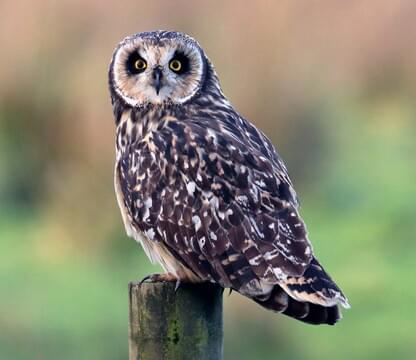
Short-eared: Listed as endangered in Massachusetts and threatened in Connecticut. They reside in large, undeveloped expanses of coastal sandplain grassland and maritime heathland, habitats which are now almost as endangered as the owl itself. The vegetation of these habitats is comprised of clumped patches of shrubs (bayberry, huckleberry, blueberry, dewberry, wild rose, pitch pine, and scrub oak) and mixed with herbaceous vegetation consisting of sedges, forbs, and grasses (goldenrod, beachgrass, wild indigo, and little bluestem).
Although these raptors mainly hunt at dawn and dusk, they can also be observed hunting during the day. When hunting for prey, the owls circle and glide close to the ground. They prey upon mice, voles, shrews, rabbits, bats, grasshoppers, beetles, cutworms, and small birds, such as field sparrows.
These birds usually roost on low perches or on the ground. There are 20-25 breeding pairs in Massachusetts.
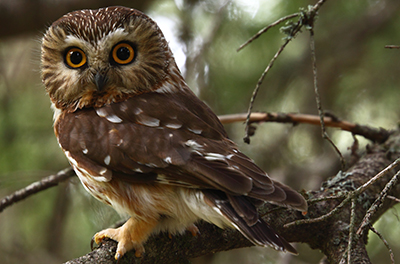
Northern saw-whet: Listed as a species of concern in Rhode Island. They are small owls with large, rounded heads that lack ear tufts. They are nocturnal and hard to see, but they have a shrill, penetrating call that they give many times in succession. During daylight they roost in dense vegetation, typically just above eye level and near the trunk in evergreen trees.
They are forest birds. They breed in extensive forests across northern North America. They winter in dense forests across the central and southern United States.
Note: Some of the species listed in each state overlap, and how often the lists are updated varies — the Rhode Island list was last updated in March 2006, Massachusetts last August, and Connecticut in January 2023. For species listed as state historical — essentially extirpated — in Rhode Island, they were included in the endangered category.
About 15 months ago I saw a Great Hormed Owl beig mobbed by over 100 crows. Video on my youtube channel. When I lived in Maine a Barred Owl would often sit in a tree outside my window just before dark.