
Misunderstood Species Stung by Bad Reputation
April 3, 2025
Share


My animosity toward the winged creatures began at a young age, likely 11 or 12. During a game of wiffleball, a summertime staple of my youth, at a friend’s house, I picked the ball out of a patch of high grass and yard debris. My left hand was immediately attacked, stung several times.
It hurt, but the game must go on. A stick was planted in the ground near the painful patch, and if you hit the ball into that area, it was an automatic out. Plus, you had to go get the ball.
A decades-long dislike of wasps was forged that summer afternoon, but in reality I had no idea what stung me. My friends and I immediately blamed wasps — like this hatred was innate — even though we couldn’t tell the difference between a bee and a wasp. We probably still can’t. To be fair, wasps are classified in the same insect order, Hymenoptera, as bees.
Wasps have a bad rap. They aren’t beloved like imported honeybees, and they haven’t been recently embraced like many other pollinators. Wasp-friendly plants aren’t a nursery thing. They’re feared, like spiders, but without the respect. They’re defamed. They share a neighborhood with ticks and mosquitoes. They get swatted and sprayed with poison.
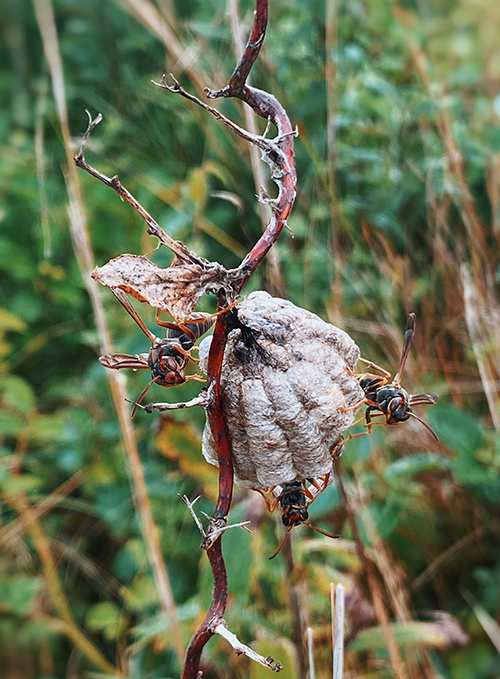
Our lack of wasp understanding is partly due to the fact wasps are so diverse taxonomically and ecologically, David Gregg, executive director of the Rhode Island Natural History Survey, recently told me.
“When thinking about wasps, most people are really thinking about the family Vespidae, which is the stinging wasps like yellow jackets and hornets,” Gregg wrote in an email, “but most ‘wasp experts’ are experts on wasps with agricultural importance, mainly tiny parasitic wasps you’d hardly even know are there.”
Casey Johnson, a research associate in the University of Rhode Island’s Department of Plant Sciences and Entomology and a member of professor Steven Alm’s Bee Lab since 2019, spends a lot of time in the summer walking through and hanging out in meadows, mostly studying bees, but she doesn’t ignore the importance of wasps.
Johnson explained that while things are on a smaller scale, wasps, bees, and other insects exhibit certain behaviors similar to how dogs communicate.
“If you see a dog that has its ears back and is showing its teeth and its tail is between its legs, you’re not going to go up and pet that dog,” she said. “If they flutter their wings a little bit at you and they all turn and look at you, you’re not going to then continue to encroach on their space. The issue is that they’re really tiny, and we do it accidentally.”
As an entomologist, Johnson is better equipped than you or I to pick up on wasp cues, but that doesn’t mean she avoids getting in their way.
“I’ve gotten stung by them, but I don’t hold it against them,” she said. “I think anytime I’ve been stung, I can kind of figure out where something went wrong and it’s all my fault.”
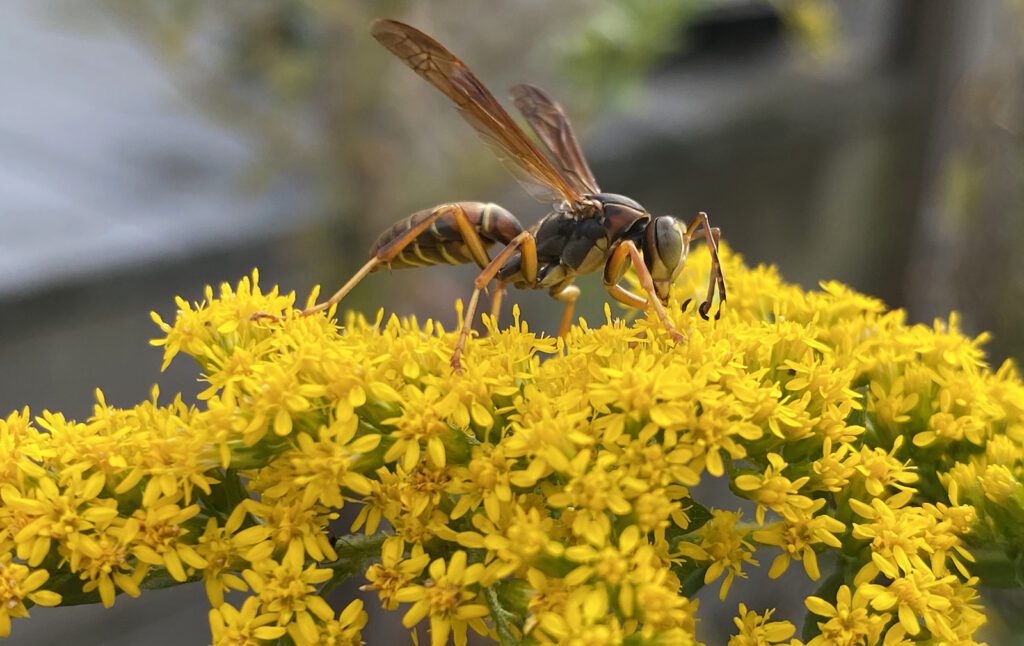
Besides eastern yellow jackets and bald-faced hornets, wasps in the family Vespidae include dark paper wasps and the invasive, at least here, European hornets, German yellow jackets, and European paper wasps.
They are all able to sting repeatedly, unlike some bee species with barbs. Like bees, only female wasps can sting, and yellow jackets are the most likely to do so. They are more defensive than bees or even hornets because yellow jackets are the only wasps in North America who produce a large amount of offspring. Because of this, their nests are often raided by hungry bears, raccoons, and skunks.
“If you stumble on a yellow jacket nest, inside of that are all of their babies, all of their food, and you just kicked down their door,” Johnson said. “And so they’re not being aggressive, they’re being defensive.”
Vespid wasps are familiar to most gardeners and picnickers, but despite their bad reputation, most provide valuable ecological services.
For instance, at least 164 plant species across six plant families and four orders depend solely on stinging wasps for pollination, according to a 2021 research paper.
The Rhode Island Department of Environmental Management has an 18-page document devoted to wasps. It notes that “despite their unfortunate depictions in popular media, wasps are largely uninterested in humans and are not inherently cruel creatures. Often, wasps pose no threat to the public, and actually provide ecological services … which help to maintain balance in the environment.”
The document doesn’t vilify those who sting us, or cause havoc at backyard birthday parties.
There are some 700,000 species of wasp worldwide and about 18,000 in North America north of Mexico, according to DEM. Those are just the planet’s known and named wasps. The ones who do sting, or annoyingly hover around your peanut-butter-and-jelly sandwich and iced tea, only make up a small percentage of that number.
About 1% of wasp species are Vespines. These social wasps use a task-partitioning caste system, similar to honeybees or bumblebees, in which a queen and workers live together in a colony.
The other 99% of wasps ignore our existence, even if they are contributing to our well-being.
Lisa Tewksbury is one of those wasp experts alluded to by Gregg. The URI research associate and adjunct professor has spent much of her career studying parasitic wasps. She told me there are about a million parasitoid wasps in the world. Many haven’t even been named beyond their unpronounceable scientific titles, and more will likely be discovered.
These wasps are among the smallest insects in the world. The fairy wasp, for example, measures 0.005 inches in length. This wingless and blind wasp is the tiniest insect in the world. Its total body length is the width of a human hair.
They may be tiny, but they have a big impact on the human food system. The fairy wasp stops the host insect’s larvae from forming. In vineyards, orchards, fields of grain, and rice paddies, growers often release these minuscule creatures as a way to help keep beetles, leafhoppers, and other crop-destroying insects from gorging on their livelihoods.
Tewksbury has worked with three species of small parasitic wasps — Tetrastichus setifer, Lemophagus errabundus, and Diaparsis jucunda — that have been released in New England and New York as biocontrol agents for the invasive lily leaf beetle. She has worked with four parasitic wasps as biocontrol agents for the invasive emerald ash borer. The most recent, Cerceris fumipennis, is about the same size as a yellow jacket and also nests in the ground.
There are about 740 species of parasitoid wasps and some 540 species of cuckoo wasps in North America, according to DEM. Parasitoid wasps lay their eggs either on or in a host species so that when the eggs hatch, the larvae will have an immediate food source. Cuckoo wasps lay their eggs in the nests of other wasps or bees, so their offspring can eat the host egg or larva and then consume the resources intended for them.
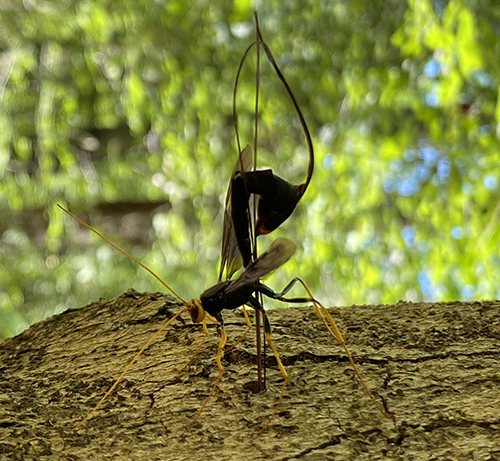
It took me a while before I realized wasps are actually one of the more fascinating insects buzzing around our lives. They are relentless apex predators that kill and dismember prey for their young. Some chew, Alien-like, their way out of host bodies, such as caterpillars. Some have complex and fascinating social lives. Others live alone, with the exception of a few one-night stands.
Like so many other insects, both of the pollinating and bothersome variety, their populations are in decline. Insect decline is largely due to a combination of issues, including habitat loss, climate change, pesticide use, and changes in the distribution of native species.
Wasps perform, for free, many important roles in the environment: natural pest control, yellow jackets and bald-faced hornets, for example, eat mosquitoes and some wasp species eat ticks or the even more annoying greenhead horse fly; pollination; seed dispersal; and decomposing. The latter is why yellow jackets buzz hungrily around your backyard barbecue. Bees get their protein from pollen; wasps get it from meat, typically from other insects and larvae and not backyard burgers.
By the way, wasp venom can kill cancer cells.
Most wasp species, such as digger wasps, mud daubers, and potter wasps, are solitary and don’t sting. The ones we are more familiar with are the social wasps who live in complex communities. Some, such as yellow jackets and hornets, like to build their nests near our homes — our backyard BBQs and garbage cans are welcoming invitations.
Anti-social eastern cicada-killer wasps can grow up to 2 inches long, but they are rarely aggressive, unless you are a cicada. They hunt for cicadas high above tree trunks and branches. The female cicada killer digs a burrow, provisions it with two or three cicadas for her offspring to feed on, and then seals the opening and flies off.
Admit it, wasps are pretty cool — at least when they’re not (possibly) terrorizing wiffleball games.
Note: The photo at the top of the page is of a tarantula hawk wasp perched on milkweed. They are a species of spider wasp and the largest of them can reach up to 4.3 inches in length. Adult tarantula hawks get their nutrition from nectar, but females will battle spiders to provide food for their offspring. The wasp never loses. The tarantula hawk has one of the most painful stings on the planet. They are found on every continent except Europe and Antarctica. In the United States, they are found in the deserts of the Southwest.
Frank Carini can be reached at [email protected]. His opinions don’t reflect those of ecoRI News.

I really enjoyed this article and would like to get better at wasp identification. Do you know of any field guides that list species found in RI and MA?
What is always a treat for me ias to see all the paper wasp nests in trees during the winter that I walked by repeatedly all sumer and enever had an inkling that there were large numbers of wasps around. There is a really large one on my bloock that I walked under every single day last summer and never saw a wasp.
Send an email along to the RI Natural History Survey ([email protected]) and we can suggest resources and field guides!
How very enlightening! Might consider bringing some native wasps in for the garden . . .