
What a Waste: Heaps of Clothing, Furniture, Household Items Overflow Dumpsters on Move-Out Weekends
June 26, 2026
Share


PROVIDENCE — Two East Side women have a concept of a plan to stop clothes, vacuums, furniture, and books from being buried in Johnston.
After our publisher and my wife, Joanna Detz, and I spoke with the duo last week, at Coffee Exchange on Wickenden Street, ecoRI News agreed to work with them to find a solution. I volunteered to be a grunt.
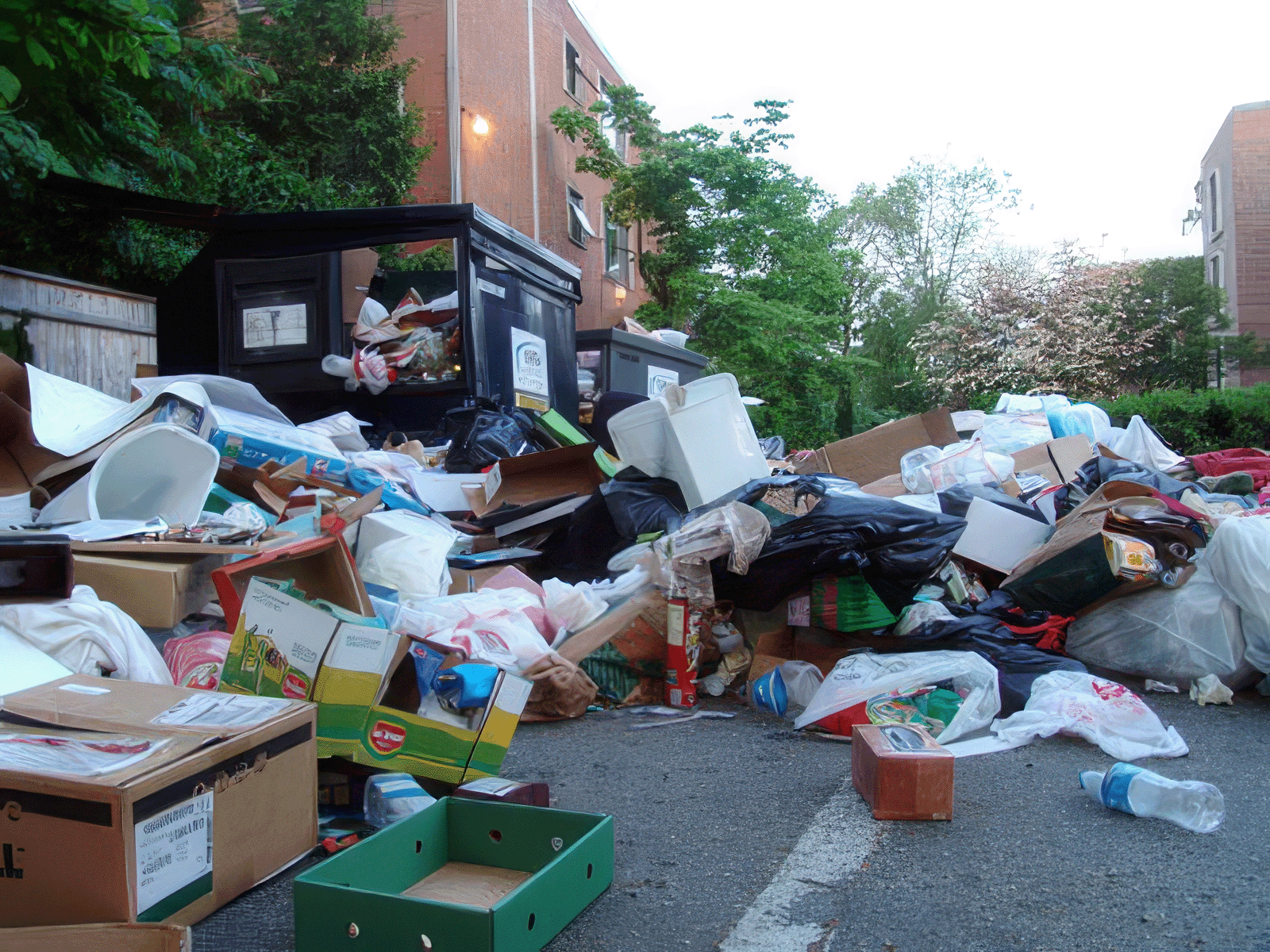
College move-out carelessness is a problem that mars the state capital every spring. Neighborhoods around Brown University are routinely littered with abandoned clothing, comforters, sheets, electronics, picture frames, books, unused notebooks, plastic shelving, shoe racks, cleaning supplies and other household items, food (some 42 tons nationwide), and beat-up furniture in need of a little TLC.
The average college student living in a dormitory generates an estimated 640 pounds of waste annually, with extreme waste coming at the end of the academic year, according to a study published in March. These spring spikes are what concern Sara Dorsch and Carolyn Birnbaum.
The amount of reusable and still usable stuff left behind this year was particularly staggering, according to the women. They both noted unopened food was casually thrown to the curb. Dorsch snagged unopened bottles of olive oil and balsamic vinaigrette. They said discarded mini fridges were aplenty.
“There was so much stuff, like totally usable stuff,” Birnbaum said. “I ended up with all this stuff that’s in my garage, just bags and bags of clothing. My husband is a physician at Rhode Island Hospital. There was a patient who had been in the hospital for weeks and was going into rehab. I don’t know the situation, but [they] had no clothing, and I was like, ‘No problem.’ I washed a big bag of clothes, and off it went.”
Birnbaum also recovered a red floor lamp in excellent condition, which she said had a retail value of $700. It’s now in her living room. Her daughter is starting graduate school in the fall, and thanks to Brown University students, she won’t need to buy any notebooks.
The piles of usable stuff recently forsaken got the friends thinking about a solution. They contacted ecoRI News to talk through some ideas. As a side hustle to help fund our journalism, we used to clean up road races and collect food scrap. We hold an annual Regift Sale — a collective indoor yard sale — in December at Flatbread Company Providence. Dorsch and Birnbaum believed we could provide some insight. They were half right: my wife and ecoRI News co-founder offered some ideas. I took notes.
“I think we’re at a point where we’re trying to figure out what is the next logical step, which, of course, is to reach out to Brown, but I think we need to go to Brown with an action plan,” Dorsch said. “I didn’t know if you guys would have any thoughts because you were collecting and doing stuff before and what you think might work well?”
Dorsch said the first step is how to get students and Brown University to participate. Getting all this usable stuff to homeless shelters, food pantries, libraries, public schools, and nonprofits is another challenge.
“I think there has to be buy-in earlier. There needs to be awareness,” Detz said. “People need to understand about the landfill, the need in the community, how your stuff can make an impact in somebody’s life.”
Most of the easily reusable dormitory items abandoned curbside or left near dumpsters — besides what the duo and other residents who live near Brown University rescue — end up taking up valuable space in the ever-shrinking Central Landfill.
Dorsch and Birnbaum believe this waste could be significantly minimized through proactive, large-scale collection efforts, with some education mixed in, that gives all this useful stuff a second life.
“It just seems like so much more could be done,” Birnbaum said. “They could be giving back to the community in a way that virtually costs them nothing.”
Brown University is hardly the lone offender. Similar heaps of waste are also created at Providence College, Johnson & Wales University, Rhode Island College, and the Rhode Island School of Design — just at different heights. The Brown University heap is the highest.
The problem isn’t even limited to Rhode Island. At Tufts University in Medford and Somerville, Mass., school officials have noted there is a significant spike in the amount of waste generated on campus during May and June, when their students annually abandon some 230 tons of stuff, much of it still usable.
Each of Providence’s institutions of higher learning have programs in place and offer guidance to help students, faculty, and staff navigate the challenges of reducing end-of-year wastefulness. The problem, obviously, isn’t a high priority, however.
“Our landfill is on its last legs, so this, in our minds, has this double whammy of filling up the landfill and not being used by people who could use this stuff,” Dorsch said. “We’re filling up a landfill and we have no plan on where we’re going to get rid of our trash. If we could cut down the trash, that would be great.”
Note: If you are interested in working on a way to redistribute these items in the future, please email me at [email protected].
Frank Carini can be reached at [email protected]. His opinions don’t reflect those of ecoRI News.
So, the same cadre of elite university students that routinely blame and shame the rest of us for wasteful habits and lack of concern for the environment have no problem at all with contributing to the problem. Typical. Most of this stuff could probably be taken to any one of a number of donation drop-offs who would be grateful to receive it. I’ll bet this wasteful behavior was learned at home from equally wasteful parents.
In 2001, while I worked at St. George’s School, I was shocked by the plethora of furniture, rugs, clothes, bedding (sheets, blankets, mattress pads, foam toppers, pillows, etc.), shoes, sports equipment, rugs, hangers, mini-fridges, school supplies, books, kitchen items, etc. that were left in the dorms. That first year I hastily assembled what myself and a maintenance dept. employee could collect and sell during the departing faculty’s small yard in the hockey rink. The following year, we set up bins in the dorms for students to deposit items for the sale, and we designated collected funds for the school’s summer camp for inner-city kids. Each year the sale grew. Staff and faculty would volunteer to wash clothes and clean items. We spent hundreds of collective hours organizing, cleaning and pricing items. When I left the school in 2011 we were literally filling the hockey rink with items and hundreds of people lined up to enter. After the sale, local agencies arrived to take what they wanted. Toiletries were sorted and given to the Women’s Resource Center, among other places. The sale that I started continues to this day. I had a PowerPoint that I would show to the students in assembly. My right-hand was my office mate, and she managed the sales for years after I left. If you ask me what the ultimate solution is, it’s for schools and colleges to have a large dedicated space for storing things for returning and new students, instead of every year students going to Target and Walmart and buying the same items. It is a huge problem, but students that fly home have no way of storing things. It’s such a simple solution and I’m so dismayed that all this stuff continues to end up in the landfill. I am happy to share my expertise with anyone, but warning, it is a lot of work. But so very rewarding.
Picturing the schools opening an arena for dropping off, sorted into bins for clothing, household items, unopened food, electronics, etc. Or a row of trucks in a parking lot that students could use for drop off so that the donations would be sorted and ready for transport to food banks, Savers, Salvation Army or wherever. Dumpsters for the unusable things. But with education, maybe they’d get the hang of “reduce, reuse, recycle”/take care of your community as the beginning of a life skill? Any community service organizations on campuses to organize end-of-the-year cleanups?
I think at one point since we moved here, Brown was doing something + with all the stuff students left behind. Obviously no longer! Martha has some great ideas. If Brown provided a place, students. could drop off what they did not want, and orgs could take what they want/need.
Unopened food=> food bank etc
I agree that I’m horrified by the rampant, unnecessary waste that happens every year, but there are models for universities to become thoughtful neighbors and act on the “sustainability” mantra we all invoke! Decades ago, I learned that students at University of Virginia had taken on themselves to organize the collection and distribution of student discards. I think it was very successful although I don’t know if it is still ongoing. Closer to home, I have read about the insane sidewalk bargains as Harvard students move in and out. Perhaps the Providence universities could team up to hire a temporary departure day coordinator to work with the city and schools to manage the exit process. Most people — even students! — will do the right thing if we make it easy for them.
Jay, you took the words right off my keyboard. These are the rich kids who learn much (or so we think) and do nothing to help. This story makes no mention of those phony environmentalist professors who virtue signal every day but apparently never mention this problem internally, happy to flee town when the semester ends. Out of sight, out of mind! That said, complaining about these children won’t help. (And Toni, good for you!! What a smart program.) If the City of Providence can muster up the courage, they might “fee” every dorm student $100 (as if they’d care….) so that the single mom on the 2nd floor flat in Mount Pleasant doesn’t have to pay for the little slobs’ uncaring disposal of perfectly good stuff. Perhaps the useful items can be brought to Meehan Auditorium and sold. When a kids brings a dorm fridge, for instance, they get their $100 back. I had never heard about this situation, and thank EcoRI for letting us know about it. It’s disgraceful, of course. Shame on those students. It must be nice living that wealthy and carefree life!
I don’t understand why durable items like refrigerators and lamps aren’t just left in the room for the next student to use. Much less waste and effort and expense that way! When I went to NU in
Boston, everything that I brought with me fit in my car and left with me on moving out. I don’t recall piles of trash on the street. A bed and dresser was provided along with a table if there was a kitchen. I’m sure some students especially international students can’t bring all their bedding back and clothing so those are the items that certainly can be reused and donated.
Two of my kids went to an urban college (NYC). Move in and move out days were a nightmare as I am sure they are at any City of Providence location. We had a minivan and a car top carrier everything that went into the dorm came out of the dorm, plus we lived close enough to do some pre-removal of items. There is so little time to move out, and so very hard to move out of an urban setting, that tossing out perfectly good “stuff” is understandable. The schools, collectively, need a less restrictive move out policy and provide space for kids to leave items for donation. Given the stress of finals and a strict move out policy, it is not surprising so many usable items end up in the trash.
I work at RISD and we have a department that works to collect, sort, and donate everything left behind in the dorms. They call for volunteers at the end of the academic year, including transport of goods to local animal shelters. Within the school itself things are reused, including studio materials and furniture. You should reach out to them for ideas. I think we do a great job in avoiding clogging up dumpsters and leaving waste, unlike our neighbors. I’m not sure why we were listed among the schools here but guessing because we get lumped in with Brown a lot and people may not know which dorms are us or them. In Boston and Cambridge locals used to comb the streets upon move out time to collect items like furniture. I’m surprised Brown doesn’t have a centralized department with staff and volunteers.
There’s a clothing sale happening at RISD next week, part of the end of year collection they just did! Proceeds go towards helping students with materials cost.
Of course, better awareness and communication to students about waste and its affect on our state should happen too. If you really want to be appalled look at the food waste and lack of actual recycling. We need a centralized compost program in this state.
Here’s a link to a recent article about a program that seems somewhat successful:
https://uknow.uky.edu/campus-news/uk-recycling-sets-record-more-18-tons-collected-during-move-out
Mike, I love this about UK! Same as what I developed at St. George’s back in 2001, except I didn’t quantify in pounds, like they did here. And I didn’t send out news briefs which I should have. But maybe because what I did there wasn’t even my job! It was all volunteer in my after work and weekend hours. Anyway, my nephew used to work at UK in the dining hall and a few years ago he gave me a tour. They were very pro-active in the dining hall with recycling and composting. Cheers to them! I wish every school was this inventive and forward-thinking!!
Martha, this is exactly what I would advocate for: A dedicated space for storing cast-offs to be given or sold to next year’s incoming students; or at least saved for returning students who arrive at school by plane or whatever. But when architects design campuses, do they ever go around to staff to ask for suggestions? Not in my experience.