
Low-Salt Road Diet Recommended
March 2, 2026
Share


For the first time in about a decade, I’ve enjoyed a winter where snow hung around for more than a few days. Admittedly, the blizzard was a bit much, but I’ll still take January and February over the heat and humidity of July and August.
This season’s winter wonderland, however, came with a pretty high cost — one that routinely gets overlooked every time it snows.
Salting roads as a method of preventing ice from forming began in the late 1930s, perhaps in New Hampshire or maybe Detroit. Nearly nine decades later, with sand sometimes mixed in, salt remains the go-to method for de-icing roads. It’s effective, in a narrow scope. Salting roads reduced car accidents by 87%, according to a 1992 study from Marquette University. It’s still reducing them.
While safer winter driving is certainly important, throwing tons of salt around comes with side effects, some of which are costly and impact human health in a different way than a head-on collision.
All this salt can contaminate wells, eat away at pavement and bridges, and degrade underground pipes that carry drinking water or wastewater.
A 2021 study found introducing salt into the environment from de-icing roads, or fertilizing farmland, releases toxic concoctions and decreases the availability of freshwater resources. Because of their structure, salt ions can bind to contaminants in soils and sediments, forming chemical cocktails that circulate in the environment.
If salinity levels are too high, drinking salty water can cause dehydration, or exacerbate certain medical conditions such as high blood pressure and chronic kidney disease.
Besides causing public health problems, road salt also attacks the human-built environment. A Washington State University professor and author has estimated the United States spends some $5 billion annually on infrastructure damage caused by road salt.
Due to its chemical properties, road salt can exacerbate the damage roads suffer each winter when they repeatedly freeze and thaw, according to Xianming Shi, a professor of civil and environmental engineering who wrote a book on the subject titled Sustainable Winter Road Operations. He has noted the salt’s impact expands and cracks roadway surfaces.
Road salt also eats away at vehicle undercarriages and other exposed metal, causing corrosion and rust. A study by the American Automobile Association found road salt could be costing car owners as much as $3 billion annually in repair costs.
The United States spends about $2.3 billion annually to remove roadway snow and ice, and to degrade the environment.
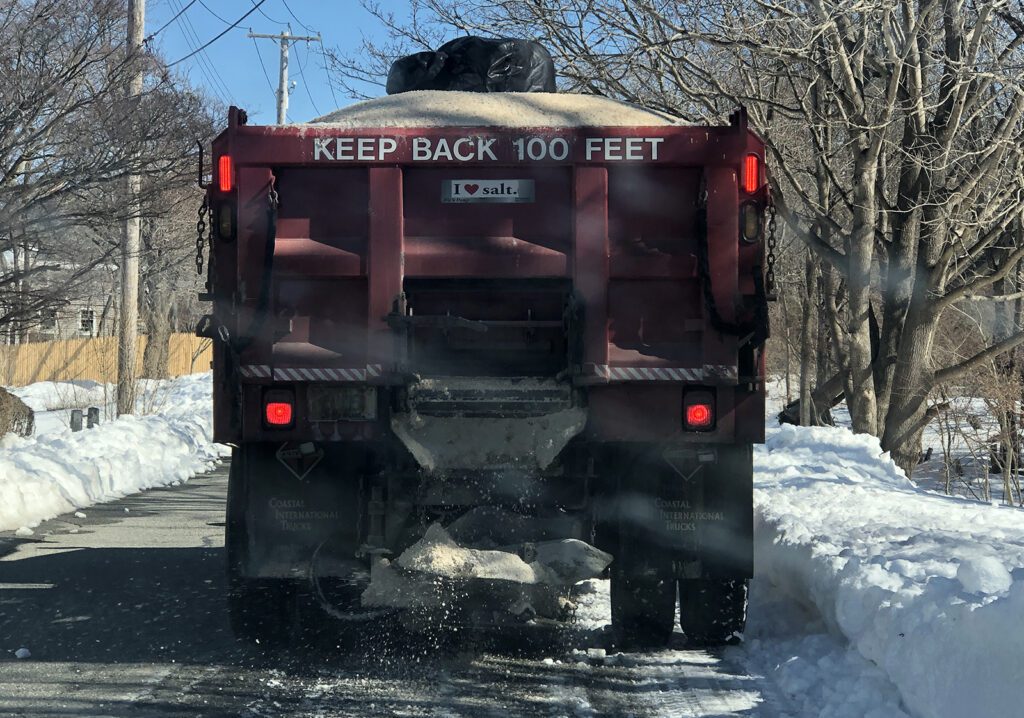
Road salt pollutes wetlands, both fresh and salt, vernal pools, lakes, ponds, rivers, and streams. Winter salt is just another stressor placed on wildlife, such as salamanders, frogs, fish, insects, plants, and zooplankton, by our omnipresence.
Road salt can also encourage the growth of certain invasive plants such as the common reed (Phragmites australis), which are more salt tolerant and can outcompete native plants for resources.
If you cover half of the head of a penny with rock salt, dump that into a quart of water, and stir it until it dissolves, that salt concentration is harmful to spotted salamanders, according to Nancy Karraker, a University of Rhode Island research professor. If you completely cover the head of a penny and let a little bit spill over the side, and dump that in a quart of water, that concentration harms wood frogs.
And the amount of salt being dumped on roads is hardly a pinch. In fact, it’s a growing problem pushed to greater and greater quantities by our adduction to cars and pavement and our disdain for public transit.
The country used about 164,000 tons of road salt in 1940, according to the U.S. Geological Survey. We used a million tons in 1954, 10 million in 1985, and now average about 24 million tons annually.
Massachusetts alone uses nearly half a million tons of road salt every year.
In 2012, Rhode Island began applying a brine solution to its roads as a pretreatment to reduce salt use. The negative impacts, however, largely remain, because salt is salt, whether it is sodium chloride, magnesium chloride, potassium chloride, or a water-downed mixture.
This winter, while walking the dogs around our Portsmouth neighborhood, I’ve been dismayed at the amount of salt covering the roads and the adjacent shoulders of crabgrass and other invasives and residential lawns.
I’ve picked up at least a half-dozen softball-sized hunks of road salt and thrown them in my trash headed for the Central Landfill. I’ve accidentally and intentionally kicked countless other decent-sized pieces. The dogs have even gotten a few of these pieces stuck in their paws. (The chances of getting booties to stay on this sister duo are next to impossible.)
We can’t keep salting the earth at this pace.
“This is a slow-moving train wreck,” according to Megan Rippy, an assistant professor in civil and environmental engineering at Virginia Tech. “It’s playing out so slowly that it’s easy to overlook that our streams, lakes, and drinking water resources are becoming progressively saltier.”
There are alternatives, both real and possible. Some municipalities use “live edge” snowplows that conform to the shape of the road and can significantly reduce salt use. Some salt trucks, including several Rhode Island Department of Transportation vehicles, use GPS and special software to track routes and salt dispersal, increasing efficiency. Localized weather forecasts help anticipate needs so that trucks using a brine solution can pre-treat roads and reduce overall salt use.
Another solution to this winter problem could be the development of environmentally friendly anti-icing agents that can reduce the need for road salts.
Shi, the Washington State University professor, has studied turning locally sourced and environmentally friendly industrial byproducts, such as liquid wastes from a vodka distillery, into additives for greener anti-icing solutions. He has also researched vegetable juice ice-melt, ice-free pavement, and “smart snowplows” that read temperature, residual salt from previous applications, the presence of ice, and the amount of friction on the road to help operators apply less salt.
Frank Carini can be reached at [email protected]. His opinions don’t reflect those of ecoRI News.

Thank you for highlighting this extremely important issue! Our well was contaminated with road salts from run off to the level that our water is undrinkable. How do we curb this issue?!
Middletown changed to brine several years ago. Roads are sprayed before a weather event.
Brining prevents wasteful overuse of the product (those chunks and dumps), and saves the Town money as well.
Love the title, Frank! I thought more work had been done on what we put on our roads. If not, that seems like a good direction to go, along with pre-treating roads. Given our budget woes, better snow plows not likely.