Jamestown Grows Its Own Beachgrass to Bolster Conanicut Island’s Dune System
June 13, 2025
Share


JAMESTOWN, R.I. — There’s something strange growing on one of Conanicut Island’s farms.
Sandwiched between the Jamestown Reservoir and East Shore Road, the Jamestown Community Farm has occupied 17 acres of prime farmland in eastern central Jamestown since 2001. Its primary focus is actually vegetables; every year it grows more than 11 tons of produce for distribution to food pantries around Rhode Island.
But visitors to the farm might be surprised to see tucked away on a small plot of land green grassy plants, familiar to the state’s avid beachgoers, but foreign to farmland in southern New England. They’re not weeds, or invasive plants; they are four different species of American beachgrass.
“We used to buy it for years from an organic farm out in Cape Cod,” said Anne Kuhn-Hines, a member of the Jamestown Conservation Commission and one of the town’s beachgrass farmers. “Our commission only has a $2,000 budget every year, and we were spending half of it or more on purchasing plants.”
Kuhn-Hines and the rest of the commission began working with Jamestown Community Farm in February 2024, after a series of nasty winter storms dropped 4 inches of rain, and winds of up to 60 mph wiped out the sand dunes at Mackerel Cove, closing down Beavertail Road, the only evacuation route for the Beavertail peninsula, for several hours.
At the farm, the commission grows four different species of beachgrass: American beachgrass, seaside goldenrod, bitter panicum, and coastal bluestern. The planting was partially offset by a $1,700 grant from the Rhode Island Wild Plant Society.
Beachgrass species in Rhode Island are keystone components of the state’s dune systems. They grow on the large sand berms that are the true demarcation line between the ocean and inland areas. Such beach dunes provide protection from coastal flooding, prevent erosion, act as a buffer against storm surge, and provide critical wildlife habitat.
Beachgrass is easily destroyed by supercharged storms, routine coastal erosion, and careless people walking or driving on the dunes. For that reason, many municipalities along Rhode Island’s southern shore regularly install thousands of plugs of beachgrass, called culms, every year to boost the resilience of dune systems.
Like trucking sand in to be dumped along the shoreline, buying thousands of beachgrass culms every year can get expensive quickly, and can put financial strain on a town beach that has to fund itself through its own revenue.
Growing beachgrass, which sounds unusual to even the most avid gardeners, turns out to be a more financially sound move for budget-strapped towns. The Conservation Commission bought 1,300 culms of beachgrass last fall, and is eyeing a transplantation date sometime this fall.
“Normally, when we buy the culms, we’d just stick them in the dunes,” Kuhn-Hines said. “But instead we planted them in our farm plots because we thought we’ll just keep growing them. They’ve really started to take off, too. They were these bare root columns in October, but now they’re green blades and getting thicker and thicker.”
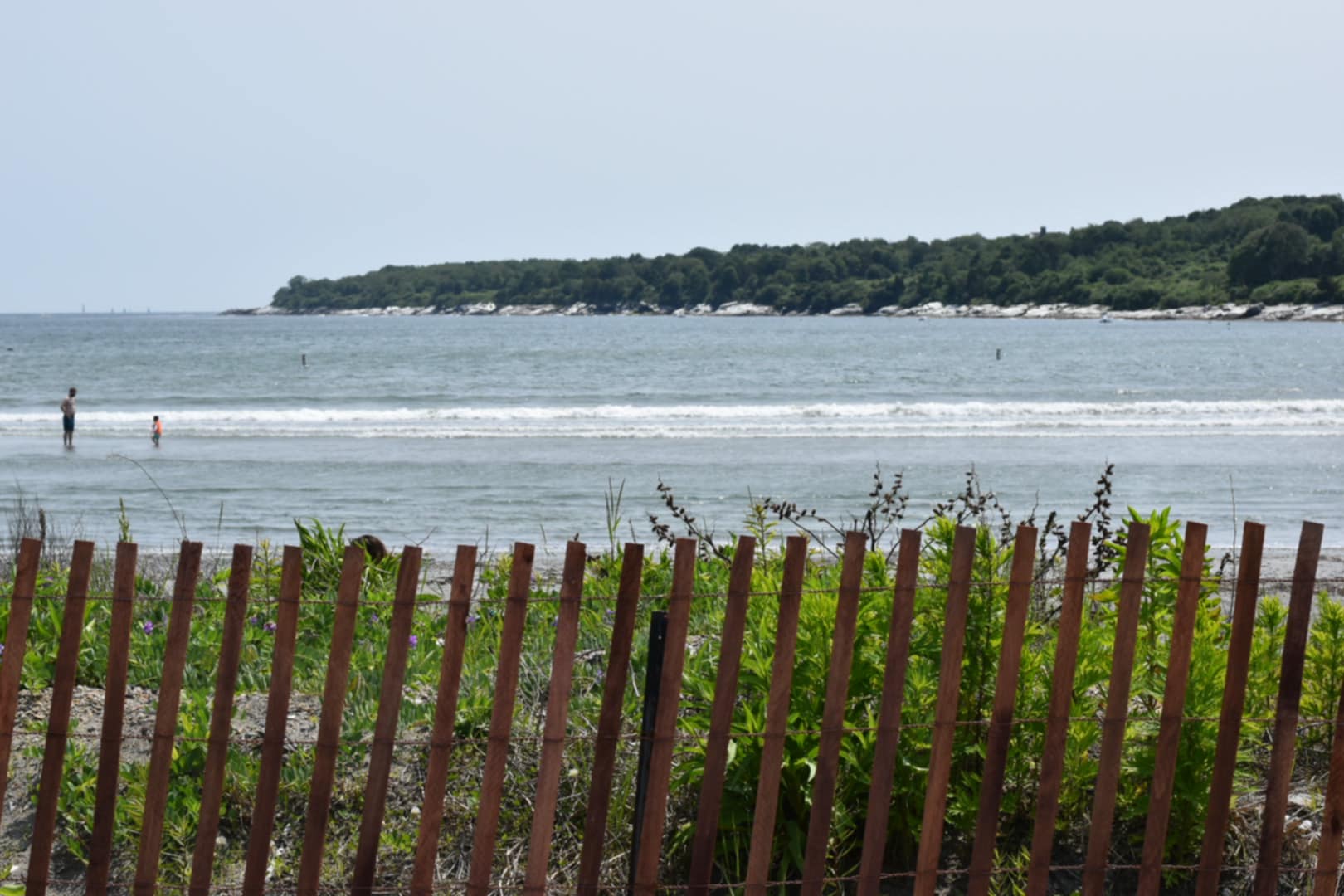
In the fall, those culms of beachgrass growing on Jamestown Community Farm will be transplanted 2 miles to the southwest of their current home, on a sliver of beach that’s one of the town’s few public swimming holes.
For most beachgoers, Mackerel Cove Beach probably doesn’t look like a critical piece of transportation infrastructure. The beach itself is located on the south side of Beavertail Road, the only road that connects Beavertail, Fort Getty, and other neighborhoods that make up southwest Conanicut Island.
At its widest point, the beach, the road, and the tiny strip of land to the north of Beavertail Road is at most 200 feet, making it a vulnerable target for sea level rise, superstorms, and climate change. If the beach’s dunes erode, and Beavertail Road floods, the southwest portion of the island is completely isolated, with no land-based means of escape in emergencies.
The small dunes at Mackerel Cove were installed in 1992, after Hurricane Bob, making the dune system likely younger than most millennials. But since 2011, starting with tropical storm Irene, and Superstorm Sandy in 2012, the Mackerel Cove dunes have needed more and more replenishment.
The Conservation Commission started in summer 2014 to buy beachgrass and other related plants to strengthen the dunes’ resiliency. In April 2022, the commission and its volunteers installed 8,000 plants along the dunes, planting them around 8 inches deep, and clumping two or three plants together at a time.
“We had two or three superstorms back-to-back in December 2023 and January 2024 that blew all of the dunes at Mackerel Cove across Beavertail Road,” Kuhn-Hines said. “Jamestown had to close the road for eight hours, and bring bulldozers and bulldoze the dunes back onto the beach. It was pretty bad.”
Mackerel Cove Beach’s dunes are particularly vulnerable. They’re only 4-5 feet tall, compared to the much grander dunes found in many other beaches along Rhode Island’s southern shore. Installing beachgrass that will strengthen the structural integrity of the dune system with its roots is a necessity, both to save the public beach and the public road.
A long-term solution to Beavertail Road is still years away. It’s a state road, which means improvements and resiliency projects fall to the Rhode Island Department of Transportation. According to RIDOT’s State Transportation Improvement Program (STIP) plan, construction on improvements won’t commence until 2029 at the earliest.
Beachgrass plantings aren’t the only work being done to boost Mackerel Cove’s dunes. The town in March was awarded $199,400 from the state’s Ocean State Climate Adaptation and Resilience (OSCAR) program, which is designed to help municipalities with local climate adaptation and resiliency projects.
The money Jamestown received from the program will be used to develop a strategy to restore and stabilize the sand dunes, protecting Beavertail Road from flooding and providing essential habitat for nesting birds and pollinators. That work is ongoing.
Meanwhile, the Conservation Commission will still be growing beachgrass at Jamestown Community Farm. Kuhn-Hines said the commission is hoping, with a grant from the town recreation department, to expand the plot they have on the farm and grow more grass.
“The hope is we’ll be able to provide plants for other areas,” Kuhn-Hines said. “There’s other beaches that the town owns that could use beachgrass, [and] there’s different coastal areas around Jamestown that could use more plants for buffering.”