
Device Allows Beavers, Humans to Co-Exist
August 11, 2025
Share


BURRILLVILLE, R.I. — Beavers are attracted to the sound of running water, whether it’s coming through a bubbling brook in the depths of a forest or from the side of a road flowing through a human-made culvert.
When they hear the water, their natural inclination is to start damming it. On a brook, in the middle of an unpopulated forest, that isn’t usually an issue.
But when beavers find themselves plugging up human infrastructure — and they often do — they can cause flooding that harms properties and makes roads impassable.
Killing what the state refers to as “nuisance beavers” is one frequently used solution, but some groups in Rhode Island and around New England are looking to change that.
For years, local environmentalist Roberta Lacey and town workers have frequently cleared the culvert that drains out of Wilcott Pond on Lacey’s property in Burrillville, and the beavers that live in the pond have continued to dam it back up, almost on a weekly basis.
Lacey started looking into beavers and realized that even though they cause problems, they also add a lot of benefits to the environment.
Their dams can help remove contaminants from waterways and they often remove overgrown vegetation, which makes aquatic ecosystems healthier.
Lacey learned she could install a flow device to keep the water moving through the culvert while forcing the beavers to stay out. She recently invited a crowd of locals and ecoRI News to watch the installation of one of these devices on her property.
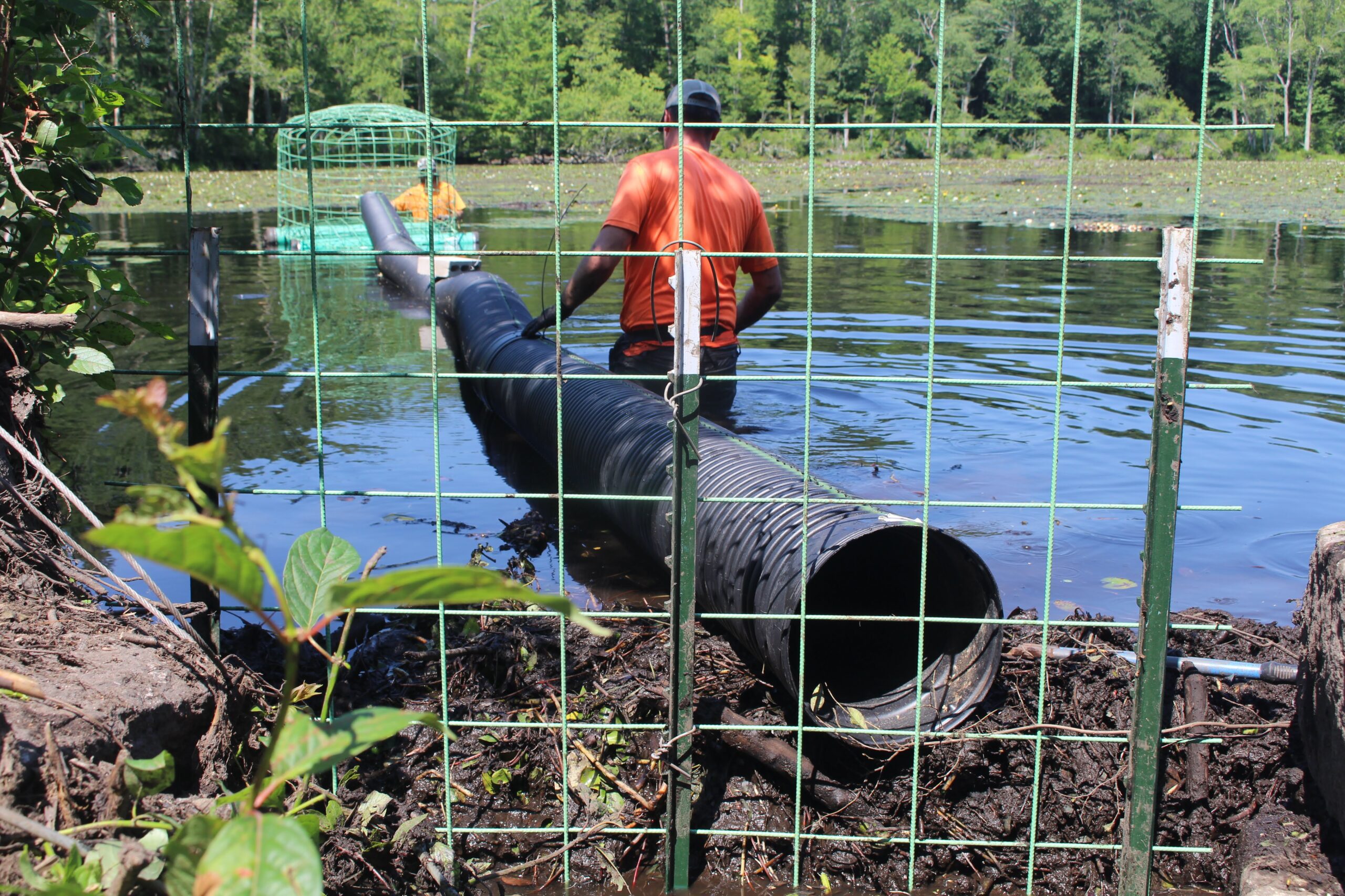
Workers from Beaver Solutions in Massachusetts rolled up to the pond with 40 feet worth of pipe and large squares of wire fencing.
As they worked, John Egan and Ed Beattie explained that they would place a cage around one end of the pipe, submerge it in the pond, and place the other end into the culvert through a fence they would install.
Although the beavers, attracted to the sound of running water near the culvert’s mouth, may still try to dam the fence around the new pipe, ultimately water will still flow through the culvert from the pipe at the caged end, farther away from the sound.
Egan said the company installs about five of these devices a week, with about 2,500 in areas around New England.
“They’re like 98% successful,” Lacey said. “They really, really work.”
Lacey said the device cost around $2,500 to install, but she was able to get a grant from the Beaver Institute, a nonprofit group started by the founder of Beaver Solutions, that covered about half the cost.
In the long run, Lacey said the solution is cost-saving — the town will save money on the cost of clearing the culvert and the contracts for trappers to kill the nuisance beavers.
While Egan and Beattie worked, folks in the crowd asked them questions, in particular whether they had ever gotten in trouble with one of the creatures whose dams they were messing with.
The pair said even though they have gotten really close to beavers, the animals always kept their distance.
Lacey said when she’s been mucking out the culvert, the resident beaver pair have come out of their den and smacked their tails — a beaver warning sign.
“Your beavers are going to be pissed when they come out tonight,” Samantha Young, another local environmentalist who had come to watch, joked to Lacey.
But, at least, they’d still be around.

I literally just finished reading an article in the June 2025 issue of National Geographic about beavers and the positive effects they have on the environment, when I opened today’s Tuesday News Day. It made me hopeful that RI will embrace implementation of strategies to coexist with beavers, rather than kill them.
BRAVO!