Catch Me If You Can: Some Freshwater Crustaceans Are Hard to Find But Their Presence Matters
February 24, 2025
Share


Series note: The region’s collection of native species is under threat on several fronts, most notably from humanity’s shortsightedness. Humans aren’t giving the natural world the space it needs and deserves. We’re crowding out nonhuman life, which, in turn, makes nature less productive and us less healthy. Wild New England examines the animals and insects most at risk.
Crustaceans are a diverse group of invertebrates that includes active animals such as crabs, lobsters, shrimp, water fleas, and woodlice and more fixed creatures such as barnacles.
Of the some 45,000 aquatic species of crustaceans, only about 10% occur in freshwater habitats. A few crustaceans are found on land.
All crustaceans, however, share several characteristics: a hard exoskeleton; jointed, paired appendages; and three body regions, a head, thorax, and abdomen.
Amphipods — an order of crustaceans in many groundwaters, springs, and spring-fed streams — are “super important” in freshwater ecosystems, according to Jason Carmignani, aquatic ecologist for the Massachusetts Division of Fisheries & Wildlife’s Natural Heritage & Endangered Species Program.
“They’re found in high abundances in pretty much every freshwater habitat,” he said. “They’re doing a lot of nutrient processing and breaking down organic matter. A lot of things are eating them, so they’re really critical in the food web. But the species that we we focus on tend to live in fairly specialized environments.”
He noted amphipods are short-lived, generally no more than a year and a half.
Three of the four amphipods listed in Massachusetts are only found in the western part of the state, in the Housatonic Valley, where they live in calcium-rich waters.
“The Housatonic Valley is fairly unique compared to the rest of the state, because it has a carbonate bridge bedrock,” Carmignani said. “A couple of those species, the Taconic cave amphipod and the Piedmont groundwater amphipod, actually inhabit caves, so a super specialized, super niche habitat that you don’t see anywhere else in the state.”
The habitat of the state’s two listed clam shrimps are much more common than calcium-rich waters in caves, but kind of unique in their own way: puddles.
“These puddles probably last a couple of weeks to a month, and they’re in sandier habitats, like southeastern Massachusetts and the Cape, or some sandy deposits along a river,” Carmignani said. “Clam shrimp are fairly unique species. They’re super ephemeral. They boom and bust. After a huge rain event, like during the summer, these puddles form and within like eight or nine days, they’ll be ready to reproduce. They’ll deposit eggs, the puddle will dry up, they’ll die, and the eggs will stay there waiting until the next rain event. Those eggs can last for like five to eight years.”
Carmignani noted clam shrimps do well in puddles because there aren’t as many predators. “They’re just kind of sitting ducks in a vernal pool,” he said.
The ephemeral pools, and puddles, that support many freshwater crustaceans are usually dry during much of the year. Development that disrupts these depressions and pools is the most obvious threat to this species, according to the Natural Heritage & Endangered Species Program. Draining, filling, and contamination from seepage or the leaching of toxic substances into these habitats also represent potential threats.
“Any alteration to hydrology, even just filling in a rut on a dirt road, can have an impact,” Carmignani said. “It’s those smaller environments that can be really challenging to work in.”
The following is a look at the freshwater crustaceans in southern New England that are listed as species of concern, threatened or endangered (none of the three states listed any marine crustaceans):

Agassiz’s clam shrimp: Listed as endangered in Massachusetts. This small crustacean resembles a mollusk at first glance because it’s enclosed in a bivalved structure called a carapace. The egg-shaped carapace is transparent, ranging in color from clear to brown.
Little is known regarding the status of the species in Massachusetts. They have been found in the ephemeral pools of a floodplain depression and in a flooded hay field after a heavy rain. They have also been found in a flooded sand trap and a nearby flooded depression on a golf course and in a heavily vegetated drainage ditch that was dominated by butterfly weed. They are rare throughout eastern North America.
The species has as a short life cycle, reaching sexual maturity in 8-9 days. They appear primarily in late spring and early summer during large storms in years of unusually heavy rainfall. Its short life span has evolved to meet the ephemeral circumstances of its habitat. Adults begin to die shortly before the shallow pool dries or they die stranded as the pool dries. Once the pool dries, the resting eggs remain dormant until the appropriate wet conditions return. This resting period can last several years.
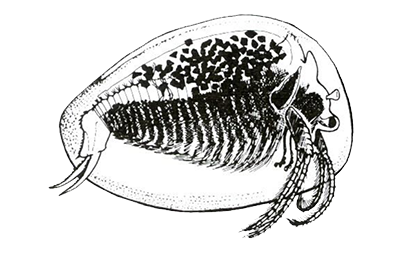
American clam shrimp: Listed as a species of concern in Massachusetts. This species is known from scattered locations in Massachusetts and the Atlantic coastal plain province of South Carolina, Florida, and southwest Georgia.
The species has a short life cycle, typically producing only one generation per wet period They swim using a paddling motion created by the second antennae. If they cease to paddle, they tip on their side. They are most often found moving along the pool bottom in vegetation.
This species isn’t found consistently year after year in the same shallow pool. Its presence fluctuates depending on environmental conditions.
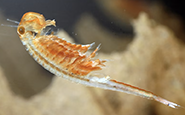
Intricate fairy shrimp: Listed as a species of concern in Massachusetts. Prior to 1977, there were only two records of the species in Massachusetts. To date, small numbers have been recorded from several vernal pool locations.
The species is typically found in deeper, less temporary, and more bowl-shaped pools than the more often encountered springtime fairy shrimp.
Intricate fairy shrimps are distinctly segmented with a series of paired, flattened, leaf-like appendages that resemble legs and are used for respiration and locomotion. This species is reddish-yellow or orange and as they mature, the orange color gets darker and the extremities become yellowish white.

Coastal swamp amphipod: Listed as a species of concern in Massachusetts. The species is known locally from locations in Dartmouth and New Bedford. In New England, records exist in southeastern Maine, Rhode Island, and eastern Connecticut.
This species is a laterally compressed, many-segmented, freshwater crustacean that looks like a small, flat shrimp. They are orange in color with a green tinge. Mature females range in length from 8-11.5 millimeters and males from 4.8-8.5.
Highway runoff is a specific threat to one of the known populations in Massachusetts.

Northern spring amphipod: Listed as a species of concern in Massachusetts. The species is only found in a restricted area characterized by carbonate-rich springs.
The life cycle of this species ranges from 9-16 months. Reproduction begins in late winter and early spring. Eggs are brooded for three to four weeks with young appearing in late March or early April.
In general, amphipods aggregate in large numbers and remain hidden in organic debris or among beds of aquatic vegetation. All appendages are used to aid locomotion, and some specifically aid in swimming by providing a thrusting force, while others flex outward to bend the body, allowing for side-swimming.
Land development or water-related projects that might result in groundwater contamination are a potential threat to this species.

Piedmont groundwater amphipod: Listed as a species of concern in Massachusetts. The karst habitat where it is found is uncommon in Massachusetts.
In Massachusetts, the known range of this species is limited. It’s only found at one site in the extreme southern Taconic Mountains in the southwestern part of the state. Historically, it’s known only from groundwater habitats in south-central Connecticut, extreme southeastern New York, and eastern Maryland.
Potential threats to this species are groundwater contamination and use. For instance, springhouses where rare species have been found are often on private property and subject to owner discretion. If the spring outlets were dammed to create a pond for irrigation, livestock, or aesthetic reasons, this hydrologic alteration could be detrimental to the rare species population.
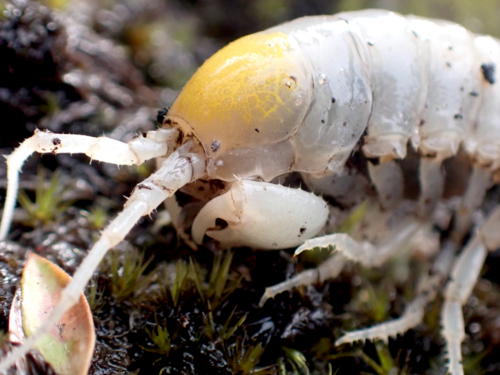
Taconic cave amphipod: Listed as endangered in Massachusetts. The karst habitat where it is found is uncommon in Massachusetts. It’s only known from one site in the karst terrain of the Taconic Mountains. It has been collected from only two other sites in the northern Taconic Mountains, one in Vermont and one in New York.
Adults are present year-round and reproductive females have been found in winter, spring, and fall.
Freshwater crustaceans and their habitats are best protected by safeguarding water quality. If you live next to a waterbody, preserve or create a native vegetation buffer zone along its border. Don’t use herbicides, pesticides, and fertilizers on your lawn. Replace lawn with native plants, shrubs, and trees.
Note: Some of the species listed in each state overlap, and how often the lists are updated varies — the Rhode Island list was last updated in March 2006, Massachusetts last August, and Connecticut in January 2023. For species listed as state historical — essentially extirpated — in Rhode Island, they were included in the endangered category.