
Beetle Mania: On the Hunt for Tiny Tigers
March 24, 2025
Share


Series note: The region’s collection of native species is under threat on several fronts, most notably from humanity’s shortsightedness. Humans aren’t giving the natural world the space it needs and deserves. We’re crowding out nonhuman life, which, in turn, makes nature less productive and us less healthy. Wild New England examines the animals and insects most at risk.
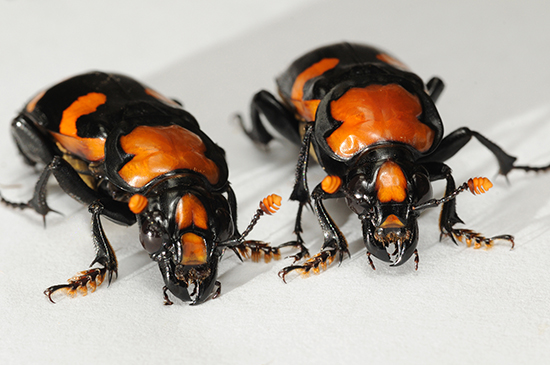
The American burying beetle, thanks to the efforts a decade ago by third-graders at St. Michael’s Country Day School in Newport, is Rhode Island’s state insect. The students’ effort helped raise awareness about this orange-spotted insect with an interesting occupation.
After sniffing out a freshly dead animal from up to 2 miles away, the beetle joins a mate in burying the carcass, stripping it of fur or feathers, rolling it into a ball, and covering it in oral and anal fluids to preserve it as a shelter and food source for the pair’s litter of larvae.
Nicrophorus americanus, the largest carrion beetle in North America, is native to at least 35 states and the southern borders of three eastern Canadian provinces.
Today, the 1- to 1.8-inch-long insect is believed to be extirpated from all but nine states, and is likely extirpated from Canada, according to the U.S. Fish & Wildlife Service. The species’ current range, however, is much larger than originally thought when the species was listed in 1989 as endangered.
Based on the past 15 years of surveys, the American burying beetle occurs in portions of Massachusetts, Arkansas, Kansas, Oklahoma, Nebraska, South Dakota, and Texas; on Block Island off the coast of Rhode Island; and in reintroduced populations on Nantucket Island off the coast of Massachusetts and in Ohio and southwest Missouri.
The species was federally reclassified in 2020 from endangered to threatened.
The American burying beetle isn’t the only invertebrate of its kind facing a suspect future. Thirteen tiger beetle species are listed in southern New England.
For instance, the total population of Puritan tiger beetles, a medium-sized terrestrial species, in New England is less than 1,000 and about 99% of the remaining population is found only in Connecticut, according to that state’s Department of Energy & Environmental Protection.
Historically, this tiger beetle species inhabited scattered localities along rivers in Massachusetts, Connecticut, and New Hampshire and on the shores of Chesapeake Bay in Maryland. It’s now found at only a few locations along rivers in Massachusetts and Connecticut, a 26-mile stretch of the Chesapeake Bay shoreline, and one additional site in Kent County, Md.
Puritan tiger beetle populations, like other beach tiger beetles, are limited by the availability of sandy beach habitat. Some historical sites where this beetle occurred have been lost to bank stabilization around cities and by habitat loss due to flooding behind dams. At least one site, in Massachusetts, appears to be threatened by heavy recreational use.
They are long-legged predators who hunt by running along the sand, capturing small insects in their sharp, toothed jaws. In turn, they are preyed upon by dragonflies and robber flies. Their markings and color are cryptic, making them difficult to spot if they aren’t moving. Their larvae, in contrast, are somewhat like thin white caterpillars and are sit-and-wait predators. They almost never emerge from their burrows.
The species depends on areas that are disturbed enough to remain relatively open and free of plant cover, but not so disturbed that they wash away. Their habitat can be covered by floods in almost any month of the year, and larvae often spend a month or more underwater during spring floods.
Although some other tiger beetles take only a year to develop, the Puritan tiger beetle takes two years, running the risk of being washed away by two successive years of spring floods.
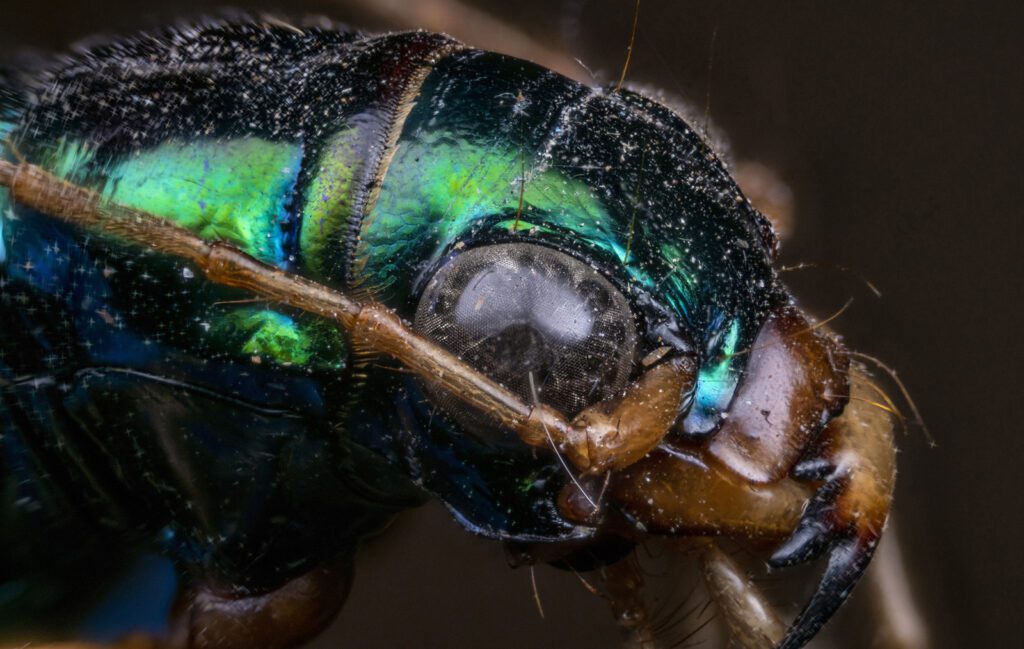
There are some 2,600 species of tiger beetles worldwide. They get their name from the voracious eating habits of both larvae and adults. Tiger beetles usually have large eyes for spotting and tracking prey, long, slender legs that make them fast, and large curved mandibles to catch and hold prey that is sometimes larger than they are, but they mostly feed on flies and ants. Their larvae live in burrows that can be several feet deep.
“There’s the stripes and then there’s the fact that they have these fierce jaws. And they pounce on stuff,” David Gregg, executive director of the Rhode Island Natural History Survey, said. “Like, when you’re out watching them hunt, they run up to stuff and pounce on it.”
Tiger beetles prefer habitats where they can run and fly in short bursts unobstructed by vegetation. They are often found on sandy surfaces along ocean and lake shores, on sand dunes, and on clay banks or woodland paths.
Many species are in decline and several are listed as endangered or threatened under the Endangered Species Act, according to the Xerces Society for Invertebrate Conservation.
In Rhode Island there are 14 known native species of tiger beetles, according to Gregg. He noted two, the northeast beach tiger beetle and the patterned green tiger beetle, “haven’t been seen in at least 50 years and are probably gone.”
“Tiger beetles are totally cool. That’s why people likely got interested in them,” Gregg said. “First of all, they’re out in the daytime … a lot of beetles are nocturnal. Throughout the daytime, they’re active. They’re running around in the open.”
Since tiger beetles — they are, on average, about a half-inch in length — are of interest to collectors and nature watchers, he noted there is more information about them and their whereabouts.
“There are probably other groups of beetles that are also in trouble,” Gregg said. “But because they haven’t attracted collector interest, we actually have no idea.”
Beach tiger beetles are being threatened by habit loss, sea level rise, and shoreline driving, according to Gregg.
“Driving on the beach is tough on things that live on the beach. The reason it’s particularly bad for tiger beetles is the larva and the adult, during certain seasons, are buried in the sand, and they’re buried at a certain height above the tide,” he said. “So on a beach that’s a strip that might only be a foot or two wide. And if you were to drive with one wheel in that exact distance from the water, which is actually probably pretty likely, you could actually drive over the entire population of tiger beetles in one pass.
“The larva live in tunnels in the sand. I mean, it’s pretty hard to tunnel in sand. It’s fragile. Just stepping anywhere near it could collapse the tunnel. It could dig itself out, but, you know, you do that a few times and then it creates stress. It’s not being able to hunt while it’s doing that.”
Since tiger beetles are ferocious hunters they don’t automatically run away from humans, as Gregg explained.
“They’re visual predators, so they actually respond to your presence. So when you come into an area where there’s tiger beetles, like on a beach, they might just run away, but they also turn to face you. They go, they turn around to face you. They might fly five or six feet. Then they they land, and they turn around to face you.”
The following is a look at the beetles in southern New England listed as a species of concern, threatened or endangered:

American burying beetle: Listed as endangered in both Rhode Island and Massachusetts. Their habitat requirements are poorly understood. In the western portions of its range, they prefer open oak-hickory savanna forested areas with deep sandy soils and little shrub cover. They will also breed successfully in grasslands.
In Massachusetts, the species has been documented in three counties in the Connecticut River valley and in Essex, Barnstable, Dukes, and Nantucket counties. A reintroduction attempt on Penikese Island failed.
They live for about a year. Parents will cannibalize their young while they are very small, to reduce the larvae to a number that can be successfully reared on the available food. Brood size varies between 8 and 23.
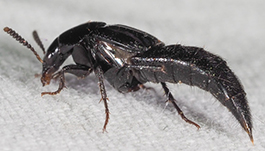
Black lordithon rove beetle: Listed as a species of concern in Rhode Island and is believed to be extirpated in Connecticut. Once thought to be widespread, but rare, throughout the eastern United States and southeastern Canada. Now ranked as historic through much of its past range.
This elongated black beetle has a broad, convex body and a pointed abdomen often bordered by long hairs. Little is known about this species, but maintaining large tracts of late successional or old growth forest habitat would likely prove beneficial.
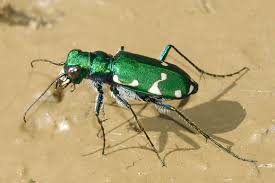
Barrens tiger beetle: Listed as state historic in Rhode Island — last observed there in 1921 — and endangered in Massachusetts. This species has a 2-year life cycle. Adult beetles emerge in late August and September, entering diapause by October and overwintering. The adults are active again from late April through early June, when they mate and females lay eggs. Eggs hatch soon after they are laid, and larvae feed until the fall, spending the first winter in larval diapause.
In Massachusetts, this species is only known to occur in Plymouth County. This beetle occurs in sparsely vegetated openings in pitch pine-scrub oak barrens. This species requires patches of bare sand, where adult beetles forage and mate and where larval beetles construct burrows and capture prey.
The species’ survival is threatened by habitat loss and suppression of fire, which is needed to maintain the open vegetation structure of its habitat. Off-road vehicles kill adult beetles and larvae by crushing them, as well as cause extensive habitat damage by rutting consolidated sand, rendering it unsuitable for larval burrows. Aerial insecticide spraying is a potential threat.
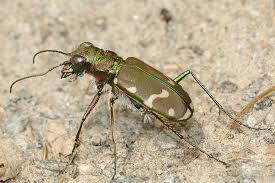
Claybank tiger beetle: Listed as a species of concern in Rhode Island and threatened in Massachusetts. This beetle inhabits sparsely vegetated clay and till banks and cliffs. Larval burrows occur in sloping banks of clay soils. In Massachusetts, this beetle occurs on morainal deposits of the offshore islands, on eroding cliffs, and adjacent beaches.
This beetle has a 2- to 3-year life cycle. Adult beetles emerge in late summer or early fall, overwinter, and are active in spring and early summer, when mating and egg laying occur.
The species is threatened by loss and alteration of its habitat as a result of bank, bluff, and cliff stabilization. Other potential threats include off-road vehicles and insecticide spraying.
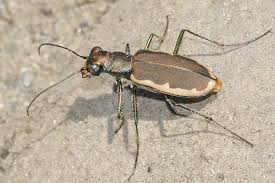
Cobblestone tiger beetle: Listed as endangered in Massachusetts. This beetle is a summer species. In Massachusetts, adults emerge in July. They forage, mate, and the females lay eggs during July and August. It is only known to occur at a single site in Franklin County.
The species is threatened by hydrologic alteration that disrupts natural seasonal flooding and deposition of cobble and sand in its habitat. Other potential threats include invasion by exotic plants, eutrophication or other water pollution, river bank stabilization, aerial insecticide spraying, and off-road vehicles.
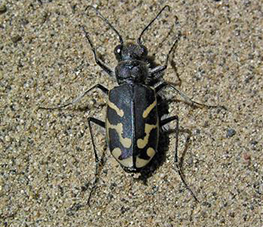
Dark-bellied tiger beetle (also known as the oblique-lined tiger beetle): Listed as threatened in Rhode Island. A generalist species that ranges widely across much of North America.
This species can be found in a large range of sparsely vegetated, open or semi-open habitats, including, but not limited to, old sandpits, trails, abandoned quarries, sandy roads, and pine barrens.
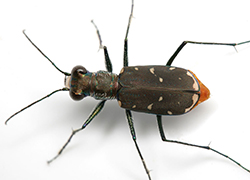
Eastern red-bellied tiger beetle: Listed as a species of concern in Rhode Island. This beetle is active as an adult in summer into autumn, and is generally found in upland regions away from the immediate vicinity of water. It can be found in a variety of habitats, including trails, dirt roads, open patches with small rocks or gravel, dry clay slopes, and other similar habitats with sparse vegetation.
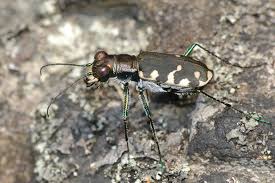
Hentz’s red-bellied tiger beetle: Listed as threatened in Massachusetts. This species is restricted to bedrock outcrops in the hills around Boston and extending along the North Shore to Gloucester. Inhabits sparsely vegetated bedrock outcrops, often of granite composition.
This beetle is a summer species with a 1-year life cycle. Adult beetles are active in July and August, during which time they forage, mate, and the females lay eggs.
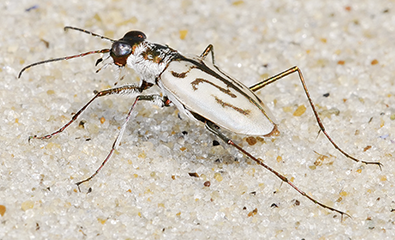
Northeastern beach tiger beetle: Listed as state historic in Rhode Island — last observed there in 1978 — and endangered in Massachusetts. This beetle is a coastal species that inhabits large, exposed ocean beaches with fine sand and a low intensity of human disturbance.
In Massachusetts, high-quality habitat consists of wide beaches with a well-developed and dynamic dune system. The species is currently occurring at only three sites in the state — one site is the result of a reintroduction project by the U.S. Fish & Wildlife Service and the Massachusetts Division of Fisheries & Wildlife. This species formerly inhabited other beaches on Cape Cod and the offshore islands, but it hasn’t been found at any of these sites for many years.
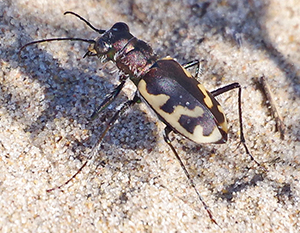
Pine barrens tiger beetle (also known as eastern or big sand tiger beetle): Listed as threatened in Rhode Island. This species occurs exclusively in inland sand flats and barrens. Although this species has been known from about 10 sites in Rhode Island, some populations have disappeared or are extremely threatened.
Except for one large population in the Big River Management Area, sites tend to contain only a few individuals. Most of the recent localities for this species occur on state-managed lands and other preserves. However, many of these sites have been degraded because of trampling by off-road vehicles.
There are few places where this species could be considered secure. One is the Nockum Hill area of Barrington, where the habitat is maintained for the benefit of nesting turtles and vehicular traffic is prohibited. A Nature Conservancy preserve in North Kingstown has an intact inland sand flat that isn’t often visited by humans.

Puritan tiger beetle: Listed as endangered in both Massachusetts and Connecticut. Their populations are limited by the availability of sandy beach habitat along rivers. Some historical sites where beetles occurred have been lost to bank stabilization around cities and by habitat loss due to flooding behind dams.
In Connecticut, this beetle was collected in several towns from Middletown to the Massachusetts border in the late 1800s and early 1900s. Presently, they are found at a single cluster of three small sites.
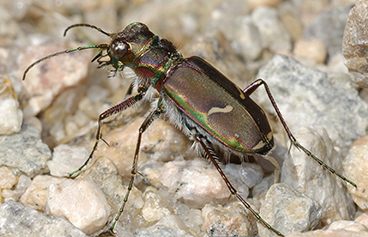
Purple tiger beetle: Listed as a species of concern in both Rhode Island and Massachusetts. This species inhabits areas of sandplain soils — or less often, sandy clay soils — with sparse or patchy vegetative cover, particularly sandplain grasslands and heathlands, as well as pitch pine-scrub oak barrens.
In Massachusetts, this beetle occurs primarily in the southeastern part of the state. Historically, the species occurred at more than 50 localities throughout the state. Its decline is probably a result of its previous affinity for disappearing agricultural habitats.
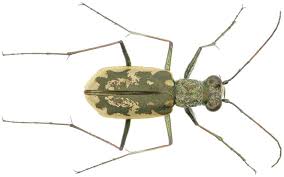
Salt marsh tiger beetle: Listed as threatened in Rhode Island. This species has a narrow coastal distribution, as its habitat is specialized and vulnerable.
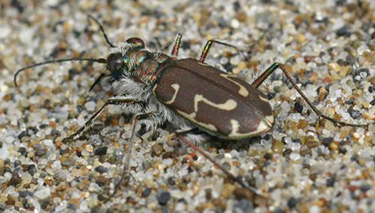
Seabeach tiger beetle (also known as hairy-necked tiger beetle or moustached tiger beetle): Listed as threatened in Rhode Island. This species is commonly found on sand bars and along sandy beaches of North America, but its population is in decline.
Physical disturbance of its sandy beach habitat, particularly by human activity such as off-road vehicles is a major threat. In additional to physical disturbances, it has a narrow range of moisture tolerance that make it susceptible to droughts, pollution, pesticides, river damming, and other shoreline modification by humans.
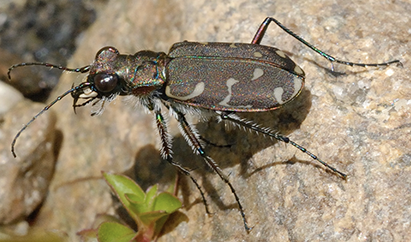
Twelve-spotted tiger beetle: Listed as a species of concern in Massachusetts. This beetle prefers open areas with silty or sandy soil, typically in or near wetlands, particularly stream and river banks and lake and pond shores. Adult beetles may be found in anthropogenic habitats such as old sand pits and sand roads.
This species occurs throughout most of mainland Massachusetts, although there are no recent records from the northeastern part of the state or more southeast than the town of Hanson.
Note: Some of the species listed in each state overlap, and how often the lists are updated varies — the Rhode Island list was last updated in March 2006, Massachusetts last August, and Connecticut in January 2023. For species listed as state historical — essentially extirpated — in Rhode Island, they were included in the endangered category.
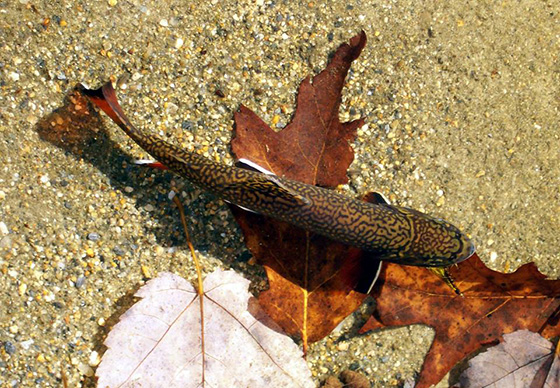

Great article but I wanted to point out that the species pictured and labeled as American burying beetles are not ABB’s. This will mislead people into thinking they see them all the time. I get calls all the time already seeing I have worked with the species for three decades. I was sad to not see any mention of the Roger Williams Park Zoo’s 30-year breeding and reintroduction program for the ABB on Nantucket Island. We would have been happy to provide you with photos of actual ABB’s.
Thanks for writing this article. I love the recent stories highlighting our natural heritage and rich diversity. Keep it up.