Bee Careful When Conducting Spring Cleanups
Leaves and stems are prime pollinator habitat
March 29, 2026
Share


For some, longer daylight hours, warming temperatures, and early blooming flowers are the signs that winter is over, but the sight of one special species of pollinator marks the true beginning of spring.
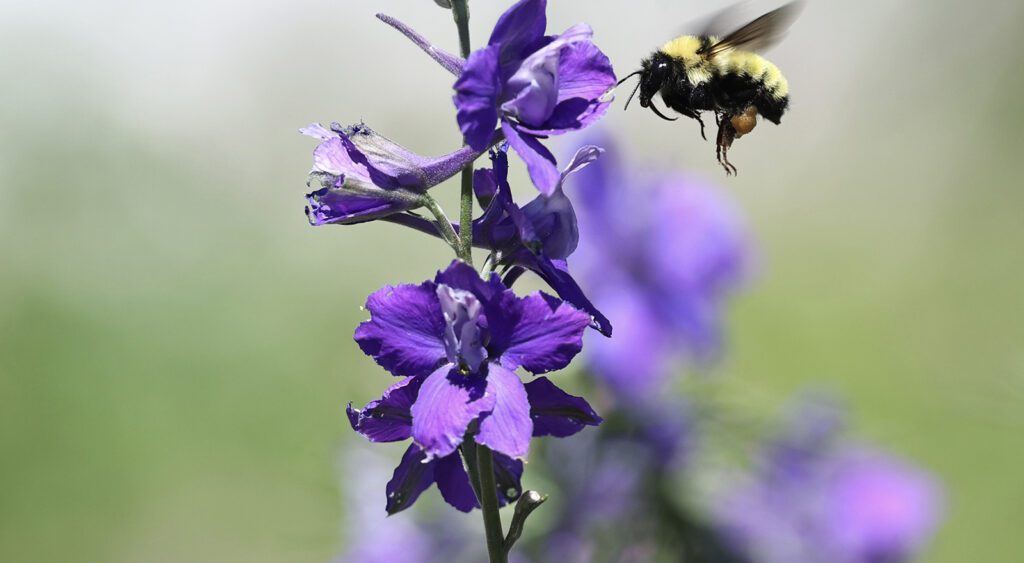
Colletes inaequalis, commonly known as cellophane bees, are the true harbingers of spring. These docile plasterer bees emerge from their underground nests as early as mid-March, making it one of the earliest pollinators and bees to emerge from wintertime hibernation in the Northeast.
Until around mid-April, female cellophane bees will venture out from their nests to collect all the nectar and pollen they need. The pollen is protein and food for her young brood; the nectar is energy for the female to keep going.
Cellophane bees are generalists, meaning they aren’t too choosy with the flowers, shrubs, and budding trees they visit for pollen and nectar. Casey Johnson, a scientist at the University of Rhode Island’s Bee Lab, said they prefer red maples, but will also visit willow trees and crocuses that are starting to bloom.
“A lot of bees are cryptic and hard to determine for most people,” Johnson told ecoRI News in a recent interview. “You can tell them apart from a honey bee, but they’re round, and big and fluffy. Cellophane bees are a bit smaller than honey bees.”
Johnson has worked in some capacity in the Bee Lab for seven years, starting as an undergraduate before receiving her master’s degree from URI in 2022. She had always been interested in biology, and when she started attending URI her real interest was studying whales. It took one entomology class to switch from the largest mammals to some of the tiniest insects.
This species gets its name from the cellophane-like substance the bees secrete, coating their brood cells with a lining that keeps out moisture and fungus.
The brood cells in their nest are underground, up to 2 feet deep, although Johnson said they’re typically between 8 and 12 inches, shallow enough for most people to not realize they’ve disturbed a nest if they’re tilling soil. Underground nests aren’t uncommon with Rhode Island’s bees, about 70% of bee species nest underground.
“A female will lay 20 to 30 eggs in one lifetime, and then die,” Johnson said. “So they only live for a couple weeks to really produce the next generation of pollinators, and in this region they only have one generation a year.”
Their status as the early risers of spring and their short life cycle are probably the reasons these insects aren’t better known. Cellophane bees are only active one month out of the year, the other 11 months they’re hibernating or overwintering underground.
As pollinators, bees are a keystone species for the Ocean State’s environment. Some 90% of all plants require an animal, like birds or bats, or insects to transfer pollen. Pollinators also account for fertilization of 35% of all crop production worldwide.
Pollinators, especially bees, have driven large numbers of headlines in recent decades. In the mid-2000s, colony collapse disorder, where worker honeybees fled their hives and nests in huge numbers for reasons we still don’t understand, peaked in 2008.
“That whole thing was, these insects are much more sensitive than we originally thought,” explained Toby Shaya, a state entomologist with the Department of Environmental Management.
Shaya was part of the team that worked on the state’s inaugural Bumble Bee Survey, which DEM released earlier this month. The survey catalogs all the bee species, historical and current, observed in Rhode Island by naturalists and the public. The exact estimate of bee species is around 285 different species of bee, with around 250 still around today.
The results are among the first published reports for DEM’s first statewide Pollinator Atlas, which seeks to study all observed pollinators found in Rhode Island. The intention was to begin with bees and move on to wasps, flies, butterflies, and other pollinators. As part of the effort, DEM currently has an ongoing survey for wild bee species.
The Bumble Bee Survey itself was a big undertaking. Since 2021, when the project launched, 46 volunteers across 67 sites statewide recorded 6,200 observations of Rhode Island’s bees. The state was divided into a 165-grid system, adopted from the state’s Breeding Bird Atlas.
Volunteers would choose one of the grids to survey once a month, from April to October, and take training to teach them how to identify bumble bees. The observations range from 2022 to the end of 2025, but Shaya said, thanks to the URI Bee Lab, they have data from 2019 to 2022 as well included in the report.
“Bees are quite diverse,” Shaya said. “And as wonderful as these insects are, these species are threatened by decline. There may be, of the species we have observed, maybe three species have potentially increased populations compared to the past.”
Habitat loss and climate change are among the greatest threats facing all species of Rhode Island bees today.
In order to thrive, native bees need native plants — trees, flowers, and shrubs — to be able to gather enough pollen and nectar.
Bumble bees and cellophane bees are both generalists and aren’t particularly choosy when it comes to what native plantings to pollinate. But while generalists, they can show some preferences. The brown-belted bumble bee, for example, prefer milkweed.
About a quarter of all bee species observed in Rhode Island are specialist bees, meaning they have specific preferences to what plantings they want to pollinate. Take cold miner bees for example. They are another early spring riser and prefer willows.
Despite the challengers, bees are also pretty hardy. Planting a pollinator garden using native plantings attractive to the insects, even in the middle of a concrete jungle, will still attract “a lot of really cool bees,” Shaya said.
“You have that power,” Shaya added. “When you lose that habitat, you lose both the foraging resources as much as the nesting resources. It’s not just bumble bees and other pollinators at risk, you lose so many other things.”
The big things people can do for bees, said Johnson, centers around planting a diverse selection of native plants. Shrubs and trees especially; they both flower early in spring, and are often overlooked as an essential planting for pollinators.
Minimizing chemicals and pesticides are another key way residents can help bees. The chemicals found in mosquito sprays, said Johnson, should especially be avoided; they just kill everything. Avoiding spring cleanups and removing leaves and especially stems, which provide good nesting habitats for bees.
“I think educating other people is a really big thing,” Johnson said. “Talk with your neighbors, letting them know what you’re doing, and what you learned about bees and pollinators. Have a little conversation with people to get them to start thinking about things.”