
Bird Watching with Side of Humor Served Every Other Sunday Morning
April 21, 2025
Share


Series note: The region’s collection of native species is under threat on several fronts, most notably from humanity’s shortsightedness. Humans aren’t giving the natural world the space it needs and deserves. We’re crowding out nonhuman life, which, in turn, makes nature less productive and us less healthy. Wild New England examines the animals and insects most at risk.
MIDDLETOWN, R.I. — Much is known about southern New England’s bird populations, especially those in trouble, by the work of a variety of professionals, birders, amateur and otherwise, volunteers, and observers of backyard bird feeders.
David Gregg of the Rhode Island Natural History Survey; Steven Reinert and Deirdre Robinson, co-directors of the Saltmarsh Sparrow Research Initiative; ornithologists Charles Clarkson of the Audubon Society of Rhode Island and Peter Paton at the University of Rhode Island; Lauren Parmelee, senior director of education at Audubon; and current and former state Department of Environmental Management wildlife experts such as Jason Osenkowski, Chris Raithel, and Rick Enser have stayed up late to listen for owls and have trudged through wetlands, hiked forests, walked along the coast, and hung out in fields looking and listening for birds.
Then there is Jay Manning, the affable assistant director for conservation at the Norman Bird Sanctuary and past president of the nonprofit’s board of directors. I hesitate to call the engineer and former head of DEM’s Clean Water State Revolving Fund an amateur, but he’s the first to admit he’s neither a scientist nor a biologist.
Manning, though, has been leading a free guided bird walk at the Norman Bird Sanctuary every other Sunday morning for the past 30 years. The next one is scheduled for April 27.
He shared an amusing story on how he got the non-paying gig.
“I went to summer camp here, did service projects here during my high school and college years and, after I drifted away, I came back, moved back to Aquidneck Island and saw an advertisement for a free bird walk,” Manning recalled. “I wanted to reconnect with my old place. It was kind of funny. The executive director at the time was leading the walk and he wasn’t a birder. He goes, ‘I think that looks like and there’s a blah, blah, blah.’ I’m like, ‘Well, if you look closer, I think it’s really,’ and so after a few times, he’s like, ‘OK, so we have this tag team going.’ I would identify and then he would talk about the natural history of it, and then it dawned on him. He’s like, ‘I’m here five days a week. I’m coming in on Sunday. Why am I here? This idiot will do it for fun.’”
Manning’s great sense of humor and storytelling skill spilled over during a recent conversation in his sightly flooded office — mechanical, not environmental, and not the engineer’s fault. He had an amusing story for just about every bird species he was asked about. But don’t let his playful ways fool you into thinking he doesn’t know what he’s talking about.
He noted about 20 warbler species pass through Rhode Island annually.
“Most of them are here in May, and then move on to their breeding grounds in northern New England and Canada in the boreal [forest] belt,” Manning said. “A fraction of what passes through actually stays to breed.”
Warblers and many other bird species pass through Rhode Island again from late August into September and October on their way back south. He noted the fall migration isn’t as concentrated, as arrivals are more spread out.
He said May is prime bird-watching time in the Ocean State, and not just for warblers.
“It’s like the Super Bowl, the World Series, March Madness, Kentucky Derby, NHL playoffs, the Masters, all at once,” said Manning, noting it can be overstimulating for some. “It’s the toughest time if you’re going to begin birding, because there’s so many birds. They’re all singing. They get overwhelmed. I joke that they throw their binoculars down and pick up golf clubs.
“There’s a lot of humor in my bird walks. It’s not a classic, dry, esoteric bird walk. I’m not a scientist, so I make fun of scientists.”
The 64-year-old may playfully poke fun during a conversation with a reporter, but the Middletown native seriously learned a lot from Raithel, Enser, and other scientists, plus wildlife educator Parmelee and other amateur birders.
In 1985, he and Enser recorded the first sighting of a red-bellied woodpecker in Rhode Island, spotting a nest behind the Yawgoo Valley Apartments in Exeter. In the late 1980s or early ’90s, the duo spotted a rare visit from a golden eagle, on a stump in Sisson Pond in Portsmouth “eating something.”

Manning’s interest in birds began as a kid on his father’s sailboat.
“One day, I said, there’s got to be more than just a seagull. And so I went to the library and took out a bird book and found out, yes, there are a lot of gulls,” he said about his birding beginnings.
Frequent attendees of Manning’s Sunday morning bird walks have learned not to use the “S-word” in his presence. When someone blurts out seagull or points to a gull and calls it the S-word, Manning is quick to hand them the bird book he carries with him.
“I give them the bird book and tell them find me a seagull,” he said with a laugh. “There are no seagulls. They’re gulls. There’s no one bird called a seagull.”
He then proceeded to rattle off the species that can be found in Rhode Island: great black-backed gull, the largest gull species in North America; the American herring gull; Bonaparte’s gull; black-headed gull, a European species; white-winged gull; Iceland gull; glaucous gull, the second-biggest gull in the world; and laughing gulls. (No gull species is state-listed in southern New England.)
Despite his early curiosity about gulls, his favorite birds are the American barn owl and the prothonotary warbler.
“They’re both rare in Rhode Island,” Manning said. “The barn owl has the scariest call, I think, in the bird kingdom. The prothonotary warbler is kind of a really neat orange-juice yellow.”
It took a while, but Manning, after a 38-year career at DEM, became a paid Norman Bird Sanctuary employee in 2022.
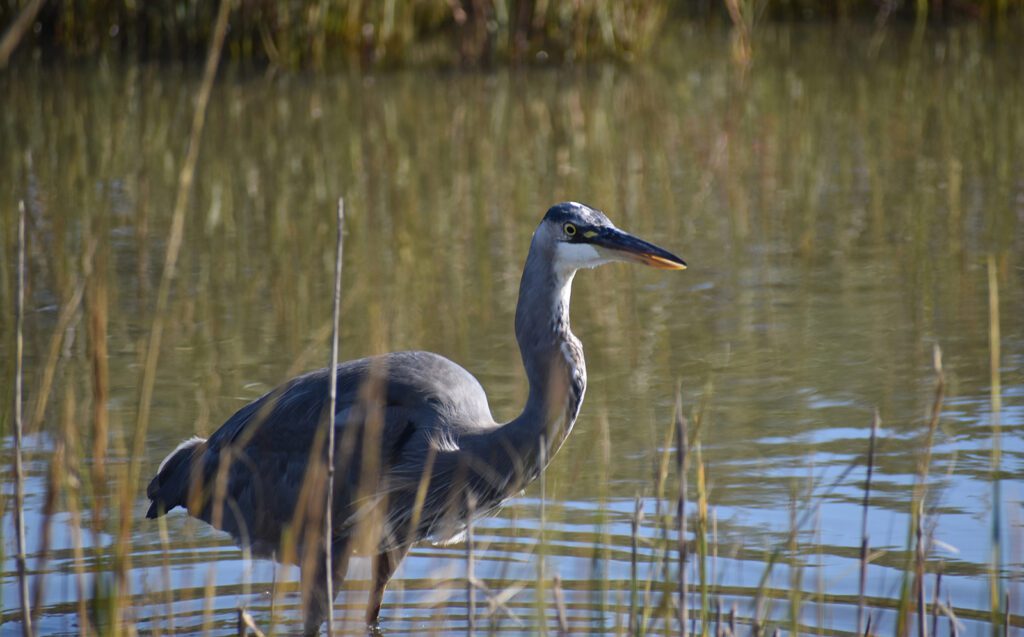
The following is a look at the herons in southern New England listed as a species of concern, threatened or endangered:
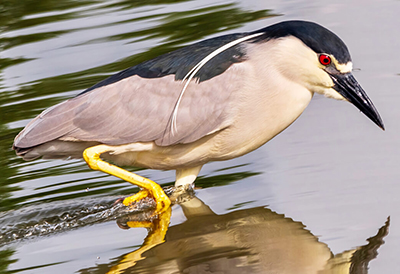
Black-crowned night heron: Listed as a species of concern in Rhode Island. These birds range in length from 23-28 inches. When seen during the day, these herons are usually inactive, with a hunched posture. At dusk, they fly to their feeding areas.
Their preferred habitats include salt marshes and tidal flats, fresh and brackish marshes, ponds, and creeks. They are primarily foragers of small fish, amphibians, crabs and other crustaceans, and insects.
For decades, the species suffered from a combination of bioaccumulated pesticides and the extermination of its untidy rookeries by humans, according to Mass Audubon. Even though these pressures may have lessened, this heron remains local and rarely encountered as a breeding species.
Threats include human disturbance at nesting colonies; destruction of woody vegetation used for nesting; and coastal development that degrades or destroys nesting, roosting or feeding habitat.
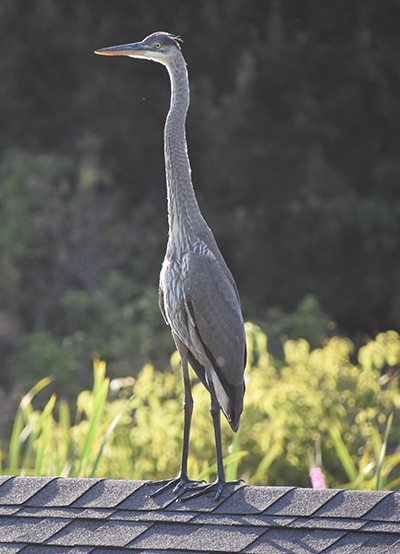
Great blue heron: Listed as a species of concern in Rhode Island. This species is one of the most familiar wading birds in North America. It’s also the largest heron in North America, standing close to 5 feet tall, with a wingspan of up to 6.5 feet. They eat whatever they can catch with their formidable bills — fish, crustaceans, reptiles, amphibians, small mammals, and birds, especially ducklings. They usually forage alone, locating food by sight.
They can be found in saltwater and freshwater habitats, from open coasts, marshes, sloughs, riverbanks, and lakes to backyard goldfish ponds. They also forage in grasslands and agricultural fields. Breeding birds gather in colonies to build stick nests high off the ground.
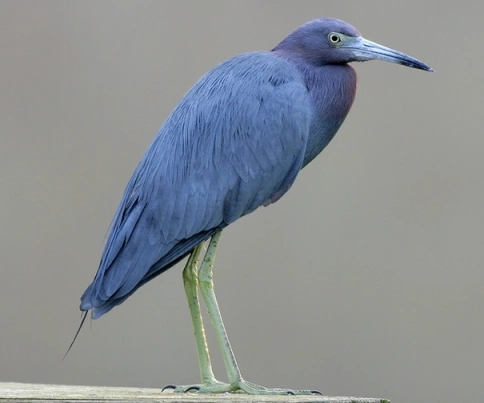
Little blue heron: Listed as a species of concern in Rhode Island. This bird is a fairly small heron with a slight body, slender neck, and fairly long legs. It has rounded wings, and a long, straight, spearlike bill that is thick at the base. Adults are dark all over. At close range or in good light, they have a rich purple-maroon head and neck and dark slate-blue body. They have yellow eyes, greenish legs, and a bill that is pale blue at the base and black at the tip. Juveniles are mostly entirely white.
They are stand-and-wait predators. They watch the water for fish and other small morsels, changing locations by walking slowly or by flying to a completely different site. They nest in trees, usually among other nesting herons and wading birds. Look for them on quiet waters ranging from tidal flats and estuaries to streams, swamps, and flooded fields.
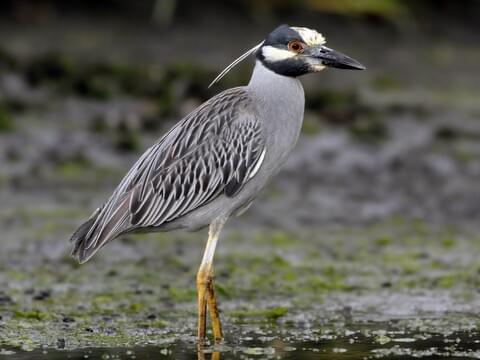
Yellow-crowned night heron: Listed as a species of concern in Rhode Island. They are fairly small herons with stocky bodies and short, thick necks, and short legs. They have large, blocky heads with thick, relatively short bills. Adults are cloudy gray with a bold face pattern — a black head with large white cheek patch, a creamy yellow crown, and head plumes. Juveniles are brown with fine white spots on their back and wings. Their legs are orange-yellow, brighter in adults.
They slowly stalk prey in or near shallow water, usually alone, with a hunched, forward-leaning posture. They perch quietly on stumps and tree branches, often over water. Most of their prey is crustaceans, especially crabs and crayfish. They are most common in coastal wetlands, barrier islands, salt marshes, drainage ditches, and mangroves.
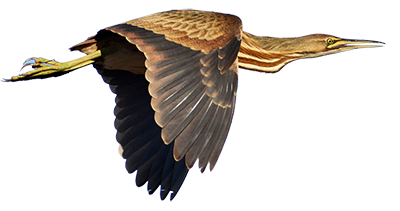
American bittern: Listed as endangered in Rhode Island, Massachusetts, and Connecticut. They spend most of their time hidden among marshland vegetation. They walk slowly and stealthily. When startled, they assume what is perhaps the species’ most characteristic stance: standing frozen with their bills pointed skywards to camouflage themselves among the reeds, occasionally swaying from side to side with the vegetation as if blown by the wind.
They feed in marshes, meadows, and along edges of shallow ponds, standing motionless with their neck outstretched and level bill, eyes focused down, slowly aiming their bills before suddenly darting downward to seize prey. Preferred foods include frogs, small snakes and eels, salamanders, crayfish, fish, and occasionally mice and grasshoppers caught on visits to open fields.
The primary reason for their decline in southern New England and across their range is loss of habitat. Many of the marshes and swamps upon which this species depends have been drained and filled for a variety of human uses, including roadways, housing, and other development.
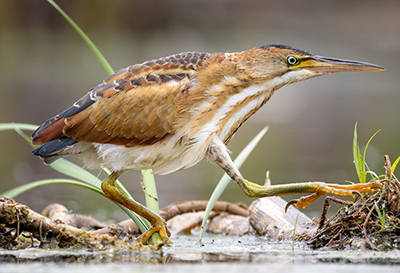
Least bittern: Listed as threatened in both Rhode Island and Connecticut and endangered in Massachusetts. They generally arrive at nesting areas in the Bay State by mid- to late May, and pairs form soon after. They inhabit freshwater and brackish marshes with dense, tall vegetation, particularly cattails, sedges, bulrush, and arrowhead, and interspersed with clumps of woody vegetation and substantial areas of open water.
Both adults and chicks are vulnerable to predation by various mammalian, avian, and reptilian predators including raptors, crows, raccoons, mink, snakes, snapping turtles, and bullfrogs. They seem tolerant of human presence, and may persist in highly urbanized areas. But this secretive bird has been adversely impacted by the draining and filling of wetlands.
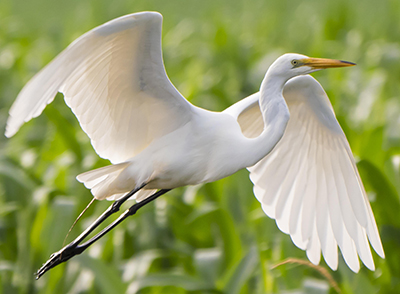
Great egret: Listed as a species of concern in Rhode Island and threatened in Connecticut. They are also called the American egret, the common egret, the great white egret, and angel bird. They prefer freshwater and saltwater marshes, streams, ponds, lakes, and mud flats. In Connecticut, they typically nest on uninhabited offshore islands in Long Island Sound. They don’t feed at night like some other heron species. They either forage alone or in mixed flocks, often by slowly walking in shallow water.
This bird was a rare Connecticut visitor by the mid-1800s due, in large part, to hunting. Protective legislation passed in the early 1900s helped populations stabilize. By the 1920s, this species was increasingly seen along the Connecticut coastline during migration. In the 1940s, they were regular coastal visitors and were even spotted in the Waterbury and Hartford areas.
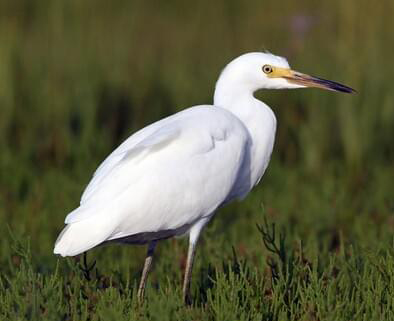
Snowy egret: Listed as a species of concern in Rhode Island and threatened in Connecticut. They can be found in marshes, swamps, ponds, lakes, shallow coastal areas, tidal flats, and, occasionally, in fields. They prey upon fish, shrimp, crayfish, fiddler crabs, snakes, snails, aquatic and terrestrial insects, small lizards, young frogs, and aquatic vegetation.
While feeding in shallow areas of ponds and marshes, they use one foot to stir up the bottom, flushing prey into view.
This species was once a common nester in Connecticut. Widespread killing of these birds for the millinery trade nearly caused the species to be extirpated from the state by the late 1800s. Since the establishment of protective laws, which put an end to the plume trade, the population has been slowly recovering.
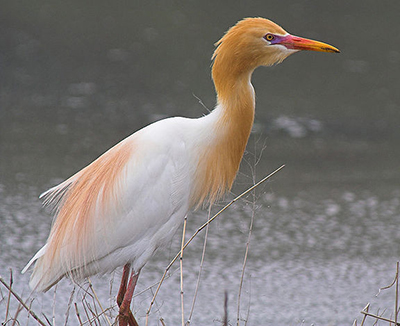
Cattle egret: Listed as a species of concern in Rhode Island. These birds are thought to have arrived in North America from the floodplains of Africa. Agricultural practices such as irrigation and livestock grazing have been beneficial to this species, and they have expanded worldwide.
The first cattle egret positively identified in Massachusetts appeared in Wayland on April 23, 1952. Unlike those of several other heron and egret species, the arrival of this bird wasn’t one by a species on the edge of its range. This species had already made a transoceanic journey from Africa.
Note: Some of the species listed in each state overlap, and how often the lists are updated varies — the Rhode Island list was last updated in March 2006, Massachusetts last August, and Connecticut in January 2023. For species listed as state historical — essentially extirpated — in Rhode Island, they were included in the endangered category.
Does this mean the Green heron, one of my favorites, is not a species of concern? There was a family that raised two youngsters on my local pond last summer in providence
Frank, so glad you found Jay Manning and given him some long-deserved recognition as not just a bird watcher, but a bird whisperer. The team of Manning, Raithel, and Enser spent 25+ years doing the Newport Christmas Bird Count, exclusively in Middletown where old barns provided shelter for the Barn Owls. Jay’s birding humor is partially an amalgamation of the three of us, as we pursued together certain objectives. Like finding the most species of owls. One year we found eight: Barn, Great-horned, Barred, Saw-whet, Long-eared, Northen-screech, Short-eared, and Snowy, all within the town of Middletown.
Good to see Jay has found his true calling, and he looks pretty good with the beard too.