Wild Idea: Collect and Grow Native Seeds
October 29, 2025
Share


EAST GREENWICH, R.I. — Spring 2020 was a difficult time all around, but attempting to enter the real world after just graduating from college was particularly challenging.
Lizzie Hunt, who graduated that May from the Rhode Island School of Design with a master’s degree in landscape design, thought she had at least a stepping stone to the future as she and the rest of us buckled in to ride out the COVID-19 pandemic. She had asked RISD professor Hope Leeson to set her up volunteering for Rhody Native, which Leeson was essential in creating.
The initiative was designed to preserve the biodiversity of Rhode Island’s native plant communities and the wildlife, including pollinators, they support by providing access to native plants for use by landscapers and in habitat restoration projects.
“It was an unusual time. Offices weren’t hiring, so I was patching together work,” Hunt said. “I asked if I could volunteer and learn from her, and right when I started volunteering, that program was canceled. So she offered if I wanted to start a nursery, that she would help me learn how to seed, collect, and germinate the seeds, and go through the whole process. She’s been a really enormous support.”
Hunt sold her first native plugs out of her backyard nursery off Frenchtown Road in 2023.
Plant Community LLC sells native plants grown from locally adapted seeds. Wild seeds are sourced from the Connecticut-based Northeast Seed Collective, an initiative managed by Dina Brewster, who founded The Hickories in Ridgefield, Conn., and the Rhode Island Wild Plant Society and collected by Hunt’s own hands. The 2025 season featured 43 native plants for sale.
Hunt said it felt like this work really needed to be done and few were doing it, so once the pandemic lifted she didn’t look for a job in landscape design. Besides running her native species nursery, she also works as an adjunct professor at RISD.
“I think there’s a lot of overlap between being a designer and trialing different things and starting a new industry and having to just trial and experiment to figure out what works,” she said. “So probably both of those appealed to my brain, but also I was realizing that landscape architecture is a computer job, and I wanted to be outside. I loved working with the plants.”
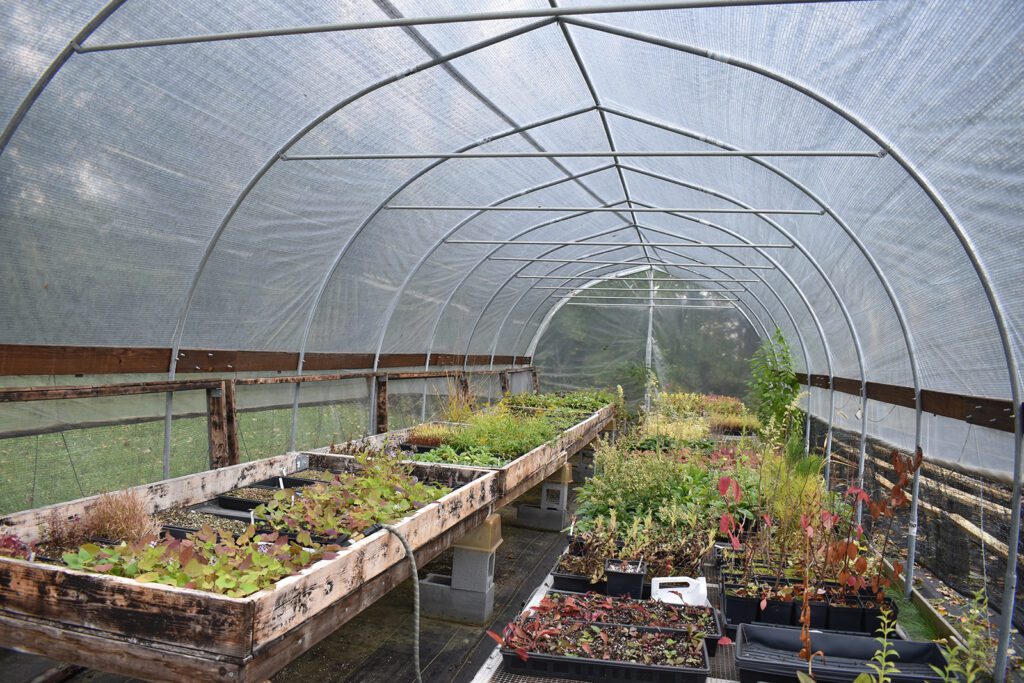
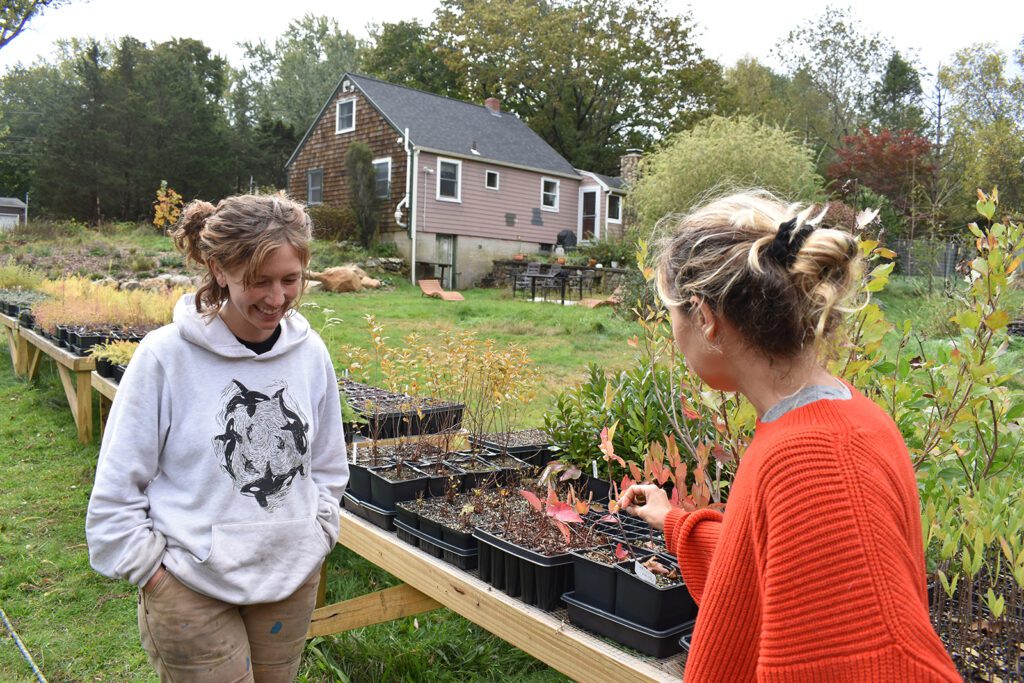
To support her new endeavor, Hunt built the nursery’s high tunnel herself by bending fence posts. Inside the homemade hoop house are waist-high tables to keep invasive jumping worms from invading native plant plugs. Hunt also built the tables to be mice-proof.
In her yard-turned-nursery there are more tables holding plugs a safe distance off the ground from the reach of jumping worms. There are gardens growing a variety of native plants. A wooden plant stand sits in the front yard, near Frenchtown Road, for pick-ups by those who bought native online.
Plant Community’s inventory, like that of the Northeast Seed Collective and the Rhode Island Wild Plant Society, features species native to EcoRegion 59, also known as the Northeastern Coastal Zone. It is one of 105 ecoregions mapped on the continental United States and includes all of Rhode Island, most of Connecticut and Massachusetts, and sections of New Hampshire, coastal Maine, and Long Island, N.Y.
Hunt and her sole employee, Annie Bayer, noted the nursery’s mission is to grow native seeds to help address the lack of locally sourced genetic diversity.
“The way that Rhody Native had functioned was just to take the seed from the wild, grow it into plugs, and then immediately get it to sale,” Hunt said. “But having a middle step where you grow out the seed into much larger numbers with such a more sustainable and abundance giving method.”
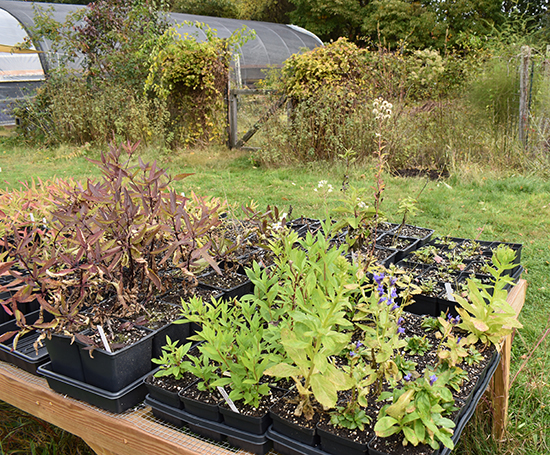
That’s the niche Plant Community is hoping to fill: ecotypic offspring of native plants to rejuvenate the local landscape.
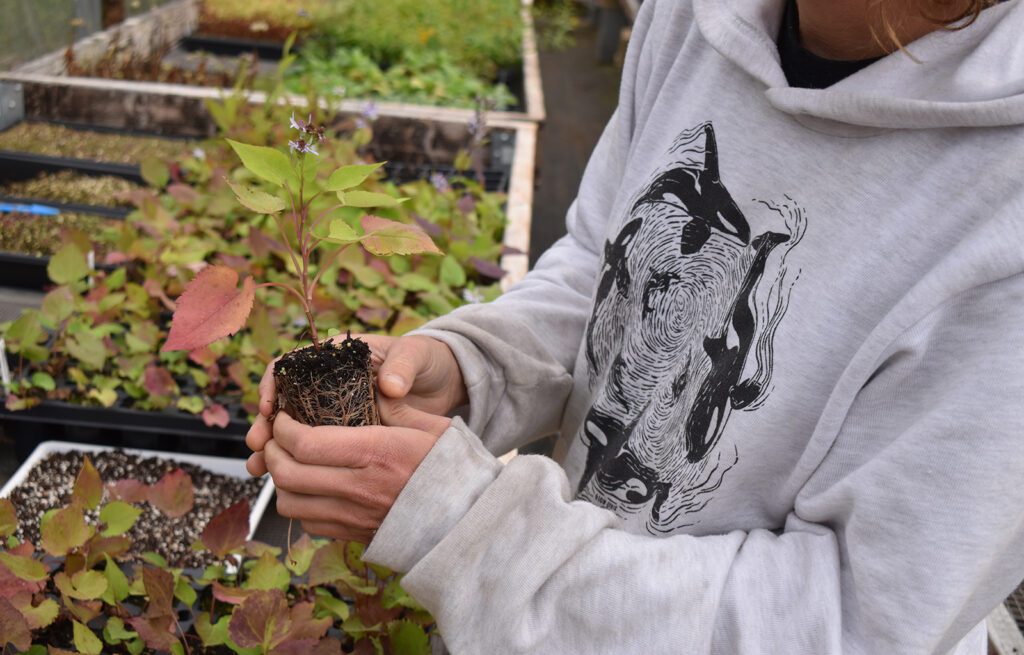
“Most of them need to be cold, stratified so they have to be moist and wet for like three months, but not eaten by a mouse,” Hunt said. “Then they will break their dormancy and germinate. That first year when things germinated, I was just like, completely hooked. It just felt so magical to see them.”
Native plants are the foundation of the entire food web that all life, including humans, relies on. They are vital host plants for many insects, including the caterpillars of butterflies and moths that feed hungry baby birds, and native pollinators.
They thrive in the soils, moisture, and weather of a particular region, which means little supplemental fertilizing is required. They typically have deeper root systems that help reduce watering needs, better manage runoff, and maintain healthy soils. They are less prone to pest problems.
The National Audubon Society says restoring native plant habitat is vital to preserving biodiversity. It has noted that during the past century humans have “taken intact, ecologically productive land and fragmented and transformed it with lawns and exotic ornamental plants.” This transformation has caused the continental United States to lose a “staggering 150 million acres of habitat and farmland.”
“The modern obsession with highly manicured ‘perfect’ lawns alone has created a green, monoculture carpet across the country that covers over 40 million acres,” according to Audubon. “The human-dominated landscape no longer supports functioning ecosystems, and the remaining isolated natural areas are not large enough to support wildlife.”
Changing the human-made landscape that doesn’t sustain biodiversity begins at home, by planting native flowers, shrubs, and trees and by creating native meadows and pollinator gardens.

Both Hunt and Bayer are 34 and are lifelong New Englanders. Hunt grew up in New Hampshire. Bayer is from Attleboro, Mass. They are both heavily involved in the Wild Plant Society’s ReSeeding Rhode Island initiative. They initially connected at a Wayland, Mass.-based Native Plant Trust event.
“We first met at the Native Plant Trust,” Hunt said. “Annie always forgets that. We were the only ones from Rhode Island. Then I started coming to Revive the Roots for some of the more community stuff. We became friends out of a love for plants.”
Bayer, who has a degree in sustainable agriculture, has been farming for the past 12 years, including plenty of time spent at Revive the Roots, a nonprofit in Smithfield. The Coventry resident is also the program coordinator for the Young Farmer Network of Rhode Island and southeastern Massachusetts.
“As a farmer and from the perspective of farmers getting involved, or even just thinking about putting something that usually is a weed to them on their farm, that’s a very new concept and new idea to people,” Bayer said. “There’s still some people that see joe-pye weed and they’re like, ‘No, get that off my property,’ even though it’s an incredible host to so many different pollinators. I feel like there’s still so much growth that can be happening educating people about the different ways that we can interact with the native plant world.”
On the mid-October day we spoke at the 2-acre nursery that surrounds a modest multicolored house, Hunt noted “now is collection time for a lot of species, though, of course, it ranges all the way through the season.”
Most of their wild seed collecting is done on land trust properties and private property. They get permission from every landowner.
“It is such a big deal to get permission to collect,” said Hunt, who is a Rhode Island Wild Plant Society board member. “To go through that process it takes a long, long time because it’s such a foreign idea to people. The first reaction is, ‘Oh, are you going to overcollect from the populations and degrade it? Everybody seems to be trying to figure it out at the same time, because there’s a lot of momentum right now around ecotypic seed.”
In a paper published in 1922, Swede Göte Turesson, based on his research of 20 species from 13 genera, coined the term “ecotype.” The evolutionary botanist noted how environmental factors, such as climate, soil, and light exposure, play significant roles in creating genetically distinct populations in a variety of plant populations. He used this new word to describe these unique populations. He defined ecotype as “an ecological unit to cover the product arising as a result of the genotypical response of an ecospecies to a particular habitat.”
Basically, Turesson considered an ecotype a population that is genetically adapted to a specific environment. In the century-plus since ecotype was introduced into scientific lexicon, new lines of research have been begun and scientists have interrogated the ecotype concept within the fields of ecology, evolution, genetics, and virology.
Hunt explained that the wild seed she and Bayer collect is germinated and grown out into plants. Those plants aren’t sold. They are put into blocks of 200 plants known as “foundation plots.”
“The general ethic right now is not to sell any plants immediately grown from the wild,” she said. “The seed from the foundation plots, which is ecotypic, can then be grown out into lots of plants at a pretty big scale, and then those can be sold.”
Plant Community’s first priority is supporting the work already being done by the Northeast Seed Collective and Reseeding Rhode Island, according to Hunt.
Both Hunt and Bayer stress the importance of being responsible purveyors of ecotypic seed. They follow the guidelines set out in the Bureau of Land Management’s Seeds of Success collection program.
“You need to be thoughtful, careful when collecting wild seed,” Hunt said.
Native plants are generally understood as those whose ancestors had roots in this region before the arrival of Europeans. These species and native wildlife adapted over the millennia to exist in harmony. The movements of pollinators allow plants to become fertilized and to produce fruits, seeds, and young plants. In turn, native plants feed native pollinators and provide habitat.
“My dream is that there will be a circular agreement where I can talk to large landowners, land trusts about the habitats that they have and come up with a relationship where I can collect a certain amount of seed and then plant back to improve the diversity of their habitats,” Hunt said. “But also to create a relationship among the landowners to share the seed, so that just the practice of collecting is building diversity and education around those spaces.”
Note: On Sunday, Nov. 9, from noon-3 p.m. a community seed exchange will be held at Tillinghast Place — better known as RISD Beach — 231 Nayatt Road in Barrington. The event is free and open to the public.