Warwick Horseshoe Crab Harvesting Operation Received Special Favor
July 27, 2026
Share


WARWICK, R.I. — George Shuster knows a thing or two about American horseshoe crabs. He has to. His grandfather was a foremost horseshoe crab scientist. Carl Shuster Jr. spent the bulk of his life, from his 20s into his 90s, studying Limulus polyphemus.
To honor Shuster Jr.’s work in the field, the Atlantic States Marine Fisheries Commission, in 2001, set aside hundreds of square miles in the Atlantic Ocean off the coasts of Delaware and New Jersey and named the area the “Carl N. Shuster Jr. Horseshoe Crab Reserve.” Harvesting these ancient creatures with 12 legs, 10 eyes, and blue blood in this area is prohibited.
Shuster is also well aware of the lengths the Ocean State will go to harvest horseshoe crabs.
A decade ago, when Gina Raimondo was governor and Janet Coit director of the Department of Environmental Management, state powers intervened with a sea-life grab. As is the state’s modus operandi, favor rules.
Shuster, an 18-year resident of River Vue Avenue, noted there was already neighborhood opposition to how the operation was conducted. Neighbors didn’t want to see it expanded.
The operation, just down the Narragansett Bay shoreline from Shuster’s home, is off a beach in the Conimicut Point neighborhood, where horseshoe crabs regularly spawn during new and full moons in May and June. The business needed a permit — aquaculture, fishing, or whatever label the state needed to put on it — for its plan.
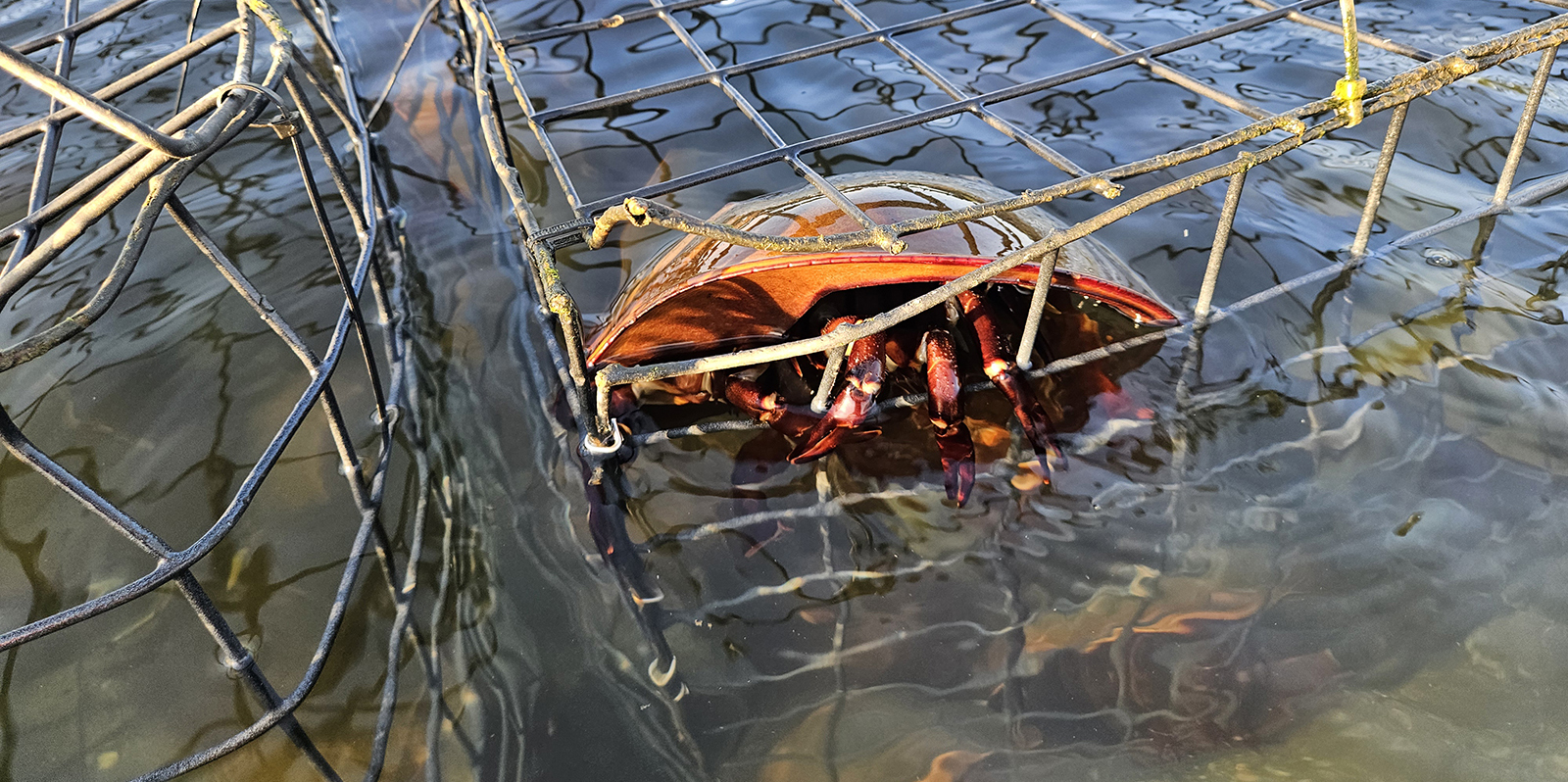
The operation uses offshore cages to store horseshoe crabs after they are caught and before they are removed to have their blood drained for medical science, or sold as bait. They are then put in trash barrels and driven away in a truck.
Shuster said the Coastal Resources Management Council had been “paying attention to all of this at the annoyance of the operator.”
Local legend has it that a politically-connected friend of the operation — the owner of a Smithfield-based construction company — called Gov. Raimondo to complain that CRMC wasn’t being business friendly. Raimondo supposedly reached out to Coit to address this unfriendly business allegation.
In a letter dated April 13, 2016, Coit told then-CRMC director Grover Fugate that horseshoe crabs were not in CRMC’s jurisdiction because they are crustaceans.
Horseshoe crabs are not crustaceans, despite what Rhode Island general law may say. Horseshoe crabs are marine arthropods that belong to the subphylum Chelicerata, making them much more closely related to arachnids such as spiders, including sea spiders, ticks, and scorpions than to crabs or lobsters.
“DEM has the exclusive authority to issue licenses for the commercial fishing of crustaceans,” Coit wrote in the five-page letter. “The statutory definition of crustaceans includes horseshoe crabs.”
She noted the operation’s horseshoe crab fishing is commercial fishing of crustaceans exclusively licensed by DEM.
“Essentially, he harvests and holds crustaceans and offers their fluid for sale,” Coit wrote. “This commercial fishing of horseshoe crabs is within the exclusive jurisdiction of DEM.”
I thought CRMC is responsible for permitting coastal infrastructure, of which offshore cages would seem to apply. Laura Dwyer, CRMC’s public educator and information coordinator, corrected me.
“We do not permit fishing activities, so you’d have to check with DEM regarding a permit,” she wrote in an email. She noted DEM ruled this Warwick operation is fishing and not aquaculture.
Many, perhaps most, horseshoe crabs caught in the United States are simply collected off a beach or plucked from shallow water during full moons. They’re not difficult to catch by hand. It’s not fishing. It’s more like shooting arthropods in a barrel. Trawling for horseshoe crabs miles off shore is the more-expensive and less-popular approach.
Coit ended her 2016 letter with this sentence: “I hope that this letter clarifies any confusion regarding this matter and appreciate the cooperative relationship of RIDEM and CRMC in our joint efforts to protect the State’s natural resources.”
This fishing operation — not to be confused with aquaculture — touted by DEM keeps this particular natural resource locked up in cages a few hundred feet into Narragansett Bay. During my early-morning visit last week there appeared to be a few hundred horseshoe crabs in these cages. Shuster has visited the cages before and said he has found up to two dozen dead Limulus polyphemus.
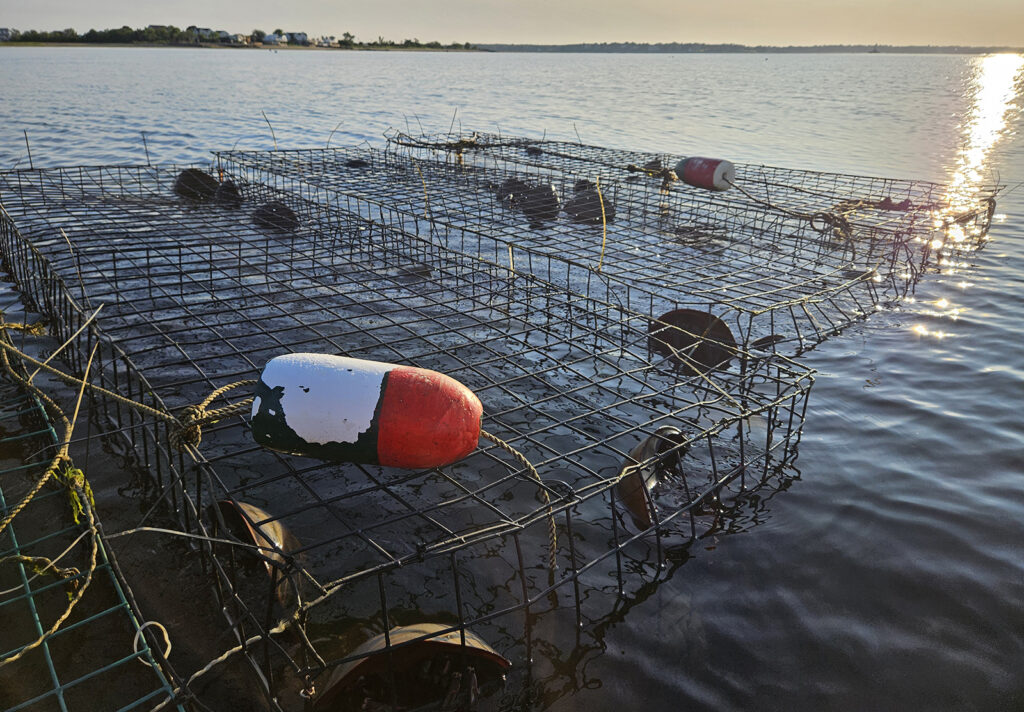
The Whipple Avenue-based operation has a permit for the 2026 horseshoe crab harvest season for both biomedical and bait harvest, according to DEM spokesperson Evan LaCross.
The operation “has consistently provided DEM with the information required by regulation during the spring harvest season when returning horseshoe crabs from the biomedical facility,” LaCross wrote in an email. “Horseshoe crabs must be returned to the waters from which they were taken, not specifically the beach they were taken from. The crabs are harvested from Narragansett Bay and are typically released in the upper Narragansett Bay area or outside Greenwich Bay proper … to maximize the likelihood of even distribution upon release.”
To the best of Shuster’s knowledge, the operation has never returned any horseshoe crabs to the waters off the beach at the end of Whipple Avenue, where a right of way grants the public access to the Warwick shoreline.
“Horseshoe crabs harvested and transported to a biomedical facility for purposes of extracting bodily fluids shall be returned to the waters from which they were taken within 72 hours following the completion of the biomedical procedure,” according to DEM regulations. “The harvester dealer is responsible and liable for returning the crabs and shall make every attempt to assure their survival.”
Shuster questions whether it’s appropriate to be storing live horseshoe crabs in offshore cages.
“It’s not morally or ethically right to keep horseshoe crabs this way,” said Shuster, after walking out to the cages during a recent low tide. “They bring a white box truck to the end of Whipple Avenue. They take the horseshoe crabs out of those pens, put them into black trash cans, put them into the box truck, and take them away. You would normally think about harvesting horseshoe crabs, taking them out of their natural environment, and immediately taking them to where they’re going to be.”
LaCross told me horseshoe crabs for biomedical harvest are held in pens until they can be delivered to a biomedical facility.
“This typically occurs by the end of July at the latest. Last year, all biomedical horseshoe crabs were delivered before the end of June,” he wrote. “Permits are not required for these pens because DEM considers this activity as similar to allowing fishermen to retain lobsters and crabs in ‘live cars’ to hold animals prior to sale.”
DEM regulations require permit holders to file weekly and monthly horseshoe crab landing reports. Weirdly, this information isn’t available to the public. “These reports shall not be made public and shall be kept only for statistical purposes,” according to state law.
While these ocean creatures have experienced a few evolutionary adaptations, their physiology has remained largely unchanged, which is why they are often referred to as “living fossils.” Four species are known to be alive today, and only one calls American waters home: the Atlantic horseshoe crab. This species can be found from Maine to Mexico, populating deeper waters as adults but traveling to coastlines, like the one in Warwick, annually to spawn.
They were once so prevalent on southern New England beaches that people, including children, were paid to kill them. In the 1950s, coastal New England paid fishermen and others bounties to kill the up to 2-feet-long arachnids because they interfered with human enjoyment of the shore and were viewed as shellfish predators.
Those ignorant days may be over, but horseshoe crabs are facing other threats to their existence. While their helmet-like bodies can still be seen along the region’s coastline and around its salt marshes, it’s just a fraction of the numbers witnessed seven decades ago when bounties were placed on their heads.
Today, horseshoe crabs are a popular bait and biomedical species. The animal’s copper-based blood is used for tests to ensure that medical devices, vaccines, and intravenous solutions are free of harmful bacteria.
Horseshoe crab blood harvests have doubled since 2017, with nearly a million horseshoe crabs harvested for their blood in 2022, according to the Center for Biological Diversity. The biomedical industry likes to claim most of those captured for their blood are returned to the sea. It has been estimated that the mortality rate of horseshoe crabs harvested for their blood is about 30%.
Federal guidelines have recognized non-blood-based alternatives as safe for detecting contaminants in drugs and vaccines.
Besides overexploitation, horseshoe crabs are also threatened by habitat loss, sea level rise, the climate crisis, the inadequacy of existing regulatory mechanisms, and political favors. Horseshoe crabs don’t breed until they are 9 years old or older.
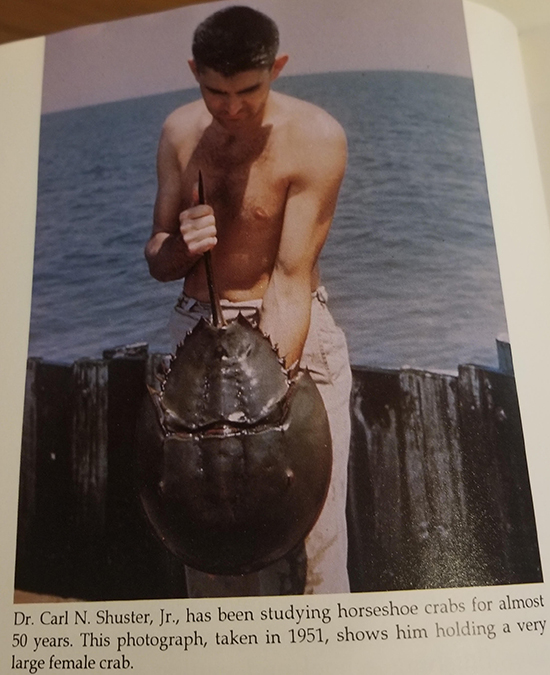
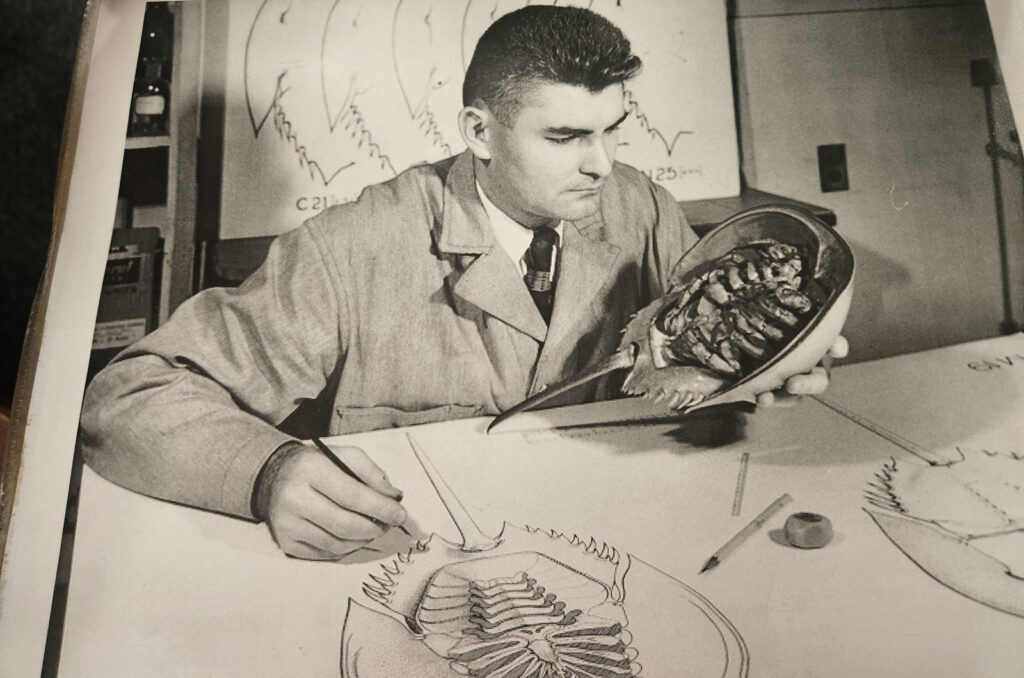
Shuster Jr., who has been dubbed the “founding father” of horseshoe crab science, died in May 2020 in his Arlington, Va., home. He was 100.
During his seven-decade-long career studying the biology and ecology of the American/Atlantic horseshoe crab, Shuster Jr. authored hundreds of scientific articles; presented at regional, national, and international conferences; and co-edited The American Horseshoe Crab, the definitive book on the species.
His tireless work contributed substantially to education about and conservation of this ancient species.
Shuster credits his grandfather with his interest for and concern about horseshoe crabs. As a boy, he would visit his grandfather in Virginia.
“He would sometimes have horseshoe crabs in the house in tanks that he’d be studying,” Shuster said. “He was also a scientific artist, and so he did a lot of drawings and diagrams of horseshoe crabs. When he was coming up as a student, there was no such thing as studying horseshoe crabs. He took it on, in part, because no one was studying it. And one way that you get your Ph.D. is find something that no one is studying and and write about it.”
After growing up on a farm in central New Jersey, Shuster Jr. attended Rutgers University, with plans to pursue a career in farm animal science. After receiving his undergraduate degree in 1942, his education was interrupted by World War II. As a navigator in the Air Force, he flew 27 missions over Europe.
Upon returning from the war, Shuster Jr. undertook graduate work at Rutgers under the guidance of an oyster scientist. One day, as he would later recount, his advisor provided him with a “jar of gunk” and told him to “study this.” The gunk jar held eggs, embryos, and associated detritus of Limulus polyphemus.
In 2000, Shuster Jr. redirected his knowledge about and passion for horseshoe crabs toward education. As awareness of the significance of horseshoe crabs to shorebird ecological, environmental health, and human uses emerged, he helped launch an initiative to bring the story of horseshoe crabs and the controversy regarding their management into schools in the Delaware Bay region.
The resulting Green Eggs and Sand project featured the development of a comprehensive curriculum on horseshoe crabs for weekend teacher workshops up and down the Atlantic Coast. Shuster Jr. presented at 25 workshops in six states.
“My string of Dr. Shuster memories runs deep and wide,” Green Eggs & Sand co-founder Gary Kreamer said in a memoriam published in a Partnership for the Delaware Estuary newsletter shortly after Shuster Jr.’s death six years ago. “They span nearly two decades and thousands of miles of I-95 travel to workshop venues up and down the coast, with memorable Carl stories entertaining me along the way. Like all great teachers, he challenged me to be a better observer, look at things in new ways, ask good questions, and trust my brain, gut, and common sense to seek the best answers.”
Rhode Island could use a little more common sense when it comes to protecting horseshoe crabs and the rest of the state’s natural world.
Frank Carini can be reached at [email protected]. His opinions don’t reflect those of ecoRI News.