Two Species Wormed Their Way Into Being Listed
March 3, 2025
Share


Series note: The region’s collection of native species is under threat on several fronts, most notably from humanity’s shortsightedness. Humans aren’t giving the natural world the space it needs and deserves. We’re crowding out nonhuman life, which, in turn, makes nature less productive and us less healthy. Wild New England examines the animals and insects most at risk.
This diverse group of invertebrates are long, soft, typically lack appendages, and usually have no eyes. They also have some of the best names: hammerhead, snake, leech, and sand striker.
The latter — a fearsome-jawed worm that eats fish and can grow up to 10 feet long — is typically found in shallow tropical marine waters around the world, but the other three can be found here. The first two, however, are invasive — one can jump and the other is toxic.
Native to Asia and Madagascar, the hammerhead worm was transported to Europe and the United States in shipments of exotic plants. It has been in the United States since the early 1900s and is most commonly found in states such as Louisiana, where conditions are warm and humid. But now, as the climate warms, these invasive worms are spreading.
In 2022, some of these worms were found in a Harrisville, R.I., yard.
With their distinctive heads and long, flat bodies, hammerhead worms, which are members of a large family of flatworms, are easy to identify. They are usually striped, and can grow in length to nearly a foot.
Hammerhead worms produce a neurotoxin, tetrodotoxin, which is also found in puffer fish. These worms can also transmit harmful parasites to humans and animals, and they regenerate from segments if they are cut up.
Even though snake worms look similar to the region’s more common, and nonnative, earthworms and are not much bigger, their behavior easily identifies them. Not only do they slither through the grass like snakes, they also jump away if you try to pick them up. In their native Korea and Japan, they are called Asian jumping worms.
In Rhode Island, they have been found in Slater Park in Pawtucket and in gardens and mulch piles in Barrington, Jamestown, North Kingstown, Richmond, and South Kingstown.
There are many different types of worms, including flatworms, roundworms, and segmented worms. Some are microscopic, while others can grow to be longer than a human.
As for the much-heralded earthworm, most of those in the United States came from somewhere else. Native earthworms all but disappeared more than 10,000 years ago, when glaciers from a Pleistocene ice age wiped them out. A few survived further south. But today, virtually all earthworms north of Pennsylvania are nonnative.
These earthworms began entering North America as early as the 1600s, with the first European settlers.
The following is a look at the native worms in southern New England listed as species of concern, threatened or endangered:
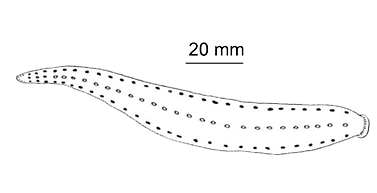
New England medicinal leech (segmented): Listed as a species of concern in Massachusetts. It’s one of the rarest species of leech in North America. It’s also one of the largest leeches found in New England, reaching a length of 5-plus inches. This species is a bloodsucking one, having a medium to large mouth with 38-48 teeth on each of its toothed jaws.
Only three individuals have been collected from the state since 1886 — two
specimens were collected from a lake in Essex County and one from a river in the town of Harwich.
Until the early 1990s, it was thought that the species was endemic to the
coastal fresh waters of Massachusetts. Since its discovery in Maine in 1993, the distribution of this species remains unclear, but is likely restricted. It can probably be found in freshwater habitats of the coastal regions of New England associated with past glacial activity during the Pleistocene Epoch.
They are found in natural ponds with abundant bordering vegetation. They are sensitive to shoreline changes and declines in water quality. The filling of ponds or the seeping of sewage into vegetated ponds and streams pose potential threats.
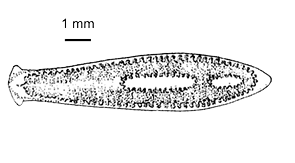
Sunderland spring planarian (flat): Listed as a species of concern in Massachusetts. The species is restricted to a cold spring in Sunderland, Mass., which has water temperatures of 47-48 degrees Fahrenheit throughout the year.
Pollution from development and gravel excavation operations near the spring site are possible threats to this species. Any changes in water quality within the narrow habitat of this species could also pose a risk to the population.
Like other flatworms, this species easily glides over the bottom substrate.
Note: Some of the species listed in each state overlap, and how often the lists are updated varies — the Rhode Island list was last updated in March 2006, Massachusetts last August, and Connecticut in January 2023. For species listed as state historical — essentially extirpated — in Rhode Island, they were included in the endangered category.