
Transit Night at Statehouse: Plenty of Talk, Not Much Action
April 11, 2025
Share


PROVIDENCE — Armed with buttons, stickers, T-shirts, and lists of bill numbers and sponsors, dozens of transit advocates split into two groups to tackle the Senate and House chambers Tuesday afternoon.
It was 3:30 p.m., and the group was ready for a long night.
Providence Streets Coalition operations manager Dylan Giles, while handing out transit-themed merch, told advocates pizza would be ordered.
The advocates had descended on the Statehouse for the annual transit and housing lobbying day, an opportunity to talk and testify to the importance of public transportation in Rhode Island — but this year, the stakes felt especially high.
The Rhode Island Public Transit Authority faces a $32.6 million deficit in the fiscal 2026 budget, a funding gap that could force the agency to cut a third of its staff.
The 30 minutes before the rise of the House and Senate — which is supposed to be around 4 p.m., but often starts later — was chaos on the rotunda and second floor.
In addition to the transit advocates wearing black “Save RIPTA” shirts, housing advocates, many of them wearing “Save RIPTA” buttons, milled around in green; a large group of volunteers with Moms Demand Action, an anti-gun violence group, handed out fact sheets while wearing red, next to people in yellow tees with “2A” lettering, there to support the Second Amendment.
All of them were talking to each other, or trying to convince constituents who weren’t wearing any affiliated colors to join their cause, or running over to the desks of state representatives and senators to ask them to support their bills.
Giles circled the bills up for Senate hearings on the legislation cheat sheets he printed out: $32.6 budget allocation to fund RIPTA’s funding gap; gas tax reallocation; rideshare tax reallocation; and rideshare surcharge.
While the advocates lobbied, their elected officials chatted, shook hands, took photos, and grabbed papers from their pages.
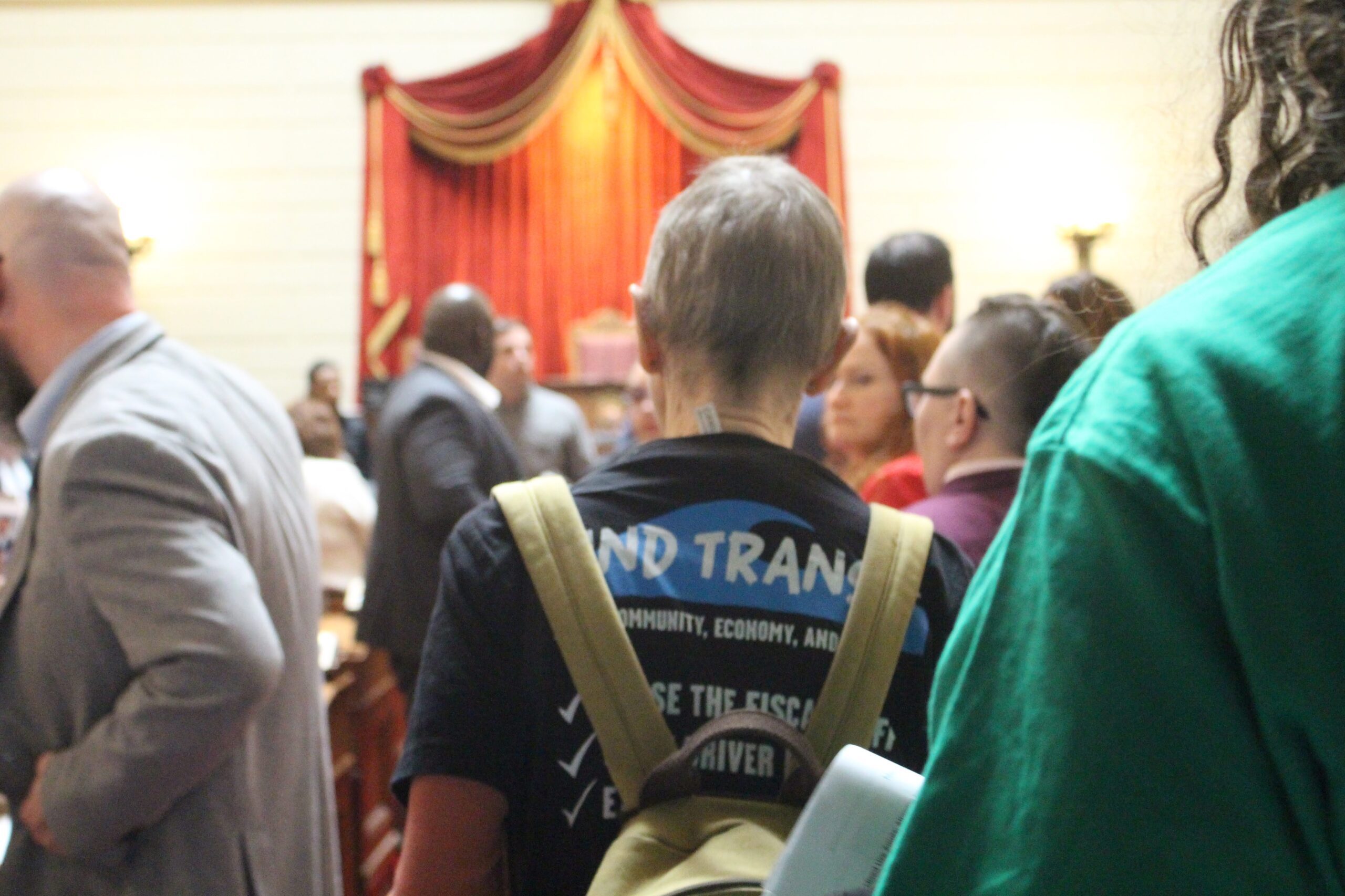
A loud bell rang around 4 p.m., letting everyone know the session was starting. But no one listened.
Eventually, anyone who wasn’t supposed to be in the legislative chambers filtered out, and Save RIPTA campaign organizer Nicole O’Loughlin wrangled as many advocates as she could for a photo on the rotunda stairs with a large cardboard bus.
While the chambers dealt with body-wide business, there was a short pause in the action. Constituents found their committee rooms, signed in to testify, and hit the vending machines — if they were willing to find them in a niche in the building’s basement.
Room 211 hosted the Senate Finance Committee hearing, where all the RIPTA bills were heard Tuesday night.
“I hate this room,” someone said, trying to wedge their way into the tiny chamber, already stuffy and filled with people 20 minutes before the hearing began.
Dozens of people signed in to speak or simply note their support for the RIPTA bills about to be heard, so many that they couldn’t all fit in the room.
In the hallway, RIPTA CEO Christopher Durand, authority board members Patrick Crowley, who is also president of the RI AFL-CIO, and Normand Benoit, and Amalgamated Transit Union Local 618 president Walter Melillo were among those waiting for the hearing to start.
Melillo, who represents RIPTA’s drivers and drove a bus himself for many years, acknowledged how difficult the agency’s financial situation would be for union members.
Working at the agency and union for 28 years, “I’ve never seen a deficit like this,” he said.
The cuts that come from a funding gap like this could likely affect service on weekends and holidays and buses that bring Providence students to and from school, he said, as well as bus maintenance and cleanliness.
“We’re concerned we’re going to lose some members,” Melillo added.
After the hearing began around 5 p.m., the senators listened to testimony about the budgets for the office of the lieutenant governor and the Governor’s Commission on Disabilities before it was time for RIPTA.
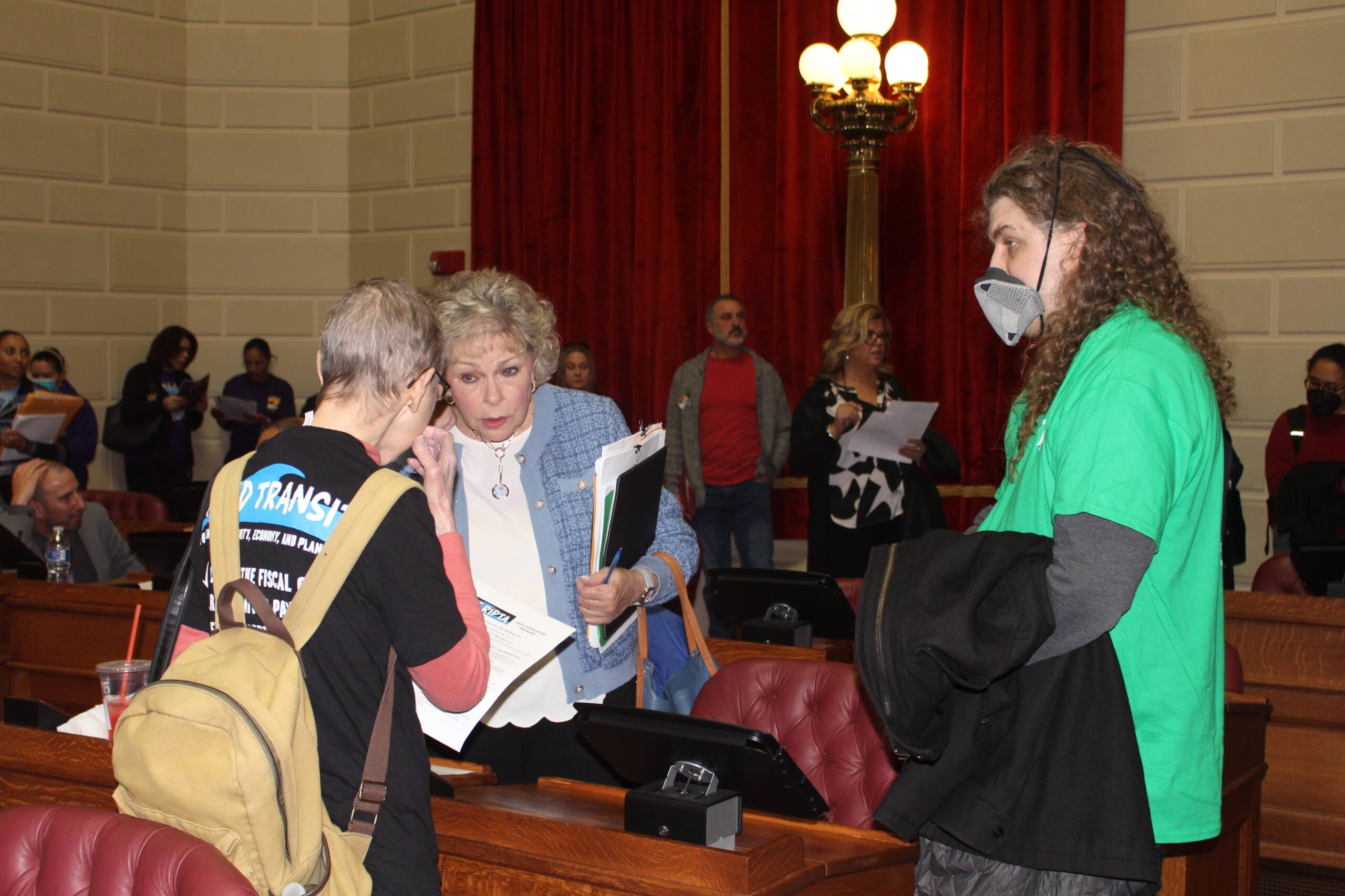
Durand took the committee through the agency’s finances, saying its problems are based on RIPTA’s revenues rather than its expenses.
Expenses, he said, have gone up about 2% annually while, over the past 10 years, revenues from fares and advertising have gone down.
He outlined a few ways to bring in more revenue, including increasing advertising on bus shelters and raising fares by 5%, which would bring in about $1 million annually.
“All these scenarios on the table, you know, I think the size of this gap … the situation is pretty dire,” Durand said.
In one slide, Durand showed how deficits of different sizes could impact cuts to full-time staff. Leaving the funding situation as is would lead to a reduction of about 284 full-time employees from a staff of about 900.
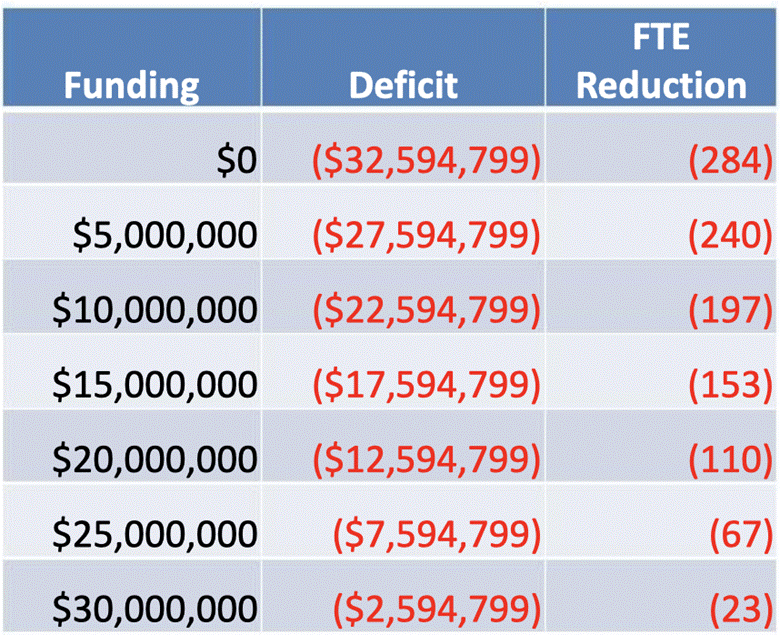
Those reductions in staff would lead to serious service cuts, Durand explained, and the agency has already reduced service pretty significantly in the recent past.
Looking back to last year, when RIPTA had suggested service cuts to combat a driver shortage, he said the agency learned during public hearings that with the services they were offering, “RIPTA had already cut what would have been useful to trim back.” Further cuts would have made it difficult or impossible for many riders to get to work, school, or appointments.
All the members of the Senate Finance Committee reiterated the importance of public transit in their questions for and remarks to Durand, but committee chair Sen. Louis DiPalma, D-Middletown, expressed frustration that the gap has been left up to the General Assembly to fix in a tight budget year.
“That’s the challenge,” DiPalma said, “finding $33, $32 million dollars that’s being requested, that you requested originally, that the [McKee] administration said, ‘No.’”
“It’s unfortunate,” he added. “It doesn’t jive.”
To make a decision on how to move forward, DiPalma said he would have liked to refer to the results of the efficiency study Gov. Dan McKee’s administration had asked RIPTA to complete to receive additional funding.
The study had a deadline of March 1, but RIPTA’s board didn’t sign off on hiring a firm to complete the study until March 27.
“We purposely put that in to have it in time,” DiPalma said of the initial request for the study.
RIPTA’s board of directors told agency staff to delay choosing a firm for the study last fall, citing the need to appoint a permanent CEO — Durand, the acting CEO, was appointed to the role in November and signed a contractor earlier this year.
In addition to evaluating the solutions already offered in proposed legislation, DiPalma suggested that Durand and RIPTA staff look into how the agency could take up non-emergency medical transportation as a revenue source.
Following the presentation, DiPalma asked sponsors to speak about their bills, so that constituents could testify to several up for discussion all at once. The next few hours were filled with advocates and riders speaking their support for the bills into the record, with many recounting stories about how transit has positively impacted their lives.
Lounay Oliver-Camacho, a ninth-grader at Mount Pleasant High School, said she has relied on the bus since she was a little kid. Recently, because she’s been in a situation where she’s had to move a few times, she said RIPTA has come in handy because “there has not always been someone to drive me places.”
Zach Gauthier, who uses a wheelchair and often takes RIde, RIPTA’s paratransit service, called the service a lifeline. Paratransit is only mandated to operate within corridors around fixed routes, so when bus routes are cut, so too are the services Gauthier and other people with disabilities rely on.
No one testified against the bills, but Sen. Sam Zurier, D-Providence, mentioned one letter of opposition to his bill, which would increase RIPTA’s share of the gas tax to 30% from 24%, the only letter of that nature that he was aware of, from Rhode Island Department of Transportation director and RIPTA board chair Peter Alviti.
RIDOT and RIPTA share gas tax revenue, and Alviti wrote that he was concerned that allocating an additional 6% to RIPTA could hurt RIDOT’s ability to raise matching funds for bridge work.
Zurier, who calculated his bill could generate about $7 million to $8 million annually for the transit agency, said he believes there’s room to reallocate that money, seeing that RIDOT recently secured tens of millions of dollars for repairs to the Washington Bridge.
He also noted that during RIPTA’s budget presentation, Durand told the committee the authority’s board, including Alviti, had approved the budget as is and endorsed finding sustainable funding sources for the agency.
As the hearing continued, seats started emptying, and the room cooled down, Providence Streets Coalition board president Liza Burkin got up to speak, wearing a Save RIPTA shirt.
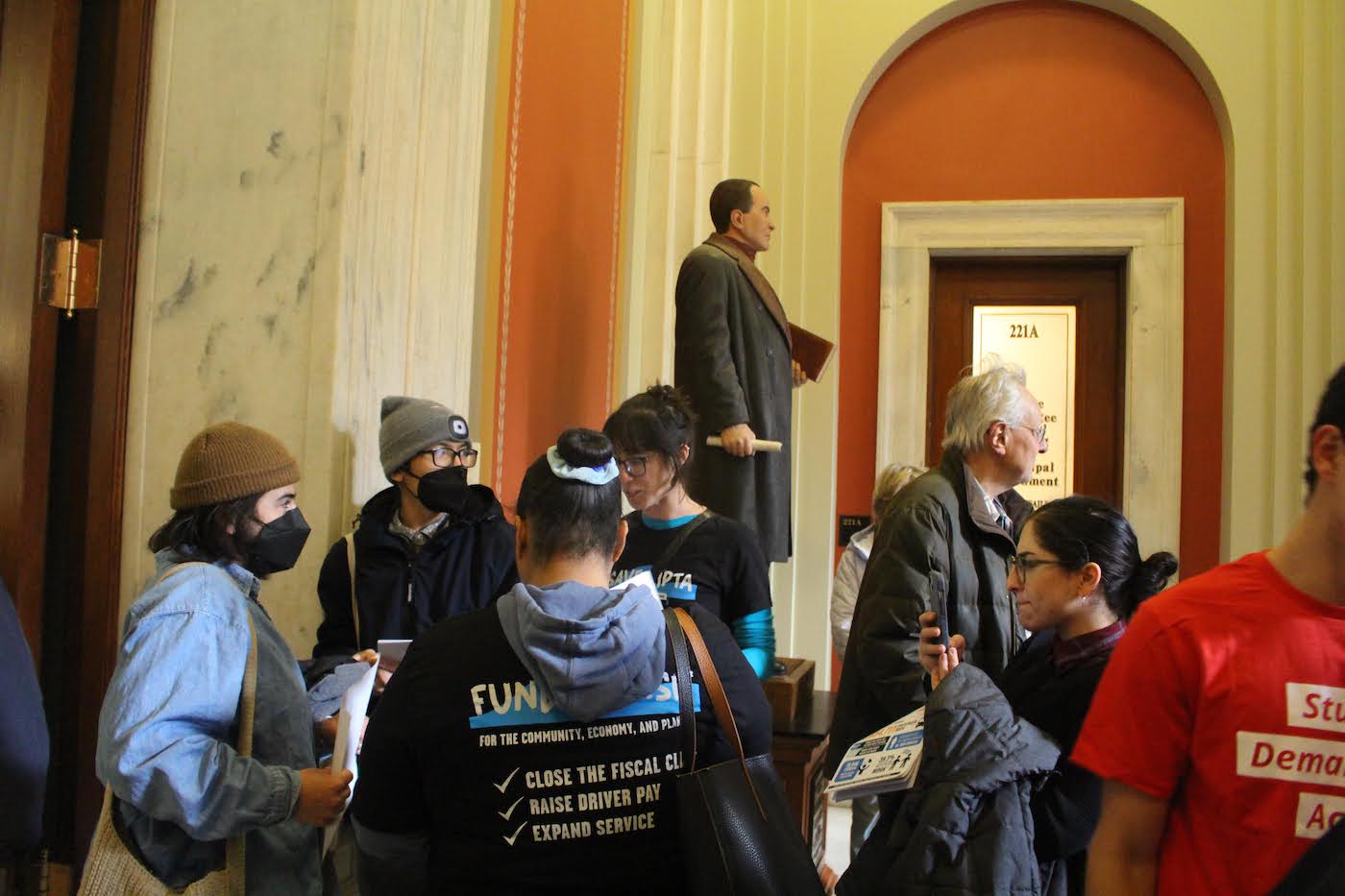
“I really wish that my T-shirt here said, ‘Expand RIPTA,’ but it doesn’t, because we have to save it. We have to save it for the people who need it, who don’t have other choices,” Burkin said, “and I honestly don’t think that we’re asking so much.”
She outlined how RIPTA is one of many agencies across the country facing serious fiscal issues. She rejected the idea that the efficiency study is necessary, rattling off a list of similar studies and commissions the state has created over the past two decades.
DiPalma nodded his head when she mentioned a commission he’d been a part of.
“RIPTA was credited with, quote, ‘Outperforming similar agencies across the country in almost every key performance indicator. Despite a chronic lack of funding, RIPTA provides more trips across a larger area, at a more efficient, effective cost per trip than other agencies that serve a similar population anywhere in America,’” she said, referencing the findings of one of the studies.
“I really don’t think one more study is going to fix this problem,” Burkin added, “and I really don’t think that we should be using this delayed efficiency study as an excuse not to find this money right now.”
Several more people spoke in favor of RIPTA after Burkin’s testimony, and around quarter to 8, a Rhode Island Capitol Police officer peeked into the room. The hearing still had about 20 minutes left.
The committee members didn’t vote on any of the bills and instead held them all for further study. Then senators’ hands quickly flipped up for the vote to adjourn.
While the stragglers filed out of Room 211, most of the lights in the building were already turned off, the hallways were empty, and a pile of greasy pizza boxes were stacked on a table outside the door.
“Have a good night,” a lone Capitol Police officer said as people left through the front door.
note the Board that delayed the study that is the excuse for not taking action is chaired by DOT Director Alviti who also opposes restoring RIPTA’s share of the gas tax. Perhaps he is deliberately trying to sink RIPTA at the urging of the Governor who evidently regards transit at best as a barely needed service so that the poor have some minimal mobility. Alviti also used all the discretionary additional funding from the Federal infrastructure act for highway expressway capacity expansion that deepens auto dependency, promotes more and more driving and sprawl out into the countryside, and zilch for transit or bike/pedestrian programs. Further, they are still promoting, at a great expense, moving RIPTA out of Kennedy Plaza to an inferior location. Clearly if we want to do transportation differently we need a different Governor and RIDOT Director
s
Fire Alviti, he is a dinosuar