Stuck in the Muck: Will the Quahogs Get Out in Time?
March 18, 2026
Share


“Quahogs were everywhere,” says James Boyd, as he reflects on the Saturdays he spent on Narragansett Bay, harvesting boatfuls of Rhode Island’s state shellfish. “You could go out here and make a living in the middle of the bay.”
A native of Providence, a retiree from the Coastal Resources Management Council (CRMC), and a member of the Rhode Island Shellfishermen’s Association (RISA), Boyd has lived and worked with these waters his whole life. But quahog harvests aren’t what they used to be, he says.
When Boyd took up quahogging in the mid-1980s as a college side hustle, the state Department of Environmental Management (DEM) was recording over four million pounds of quahogs landed annually. In years since, however, that number has plummeted to below 300,000 pounds per year, a 93% decrease from the industry’s glory days. Long-term data do show natural cycles of shellfish scarcity and abundance, but in the last 20 years, the decline has reached new lows and shows no signs of slowing.
Shellfishers and scientists agree that the fishery is in trouble, but they remain divided over what’s driving the decline — and how to save what’s left. With a once-in-a-generation dredging cycle on Providence’s horizon, a critical population of these clams hangs in the balance.
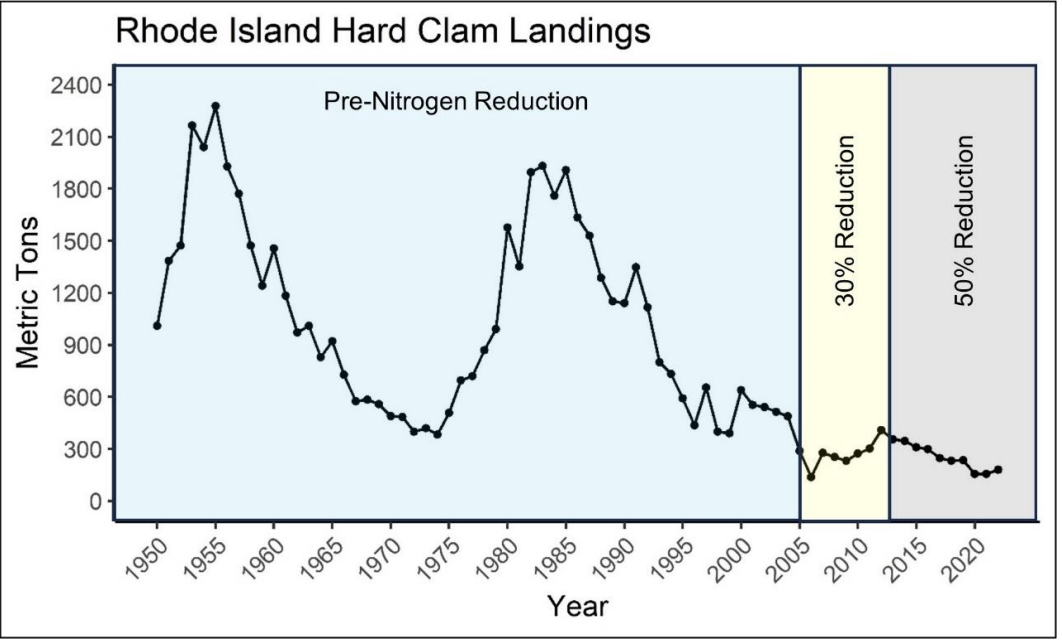
The cause of this drastic decline has become a point of contention between shellfishermen, researchers, and state agencies, particularly around the issue of the nitrogen reduction initiatives from wastewater treatment facilities in the bay. Quahogs rely on phytoplankton for food, which in turn depend on nitrogen for their own growth. As the reduction of nitrogen in the bay has increased beyond the original goal of 50%, RISA members like Boyd have pointed to the state-mandated projects as being the primary culprit in quahog’s decrease in abundance in documents such as their October 2023 problem statement.
Candace Oviatt, a professor of oceanography at the University of Rhode Island and the director of their Marine Ecosystem Research Lab (MERL) put forth a report at a similar time, which endorses the use of a winter nitrogen release as a means of bolstering the quahog population. However, the study found that there was actually “no evidence in quahog landings data that quahogs have decreased because of the nutrient reduction,” and Chris Kincaid, another marine researcher at URI, has said that people “need to be careful with data sampling bias.”
So, what do these scientists think is to blame?
Climate and consequence
One of Oviatt’s PhD students, Michael Potter, has been conducting studies at the MERL focused on quahogs and water quality to determine what has actually caused their decline in Narragansett Bay over the past 20 years. Potter refutes the nutrient reduction stance, saying that their lab has verified the presence of plenty of phytoplankton in areas such as Greenwich Bay, the upper bay, and the Providence River — places he identifies as main quahog hotspots.
To Potter, people have to look at the issue from more than one angle. He says the nutrient reductions “may be exacerbating the issue because [the populations] are already stressed beyond the point where they can recuperate,” but reductions are “not the silver bullet that killed the fishery.” For example, he says that the technological advances in quahogging may have led to overfishing, creating a devastating cycle where there are not enough quahogs for shellfishers to make a living, and the population is not robust enough to sustain continual fishing.
He also has documented multiple ways in which shellfish are harmed by warming waters. One critical juncture in the quahog life cycle in Rhode Island is the winter-spring phytoplankton bloom; without the bloom, juvenile quahog survival rates can be less than 50%. Potter says the bloom only occurs at a very specific water temperature, around 3ºC. Even a change of one or two degrees could be the deciding factor in whether the clams have enough food.
“If [the bloom] doesn’t happen, and there are several years of it not happening, that could be kind of disastrous, because then you have clams that are starving,” says Potter.
Eight million clams
On top of overfishing and climate change, there is another looming prospect for the quahog: getting dug up. The U.S. Army Corps of Engineers has proposed a Federal Navigation Project dredging the Providence river to begin in 2026 that will have two 20-year cycles. During this time, they plan to construct a new contained aquatic disposal (CAD) cell in the Edgewood Shoals area to store dredged material.
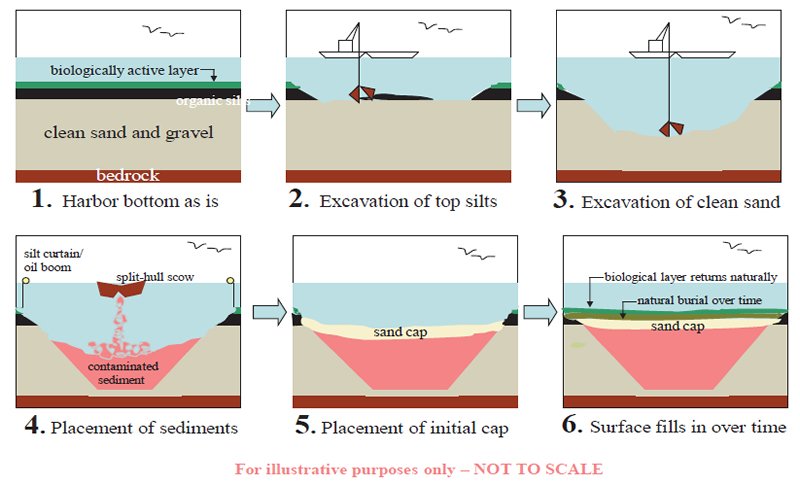
CAD cells have been used in and around Providence since the early 2000s; they are deemed an effective strategy for storing and sealing contaminated sediment by the EPA. Even so, a project of this magnitude is bound to affect local communities and surrounding ecosystems. This spring, the Army Corps released a draft Dredged Material Management Plan (DMMP) and opened it for public comment. Organizations like the Rhode Island Shellfishermans Association and Save The Bay posted responses addressing various points in the plan. Chief among their shared concerns: the proposal offers no clear strategy for the quahogs that inhabit the area slated for dredging.
The proposed location for the CAD cell is in a part of the bay with one of the highest densities of quahogs. According to the 2024 Department of Marine Fisheries quahog dredge survey, the area boasts a density of roughly 30-50 quahogs per square meter of sediment. By comparison, most of the upper bay has less than half that, around 15 quahogs per square meter. During CAD cell construction, unless they are relocated, the project will destroy 63 acres of quahog habitat. Even using the most conservative estimate of only 31.5 quahogs per square meter, the number of clams impacted by this project would be over eight million.
The Rhode Island Shellfish Association hopes to relocate a majority of this population down-bay to a designated shellfish management area, where they can be tested to see whether they are safe for human consumption. If the quahogs are not too contaminated, shellfishers can harvest them in the spring. Quahogs that are not currently safe to eat can be transferred to other areas of the Providence River to serve as a breeding population that can be used to replenish less densely populated areas of the bay.
Boyd, who helped draft RISA’s response to the DMMP, explains that he did a bit of “back of the hand math” to figure out just how big of an endeavor it would be to move eight million clams. He believes that the area where the clams would need to be harvested from is only about 15 feet deep, making it neither economically nor physically feasible for a large hydraulic clam dredge to be employed. As a result, the work of moving over eight million clams would need to be done by hand by those who know how to do it best: quahoggers.
[Figure 3. Boyd’s quahog harvest photo.]
Relocated by the community
Based on figures from a previous relocation project in May 2025, Boyd estimates that the cost of a quahog transplant at this scale would be over $300,000 and could be as high as $450,000, depending on just how many clams there are. This might seem expensive, but he says it’s important to note the scope of a Federal Navigation Project like this one: the budget of the first cycle of dredging (2027-2047) hovers around $100 million.
Close readers of the DMMP can see that there is no explicit language around what will happen to the shellfish; in a nearly 700-page document, eight million clams’ future is reduced to a single line on the budget: “CAD Shellfish Relocation (if needed).”
The value allocated? $60,000.
Without proper funding to pay the fishermen, the relocation may not happen in time. Boyd explained that the destruction of raw quahog resources would come as a massive blow to a population already in decline, and so too would the loss of potential employment from a project that could support the industry. He says the budget is “unacceptable, because right now, our industry is struggling.” Though he is retired and does not directly rely on income from quahogging, his friends and colleagues have become unable to support their families through fishing and have had to turn towards other career paths, he said.
Mason Sherman, a member of the the CRMC, says that the feedback on the report has helped the agency “dial in on their estimate” but that “it’s still in the works, so [there is] nothing final.” He says the primary goals are to ensure that there are no holdups and that dredging can begin next fall. However, that leaves just a few months for this relocation project to occur, and there has been no update on when this transplant could take place; nor have the Corps initiated any testing of whether the clams are suitable for human consumption.
This story was published as part of a collaboration between ecoRI News and students in Brown University’s Science Journalism class. The stories examine the science, history, and human experiences connected to the Ocean State’s rivers — from water quality and wildlife restoration to flooding, pollution, social justice, and the communities working to protect them. To read more of these stories, click here.