
South Side Residents Have Something to Say. Is Providence Listening?
May 15, 2026
Share


PROVIDENCE — Representatives from five organizations gathered on the steps of City Hall on May 12 with a united message: the South Side will not be ignored or silenced.
The demonstration — organized by sisters Yaimani and Yadira Rivera — took aim at Mayor Brett Smiley, Rhode Island Hospital, Brown University Health, private developers, and ProvPort, whom they said are shutting residents out of decisions that shape South Providence.
“The South Side is not asking for saviors,” Yaimani Rivera, co-leader of the Jacqueline Clements Park Collective, said. “We’re asking for what we deserve.”
The Riveras opposed Marathon Construction & Development’s proposal to build a parking garage at 140 Prairie Ave. tied to a housing development on Blackstone Street.
The garage would have risen on hospital land, where dozens of homes once stood before they were demolished over the years. Four surviving houses near the property became known as “The Resistance Houses,” a name that landed on the Providence Preservation Society’s 2026 Most Endangered Places list.
Ron Crosson’s grandmother’s salary from her job in Rhode Island Hospital’s laundry room helped his family stay afloat on Dudley Street. The house he grew up in near Prairie Avenue is now one of the endangered homes.
Their efforts led Marathon to scrap plans for a standalone garage and instead fold parking into its housing development, the Providence Preservation Society reported. But the company still plans to redevelop the property tied to Brown University Health and will present a revised proposal in the coming months, according to a news release.
“The administration needs to stand up, listen, and stop seeing themselves as rolling out the red carpet for the developers to come into this city and just do what they want, however they want,” Crosson, the president of the South Providence Neighborhood Association, said.
Terri Wright said the project felt like a betrayal. Her mother, Lottie Hodge, worked at the hospital for 25 years and donated her body to Brown University for cancer research before her death.
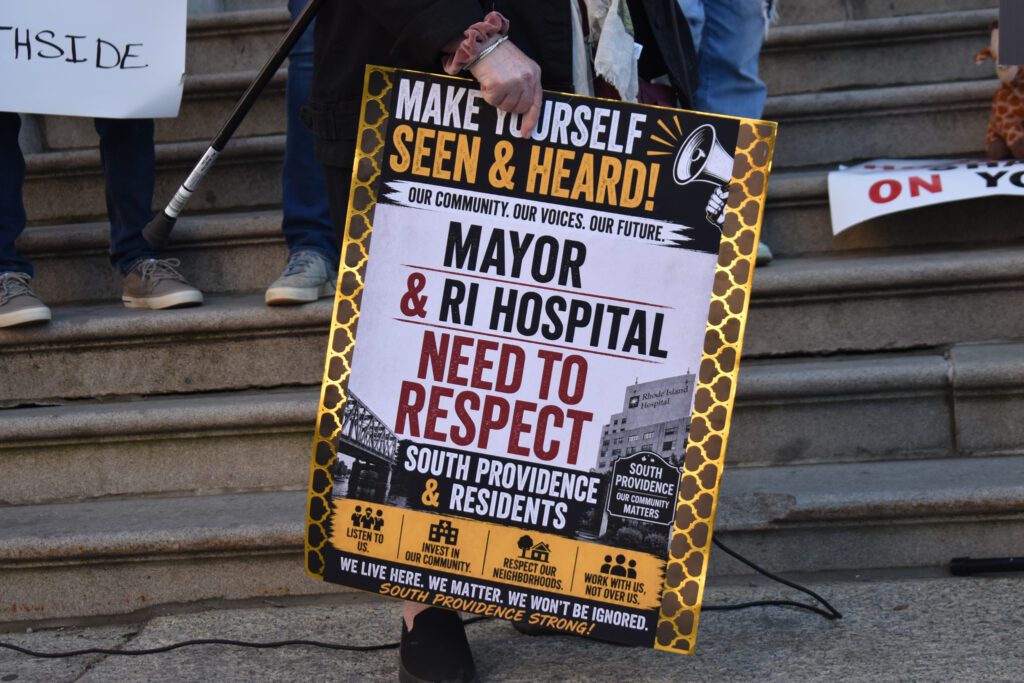
Wright, a member of the Racial and Environmental Justice Committee who worked on Providence’s climate justice plan, said the proposed seven-story garage contradicted the city’s environmental goals.
South Providence is made up of four wards, and one of those wards, Linda Perri said, lives in the shadows of the Port of Providence.
Wards 10 and 11 are split by Public Street, which was once a fishing spot for neighborhood families before private development cut off access to the waterfront over time.
Perri, the president of the Washington Park Neighborhood Association, pushed the Coastal Resources Management Council in 2021 to permanently preserve the street as a public access point.
“We have been ignored and swept under the rug too many times,” she said. It’s so important to get rid of the status quo; we need new representation across the board.”
South Providence faces poverty rates above the national average, high food insecurity, and some of the city’s highest asthma-related emergency room visits. Its public schools have endured chronic underfunding and state intervention, while Providence has become the nation’s least affordable metro area for renters.
“Every time this community was knocked down, it rose again,” said Will Casey, tenant and housing coordinator and case manager for Direct Action for Rights for Equality.
Casey joined the push for the rent stabilization ordinance that the City Council passed in April, only for Smiley to veto it. The council planned to override the decision but failed in a last-ditch effort.
The weight of life in some neighborhoods can wear people down, said Monica Huertas, adding that the resilience of those who once walked the streets of the four wards carries the communities forward.
“We’re all standing on their shoulders,” said Huertas, the executive director of The People’s Port Authority.
Huertas has asked the nonprofit that oversees the Port of Providence to send its master plan back to the drawing board, to include community members on its governance board, and to insert compliance with the state’s open meeting laws before it reaches the City Council.
Her children stood behind her, holding signs that criticized Smiley and the living conditions near the port — a reminder, she said, that her fight is about securing a better future for the next generation.
Cindy Miranda stood on the steps of City Hall with her teenage son beside her to help deliver a message echoed throughout the rally: Neighborhoods aren’t looking for saviors; they want partners.
“The South Side Providence community members need a seat at the table,” said Miranda, the president of the Olneyville Neighborhood Association.

Focusing on environmental justice and climate justice is the only way to move the RI economy forward. The efforts to continue to subsidize the rich will back fire and more pollution creates more costs than benefits.