Roger Williams Study Will Chart Effects of Salt Air, Coastal Climate on Mass Timber Construction
June 2, 2025
Share


BRISTOL, R.I. — Along the Shell Path on the Roger Williams University campus overlooking Mount Hope Bay sit two wooden structures that look a little, well, odd.
Thick wood panels rest on cinder blocks, with stubby columns and shortened rear walls, with seemingly no rhyme or reason as to why they are there.
But it’s no random installation. The timber mock-ups were built to study the effects of salt air and proximity to the coastal climate on mass timber construction, a project designed by Shay Kurzinski, assistant professor of construction management at Roger Williams’ School of Engineering, Computing and Construction Management.
Mass timber construction first gained popularity in Europe, Kurzinski said, after World War II, when the steel industry there was decimated. Mass timber buildings are constructed with large pre-manufactured, multilayered wood panels typically ranging from 5-12 inches thick, according to the American Wood Council.
Typical products include cross-laminated timber (CLT), nail-laminated timber, glued-laminated timber (glulam), and structural composite lumber. The use of prefabricated wood panels makes construction and renovation easier and allows the building to be disassembled and the materials repurposed, reducing waste and extending the lifetime of carbon stored in the wood.
“So the hope is, thinking about future generations, we want to reduce the carbon footprint or carbon emissions as much as we can,” Kurzinski said. “Using wood has the benefit of using less carbon or energy that needs to be used to produce this type of product, compared to steel manufacturing or concrete manufacturing.”
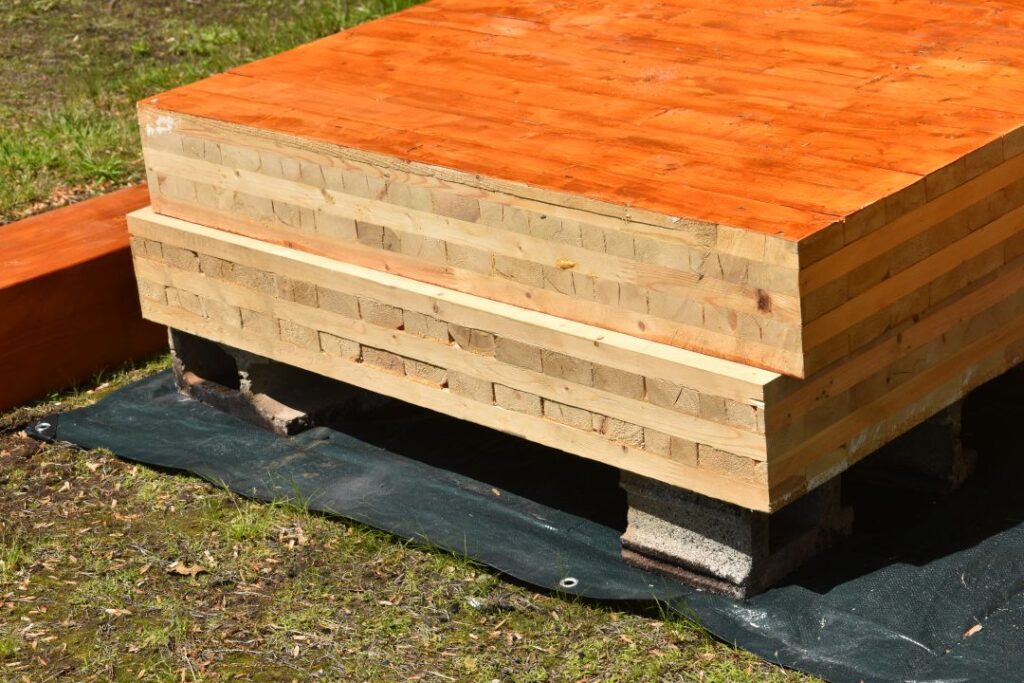
The method provides more sustainability in the building/construction industry because wood is a renewable material and has a smaller carbon footprint compared to concrete and steel. But traditional two-by-fours aren’t great for stronger and taller structures, so that’s where mass timber comes in. Because it consists of layers either glued, nailed or doweled together, mass timber provides better strength-to-weight ratio.
Andrew Mungovan, a senior RWU construction management major and a student of Kurzinski’s, built the cross-laminated (for the floors) and glue-laminated (for the columns and beams) mass timber for the mock-ups.
“This is supposed to be a wall,” Mungovan said, “and it’s how they actually make them, just like these big pieces of wood that they kind of piece together for floors and walls, and then we’re incorporating a column and a beam going across.
“This was a good opportunity for me to not only build something new, but learn more about mass timber. We touch on it in school, and we learn a little bit about it, but don’t dive into it too deeply.”
Once the structures are complete, RWU assistant professor Joel Singley will install sensors in and around the timber mock-ups to record the effects of the coastal climate and corrosive salt air on the wood.
“The weather station itself will basically track all of the meteorological variables that would be relevant for thinking about putting this type of material outside and exposing it,” said Singley, who specializes in critical zone science, hydrology, biogeochemistry, and geophysics and runs the eponymous Singley Lab at the university.
“We’ll be tracking relative humidity, wind, precipitation amounts, sunlight … just to get a sense of all the different factors that are going” to potentially degrade the wood, he said.
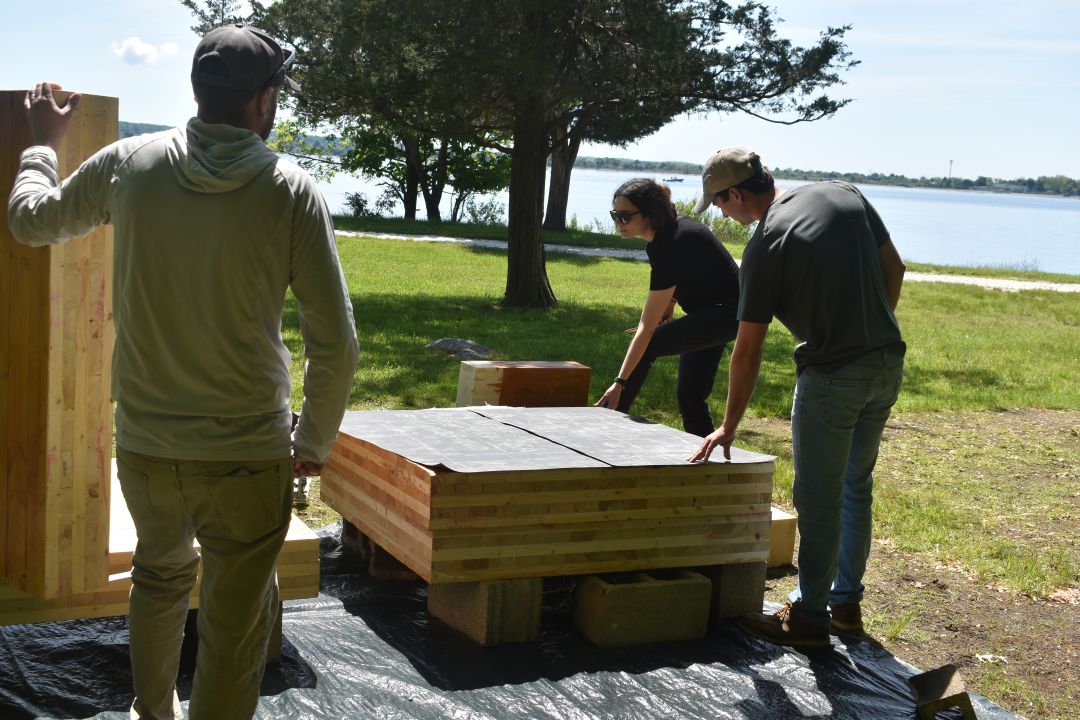
Kurzinski said mass timber construction is typically used inland, and there hasn’t been much testing on the effects of coastal climates on the construction method. Her project is funded by a $33,500 Wood Innovation Program grant from the U.S. Department of Agriculture.
Some of the timber used in the mock-ups has been treated with a typical industrial weatherproof coating; some has been treated with a wood stain that can be found in retail stores; some of the timber will be covered with a waterproof membrane that usually goes behind wood siding in construction; and some will be wrapped with a tape that blocks UV light.
“We’ll see how much moisture absorption there was using the industrial coating that comes with the mass timber,” along with all the other variables, she said.
The year-long study hopes to provide data about cost-effective options for sustainable building practices in coastal environments.