
There Will Be Blood
Conservationists question proposed horseshoe crab quotas in Massachusetts
February 24, 2026
Share


Massachusetts is bleeding dry its Atlantic horseshoe crab population, or at least that’s what the Southeastern Massachusetts Pine Barrens Alliance fears.
The Massachusetts Division of Marine Fisheries (DMF) is set establish the state’s horseshoe crab quotas for 2026. The DMF has proposed to reduce the bait quota from 140,000 to 100,000 crabs and increase the biomedical quota from 200,000 to 280,000.
Under the state’s “Rent-A-Crab” program, biomedical companies would also be permitted to bleed up to 100,000 bait-designated crabs before they are used in the whelk and eel fisheries.
Written public comments on DMF’s horseshoe crab quotas for this year will be accepted until 5 p.m. Feb. 27. To file, send an email to [email protected].
The Alliance is concerned that this year’s DMF proposal expands biomedical exploitation; maintains bait quotas that exceed actual need; puts Massachusetts out of step with neighboring states; and ignores unresolved concerns about population recovery.
The DMF’s own proposal states that “the current local bait crab demand approximates 75,000-90,000 horseshoe crabs annually” — an explicit acknowledgment that the proposed bait quota exceeds actual bait needs, the Alliance recently noted.
“This management decision comes at a time when bait demand is declining due to the collapse of the whelk fishery, and biomedical companies are increasingly transitioning to a synthetic alternative to horseshoe crab blood,” according to the Alliance. “Rather than using this moment to reduce pressure and rebuild horseshoe crab populations statewide, DMF’s proposal moves in the opposite direction — prioritizing private commercial interests over long-term population recovery, ecosystem health, and resilience.”
The Alliance, all-volunteer, Plymouth-based nonprofit, was created in 2013. The organization’s volunteers have been conducting local horseshoe crab surveys since 2017. They quickly found fewer horseshoe crabs than they expected.
To address its concerns, the Alliance last year filed a bill that sought to prohibit the taking of Atlantic horseshoe crabs, also known as the American horseshoe crab, for use as bait in commercial fishing. The reporting date for the legislation was extended to March 18 of this year.
In 2023, the Alliance filed a petition to have the Atlantic horseshoe crab state listed as endangered. No public hearing was ever scheduled. Atlantic horseshoe crabs aren’t currently classified as endangered or threatened in Massachusetts, or at the federal level. The International Union for Conservation of Nature (IUCN) lists the Atlantic horseshoe crab as vulnerable.
Nearly twice as old as dinosaurs, horseshoe crabs have been crawling ashore underneath the light of a full moon for some 450 million years to lay thousands of eggs in the sand. In the past three decades, however, horseshoe crab populations have declined by two-thirds in Delaware Bay, their largest population stronghold, and are declining up and down the Atlantic Coast, at least when compared to historic populations.
The best available scientific information demonstrates that listing the horseshoe crab as threatened or endangered throughout all or a significant portion of its range may be warranted, the Center for Biological Diversity has noted.
“The American horseshoe crab is threatened by habitat loss, sea level rise, and climate change across the entirety of its range, and overharvest threatens the American horseshoe crab across a significant portion of its range,” according to a Center for Biological Diversity-led petition filed two years ago. “Populations have declined across the entirety of the horseshoe crab’s range, and their numbers continue to decline or remain at historically low levels across nearly all of their range.”
In 2024, the Center for Biological Diversity and 22 partner organizations, including the Alliance, petitioned NOAA Fisheries to list the Atlantic horseshoe crab as an endangered species.
“Horseshoe crabs are imminently threatened by habitat loss, overexploitation, inadequacy of existing regulatory mechanisms, and other natural and manmade factors, including climate change,” according to the 142-page petition. “They are in danger of extinction across a significant portion of their range, and threats are likely to persist and worsen in the foreseeable future.”
Each female lays between 80,000 to 100,000 eggs over the course of several nights. In less than a month, the juvenile crabs emerge and make their way back to the sea, but only a tiny percentage survive the 10 years it takes to reach sexual maturity. Most fall prey to birds, fish, reptiles, and humans.
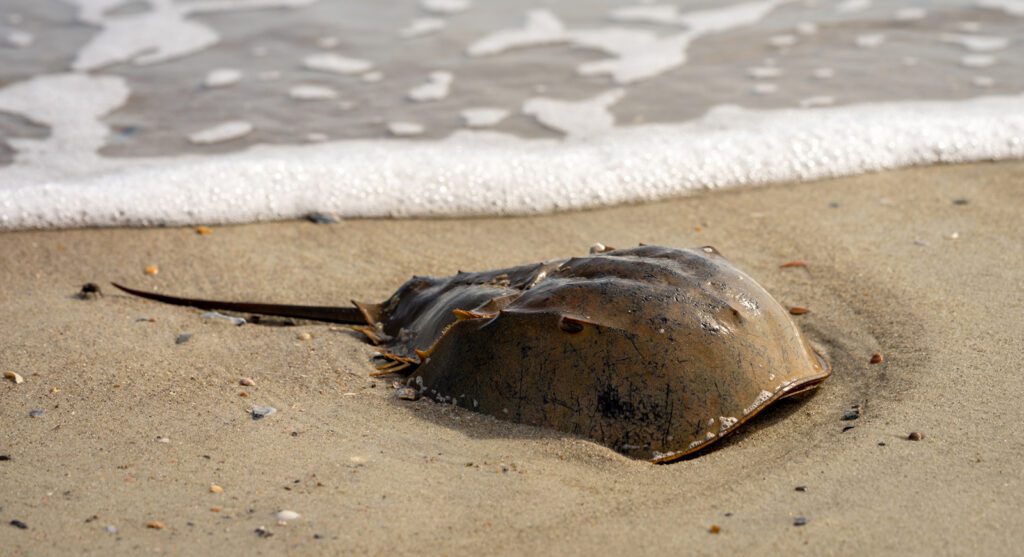
Each spring along the Atlantic and Gulf coasts, female horseshoe crabs lay their eggs in massive beach spawning events. But this fragile landscape continues to be ruined by shoreline hardening and rising waters.
Horseshoe crabs, which can live up to 25 years, rely on estuaries for food resources, places to spawn, and for larvae and juveniles to develop and grow. Many of these ecosystems have become increasingly developed, dominated by human activity, and polluted.
About 90% of spawning horseshoe crab activity in Massachusetts is done between May 1 and June 7.
These ancient creatures with 12 legs, 10 eyes, and funky blue blood were once so prevalent on New England beaches that people, including children, were paid to kill them. Their helmet-like bodies can still be seen along the region’s coastline and around its salt marshes, but in a fraction of the numbers witnessed decades ago.
In the 1950s, coastal New England paid fishermen and others bounties to kill the up to 2-feet-long arachnids — horseshoe crabs are more closely related to spiders, scorpions, and ticks than to crabs — because they interfered with human enjoyment of the shore and were viewed as shellfish predators.
People were reportedly encouraged to toss horseshoe crabs above the high-tide line, so they would dry out and die. They were labeled “pests” and ground up for fertilizer. Beachfront property owners were concerned the creature’s presence and their decaying death would impact real estate values.
Limulus polyphemus were hunted heavily by humans from the 1800s to the early 1900s, with catches often topping 5 million crabs annually, according to the Atlantic States Marine Fisheries Commission. Millions more were likely harvested unreported. At the time, many fishers and industry regulators didn’t see the value of horseshoe crabs to the greater ecosystem.
Mindless slaughter, ignorance, and more-modern human pressures have greatly reduced horseshoe crab populations.
Today, the bait fishery sells chopped-up horseshoe crab meat largely to the whelk fishery. DMF considers channeled whelk “to be depleted throughout their range within the waters” of its jurisdiction. A 2018 stock assessment of the species within Nantucket Sound showed it to be overfished.
Depleting a vulnerable marine creature to catch a species we know is overfished likely isn’t sustainable.
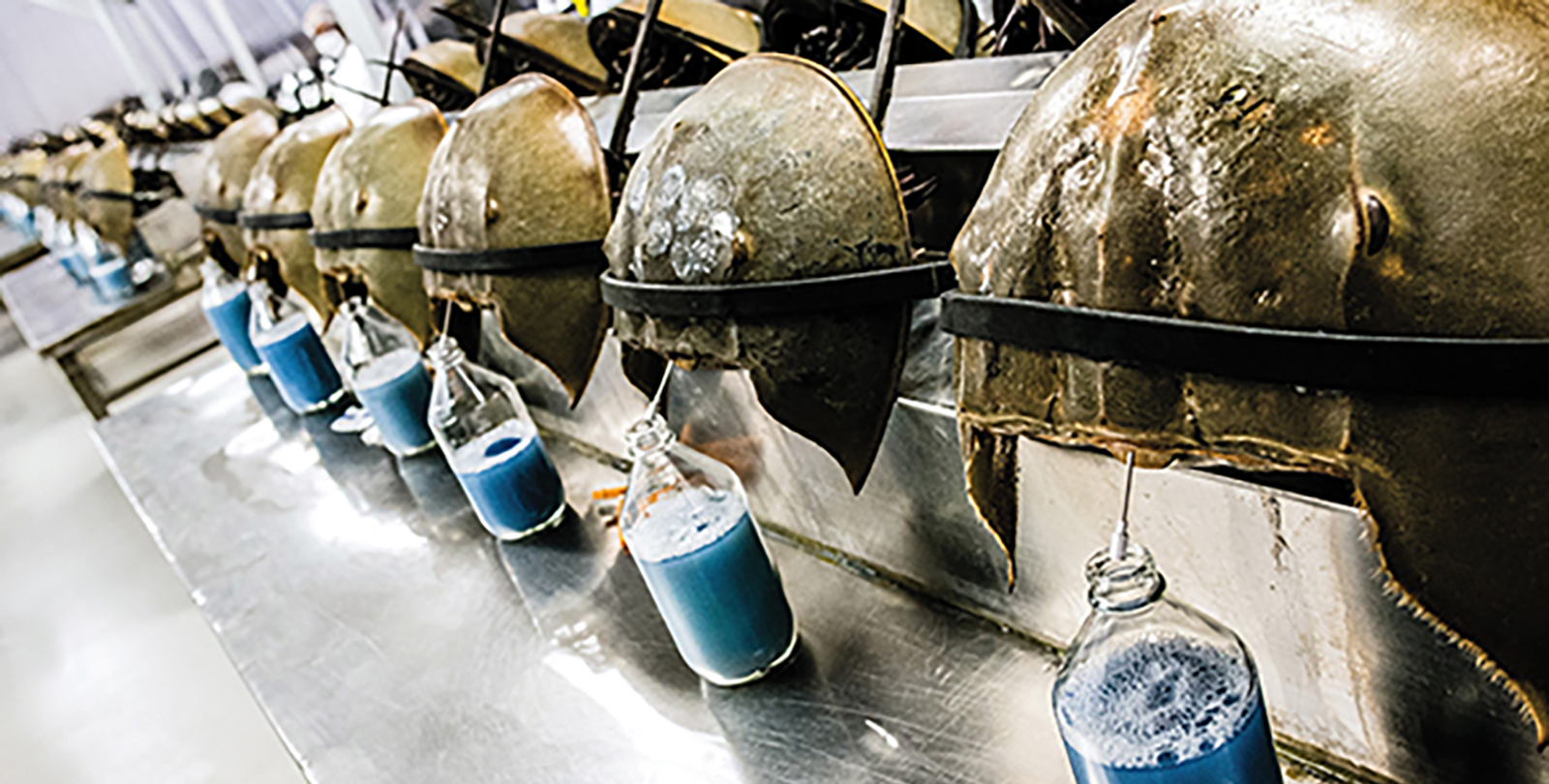
The biomedical fishery harvests the animals to extract an antibacterial compound — Limulus amebocyte lysate — from their bright-blue, copper-based blood. It’s used to ensure that medical devices, vaccines, and intravenous solutions are free of harmful bacteria.
Needles pierce the animals’ hearts and a third of their blood is drained. Horseshoe crab blood harvests have doubled since the Alliance began its horseshoe crab surveys nine years ago, with hundreds of thousands caught annually.
Synthetic alternatives exist, and some pharmaceutical companies are phasing out the crab-based test. But upfront costs and the difficulty of switching from products that have already received approval to be tested with crab blood have slowed the transition.
The biomedical industry claims most of the crabs captured for their blood are returned to the sea. It has been estimated, though, that the mortality rate of crabs harvested for their blood is about 30%.
The Alliance has noted when a horseshoe crab is removed from a beach before it spawns, there is no guarantee it will successfully reproduce, even if it is later returned during the same spawning season.
In 2023, DMF capped the biomedical horseshoe crab quota at 200,000 and split that quota evenly between the two existing in-state processors. That decision was intended to prevent a rush to grab as many crabs as possible and to discourage a third firm from relocating to Massachusetts.
But just three years later, DMF is allowing biomedical companies to bleed up to 380,000 horseshoe crabs. Continued harvesting at these levels undermines long-term population recovery and ecosystem function, according to the Alliance.
Massachusetts is likely to face increased conservation pressure following the passage of legislation in New York that bans the use of horseshoe crabs for both bait and biomedical purposes by 2029. Connecticut banned the commercial harvest of horseshoe crabs on Oct. 1, 2023.
Horseshoe crabs support migratory shorebirds, marine life, and coastal ecosystem health. The docile and slow-moving animals play host to other life. Barnacles, blue mussels, eastern oysters, ghost anemones, red beard sponges, scuds, skeleton shrimps, and snail furs make the horseshoe crabs’ carapace their home.
The red knot, a shorebird species that feeds on horseshoe crab eggs during its 19,000-mile migration from South America to the Arctic, was listed as threatened in 2015 under the Endangered Species Act. The listing decision cited the horseshoe crab harvest as one of the contributing factors to the red knot’s decline.
Three Asian sister species to the Atlantic horseshoe crab faces similar threats. The IUCN lists the tri-spine horseshoe crab as endangered. The other two — the coastal horseshoe crab and the mangrove horseshoe crab — are listed as data deficient.
All four of the crab species are imperiled because of overfishing for use as food, bait, and the production of biomedical products and habitat loss and/or alteration due to shoreline development and armoring against coastal erosion, according to the IUCN.

There is not enough time to correct the number of errors in this “article”
For one: The scientific data regarding the population in Ma. and DE does not support your claims. The population in both has grown in the last 20 years and is measured in the tens of millions of animals ASMFC.COM.
It is astonishing and troublesome the number of incorrect statements presented as fact.
from an anecdotal standpoint – i grew up on the Morris Cove beach on the outskirts of new haven. there were huge amounts of horseshoe crabs spawning on the beach in late spring. the numbers decreased as i aged into my twenties. we moved to RI in 1974. i m on the water constantly. it is a novelty to see a horseshoe crab. i ve also potted for whelks and eels. you don t need horseshoe crab carcasses for bait. fish frames work very well plus they are easier to deploy. they should ban the commercial harvest of limulus. BTY B.H. i couldn t find anything on the NE ASMFC web site about horseshoe crabs. you re obviously a fisherman who uses horseshoe crabs as bait.
The article shows another case of mismanagement by the state of Massachusetts.
Nearly every marine animal/ fish stocks that have any value to commercial fisheries are at low levels.I live in southeastern Massachusetts and have witnessed the increasing absence of horseshoe crabs laying eggs at our local rivers.
Whether its’ Striped bass,codfish,whelk, or horseshoe crabs it’s evident that commercial interest are more important than maintaining local species.