
Providence Project Aims to Reduce ‘Loud’ City’s Noise Pollution
October 23, 2025
Share


PROVIDENCE — By the time John Wilner moved to the city eight years ago, he was already used to city living.
A New York native and graduate of Tufts University, Wilner had, at different times in his life, lived in Boston, Washington, D.C., and Chicago. He met his partner on the West Coast, and prior to moving to Providence they had been living in San Francisco.
When they moved to a new apartment in Providence in 2017, they were expecting a quieter and sleepier urban experience given the city’s general size and population. But Providence, it turns out, was audibly different than what they were expecting.
“We were astonished how loud it was,” Wilner said. “Especially for a city of this size.”
It went beyond illegal fireworks. The city seemed to have little interest in enforcing its own preexisting noise ordinances, according to Wilner. Whether it was loud music from cars or clubs, illegally modified mufflers cranking vehicle noise higher, or leaf blowers used by landscapers, Providence has a noise pollution problem, he said.
As Wilner and his partner settled into their apartment, they would ask the same questions of every resident they met. Where did they live? Was it loud? Have they tried to do anything about the noise?
Wilner said the answers they got were frustrating. “Most people would just sit there and shrug,” he said. “People would tell us they had been trying to do stuff about the noise for years, but it was a problem for so long and they were trying for so long, they’d have this resignation in their voice.
“People just sort of accept it. It’s a what-are-you-gonna-do kind of thing, whether it’s government officials or residents, that’s just how it is here.”
‘Noise is the new smoking’
The debate over noise pollution has been steadily growing since the pandemic. Some cities and towns in Rhode Island have introduced noise ordinances and considered bans on leaf blowers, citing noise complaints and environmental concerns. The General Assembly has considered a similar ban every year since the COVID-19 pandemic.
Opponents of leaf blower bans say it’s a small problem that only matters to a privileged few residents; that it’s government overreach to punish landscapers and cause them to lose money; and that it will be harder and more expensive for residents to use electric alternatives that are more environmentally friendly (fewer emissions) and quieter. But there is a growing body of evidence on the public health impacts linked to extensive exposure of excessive noise, whether it’s from construction, vehicles, airplanes, or leaf blowers.
A 2013 paper published in Environmental Health Perspectives found that excessive noise can decrease sleep quantity and quality; increase stress; and cause hearing loss.
“The body’s initial startle response to noise is activation of the sympathetic (fight or flight) part of the nervous system, similar to the preparations the body makes just before waking in the morning,” the paper’s authors wrote. “Although blood pressure normally drops during sleep, people experiencing sleep fragmentation from noise have difficulty achieving a nadir for any length of time because blood pressure rises with noise transients and heart rate increases with noise level.”
Chronic high blood pressure and endocrine disruption from exposure to excessive noise can lead to heart disease in the long term, in addition to more traditionally seen noise impacts like hearing loss — the third most common chronic physical ailment in the United States — or tinnitus.
Noise presents an especially serious concern to children’s physical and psychological health. While they are at risk of the same long-term health impacts, excessive noise can interfere with children’s learning of speech, language, and related skills such as reading and listening. If the school environment itself is too noisy, it can impair overall learning.
It’s also a social and environmental justice issue. A 2023 study from Colorado State University analyzing noise distribution across 83 cities showed that communities that were redlined or otherwise marginalized tended to have more and louder urban noise.
Marginalized communities tend to lack green space to absorb noise and pollution and be nearest the most undesirable infrastructure: interstate highways and/or industrial or fossil fuel facilities, among others.
These long-term health impacts spurred Wilner and other residents to organize. At first, said Wilner, he was only seeking to build a database or clearinghouse, somewhere where residents could find resources on the impact of noise, as well as a list of state and federal laws and possible source types of excessive noise.
“Everyone deals with noise individually; if there’s an allowed source in a neighborhood, you have to deal with it alone,” Wilner said. “But if someone in a different neighborhood has to deal with the same type of noise, they’re on their own too. There’s no communication between them despite having the same issue about noise.”
In 2019, a volunteer offered to build a WordPress website, and the Providence Noise Project (PNP) was born. The all-volunteer organization pushes for greater enforcement of city noise ordinances and collects as much data as it can from residents about how they feel about noise. Wilner, who has a background in nonprofit communications, volunteers as the organization’s communications coordinator.
We try to highlight unnecessary noise. There’s certain things that generate noise and people can’t do much about it. Like when someone’s fixing their house, doing repairs, or construction, emergency sirens and so on. We may not like the noise, but we understand the reason. But we’re focused on deliberate, intentional, and really unnecessary noise.”
— John Wilner, Providence Noise Project
The organization’s tagline, “Noise is the new smoking,” encapsulates its mission to spread awareness of how excessive noise could impact residents, even if they aren’t the ones causing it.
Part of that work, said Wilner, is rudimentary data collection. It’s difficult to argue the city is too loud if there isn’t data on complaints from residents or a measure of noise levels on a rolling basis.
PNP has two different data initiatives. The first is an ongoing community survey, asking Providence residents how they feel about excessive noise, and the complaints they have about where it’s coming from.
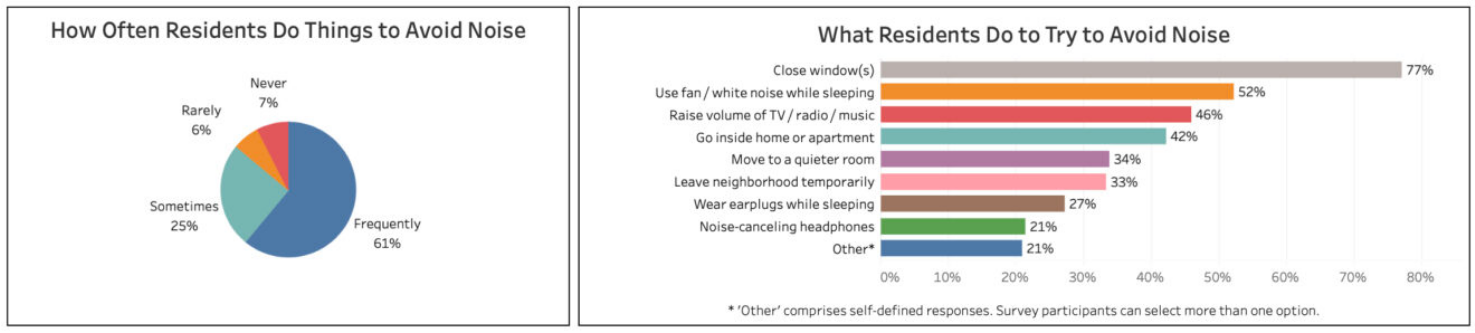
According to PNP’s survey results, 82% of Providence residents say they notice noise frequently; 47% say it disrupts their sleep frequently; and 87% of residents who never report noise say they would report it if the city would do something about it. PNP has a link on its site of ways to report noise.
Vehicles — whether music from cars or loud exhausts — make up the bulk of noise reported by Providence residents. Music from vehicles accounts for 82% of excessive noise reported by residents, while loud exhausts account for 78% of excessive noise, according to the residents surveyed.
The third-highest category — fireworks — was considered by 48% of residents surveyed as a prevalent source of noise.
PNP also has two monitors measuring noise 24/7 in Providence. Wilner declined to name the specific streets or neighborhoods in which they’re located, saying only that one is the east part of the city and another is in the west part.
‘It’s a dog chasing its own tail’
Noise was first recognized as a public health hazard in 1968. Congress passed the Noise Control Act in 1972, empowering the Environmental Protection Agency to study and regulate noise, similar to the powers it obtained under the Clean Air Act.
In its first major action on noise, on Nov. 6, 1972, the EPA announced it would embark on a major study of airport noise, and possibly set standards for noise from train cars and other motor carriers of interstate commerce. In 1975, the EPA proposed noise standards for jets, requiring old ones to be retrofitted and new ones to meet new noise requirements.
Throughout the 1970s, the EPA ran its noise regulations through its Office of Noise Abatement and Control. The Reagan administration, as a part of a larger deregulation effort of federal agencies and departments, axed the agency’s funding for noise control in 1982, in favor of transferring that responsibility to state and local governments. The federal laws girding the EPA’s work on noise regulation remain in effect, if unfunded.
Enforcement on the state and local levels remains rare. The Rhode Island Department of Health said it was in conversations with PNP, which had shared some of the data with the department. The Rhode Island Department of Environmental Management, which enforces the Clean Air Act and other federal laws governing pollution, told ecoRI News noise enforcement is up to cities and towns.
“DEM does not regulate noise pollution, and we have not developed regulations for noise,” said Kim Keough, DEM’s chief of public affairs .
Most municipalities have stricter ordinances on noise during nighttime hours. Providence, for instance, has a sound limit of 65 decibels during the day in residential zones, but from 10 p.m. to 7 a.m., the limit is lowered to just 55 decibels. In other areas, like downtown, or commercial or industrial areas, the nighttime limit is the same, but the daytime limit can be as high as 75 decibels.
Anthony Vega, a spokesperson for Mayor Brett Smiley, said the administration has made reducing noise a “top priority.” The city has bought sound meters for the city’s Licensing Bureau and Uniform Division so staff can enforce property-related sound violations for the first time.
More officers have been trained to use the same technology in the city’s neighborhoods, with 162 citations issued for noise violations last year. The city has also issued a request for proposals for a sound camera pilot program, borrowing practices from New York, Miami, and Knoxville, Tenn., with a rollout date expected before the end of this fiscal year.
“Together these efforts are improving quality of life across Providence neighborhoods,” Vega said.
The City Council recently passed a ban on gasoline-powered leaf blowers. Although attempts to outright ban the equipment have been circulating regularly at the state and local level since 2020, Providence is the first to successfully pass such a ban.
Advocates of the ban said the equipment was both overly noisy and a contributor to greenhouse gas emissions. Opponents of the ban, which included many of the state’s landscaping businesses, said it was a financial burden to switch to all-electric equipment that would do the same job less efficiently, and would do nothing to stem excessive noise.
“I haven’t gotten one call for the noise of a leaf blower,” council member James Taylor said at the Oct. 2 meeting of the City Council. “I’ve gotten complaints about fireworks and roosters and loud music, but we already have a noise ordinance that’s unenforced.”
The blanket prohibition on gas-powered leaf blowers doesn’t kick in until 2033, and there’s a six-year transition period built into the legislation that doesn’t start until 2027. During the transition period, landscapers and property owners will only be allowed to use gas-powered leaf blowers during the leaf cleanup season, Oct. 1 to Dec. 15. The leaf blowers, however, can still be legally sold in the city.
PNP has mixed feelings about the ban. While it welcomes any regulation on noise, Wilner said the final ordinance is too weak, and the eight-year timetable for full implementation is egregious.
“The Noise Project appreciates the Providence City Council finally undertook long-overdue leafblower regulation but is concerned widespread support for some degree of regulation has too easily resulted in support for any regulation,” PNP wrote on its website.
Violations of the ordinance will be attached to the property the equipment was used on, instead of the user of the equipment. Violations of the ban carry up to a $100 fine for each violation. City departments would be required to comply as soon as 2028.
“The goal of this is to reduce the noise pollution in the city, as well as our carbon emissions, and other forms of environmental degradation that come from gas leaf blowers,” said council member Sue AnderBois, who represents Providence’s third ward, at the same City Council meeting. “It’s not meant to harm small businesses; it’s meant to boost the health of our neighborhoods.”
“A lot of cities are quieter than Providence, a lot of cities in India, and Africa and Colombia and Spain are fighting noise there, people care about noise all over the world. It’s not just a small group of people who care about it,” Wilner said. “There’s this circular logic that cities are noisy, so no one should do anything about it, and we can be as loud as we want, because cities are noisy. It’s a dog chasing its own tail, there’s no logic that escapes from that.”


Do people realize the battery powered blowers are just about as loud, with a higher pitch ?
And yet, most Providence residents have no problem at all inflicting much, much louder noise in the ocean with their support of offshore wind construction. How ironic—not to mention selfish and heartless.
Noise pollution is a problem in many urban and suburban areas. It seems we have grown accustomed to the noise we all live with, and seem to accept. But many of us notice the difference in our sleep, our quality of life due to noises we are living with. The noise of lawn companies on the ground, at early or later hours during the week and worst of all during valued week end quiet times. And the increasing noise of more and more low flying commercial aircrafts in the air, particularly over many neighborhoods and regions in and around the airport, Warwick and East Greenwich just two of the cities impacted. Our compliance with all manner of noise pollutions in contemporary life encourages the noise people feel at liberty to create in so many public places now; beaches, parks and more. While greed and monetary value seem to have trumped quality of life for tax paying citizens, lawn companies seem to have no reasonable guidelines to adhere to in regard to noise control. Where does it all end?
I will celebrate the day that motorcycles will be required to meet the same noise level requirements as automobiles. As for leaf blower noise there is one other issue. The DUST that they produce. I recently had to close all my windows because an idiot neighbor was blowing leaves out of the street. The dust produced was beyond belief.
I switched all my gas outdoor equipment including lawn mower and leaf blower to battery power 4 years ago. This is one of the best decisions I ever made! These are so much quieter that often my nearby neighbors don’t realize I am working outside.
As far as leaf blowers go – removing leaves from where they naturally fall to the ground is a poorly thought out practice from the get-go. Leaving the leaves where they fall nourishes the soil with essential nutrients vital for tree-health. Leaving the leaves also creates friendly habitat for beneficial pollinating insects, such as butterflies, lady bugs, and fireflies, to lay their eggs and “over-winter”. When we remove leaf litter for aesthetic reasons, we are doing one more thing to degrade ecological health. How about we just leave the leaves where they fall! Then everybody wins.