
‘Offshore Wind Gets a Pass’ When It Comes to Environmental Concerns
August 18, 2025
Share


In 2024, I penned an op-ed here at ecoRI News entitled Commonsense Environmentalism is Being Destroyed by a Wind-Less Revolution, opening with a statement that, “the Ocean State has become ground zero for the most important environmental battle in modern times.” Indeed, this battle persists — that is, whether to preserve and protect nature, versus to concede nature for the fantastical ideology of a greenwashed industrial panacea.
This rift was exposed through recent reporting that summarizes the outcome of a recent Energy Facility Siting Board (EFSB) meeting in Portsmouth, R.I. The meeting aimed to productively discuss the plans for South Coast Wind to run a power cable from 60 miles offshore extending up through the Sakonnet River, beneath Portsmouth, and then up through Mount Hope Bay to Brayton Point. The meeting was well attended, with equal numbers of public comments presented by both opponents and supporters of the project. Despite these equal voices, the ecoRI News article emphasized that those opposed were the minority opinion, even denigrating such opinions as parroted views of those under the thumb of fossil fuel lobbyists.
This is nothing further from the truth, and a significant disservice to those seeking balanced environmental reporting from which their own opinions may be formulated.
While it would take multiple volumes of literature to collate the plethora of very valid concerns for harms that both onshore and offshore industrial activities inflict, it is worth dispelling the mythology promulgated in the follow-up to the EFSB meeting. I will do so here through several exemplary issues that are very real and should resonate for all — regardless of your personal opinions on the windless revolution.
First, the ecoRI News reporting claimed South Coast Wind is “expected to generate 2,400 megawatts (MW) of electricity, powering around a million homes by the end of the decade.” On Jan. 17, 2025, the Bureau of Ocean Energy Management (BOEM) announced approval of a Construction and Operations Plan with the potential to generate up to 2,400 megawatts of which could power 840,000 homes. These facts matter when separating marketing propaganda from reality. For visual perspective, the project is slated to span 127,388 acres of the continental shelf — more than 10 TIMES the land area of Providence. Would you advocate that an equivalent farmland area be mowed for a solar farm? Unlikely.
How far does 2,400 MW really go? It is important to understand that this is the nameplate capacity for the project, assuming everything operates to its fullest. In practice, it is well understood that these turbines do not operate 24/7 and, in fact, only deliver at 30-40% of nameplate capacity. That doesn’t mean fewer homes are powered, it means less power delivered to each grid participant. From a purely technical standpoint, this is probably the single most significant issue to overcome — with unpredictably intermittent supply to the grid, there are only two options to level grid supply — run historically reliable back-up energy sources (back to coal, oil, and gas) which cannot be turned on and off on demand, so are always operating in the background, or, store sufficient backup via batteries. The former is what we’re all in favor of reducing or eliminating — the latter should scare you beyond measure and is the topic where pro-winders often put their head in the sand…deep sea mining. Battery storage requires massive quantities of heavy metals and mining them even on land is an inherently dirty process, rife with conflict and even human rights abuses. Most marine scientists and conservationists will assert that deep-sea mining will be bad, very bad. The call for sprawling wind turbines offshore opens these floodgates, further facilitating the exploitation of ocean habitats — here where we are unable to fully understand and manage the Sakonnet River appropriately.
Second, the ecoRI News reporting includes a statement from Brown University’s J. Timmons Roberts, professor of environmental studies and of environment and sociology, stating “What you’re seeing here tonight is an attempt to go after the Achilles’ heel of an important energy source we need, but this project meets the criteria the EFSB is supposed to evaluate,” and further, “It will meet the energy needs of the state, it’s cost-justified, it’s in compliance with environmental laws and it doesn’t harm the environment. This is a very minor cost for a very big social benefit.”
This authoritative statement follows a previous report by Roberts and Brown University that includes unfounded claims targeting a grassroots organization called Green Oceans. Contrary to false claims by Roberts and the Brown University student group authoring the report, Green Oceans is non-partisan and not funded by the fossil fuel enterprise. In fact, many energy giants are deeply vested in the offshore wind sector and thus would not benefit from funding opposition voices. Green Oceans has previously published a rebuttal to Roberts report which can be found here: Green Oceans rebuttal.
In true bureaucratic form, wind project documentation aims to bury the environmental harm that Roberts claims do not exist, such that they are too cumbersome to address for the layperson. Concerned citizens, including those involved with Green Oceans, have invested countless hours of their own time to fully understand the issues for themselves and the benefit of their communities, and these were the comments spoken at the EFSB meeting. The Ocean State Current collated the comments of concerned citizens here, and they do not sound like parrots:
The populace should be grateful that people are speaking up. This is the first time, perhaps since the American Revolution, that the public has organized in a grassroots fashion so fully along the East Coast, and with a focus on the actual issue and in an apolitical fashion. Those in opposition to these industrial projects include Ds and Rs and all in between, and most are operating on adrenaline out of pocket without any funding whatsoever.
By contrast, it is those stated as in favor of the projects that are frequently operating with significant lobbied influence and promises of funding. My article of last year called out a very serious issue that was evidenced in a piece by EnergyCentral.com which indicated bought influence of a variety of entities. The article stated that “if” a certain offshore wind project is selected [approved], “then” a grant will be administered to several [Rhode Island] institutions. This is not a grant or donation; it is a clear quid pro quo to entice endorsement of a private project by state and federally supported institutions to facilitate regulatory approval. The Energy Central story has since been removed from its website.
Third, the overtly dismissive take on real environmental impacts is unsettling and exposes a clear detachment from reality of what occurs on and underwater. The concerns of electromagnetic forces (EMF) on various fisheries, suspended sediments, resuspended toxic metals, heating surrounding waters via open-loop cooling are all identified in these thousands of pages of documents — because they are indeed the environmental impacts of the project. These are not false claims — supporters just concede that they’re acceptable in the name of a greenwashed industrial panacea.
An example, the EPA permitting documentation for South Coast Wind describes the impacts of open-loop cooling systems. Offshore, multiple energized cables come together at a substation and generate massive amounts of heat. To cool this system, seawater is drawn in at depth where seasonal temperatures may fluctuate from approximately 35 to 50 degrees Fahrenheit, allowing the water to absorb the excess heat, and is then discharged near the surface at 80-90 degrees Fahrenheit. This thermal discharge occurs to the tune of multiple tens of millions of gallons per day. I have lots of questions — how will discharging this hot water over the course of decades impact the life cycle of larval fish and other planktonic species? Can endemic coldwater species handle the heat? Will a population change occur that will impact those higher-order species that feed on planktonic organisms? Will we see unseasonal algal blooms in proximity to the substations? Icing on the cake — this heated water is chlorinated prior to discharge to limit biofouling within the system. So, on one hand we have persons claiming that the “reef effect” of wind turbines adds import habitat, on the other hot chlorinated water is by design killing anything in its path. Which is it?
As reported by ecoRI News previously, the old Brayton Point power plant’s thermal discharges, which were similar to those anticipated from SouthCoast Wind, were factors that contributed to significant impacts on fish stocks in Mt. Hope Bay and the Taunton River. Advocacy against these thermal discharges from multiple environmental organizations contributed to Brayton Point plant ultimately being shut down.
Here, many of the same organizations that fought Brayton Point are disregarding the very same environmental hazards, with the only difference being that they are now occurring in an environment that is very poorly understood (offshore), and out of sight.It has become seemingly OK to concede an environment because we know so little about it — and we’re evidently allowing this to become the new normal with these massive offshore infrastructure projects. Every professional meeting, forum, congressional testimony, and community plea from the ocean community emphatically states that we don’t know what we don’t know and ocean-related work has long been underfunded. Yet, stated by Roberts, with certainty, this industrial activity “doesn’t hurt the environment.”
Fourth, we have issues of duplicity facing environmental issues here in Narragansett Bay, with offshore wind getting a pass. On July 18, Save The Bay issued a strong and appropriate letter to the Army Corps of Engineers addressing concerns over dredging activity in the Providence River. Dredging in general is well understood to present issues with turbidity and resuspension of toxic materials from the seabed, and care is needed to mitigate these issues. These are the very same issues forthcoming with burying a cable through the Sakonnet River and Mount Hope Bay. Rhode Islanders would measurably benefit from consistent risk condemnations from Save The Bay regarding these very same risks facing the Sakonnet River’s watershed and its varied uses, including aquaculture, fishing, harvesting, and recreation.
Similarly, Save The Bay issued a June 27 letter to the Department of Environmental Management describing its concern for Revolution Wind’s discharge of heavy metals in excess of 1000 percent over the allowable levels during the construction of the export cable landing site in Quonset. Such discharges were stated by Save The Bay to be cause for “multiple extreme risks to the Bay.” And yet, such exceedances have been allowed by the state for many months, without consequence, and without any reporting to spotlight the issue. Why? Because offshore wind gets a pass.
Of note, Save The Bay’s condemnation of the heavy metals discharge exceedances followed a petition from Green Oceans to the Army Corps of Engineers demanding their review of Revolution Wind’s compliance with permits. The USACE is presently reviewing this petition.
The issues go on ad nauseam. Point being: offshore wind is just more of the same, painted green.
Earlier this summer I took the trip out to Revolution Wind to view the current state of the state, and I was unprepared for and then appalled to see that each turbine has a large diesel generator positioned outside on a platform over the water, and most were running (yes, burning diesel fuel, of which thousands of gallons are stored, along with a multitude of petrochemical lubricants at each turbine). So, when the wind doesn’t blow sufficiently to generate power (60%-70% of the time), the genset kicks on to keep things moving such that bearings do not wear or seize. This was yet more confirmation in my mind that it’s just greenwashed industrialism at its finest.
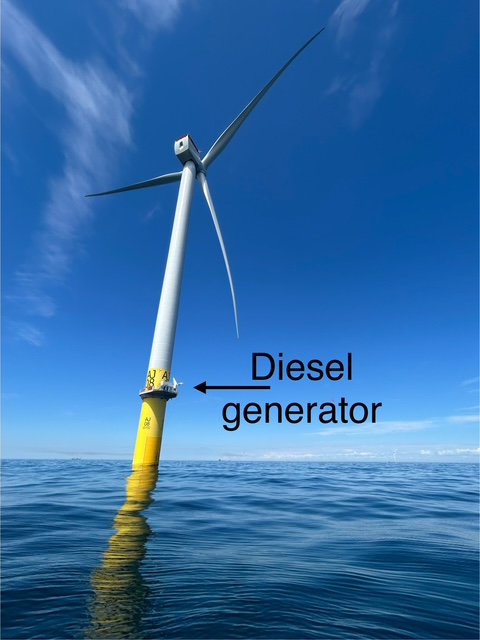
This industrial sprawl, offshore, is analogous to mowing that farmland or clear-cutting an old growth forest for a solar installation, and as such cannot possibly be considered a net benefit. No, it’s not about Not in My Back Yard; it’s about not in our ocean, the one that we’re all dependent upon to be preserved and protected, not turned into a 3.5 million acre construction site – thankfully this horrific abuse of the Outer Continental Shelf Lands Act (OCSLA) was recently rescinded, giving the ocean a much needed break.
Yet, the ground zero battle continues, as evidenced at the Portsmouth EFSB meeting, where concerned citizens are only asking for one thing: follow the laws that are in place to protect the environment, and all of us, and without a pass for politics or financial gain.
Michael Lombardi is a Rhode Island resident and has spent more than 7,000 hours underwater (much of it on the bottom of Narragansett Bay) providing services, performing scientific work, and developing life-critical technologies throughout his 30-year career in the marine and undersea sector. His award-winning environmental journalism has been recognized by the Rhode Island Press Association. He has been an invited speaker to the prestigious National Geographic Explorers Symposium and is a relentless advocate to #leavetheoceanalone. His work can be found at www.oceanopportunity.com.
Categories
Join the Discussion
View CommentsRecent Comments
Leave a Reply

Your support keeps our reporters on the environmental beat.
Reader support is at the core of our nonprofit news model. Together, we can keep the environment in the headlines.
Thank you Michael for this heart-felt and fact-filled opinion piece. Not in my ocean, indeed!
Mr. Lombardi, thank you for this level-headed analysis of offshore wind and for calling attention to the very one-sided “reporting” to which we are generally subjected. It is surprising yet commendable that ecoRI has published your commentary. You were right to call out Brown University Professor Timmons Roberts for the many false accusations published by him and his “Climate Development Lab” about Green Oceans and affiliated individuals—all condoned by Brown University administration. It is shameful that Brown supports indoctrinated by fear and false tidings, amplified by the 350.org subsidiary Climate Action RI and union group Climate Jobs RI. (And let’s not forget Senator Sheldon Whitehouse’s star role in all this!) While Green Oceans is funded only by private citizens (mostly RI and MA residents) concerned about the destruction of offshore wind industrialization on the marine environment, all of the above named institutions and groups (and Senator Whitehouse) receive significant funding from the wind industry. One can only surmise that is why folks whom otherwise seem to truly care about “the environment” turn a blind eye toward the many problems with offshore wind and other supporting technologies such as diesel and lithium battery backup.
Thank you for speaking the truth! Very few are brave enough in this climate, to actually do the work and speak out. Bravo!
Another fantastic piece. Rhode Island, The Ocean State, has some quiet voices on the issue of wind that simultaneously bring clarity to this much-propagandized issue, and do this state proud.
This is one serious piece of writing. Thank you, Michael Lombardi
RENEWABLE’s a better name is Unreliable’s. This is the fundamental cost impediment to grid integration of these machines. The AI REVOLUTION has caused Google 100% Carbon-free LIE, of buying RECs = Indulgences EXPOSED. Big Data for AI need RELIABLE high quality electrical generation. NUCLEAR supplies this which is why China will win the AI revolution as the propaganda factory run by China ensures the West will not build nuclear or reliable energy for AI data centers. You can’t win against the laws of physics.
Expensive, intermittent offshore wind is a scam of great consequence. Those who value honesty should not be silently swindled by such lies, even from their government officials.
As with many issues there are pros and cons. Obviously more research by unbiased people is needed to understand the oceans and its inhabitants. Like a doctor’s mantra , “first do no harm” if possible. We do not want to wring our hands after possibly irreversible damage has been done. We need both healthy oceans and clean energy. The question is how best to do it? How do we fund it and how to support it.
Well done! Well written!
Thank you Michael. A balanced, truthful, and informative article.
There are positive and negative consequences to every path we take to get the energy we need to tap away on our keyboards. Unless you’re part of the slim minority that has a few solar panels on your roof, you are benefitting from an energy system that’s spewing tons of methane and carbon dioxide into the atmosphere, causing untold danger to all life on earth.
The “industrial sprawl” of the ocean you speak of has been ongoing since we launched container ships capable of traversing oceans to deliver every zip tie we order from China. The “industrial sprawl” of the ocean has been ongoing since we developed a plastic wrapper that can be easily disposed in said ocean. The “industrial sprawl” of the ocean has been ongoing since we developed fishing ships that can stay offshore for months at a time, scraping every last fish out of the ocean, deciding which ones hold the highest value, and then tossing the rest back for the seagulls to devour.
If you have concerns about the effects of EMFs or diesel generators on turbines, why don’t you focus on solving these problems? Or are you proposing we build a nuclear plant behind the Marble House in Newport? If that’s your proposed solution, please let me know as I’ll be the first person to join you in the picket line.
I am posting a more global perspective on the state of the art of wind farms: https://www.marineinsight.com/know-more/biggest-offshore-wind-farms/
I cannot determine whether or not offshore wind is worth the environmental costs – as many people I respect seem to think it is because it is better than the alternatives, but I hope investigators will help better answer the question, there is after all a lot of offshore wind elsewhere to help answer. But this does reinforce my view about the dangerous and misleading use of the term “clean energy” which of course does not exist, all forms have impacts from mining, manufacture, siting, transmission, maintenance, disposal. But clean energy talk encourages folks to think they can consume all they want as long as it is from solar, wind, renewables, and that gets in the way of reducing energy demand (apprently still growing faster than renewables) thru efficiency, a stronger an more pervasive conservation ethic, and slowing population growth still adding about 70 million additional consumers every year.
By the way, I thank ecori for covering this and all the contributors to the discussion of this important issue
You know South Coast Wind must be lobbying like the wind to get EPA regulations rescinded or be excepted from for their “Green” development. And although the yellow-domed cretin in the WH is a big fan of fossil fuels, you know he will put his little thumbs on the scales in favor of SCW so he can claim what a great environmentalist he is or even get a piece of the action, because well, everything in America is for sale!
Valid arguments, especially when you factor in the environmental impacts associated with manufacturing parts. However, it should be glaringly obvious that Michael has left out the most important part of wind turbines – the vast reduction of emissions in comparison to fossil based generation. Emissions are the number one problem for any sort of energy generation – it affects all aspects of our life. Just take a look at South Providence, or “Asthma Alley,” I believe it’s been coined, due to all the emissions from the NG plants along the river. Surely a reduction in harmful NOX, CO2 and other harmful emissions is beneficial?
I’d also echo a point Tyson makes above – the “industrialization of the ocean” does not start with offshore wind. Oil and gas exploration, shipping, and commercial fishing has been ruining ocean ecosystems for decades upon decades. And Michael comparing the offshore wind farms to “clear-cutting an old growth forest for a solar installation,” is a twisted analogy. The turbines are spaced a mile apart from one another, and while they will be connected via underground transmission cables, each cable is vastly smaller thank you think – approximately 6 inches wide, and are required to be buried 1.5-2 meters beneath the sea floor (to reduce emf implications on wildlife). So yes, construction will certainly be impactful to the environment, but when weighed against the alternative of not doing anything and continuing to rely on energy generation that is proven to hurt us, this sounds like a pretty valid idea.
And before I jump off my soapbox, I’d urge those in opposition to OSW to look into the industry on a global scale. Europe and Asia have been developing offshore wind for decades. It’s a proven technology. It reduces emissions. It can even supplement work to industries that may be affected by it (look no further than an article posted on this website less than three months ago).
In short – emissions are bad, and when you compare the entire lifecycle of wind turbines (extraction of materials, manufacturing of components, development of the turbines in place) to the total emissions of fossils, offshore wind is still far better for the environment than our current options.
Last piece – enough with nuclear talk. We are decades away from deploying nuclear plants that can sustain communities as large as what we have grown into. Sure, it is a promising technology and something that private investors and the government should be researching and developing. But if you’re argument against offshore wind, a proven tech that can be deployed RIGHT NOW that will reduce emissions, is to rely on nuclear instead; you’re wrong. At least for another two decades.
THANK YOU FOR YOUR ATTENTION TO THIS MATTER.
Of course there are alternatives to offshore wind among the choices of renewable energy we have available today and they all have their downsides and upsides too. Would it not be more beneficial to all if we worked together to discuss how we can stop global heating and its associated harms and costs? The warming and its associated perils will continue to worsen until we reduce the flow of greenhouse gases. No one wants that. Can we all work together to create a better world instead of a more angry world? I have a lot of energy to devote to that but none whatsoever left to the tired debate about offshore wind.
I find it frustrating that despite the use of offshore wind for up to 25 years in Europe, there seems to be a paucity of info on its long term environmental impact, especially on fisheries. The use of auxiliary diesel power is a concern (although it pales in comparison to ocean oil and gas drilling, devastating oil spills, and current fossil fuel emissions), as is the cooling of substations with its potential to increase local ocean deoxygenation. I learned a lot from Mr. Lombardi’s essay, but wish he had included facts about the environmental impact of existing, long term, offshore wind – perhaps in a future article?
Very nice job on this professional article Michael. Save the whales! Peace out ✌️
Long term issues are being studied in Europe and elsewhere, and are consistent with expectations for any waterfront development:
https://thefishingdaily.com/science-and-research/offshore-wind-farms-leach-toxic-chemical-cocktail-warns-study/
Concessions simply shift, none if this is free. Solution to our energy crisis is reducing demand (changing human behavior) and being incentivized to do so. We should be banking against planetary health metrics, not commodities.
Well that first video is completely unbalanced.
Mr. Lombardi is wrong. The clam is not the base of the blue economy. In fact there is no base, there are bio-geochemical cycles with different components and it is a competition with things in the volume and things input from the boundaries (air-sea interface, terrestrial sources and sinks, benthic cap and release) based on various forcing. There are relevant time scales of disturbances, probably the most significant ones are the human based input of molecules. Then there is the leakage from human devices within the environment leaving behind toxins. These are persistent sources at the “base” of the blue economy. The plume from a trenching event will settle out long before all of the other toxins that we are introducing to the clam’s feeding with our everyday use of plastics and fossil fuel. If we have a spoon of plastic in our brain, imagine how much plastic is collected inside a filter feeder from sources that are not in the environment. So thank you for illustrating in your video the importance of not introducing these pollutants into the marine ecosystem.
Clam beds are shut down day to day for rain events on a regular basis due to exposure to bacteria and other pollutants. Pollutants introduced imminently are very much a reason for concern, as are the plastics and other long term pollutants referenced.
Thank you for bringing balance and clarity to such a complex issue. As you point out, renewable projects should be held to the same standard we expect in medicine — first, do no harm. Yet too often, green promises overshadow real risks like nameplate shortfalls, thermal discharges, and destructive supply chains.
Equally important is defending grassroots voices: citizens acting out of care for their communities deserve to be heard, not dismissed as industry pawns. This isn’t about rejecting renewables; it’s about ensuring solutions live up to the oath of doing no harm to the environment we all depend on.
Your prior piece had very few supportable facts, which was detailed ad nauseum in the comments to it. This one is much the same.
You go on at length about capacity factor, which anyone that has ever seen night or calm winds would naturally know plays a role in solar or wind. At full production at any given moment, say when operating at rated speeds and all turbines are online it CAN generate 2400MW and power the quoted amount of homes. Without linking the actual piece you are paraphrasing, it’s hard to parse who is being disingenuous. BI wind farm, even as the first attempt at this in the US and as a demonstration scale farm with a variety of issues, has had an average capacity factor of 40% since it began operating (https://www.eia.gov/electricity/data/browser/#/plant/58035).
The environmental impact assessments for these projects go into thousands of pages of detail based on best available science on all of things covered here and there are lengthy forced mitigation efforts for all of them. Is it all roses? Of course not, but there are very few things in life without tradeoffs. As other commenters have mentioned, you have seemingly left out all of those associated with how we would otherwise get our energy. Since you mentioned the Brayton Point power plant, it had all of the heat problems you claim for wind energy – but also was causing in excess of the 50 annual premature deaths estimated by Harvard for just a small change in their emissions (https://dx.doi.org/10.1080/10473289.2002.10470753).
This is exactly what you and green oceans have been fairly accused of – building long laundry lists of cherry-picked barely relevant anecdotes with sketchy or no scientific backing and flooding the zone with it. Diesel generators on a turbine? The relative scale of the emissions is so insignificant as to make this a purely political talking point. Sprawl? The turbines don’t actually take up all of that space, all but the biggest cargo ships can readily pass through them. Heavy metals? According to the link you shared the discharges were due to “the result of disturbing previously-contaminated sediments at the site.” Chemicals leaking into the environment? The cited paper doesn’t actually measure any or quantify their scope for potentially leaking or their toxicity if they do, but rather just provides a laundry list of chemicals that are present (in any quantity) in wind farms. Dredging? Maybe the only thing presented here that has some salience to it, but no specific impacts are supported.
I give ecori credit for giving people a platform to dissent, but I’d hope they insist on higher standards going forward. On balance this is not informing the public.
Next up on EcoRI’s opinion page: “The earth is flat, because I said so and pretend that I’m an expert.”
Thank you Mike for a much needed voice of reason in an otherwise clutter of propaganda.
Renewable Energy Harvesting Technologies are a false solution. Cats, skyscrapers and shipping arguments are not legitimate. It is never a good defense to claim that they do it, so why can’t I. Globalization has just outsourced the location of factories and mines, but did not make any economy on the planet more sustainable, more energy efficient, more green or more advanced. In fact, all that is achieved with this shuffling of production around the globe is an even faster one time draw-down of a natural life-source of Earth’s inheritance. More “renewables” doesn’t mean less conventional power use, or less carbon emissions. It just means more power is being generated overall. There will be no energy transition, there never has been one and there never will be one. The only transition that will happen will be one of less energy consumption. That means an end to growth of the economy.
Avoiding catastrophic effects of climate change requires the planet to stop burning fossil fuels. But shifting the present industrial infrastructure to a system requiring huge amounts of metal intensive mined battery energy storage system (BESS), will only add to the current use of carbon-based energy.
Embodied energy is amount of energy required to make a device. Wind turbines and solar panels generate little, if any, net energy (energy returned on energy invested). The amount of energy used in the mining, manufacturing, research and development, transport, installation, maintenance and disposal of these technologies is almost as much—or in some cases more than—they ever produce. That is why “Renewable” energy requires government subsidies which takes taxpayer money and gives it directly to corporations. Investing in weather dependent energy is highly profitable for corporations.
The super-low energy density of “renewables” necessitates their dispatch in absolutely staggering quantities, with all the mining, logistics, smelting, manufacturing and building involved. All of which would perpetrate horrific potential impacts to life on Earth from attempting to implement “green” weather dependent energy technologies at the scale required to run this ever-expanding, long-ago-overshot, capitalist industrial economic system, in a doomed effort to replace the use of fossil fuels.
“Renewables” have many inherent flaws rooted in physics, chemistry, manufacturing technology and atmospheric conditions (aka weather). Pointing them out has nothing to do with denying climate change, though.
Carl, many countries already have significant renewable deployments with essentially no battery storage systems. Nevermind that your doom story about batteries, even to the extent it has merit, is set against a rapidly changing battery landscape, with sodium ion batteries and other options made of abundant common materials actually already on the shelves and improving rapidly. The rest of your commenting is plainly untrue and presumably no one needs to be shown so.
Your comment, “So, when the wind doesn’t blow sufficiently to generate power (60%-70% of the time), the genset kicks on to keep things moving such that bearings do not wear or seize. This was yet more confirmation in my mind that it’s just greenwashed industrialism at its finest,” is ABSOLUTELY FALSE, FULL STOP. These backup generators are used to power up the turbines basic control systems when it’s not connected to the grid, usually during initial commissioning or maintenance. These generators DO NOT continuously run. Wind turbines DO NOT need to continuously spin. Kindly demonstrate the honesty and integrity to remove your comment from the article.
The ocean is dying because of fossil fuel combustion. Offshore wind energy dramatically reduces our dependence on fossil fuels. If you delay offshore wind deployment, you are contributing to the destruction of the ocean you purport to love.