
Familiar Claims About Offshore Wind Aired at Portsmouth Forum on SouthCoast Wind Cable Project
July 25, 2025
Share


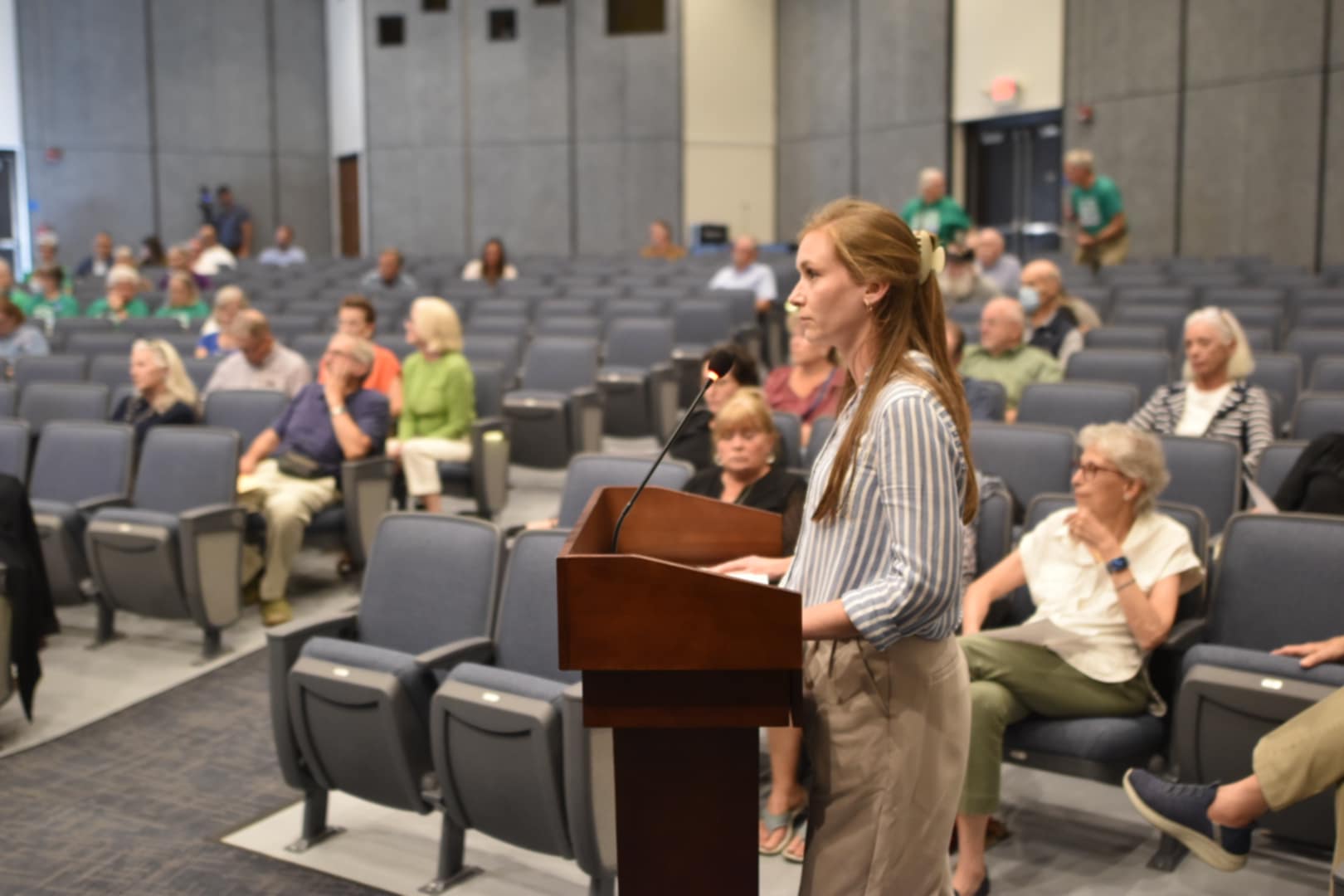
PORTSMOUTH, R.I. — While polling shows they have wide public support, southern New England’s offshore wind projects continue to be dogged by vocal opposition — and at times, misinformation — from a minority of local residents and property owners, as evidenced by a public forum Wednesday evening.
The temperature was rising, literally, as about 100 people gathered in the Portsmouth Middle School auditorium to express their support or opposition to a proposal from SouthCoast Wind to run its export cables underground through town.
The 4-hour-plus public comment hearing was organized by the state Energy Facility Siting Board (EFSB), the regulating government entity in Rhode Island that has authority over the export cables from the offshore wind project, the only part of the project in which state officials have a say.
The project itself, and the substation where the electricity generated by the turbines will connect into the grid, is outside Rhode Island’s lands and waters. The turbines will sit in a lease area in federal waters, and the substation sits at Brayton Point in Somerset, Mass.
The export cables, proposed to run up the Sakonnet River and then underground through Portsmouth to Mount Hope Bay, are the only part of the project Rhode Island gets jurisdiction over.
The July 23 public comment hearing was part of the process for considering SouthCoast Wind’s export cables. But that didn’t stop some residents from voicing their overall opposition to the entire project.
“The cables are going through my neighborhood, and I’m extremely worried,” Portsmouth resident Karen Gleason said. “I haven’t slept at all because I’m very worried about 350,000 volts of power coming through the cables.”
Gleason told the EFSB she was concerned about the impact of the project on Island Park Beach, a shoreline access point and public park off Park Avenue used by residents and which is close to Boyds Lane, the likely cable route to be used by SouthCoast Wind if the project is approved by state regulators.
The construction phase of the project also concerned Gleason. She told board members she was concerned about the traffic interruptions due to road closures from the cable burying project, as well as noise pollution and possible dust and other particulate matter that could result.
“Dust presents a big concern, like noise,” she said. “The SouthCoast project could potentially impact the air quality, public health, and the environment.”
SouthCoast Wind is the latest offshore wind project coming to Rhode Island. The project will occupy a federal lease area about 30 miles south of Martha’s Vineyard, and is expected to generate 2,400 megawatts (MW) of electricity, powering around a million homes by the end of the decade. At least 200 MW are slated to go to Rhode Island, with the remaining power going to Massachusetts. The remaining 1,200 MW are expected to make landfall at a separate export cable branch in Falmouth.
Once completed, the project is expected to avoid 4 million metric tons of greenhouse emissions annually, which will have a significant impact on the state’s emission reduction goals and renewable energy standard.
As a host community for the project, Portsmouth would be paid $23 million over 33 years in payments in lieu of taxes (PILOT) for using public byways to host the export cables.
But the project hasn’t been without stumbling blocks. In 2023, citing the rising costs of materials and interest rates, SouthCoast Wind chose to back out of its power-purchase agreements (PPA), paying a penalty for doing so, and bid for a more cost-effective agreement later.
With the inauguration of President Donald Trump for a second term, uncertainty about the project began to rise. The Trump administration has issued several executive orders seeking to claw back approvals of offshore wind projects and shut down their construction along the Eastern Seaboard permanently.
The project received its final, significant federal approval from the Bureau of Ocean Energy Management (BOEM) in January, and local coastal regulators signed off on the project in December 2023.
But SouthCoast Wind and Rhode Island Energy have delayed signing the final contract four times this year, likely due to the administration in Washington, D.C. now hostile to the entire offshore wind sector. The two companies have until Nov. 1 to negotiate and execute a contract.
Many other project opponents who attended the hearing parroted false claims that have been debunked by environmental scientists and other experts, including false narratives that export cables would heat the water around them by 36 degrees and emit electromagnetic fields dangerous to fish and migratory species; falsely alleging the project would cause sediment plumes that resuspend toxic heavy metals; claims that the wind turbines would never “pay back” the emissions generated from their construction.
In the past, ecoRI News has extensively covered and debunked many similar claims regarding offshore wind, and many claims pushed Wednesday by opponents of the project are similar to arguments made in a white paper issued by Green Oceans, a Rhode Island-based nonprofit that opposes offshore wind in the United States.
Environmental groups, labor unions, and members of the public pushed back against those comments, claiming that, in the face of climate change, offshore wind was the only alternative renewable energy source ready to be installed at scale and wean Rhode Island off its fossil fuel dependence.
“What you’re seeing here tonight is an attempt to go after the Achilles’ heel of an important energy source we need, but this project meets the criteria the EFSB is supposed to evaluate,” said J. Timmons Roberts, professor of environmental studies and of environment and sociology at Brown University. “It will meet the energy needs of the state, it’s cost-justified, it’s in compliance with environmental laws and it doesn’t harm the environment. This is a very minor cost for a very big social benefit.”
Carmine Rossi, a union member of Local 271, spoke in favor of the SouthCoast Wind project, telling board members about his experience working for 16 months on the Revolution Wind project in the Port of Providence as a foreman.
“Because of the project, I was able to provide for my family,” said Rossi, “with family sustaining wages, benefits, and health care for myself, my wife, and our five children.”
Other groups supporting the project include the Green Energy Consumers Alliance, the Rhode Island office of the Acadia Center, the Conservation Law Foundation, Climate Action Rhode Island, and 24 state representatives and 11 state senators.
The EFSB is expected to render a final decision on the export cables later this year.


There’s insufficient understanding of the Sakonnet River and its watershed to even begin to understand impacts from a major industrial installation, which is inherently damaging by the very nature of heavy construction. Leave the environment alone. Want the project? Do the science… it’s not about ‘myth debunking’.
The Sakonnet River and the eastern part of Narragansett Bay has over a hundred thousand people living immediately adjacent to it and until recently was home to the largest coal-fired generating station in New England. Sure, let’s do before-after testing (if you can find a scrap of money for science these days), but let’s not pretend there is good evidence to not do this or that we didn’t rush headlong into similar projects and large scale development.
It is simply greenwashing propaganda to say wind turbines and solar panels produce clean power. One needs only to follow the supply chains of how these machines are built. It requires a massive amount of fossil fuels throughout their process and thousands of acres of habitat destruction from the footprint to the mines for the minerals needed.
“Renewables” have many inherent flaws rooted in physics, chemistry, manufacturing technology and atmospheric conditions (aka weather). Pointing them out has nothing to do with denying climate change, though.
Avoiding catastrophic effects of climate change requires the planet to stop burning fossil fuels.
But shifting the present industrial infrastructure to a system requiring huge amounts of metal intensive-mined energy storage will only add to the current use of carbon-based energy.