
‘Iconic Trees’ Forum in Newport Tackles Issue of Beech Leaf Disease
May 12, 2025
Share


NEWPORT, R.I. — There are at least 504 beech trees in varieties large and small, native and foreign, dotting the private and public properties in the city.
“Now, this is probably just a fraction of what actually exists in Newport,” said Joe Verstandig, Newport Tree Conservancy’s living collection manager said, “because we can’t obviously inventory every tree, as much as we’d like to try to do that.”
One of the largest clusters is on Salve Regina University’s campus, about 200 trees in total, he explained at the second “Iconic Trees of Newport” gathering on Thursday.
Speaking in front of a crowd of about 150 people in person and about 200 more on Zoom, Verstandig went on to say the largest individual beech tree in the Newport Arboretum collection is a European beech that sits next to the Edward King House; it’s 80 inches in diameter.
“Unfortunately, that tree is in a great state of decline,” he added.
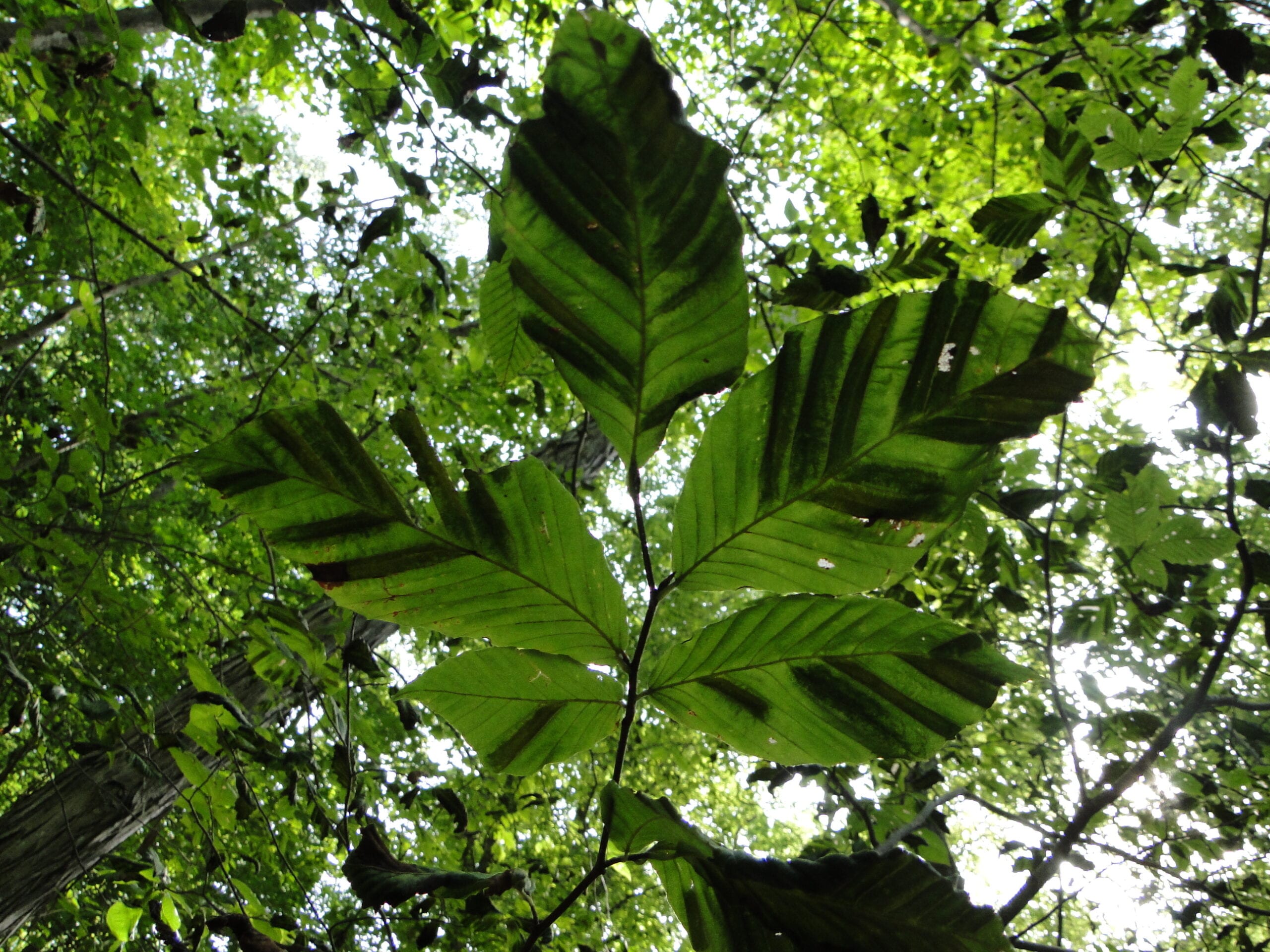
Verstandig was referring to beech leaf disease, a nematode that has infested American and European beech trees in the northeastern United States for years now, killing a huge number of trees over the past several years, including many in Newport County.
The Iconic Trees forum, which included speakers from the Newport Tree Conservancy, the Preservation Society of Newport County (which hosted the event at Rosecliff), Aquidneck Island Land Trust, the city, and Bartlett Tree Experts, aimed to present the latest research on the disease and update members of the public about how it’s impacting local plants and forests. Some key points included:
Experts have found treatments that can prevent beach leaf disease in individual trees.
According to Matthew Borden, a plant pathologist at Bartlett, there are two main treatments effective in saving beech trees. One is a foliar spray that can be applied to the leaves before the nematodes arrive, and the other is an anti-parasite treatment that can be injected into a tree’s root flare.
The first option is most effective on smaller trees. The second works best on larger trees, but requires more technical training and equipment, Borden said.
Now that experts know that there are options that work, Borden said he and others are working on ways to optimize treatment plans so they can use fewer pesticides in the future.
“A lot of folks are glad that at least now we have some options coming onto the table,” he said.
In addition to chemical options, holistic horticultural practices can also make a difference.
Jeff Curtis, director of gardens and landscapes for the Preservation Society, noted that watering, weeding, and mulching can go a long way toward helping plants stay healthy and prevent disease.
Healthier plants, he said, are more likely to fight off the impacts of the disease-causing nematodes, which damage newly forming leaves inside leaf buds during the winter. After emerging in the spring, the damaged leaves lead to reduced tree vigor and can eventually lead to tree mortality.
“To make the tree survive the elements … you can mulch your tree,” Curtis said.
The preservation society, for example, saves its leaf litter and wood scraps to reuse as a layer of much around the beech trees, which saves time weeding and also helps the plants retain moisture.
Despite the gains in understanding and treatment, beech leaf disease is still difficult to treat on a larger scale in environments where there are many trees, such as a beech tree forest.
“I’m going to, unfortunately, have to turn the tide a little bit because we’ve heard a lot of good news,” Aquidneck Island Land Trust executive director Terry Sullivan said near the end of the talk. “But there is also an ecological disaster happening in our beech forests around the Northeast.”
Specifically discussing Oakland Forest, a 30-acre parcel of land in Portsmouth that includes old-growth beech trees preserved by the land trust, Sullivan noted the area has been hit hard by beech leaf disease in part because it has such a high volume of the trees.
Sullivan said the land trust is working with Bartlett on a study to determine if “social distancing” and “herd immunity” could help protect those trees.
Bartlett’s Andrew Loyd explained that while individually inoculating beech trees either with leaf sprays or root flare injections is effective, it’s hard to do on a massive scale. But there could be other methods, which they’ll test at Oakland Forest, that could still help.
Smaller trees, for instance, seem less resistant to beech leaf disease than bigger, more mature ones.
“If we can slow beach leaf disease by removing some of these nematode manufacturing plants, we can reduce the inoculum, and then we can also do some crown separation pruning to allow light to come into the forest, can we slow it down?” he said.
Another method they are considering includes strategically inoculating some trees in an effort to create “herd immunity,” he said, by getting to a level of population immunization high enough to protect uninoculated trees.
“We want to look at long term sustainable management solutions to preserve American beech, as well as our forests, and reduce the overall impacts of this impressive, devastating disease,” Lloyd said.
I have several large Beach trees on my property. They are all infected. For about 3 or 4 years now. They’re hanging in there but the leaves drop in June. The forest around my property it’s very thin now with lots of sunlight coming through. It’s a sad situation.