
Dying 100-Year-Old Elm On Brown Campus Lives On Through Special Projects
December 1, 2025
Share


PROVIDENCE — Eiden Spilker’s adventure turning a 100-year-old elm tree into art was “sort of happenstance,” he said, or perhaps a series of happenstances.
Spilker, who graduated from Brown University in 2024, is a technical specialist and maker-in-residence at the Brown Design Workshop, where students and members of the community have access to sewing machines to 3D printers.
The artist had studied architecture and visual art at Brown and worked at the Design Workshop as a monitor when he was a student.
“I basically stayed on to sort of build out the woodworking area and be a resource for community members if they have questions about projects, to do more specialized workshops,” Spilker said.
While Spilker was studying at Brown and setting himself up for his first post-grad job, an elm tree with a gigantic canopy, a fixture on the university’s Main Green, was dying.
Estimated to be between 80 and 120 years old, the elm had escaped Dutch elm disease, the illness that had hit Brown and Providence’s other historic trees almost a decade earlier, and was instead falling victim to things greater than itself: time and humankind.
The Brown Daily Herald reported in 2023 that the leafless elm was suffering from the effects of age, climate change, and its location in a high-traffic area on campus. The groundskeepers decided the following year it needed to come down.
Even though the tree would no longer shade students on the sunny days of late spring or carpet the green grass of Brown’s lawn with its leaves in fall, its timber could still be put to use.
That’s where Spilker comes in. His boss, Brown Design Workshop director Louise Manfredi, had acquired some of the felled giant.
“I don’t know how she ended up getting a few of the branches almost immediately after it came down,” Spilker said. But once she did, he began sculpting, eventually getting more of the wood from Brown’s Facilities Management Department.
After getting started on art pieces of his own, he helped assemble the funding to start a project that invites others to pitch their own ideas for the elm.
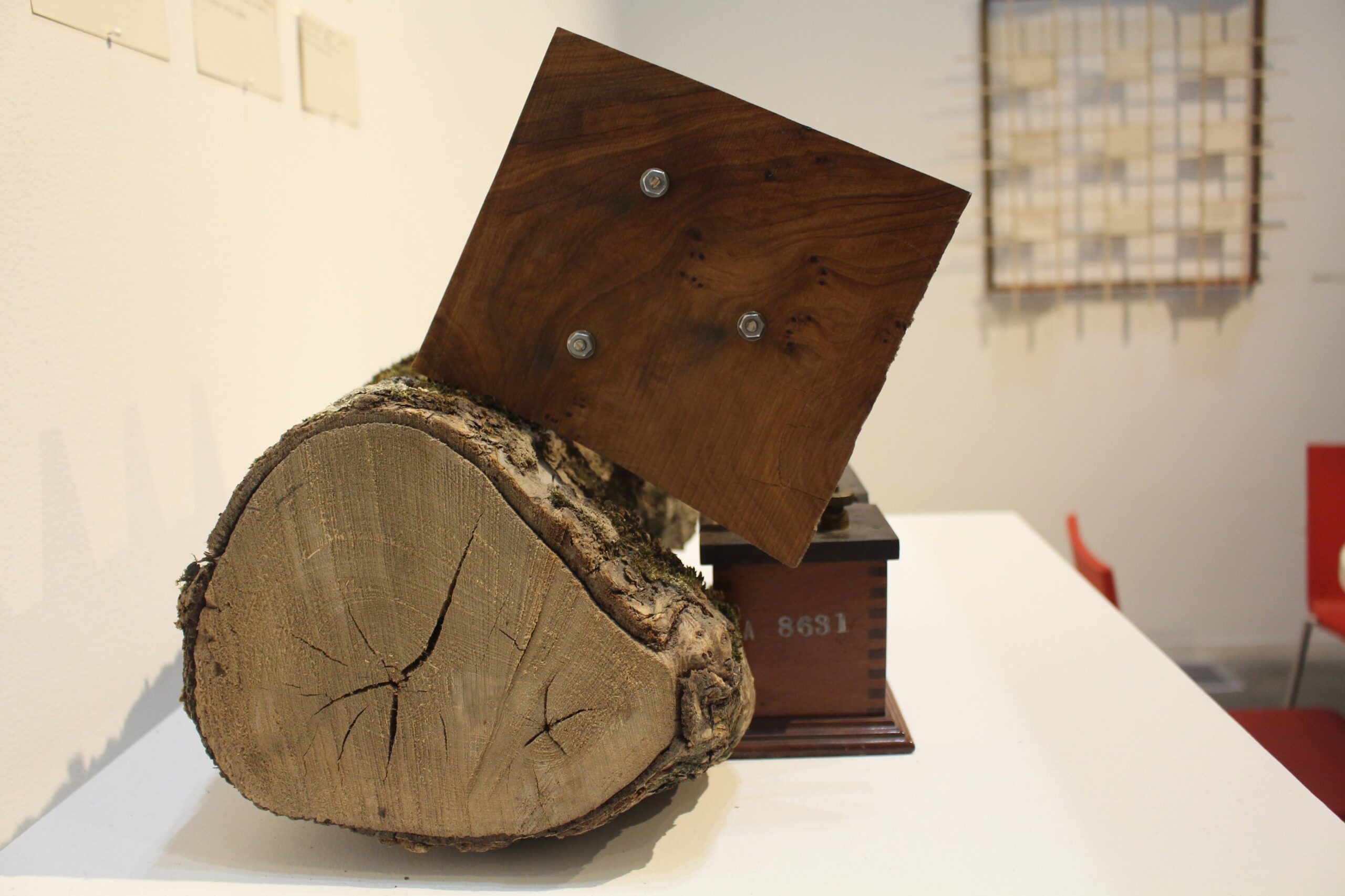
Spilker’s solo show, featuring his elm art, “Between Past and Future,” is on display at the Granoff Center for the Creative Arts on Brown’s campus until Dec. 12.
The show includes pieces such as bowls, candlesticks, and sculptures carved from the branches and stump of the tree as well as other “found objects” like pieces of lab equipment and old index cards.
One of the unique parts of the project is that the elm used for the exhibit didn’t undergo the typical processes used on wood before Spilker started working on it.
“There’s many different schools within woodworking, but most furniture or construction, you’re using wood that’s been cut to a certain dimension, and flattened out, and usually kiln dried,” he said. “That is a controlled process that removes the moisture, and so there’s less likelihood that it’s going to crack afterward.”
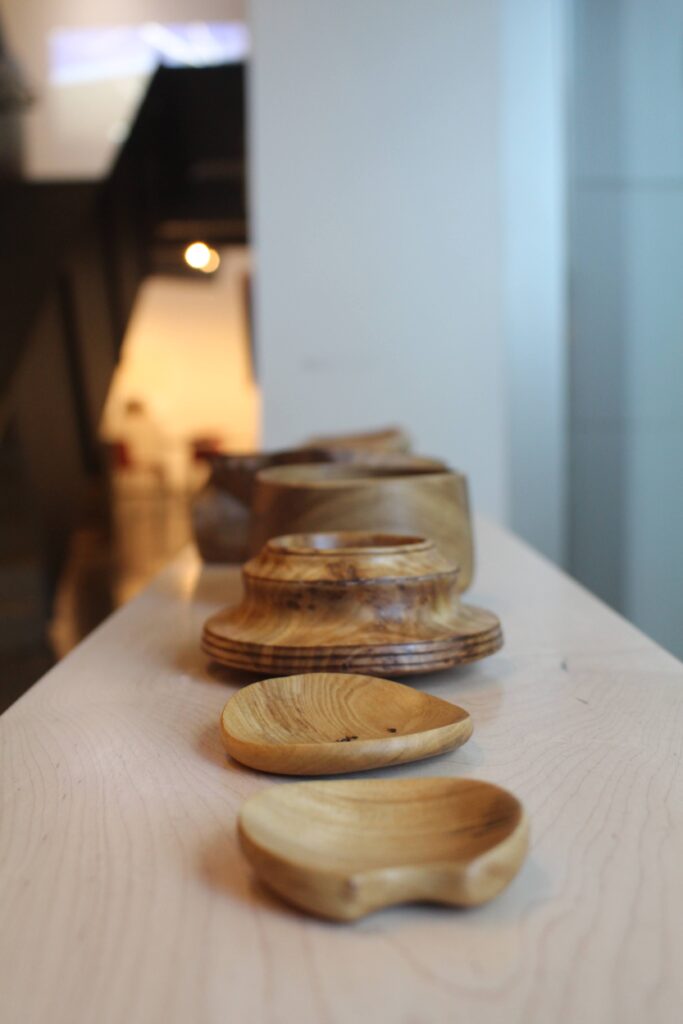
Instead, Spilker used green woodworking practices, “where you’re taking the log, splitting it and working with it, and sort of accounting for the rough form, figuring out different ways to shape it.”
Initially, Spilker tried to shape the wood into blanks with a band saw. When that didn’t work, he turned to draw knives and an adze, which is like a curved axe, to work with the natural grains of the material.
“I also found out the hard way that elm is not a wood that’s good for splitting,” said Spilker, which is one of the main tools of green woodworking. The interlocking grain of the elm made it a challenge, but also explains why the wood works so well for tool handles and chairs.
Beyond the physical elements of the wood, the exhibit also dives into more abstract questions, Spilker told ecoRI News, such as “what it means to consider something historic.”
“Are we connecting to that nostalgia, like, ‘Oh my god, I studied under this tree,’ and have all these memories where retroactively, we can locate the tree within it, even though, at the time it wasn’t really prominently featured?” he asked.
Then, there’s parsing through all the history the tree witnessed. “There’s so many different angles,” Spilker said, and he hopes they can be explored and fleshed out more in an exhibit that will be called “Point of Entry” planned for the spring.
Applications for that project opened last week. Ten spots are available for individuals interested in working with the wood. Proposals are due Dec. 15.
“Who gets to define the meaning of this material?” Spilker asked. “I think the best way is just opening it up to as many people as possible.”

That Elm clearly had Dutch Elm Disease “DED”. The picture at the top has a distinct brown ring where the vascular cambium is. DED is a disease that affects the trees vascular system. Typically vectored by the elm bark beetle, a fungus is introduced to the tree where then the trees tries to compartmentalize the fungus by blocking vascular cells, ultimately killing the tree.
Stating this the “escaped” Dutch elm disease is misleading. Statements from this publication are often misleading.
Glad the elm was salvaged and put to use. Beautiful wood.