
DEM’s Trout-Stocking Program an Annual Ritual in Rhode Island
October 10, 2024
Share


LINCOLN, R.I. — There’s a chill in the October air, and the water, as the truck backs into Olney Pond.
From the front, an industrial truck like this looks unusual, putting its rear tires into the waters of a state park. But the shield emblazoned on the vehicle’s blue cabin hints toward more unusual cargo. It depicts a pair of fish swimming above a flying goose: the logo for the Rhode Island Department of Environmental Management’s Division of Fish and Wildlife.
The truck stops in the pond just as the water touches the rims of its back wheels. A pair of men exit the cabin, each one wearing waders, hoodies, and baseball caps etched with the division’s logo. From the back of the truck, they grab fish landing nets and open the top hatch on the large gray tank the truck is carrying.
The two men are making an unusual delivery. The tanks on the back of the truck are actually enormous water tanks, carrying around 2,000 fish overall, taken from DEM’s hatcheries in North Kingstown and Richmond to be delivered to different ponds and lakes around the state.
Using the nets, the men skim them into the water tank, pulling half a dozen fish or more out of the receptacle at a time, and unceremoniously dumping them into the waters of Olney Pond. They do this about six or seven times each, before a man on the right side of the truck turns a valve to open one of the spouts on the back of the tanks, which shoots gallons of water — and plenty of fish — directly into the pond.

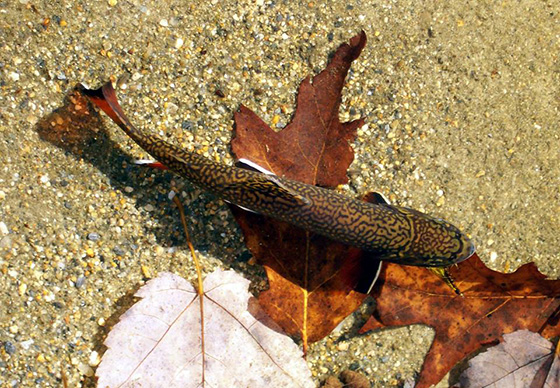
The unusual delivery is part of DEM’s annual trout-stocking program, an autumn staple for local anglers. Multiple times a year during the trout fishing season, the department stocks waterways around the state, primarily with rainbow and brook trout, for recreational anglers to catch, so long as they have a state permit and trout stamps.
Senior wildlife biologist Kenneth “KC” Fernstrom, who has worked for the Division of Fish and Wildlife since the late 1990s, said the program is all about taking fishing pressure off the native fish inhabiting state waters.
“We do this to make sure we have enough trout for anglers to catch,” he said. “There’s not enough native fishing population for the anglers to catch on their own.”
Trout isn’t traditionally found in the wild in Rhode Island. The only native species in Rhode Island in the eastern brook trout and its habitat range is severely limited to the region’s few remaining cold-water streams, such as the upper Wood River in Exeter.
The fish getting delivered by DEM into waterways are raised from fish eggs in enormous water tanks in the hatchery. As the fish grow in size, they are moved to successively larger and larger tanks with other trout of similar size. Most of the fish getting stocked in Olney Pond are between 18 and 24 months old, although it’s hard to tell the age of a fish, noted Fernstrom, and some may be as old as 3.
The rainbow trout getting stocked aren’t native to Rhode Island; rather, they’re traditionally found in the Pacific Northwest. Despite being nonnative, Fernstrom said he expects almost all of the trout stocked by the department to be caught by anglers by next summer.
Brook trout and rainbow trout are species that thrive in cold water, typically water colder than 66 degrees Fahrenheit. They struggle in the summer, when water temperatures in Rhode Island can exceed their limits, but Fernstrom noted the department has never seen mass die-offs due to temperature.
The rarity of native trout is a big impetus for the fish-stocking program. The trout fishing season lasts from April to February, and the department stocks around 25 waterways with thousands of fish grown in DEM’s hatcheries. It will take six weeks for the department to stock the rest of the ponds on the list, and any pond with a current cyanobacteria advisory on it from DEM and the Rhode Island Department of Health will not be stocked.
Recreational fishing is big business and a popular pastime in Rhode Island. It contributes $130 million to the state economy every year, and the U.S. Fish and Wildlife Service estimates there are more than 175,000 recreational anglers fishing in Rhode Island every year.
Throughout the year, DEM’s hatchery program stocks some 100 waterbodies with four different types of trout and other fish species. So far, the department has stocked ponds in Coventry, Charlestown, Westerly, Foster, Richmond, and Hopkinton, in addition to Olney Pond.

DEM limits the size and the amount recreational anglers can take. Trout caught must be a minimum of 8 inches in length, and anglers are limited to a certain number of fish per day, as well as other restrictions.
After about 15 minutes, the two men finish stocking the pond and get back in the truck. Only half of the truck’s load is being used to stock Olney Pond. The other half will be used directly after to stock East Providence’s Willett Pond. Fernstrom said the department will likely stock Olney Pond again later in the year for winter ice fishing.
“It’s about whatever helps people if they want to catch trout, catch trout,” said Fernstrom, as the truck pulled out of the water and drove off.

Several years ago Frank Carini took a serious look at issues surrounding the stocking of hatchery reared trout in RI. He contacted a variety of interested entities and did some research. The piece was informative, timely, and balanced. Mr.Smith’s item here may not even qualify as “fluff”. He clearly did not inform himself beyond accepting the party line from RIDEM. Did he not understand even that he was switching back and forth from the freshwater scene to the saltwater? This is not the caliber of work I’d come to expect from you all over the last several years and for which I was willing to provide support.