
Climate Action Group Invites All Rhode Islanders to Fight Climate Change
March 19, 2025
Share


“People Power!” The 60-year-old slogan pulls a long trail of historic images: generations of Americans with cardboard placards and raised fists, marching, milling about, demanding attention and action from government and society. But is the slogan still relevant?
For an answer, look no further than Climate Action Rhode Island (CARI) a volunteer, citizen-driven activist group formed in spring 2017, soon after the start of the first Trump administration, to push for solutions to the climate crisis.
“We are known as the environmental group that brings the troops out,” said Jeff Migneault, a co-founder and now the co-president of CARI.
The nonprofit has been busy in the state, including attending innumerable legislative hearings, since early 2017. President Trump’s reelection in 2024 led to a bump in new membership. Active members include a few hundred people; CARI has a mailing list of 3,500 people and a dynamic presence on Facebook, Bluesky, Instagram, and YouTube.
Groups within CARI include a politics team, which tracks and comments on climate legislation and endorses candidates for office; a legal team, which has been involved in friend-of-the-court briefs to oppose groups trying to block offshore wind farms; a mobilization team; and an education team, among others.
The newest subgroup, which is ramping up rapidly this year, is Yes to Wind, formed to promote the value of renewable offshore wind and to confront the misinformation promoted by anti-wind groups.
The pro-offshore wind arm of CARI made itself visible in December 2023, when members demonstrated outside a Christmas party hosted by the Preservation Society of Newport County. A few months earlier, the Preservation Society had filed a lawsuit against the U.S. Department of the Interior to block the Revolution Wind project, which is slated to be built about 15 nautical miles off Point Judith and whose turbines would be slightly visible from Newport. Demonstrators outside the Christmas party held signs declaring “Let’s preserve our sea level” and “Lives over views,” a reference to fears in Newport that offshore turbines would sully the sea view.
‘Catching a wave’
CARI’s origin story starts with the organization Resist Hate RI, formed right after Trump’s first election in 2016. By early the following year, CARI spun off as an independent organization focused on climate problems.
“There was a feeling that the climate crisis was inexorably growing and only a mass movement could stop it,” said Justin Boyan, one of CARI’s co-founders. “We thought of ourselves as needing to bring visibility and to dramatize the climate crisis to people.”
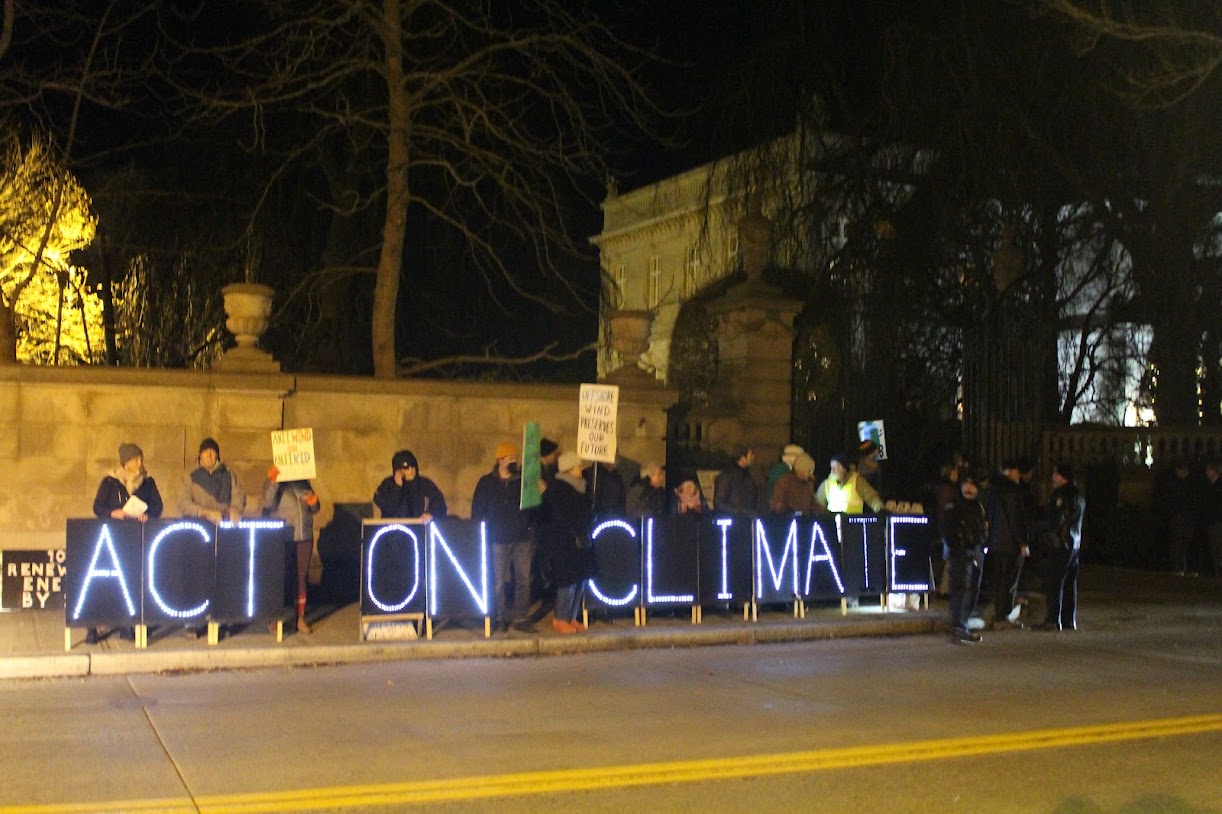
CARI does, indeed, have a flair for drama, even playfulness. One of its early acts was to build an 11-foot banner of blue cloth strung on poles to illustrate the projected rise in sea level that threatens Providence.
In February 2018, the first Trump administration sent its Department of the Interior secretary to the Providence Marriott to talk up plans for oil drilling off New England’s coast, in what CARI called a “sham” event because no public comments were allowed. CARI brought its troops to the Marriott and hosted a “People’s Hearing on Offshore Drilling” next to the DOI presentation. Speaker after speaker stepped onto a soapbox and railed against offshore drilling.
In October 2017, on very short notice, CARI attracted about 40 people to protest a Narragansett Bay watershed workshop in Providence at which the Environmental Protection Agency had forbidden its scientists to speak. Protesters placed tape across their mouths and held signs “Ungag the EPA” and “Facts Are Stubborn Things.”
In another small bit of drama, opposing banks that finance fossil fuel development, CARI members laid down on the lobby floor of a Chase Bank branch with tombstones at their heads and holding signs saying “Chase Funds Climate Disaster” and “Don’t Frack With My $.”
CARI hosts monthly meetings and invites various climate experts to talk about their work.
Building an organization like CARI, Boyan said, requires “defining your brand and what you stand for and then promoting it. A lot of it is catching a wave when external events happen, and galvanizing people.”
Small state, big results
Caitlin Sanford, co-president of CARI, worked on climate change matters from 2007 to 2009 in Nairobi, Kenya’s capital city, with the U.N. Environment Programme. She moved from California to Providence in 2020. After her daughter was born in 2021, Sanford told herself, “I have better get back to climate.”
Sanford said a big advantage to CARI’s work is Rhode Island’s intimate size, which creates easier access to state and local officials. “It feels like it is more possible to get things done,” she said. “With a smaller number of people on our side we can still make an impact.” For example, “if we want to bring in [and consult] a green builder, someone in the group is going to know a green builder.”
Sanford, who was formerly the CARI treasurer, said the group’s funding comes from grants and fundraising events, like its annual picnic. Last year, she said, CARI raised $60,000. Among sources of grants are the Global Greengrants Fund and the climate defense group 350.org.
CARI is an affiliate of 350.org, a global organization founded in 2008 to work on problems of climate change. (The 350 in the name stands for 350 parts per million of carbon dioxide, which is considered the safe upper limit to avoid a climate tipping point. The global average concentration of carbon dioxide in the atmosphere now is about 426 ppm.)
In mid-2024, the New England Offshore Wind Coalition presented a grant of $10,000 to the CARI Education Fund, also a 501(c)(3) organization and a CARI partner organization. Funds from that grant were spent on educating the public on the benefits of offshore wind energy, said Sanford, who noted that CARI doesn’t take money from wind developers, which is an allegation frequently raised by anti-wind activists.
CARI employs a part-time paid staff member and an energy fellow from the University of Rhode Island.
Sanford said Trump’s election last year was greeted with reactions ranging from despair to anger, “but for some people, it has fired them up,” boosting CARI membership since last November. Sanford said one of the group’s goals, moving forward, is to broaden its membership. She said she would like to bring in more young people, for instance, “and let them do their thing under the banner of CARI.”
Offshore wind battles
Christian Roselund is head of the young Yes to Wind group within CARI. He works as an energy policy analyst and has been active on transportation topics related to climate through the Providence Urbanist Network.
Roselund said offshore wind projects “are the single most important piece for solving our climate crisis” by creating a consistent source for renewable energy. Yes to Wind was formalized partly to fight misinformation by anti-wind organizations such as Little Compton-based Green Oceans, which believes offshore wind turbines harm whales, a view that is denied by marine scientists in Rhode Island and elsewhere.
“Green Oceans would like to push this narrative that they are protecting the oceans,” Roselund said. “They are not. The oceans are in deep, deep danger because of climate change.”
A poll by Hart Research for the Barr Foundation in June 2024 showed that 67% of Rhode Island respondents express support for their state working with Connecticut and Massachusetts to build offshore wind. Other polls have shown similar levels of support in Rhode Island for such projects.
“A lot of people in this state care about the climate,” said Roselund, noting that pro-wind people, including CARI, turn out in force at public meetings, for example, of the Coastal Resources Management Council, the Ocean State’s coastal regulation agency.
CARI’s “kind of organizing works well when you have an issue that people care about, and people care about the climate,” Roselund said. CARI also urges members and the public to show up and be heard at out-of-state public meetings pertaining to permitting offshore wind, most recently in Westport, Mass.
Yes to Wind’s campaign includes and a YouTube channel with personal messages from Rhode Islanders such as Newport resident Bart Lloyd and Barrington resident Hans Scholl, who speak to the camera while they row boats.
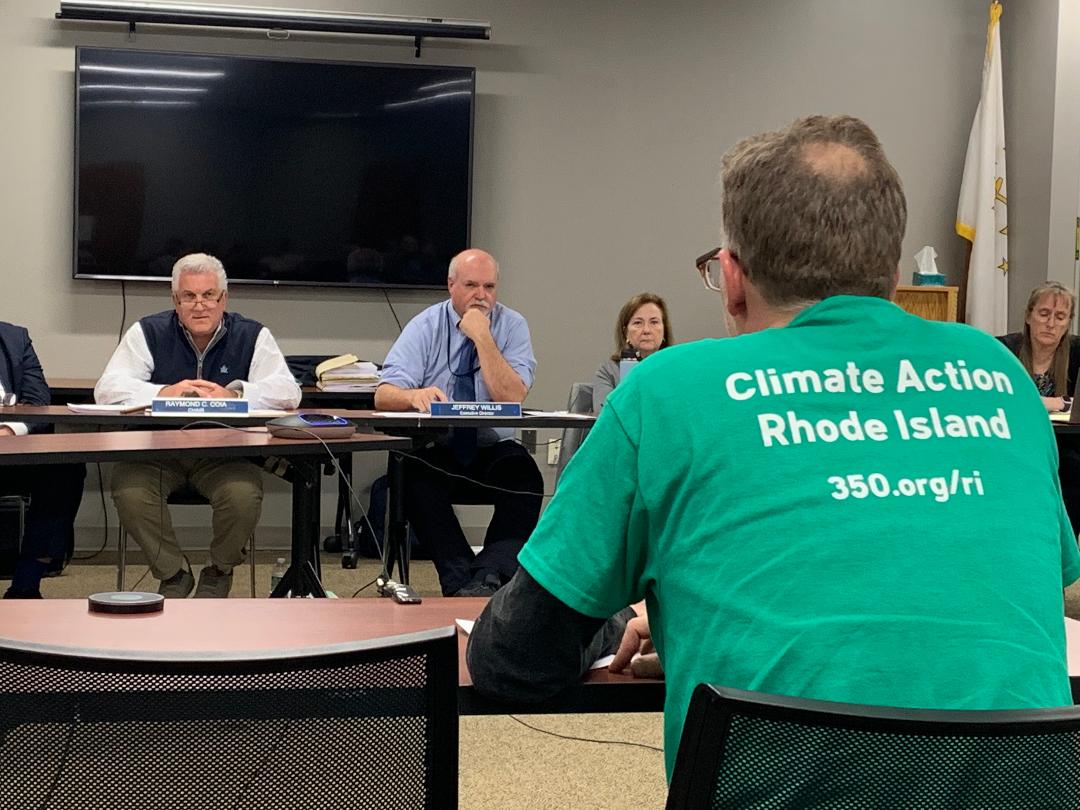
Roselund said Yes to Wind is playing catch-up to the anti-wind rhetoric by Green Oceans and others. Noting that $550,000 — Green Oceans’s revenues in 2023 — “will buy you a lot of social media and air space.”
Said Sanford, “We have been a little bit outgunned; the anti-wind people have been organized. It is easier to say ‘no’ to development than to say ‘yes.’” But, she added, “I think we are catching up on them.”
Mark Herr, a spokesperson for Green Oceans, said “We share CARI’s concerns about the environment, but strongly disagree with how best to protect and preserve the marine ecosystem.”
‘Enough is enough’
Aaron Regunberg is director of the Climate Accountability Project of Public Citizen and a former state representative from 2015 to 2019. He has been aware of CARI since it started as an offspring of Resist Hate RI. After the presidential election of 2016, “there was a massive wave of people wanting to get involved,” but “most people don’t have any reason to know the most useful ways to make a political impact.”
“CARI was the open door,” he said. “This is a group that is trying to deal with concrete challenges and to get stuff done. CARI carved out an important role in the environmental movement.”
Regunberg speaks in apocalyptic terms about climate change. “There is a vanishingly small window to correct this. That does not mean we stop fighting. There is no point at which the fight won’t matter.”
With the second Trump term “only bad things are going to come from the federal government,” Regunberg said. “So the fight at the local level is the last line of defense.”
Roselund and others noted the high caliber of skilled people — attorneys, journalists, communications experts — who volunteer with CARI.
Boyan, the co-founder, takes a different view. “I don’t think of us as a group with a lot of experts. Some of our most powerful volunteers are not credentialed. When they show up, they testify as concerned citizens worried about the quality of life on a dying planet. People don’t have to be an expert to join a group. They just have to show up and say ‘enough is enough.’”



Solar variability drives our climates.
Yes I have PhD in geophysics
Sadly, much of the 67% cited as being in favor of dangerous offshore wind (OSW) projects have no clue of their negative impacts on our oceans; they have been sold a bill of goods that not supporting such will be “apocalyptic.” Once again the people ignore the fact that OSW is unreliable as an energy source and likely detrimental to marine life, especially seen from a cumulative view.
Utilitarianism fueled by fear and stacks of dollars for those supporting the cause has displaced the sound applications of the precautionary principle which should be followed in light of the scientific uncertainty about impacts.
Our oceans are, indeed, threatened by global warming and acidification, but putting your support behind a futile ineffective solution that presents grave concerns about its impacts are a foolish way to proceed.
KEEP IT WILD!
Save the Bay submitted pro wind energy testimony to CRMC in 2021 in selective sites that avoid important wildlife habitats. See their last magazine for an informative feature article.
Green Oceans is a phony fossil fuel funded group that is totally clueless about the science and liars to boot.
Thank you for this fine report Mary.
Let’s go CARI! Hundreds of thousands of Rhode Islanders are behind you and support your mission. We will never stop fighting and winning against the lies and disinformation of climate deniers. Offshore Wind will continue advancing. Why? Because it’s less worse than fossil fuel energy, lowers energy costs for RI residents, especially during the winter when winds blow strongest and fossil fuel prices are the highest. Also, there is ZERO evidence that offshore wind endangers whales. What does harm and kill whales is entanglement with fishing gear, and ship strikes to these innocent marine mammals.
There is NO escape from the horrific effects from a warming planet. It is and will continue to negatively effect and kill all of us, along with precious wildlife and the natural world ecosystems life depends on.
We will never let self serving interests of the few conquer the masses. Never!