
Aquidneck Island Prepared to Make Transit Active
Ride Island initiative focused on creating connected bike network
April 7, 2025
Share


NEWPORT, R.I. — The initiative’s goal, a connected bicycle network for Aquidneck Island, is a lofty one. It’s also essential, to help address transit safety, public health, and the climate crisis.
Ride Island, an effort to advance non-vehicle transit on Aquidneck Island, is led by Bike Newport, Grow Smart Rhode Island, and Toole Design. It’s being funded by the van Beuren Charitable Foundation.
Those behind the effort believe the creation of a connected bike network, which would also support pedestrian travel, would encourage more and safer bicycle transit on Aquidneck Island.
The idea is to make it possible for people who want to bicycle and walk to get where they need to go, which in large part are short distances, according to Bari Freeman, founder and executive director of Bike Newport.
Freeman and other transit advocates have long viewed the Narragansett Bay island, which is just 5 miles wide and 15 miles long, as a prime candidate for improved bicycle transit.
Aquidneck Island’s compact size makes bicycle and pedestrian transit realistic. The numbers support the possibility: cars are used for 80% of all trips less than 4 miles; 50% of all trips less than 2 miles; and 24% off all trips less than a mile.
All those trips are easily bikeable, but to make them safer and more efficient requires a different way of viewing transportation beyond cars. Public and active transit are required to meet the needs and challenges of the 21st century.
A survey conducted last year for Ride Island found 60% of those living on Aquidneck Island want to bicycle but don’t because they are concerned about safety.
Bicycling to the Newport Folk Festival is another indicator that more, better, and safer bike infrastructure would be a welcome addition to the island. About 1,600 cyclists per day now ride to the popular three-day music festival.
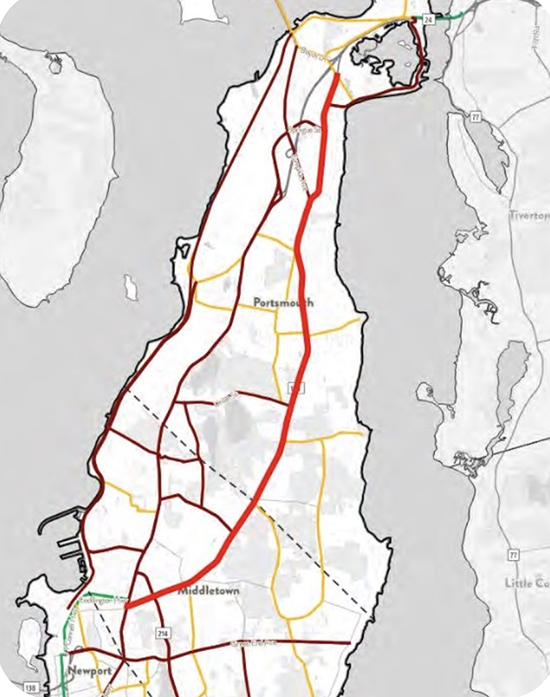
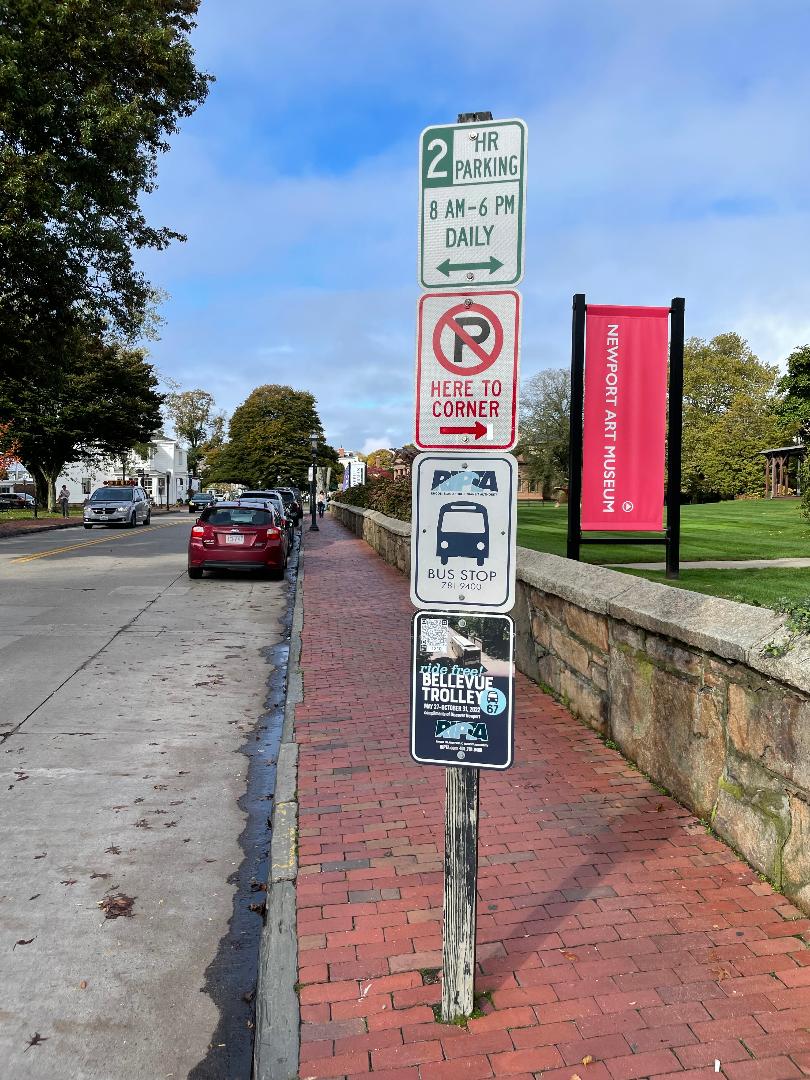
The island’s two main thoroughfares, however, aren’t safe for bicycling, or even walking. There’s barely room on East and West Main roads to wait safely for the bus.
This lack of protected or even separated non-vehicle infrastructure is why when it comes to commuting to work only 18% of Newport residents walk, bicycle or use public transit. That percentage shrinks considerably as you move north — 5.8% in Middletown and 2.2% in Portsmouth.
“There’s that saying, ‘If you build it, they will come,’” said Emily Buck, chair of the Middletown Bicycle & Pedestrian Advisory Committee. “But like, right now, it’s taboo to bike from Portsmouth to Newport, but if you had the facilities and saw people were doing it, more people are going to do it. Right now, people might say, ‘Well, there’s not enough bikes to support, not enough people doing that, to support new infrastructure.’ But then you put the infrastructure in and more people are going to bike from Portsmouth to Newport. It will become common practice.”
John Flaherty, the former deputy director of Grow Smart Rhode Island and a longtime transit advocate, is a member of the Ride Island leadership team. He said making Aquidneck Island safer for bicycling would improve quality of life, reduce traffic congestion and greenhouse gas emissions, and make the three island communities more attractive for economic investment.
The biggest speed bump to the initiative is, of course, political will and its accompanying funding.
“There’s no commitment from the state,” Flaherty said. “When Biden was elected, there was money available for active transit that required a local match. We collectively squandered those four years.”
He noted Rhode Island missed out on tens of millions for bike and pedestrian infrastructure projects because the state didn’t even try to match the 20% requirement. He also noted “there are a lot of gaps” on Aquidneck Island when it comes to connected bike paths.
Last year Rep. Teresa Tanzi, D-South Kingstown, introduced a bond referendum bill that would have asked voters to approve $25 million to fund a statewide bicycle system.
Green bonds used to fund bicycle infrastructure, but such projects have since “got nixed,” Flaherty noted.
The funding would have been used to help the implementation of the state’s Bicycle Mobility Plan, which was approved in December 2020. If passed, the bond funding would have brought in $125 million in federal money.
Tanzi’s bill didn’t make it out of the House Finance Committee.
A letter dated April 5, 2024, and signed by Aquidneck Island’s three municipality administrators supported H7918.
“Implementing this plan would bring great benefit to Aquidneck Island, to our tourism industry, to reducing traffic, congestion and climate emissions, to providing our residents with healthy activity transportation choices and to improving the quality of life on Aquidneck Island,” they wrote.
The Bicycle Mobility Plan was commissioned to strategically expand the state’s bike paths into a connected network. The plan envisioned Rhode Island becoming “the most bikeable state in New England.”
“Bicycle transportation will be fully integrated into the State’s and municipalities’ policies, programs, and improvement projects, creating a network of paths and streets that safely connect our cities, towns, villages, and other destinations,” according to the 115-page plan. “Bicycle projects will be designed to encourage people of all ages and abilities to choose to ride a bike for both transportation and recreation.”
In the four-plus years since the plan was adopted, the General Assembly has provided scant funding for bicycle infrastructure projects, and most transportation projects, especially at the state level, routinely ignore the needs of cyclists and pedestrians.
Ride Island’s 2023 bike plan notes “the potential for active transportation on Aquidneck Island is not being realized today because there are very few places to safely ride a bike and there are few walkable neighborhoods on the island.”
The creation of the “Aquidneck Island Greenway” seeks to change this by creating an island-wide network of paths for walking and biking, according to Freeman.
The Ride Island effort has united all the previously conducted plans, studies, and projects intended to create an island-wide bicycle network. It also has addressed gaps in previous work, and has incorporated additional transportation data.
“We have a plan and we have priority corridors,” Freeman said. “A culture shift that prioritizes people being able to bike and walk safely is a process.”
She noted being prepared when funding becomes available is the key. Demonstration projects are also important to build community support.
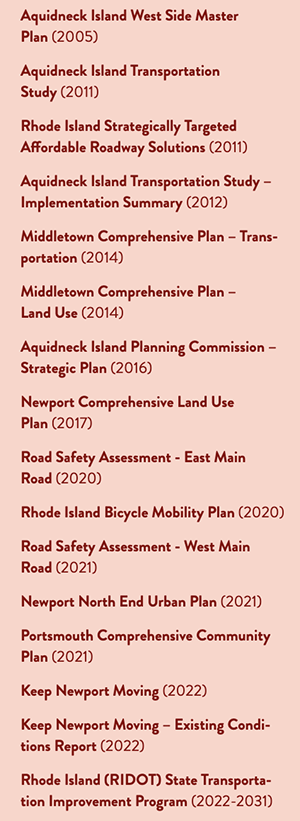
Over the years, there have been multiple plans and studies related to creating bicycle infrastructure on the largest island in Narragansett Bay, including a 2015 bicycle design study of a Portsmouth segment of a proposed island-wide bike network. The idea considered three bikeway alternatives and their impacts, estimated constructions costs, and anticipated permitting actions.
Two years earlier, in 2013, ecoRI News reported on plans for an Aquidneck Island Bikeway, which was to run from Easton’s Beach in Newport, along the western edge of Aquidneck Island, to the Sakonnet Bridge bike lane in Portsmouth.
At the time, the project was hailed as a collaboration between local, state, and federal agencies. The Aquidneck Island Planning Commission was charged with overseeing the project with input from a previous design study. It never went anywhere.
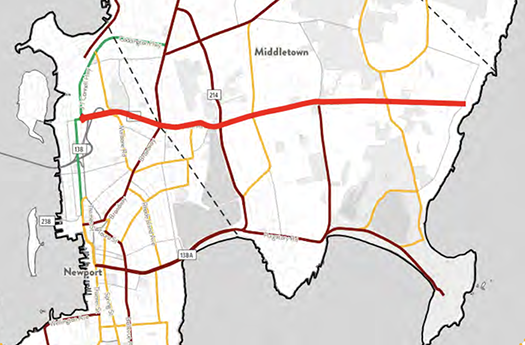
East Main Road has the greatest promise for ferrying bicyclists up and down Aquidneck Island, according to Ride Island research. Since this road, however, is maintained by the Rhode Island Department of Transportation, any improvements, even those approved and desired by municipalities, would need RIDOT support.
RIDOT is conservative in its approach to transportation and doesn’t typically support bicycle infrastructure or traffic-calming efforts, such as road diets, according to Flaherty.
For example, RIDOT didn’t recommend a road diet for when East Main Road in Middletown is repaved. The diet would have been placed on a 1.3-mile portion of East Main Road from Wyatt Drive to Miller’s Lane. The plan would have turned that stretch into a three-lane route, with a middle turning lane, to slow down traffic.
The Middletown Town Council eventually rejected the idea, although Flaherty believes if RIDOT supported the idea, the outcome may have been different.
Flaherty said the state and municipalities need to support more demonstration projects that show the value of bicycle and pedestrian infrastructure. He pointed to the success of such Bike Newport-led initiatives held on Park Avenue and Middle Road in Portsmouth. The streets are closed to traffic for part of the day, allowing cyclists and walkers to move around safely.
“The next two to four years will be critical,” he said. “How long will that federal money still be available? We need to get it.”
sad that the McKee administration has so thoroughly turned its back on bicycling and its potential for cheap, clean, healthy (and often fun!) travel. Even in his Blackstone Valley (McKee is from Cumberland) there has been virtually no progress on the Blackstone bikeway. And it’s not just RIDOT ignoring biking, DEM too has dropped bike infrastructure from its last few Green Bonds and biking plays virtually no roe in their effort to met climate goals, their transportation efforts are just focused on promoting electric cars.
But Aquidneck Island at least has some hope with the dynamic Bike Newport organization never giving up, and in less than 2 years we could have a new administration that is more supportive of biking, walking, and transit
The first map actually has West Main Road highlighted in red. Either the text is wrong or the mapmaker highlighted the wrong road …. not that I would ride a bicycle on either.
Bob, good catch. Thank you. That was my fault. I grabbed the wrong map, despite living in Portsmouth. Correct map added. — Frank Carini, ecoRI News
Amazing there is no mention of the potential for a WEST SIDE RAIL TO TRAIL conversion?? Hundreds of thousands of dollars into lights and paint at Connell Hwy circle is wasteful (we even missed an oppotunity to add another car lane into Gateway) Dinner train is long dead. Imagine walking/pedeling from Common Fence Point to Carnegie Development to the Navy Base clear into Gateway. The clear and best option is to convert the west side rail to a whole island pedestrain and bike path???!!! Just ask the folks living along the East Bay Bike about their quality of life and precious property values.
Hi Chris, The rail option is in the Ride Island bike plan. We reported on the entire plan last year in this article: https://ecori.org/a-path-forward-for-bicycle-infrastructure-on-aquidneck-island/
From the previous article:
“Another north-south option identified by Ride Island is the active rail corridor that runs along the west side of Aquidneck Island. The rail, currently used by the Grand Bellevue Dinner Train and Rail Explorers, has the potential to serve as a major car-free connection, with a portion of the corridor near the Newport Gateway center already complete.
“This rail project, which, at 10.6 miles, could have the biggest payoff in terms of an off-road island-long connector, also faces the biggest hurdles, as it would require buy-in from all three Aquidneck Island municipalities, the Navy (the rail runs through naval property), RIDOT, and operators of tourist uses of the railroad corridor. It would also require significant capital funding.”
Kind thanks for your response. Rail in any form will never be best use for this incredible state asset.
This project is so obviously beneficial and low cost. I’m puzzled by state resistance to the conversion.
Keep up the good work. I’m a big fan.
East Main and West Main will never be fit for bikes. Are these many miles of incredible state property going to be left fallow for another generation as people get injured and even die on our island roads?
Only way I can see it is park cars in lot where Hi Li was and bike in Newport with a road on the waterfront as you cannot make it safe on Spring, Bellevue , or former Thames Street. It would free up many cars coming into town and less traffic.
We need to start with a small project as a proof of concept. For example, create a bike loop around Island Park. Connect it to the Sakonnet Bridge bike path and loop around Anthony Road and Boyd’s Lane back to Park Avenue. It will intersect with the Anne Hutchinson Monument and the park and ride lot on Boyd’s Lane. There is no infrastructure required, just paint.