
A Complete and Utter Breakdown: That’s the Hope When It Comes to Compostable Packaging
August 14, 2025
Share



Having just devoured two mushroom tacos for lunch — takeout from the Mexican place across the street from the office — I turned my attention to the to-go box they had come in.
I turned the oatmeal-colored box upside down, flipped open the clamshell lid, and checked the sides of the box looking for a sign.
Any kind of sign.
Anything to indicate the container was compostable.
The timing couldn’t have been better, because composting expert and operations director at Epic Renewal, Tess Feigenbaum, was on the phone with me for an interview about this very topic for this very article. (In the interest of full disclosure, Epic Renewal collects compostable materials from ecoRI News’ co-working space.)
So, was this virtuous looking to-go box compostable?
According to Feigenbaum, if you see a Biodegradable Products Institute (BPI) or Compost Manufacturing Association (CMA) certification logo on a product, that indicates an item can be composted.
But, she added, “There is a ton of misleading labeling and packaging going on that is intended to make you feel like it’s compostable, or it’s green, or it’s responsible … the most important pieces of data you can get are from your eyes and your hands.
“So, if you’re looking at an item … and it has no labeling on it, odds are it’s not compostable, because if it were, extra money and time and manufacturing and love went into creating that product, and it’s typically celebrated and quite transparent and visible.”
To further complicate matters, some fiber containers that appear compostable, especially the molded fiber containers for hot food, can have a thin plastic lining, which improves their performance and keeps food from leaking but disqualifies them from the compost bin.
In the absence of a BPI or CMA symbol on the taco container in question, Feigenbaum suggested a scratch and tear test. If a product tears and scratches easily, it likely doesn’t have that plastic lining.
I scratched and tore, but, in the absence of evidence, I couldn’t be 100% certain, and so tossed the container in the trash, suffering a pang of guilt.
CMA, BPI, PLA, PET, and PFAS: It’s an acronym blizzard
Among environmentalists, there is widespread agreement that single-use plastics contribute to environmental harm, polluting waterways, breaking down into microplastics, and insinuating themselves into the ecosystem, where they can have deleterious effects on humans and wildlife.
A recent review by The Lancet reported there are currently 8 billion tons of plastic polluting the planet. Less than 10% of plastic is recycled. “Plastics cause disease and death from infancy to old age and are responsible for health-related economic losses exceeding $1.5 trillion annually,” according to the review.
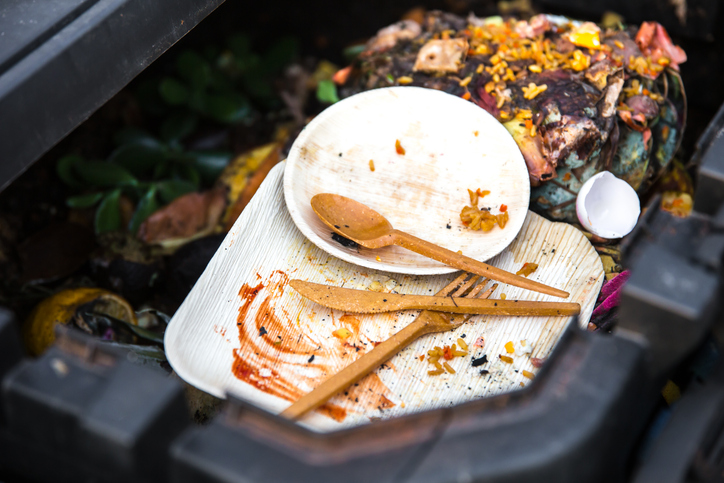
The increasing public alarm over the scourge of single-use plastics, combined with the desire to appeal to an environmentally conscious clientele along with the increasing number of composting facilities, has likely contributed to the proliferation of compostable foodware. These products promise to solve the single-use plastics problem by breaking down into soil instead of pollution.
It should be said that the absence of a composting facility that accepts compostable packaging, these articles must go in the trash, as they cannot typically be recycled with traditional paper and plastics.
For example, compostable plastic cups, which are made from plant-based polylactic acid (PLA), cannot be recycled with traditional polyethylene terephthalate (PET) plastic, which is made from oil.
Some fiber compostable takeout containers can have a thin PLA lining that disqualifies them from being accepted at a recycling facility that recycles paper and cardboard.
It goes in the other direction, too. Some fiber containers that look compostable may have a PET lining, which disqualifies them from being accepted at composting facilities.
Furthermore, it has been reported that those container linings can sometimes contain per- and polyfluoroalkyl substances (PFAS), forever chemicals that don’t break down in the environment, and which have been linked to cancer. Composters don’t want these substances in their compost piles.
Confused yet?
This is where third-party certification Feigenbaum referred to comes in.
BPI, along with CMA, is a third-party verification of standards for compostable products in North America.
According to its executive director, Rhodes Yepsen, BPI was the first certifier in the world to prohibit the use of fluorinated chemicals such as PFAS. This addition to its certification was put into effect in 2020.
So, a BPI certification or a CMA certification means no PET plastic and no PFAS. The rigor of the certification process helps bring transparency to the flood of new compostable packaging products on the market. That is good news not just for consumers but for composters who accept compostable packaging but fear contamination.
System processing
Most compostable foodware will only break down in a commercial composting facility that can provide the right conditions (moisture and heat) for these articles to degrade.
A recent study by Closed Loop Partners and Composting Consortium showed that all certified compostable packaging tested broke down to the “minimum threshold of disintegration” established by industry groups. Bio-based compostable plastic exceeded that minimum threshold in all large-scale compost systems, far outperforming compostable fiber packaging.

But even if food packaging is certified and compostable under industry standard conditions, how that packaging interacts with the available local systems also determines its success in the wider war against single-use plastic foodwares. Because without a composting outlet to take these products, they are destined for the landfill.
Rhode Island is served by several large-scale composters, but not all of them take compostable foodware.
One of Rhode Island’s biggest composting facilities, Earth Care Farm, generates about 5,000 cubic yards annually of compost from roughly 25,000 tons of yard debris, manures, and food scrap. However, it does not accept compostable packaging.
According to Earth Care Farm’s owner, Jayne Merner, “While these materials do break down at an industrial-scale composting facility like ours, we follow the standards set by OMRI (Organic Materials Review Institute) so that our compost can be used on certified organic farms.
We’ve also found that compostable packaging can cause confusion. A cup that looks like plastic, even if it’s labeled ‘compostable,’ often leads to regular trash ending up in food-scrap bins. Keeping it simple — food scraps only — helps keep our process clean and clear for everyone.”
— Jayne Merner, Earth Care Farm
There is currently a movement afoot to change the standards of OMRI to open more processors to handle compostable packaging.
According to BPI’s Yepsen, “BPI’s top advocacy priorities is to update USDA’s 25-year-old definition of compost in the National Organic Program, which currently only allows plant and animal materials to be composted.”
He said BPI filed a petition with the U.S. Department of Agriculture in 2023 that outlined the need for this change, along with the scientific rationale, and how it aligns with the statute in the Organic Foods Production Act.
Regardless of what happens with federal guidelines for organics, many composters operating in Rhode Island, like Epic Renewal, are not beholden to OMRI standards and do accept compostable products.
Serving 40,000 residential customers, 300 schools, and 500 businesses in Rhode Island and Massachusetts, Black Earth Compost is one of the bigger players in the local compost ecosystem. The company handles about 15,000 tons of food waste annually.
Black Earth Compost hauls and processes BPI- and CMA-certified products along with organic food waste. The company fully embraces compostable packaging as a solution to reducing single-use plastics.
“Compostable packaging is great when reusable and recyclable is not an option,” said Andrew Brousseau, partner and compost manager at Black Earth Compost, adding reusable items should be used first, but they are not always an option.
He noted a common concern with compostable packaging “is that we shouldn’t use them because there might not be a composting service available in a region. This is short-sighted thinking, and we should not let the perfectionists slow down a solution for the future just because our society is not coordinated enough to turn all the keys to that solution at the same time.”
While Brousseau and Feigenbaum believe accepting compostable packaging will help increase the amount of organic material diverted from the landfill and move society away from single-use plastics toward a more regenerative model, accepting compostable packaging does impact how they manage materials.

“The products that are BPI certified, we feel confident, are not having a negative impact on our finished product. They have more of an impact on our process itself,” Feigenbaum said.
Epic Renewal, which employs a system called bokashi composting — an anaerobic process done in 5-gallon fermenters ideal for indoor composting — has invested in a grinder to essentially predigest compostable packaging before adding it in with other organic materials.
“If you put a big hunk of paper towels in one spot, or paper plates in one spot, or bio plastics in one spot, they’re just going to make their own little pocket that doesn’t go anywhere,” Feigenbaum said. “So, it requires a little bit more strategy, love, and distribution, to make sure that food scraps are always in contact with [compostable packaging] and they’re not creating their own little bubbles where nothing’s happening.”
Black Earth Compost also composts the materials it collects, “which means we can put eyes on the food scraps in multiple locations,” according to Brosseau. “It starts with drivers checking bins before they are unloaded into our truck.”
Epic Renewal and Black Earth Compost take the steps of educating customers about what goes in the compost bin, pulling out any items that might potentially contaminate their compost, and testing their finished product for safety and contamination.
“We recognize that PFAS [are] everywhere in society’s food supply, so we do what we can to nudge people away from using PFAS-containing food and packaging. At the end of the compost process, we test the finished product and find, from a PFAS perspective, it can be applied on even the most sensitive soils over water supply wells, so I think we are doing a good job,” Brousseau said.
He noted more producers of compostable packaging need to get their products certified, but he also believes consumers also need to lower their expectations of packaging. “The reason packaging is complex is because consumers want the impossible (longer shelf life, more convenience, more colors, etc.).”
This story is part of a series Black Gold Rush: The Race to Reduce Food Waste and Save Soil. The series is sponsored by 11th Hour Racing.
The key is to understand the difference between BPI and CMA certifications. Most compostable products have PLA that breakdown to a laboratory standard for commercial composting (BPI Certified). However these same products do not meet real life compost timing in the real environment (not laboratory) and cannot get a CMA certificate. CMA certification means the product actually breaksdown in a composting facility in 12 weeks or less. Very few products hit this standard and so most composting facilities will not take BPI certified as mentioned in the article. Also do not be fooled by a Home Compostable claimed unless they carry a European Din Certco certification. There is no government standard in the US for Home compostable so many products make a fake claim. Great article!
For exercise, sometimes I walk all the aisles of my grocery store. The amount of plastic, bottles, bags and packaging, in one store is astounding when one thinks about ALL of the plastic waste X all the stores in RI going to our landfill. Third world countries are beginning to cut off US plastic waste, including polyester clothing, being shipped to them in giant containers.
Then, what are we going to do?