Misquamicut Pilot Composting Program Off to Strong Start
July 10, 2026
Share


MISQUAMICUT, R.I. — Sharon Saunders is encouraged by how well a pilot composting program is working at Misquamicut Beach. The program was launched June 1, after Saunders successfully pitched it to the board members of the Misquamicut Beach Foundation, on which she serves.
“It’s been very exciting,” Saunders said. “We’ve already had 13 people sign up to participate in the program. It’s easy to recruit people who are aware of the benefits and are educated about some of the negative components of throwing your food scraps into the landfill — the methane that’s produced in landfills that are close to capacity.”
The pilot program is starting small, with a collection bin provided by Black Earth Compost, based in Massachusetts. The bin — labeled “Food Scraps” — is in Saunders’ yard, because the foundation was unable to secure a public location.
“We did explore several options to see if we could come up with a more public space, either on town or municipal property or some other private property, but this was the best solution in the end for this year,” Saunders said.
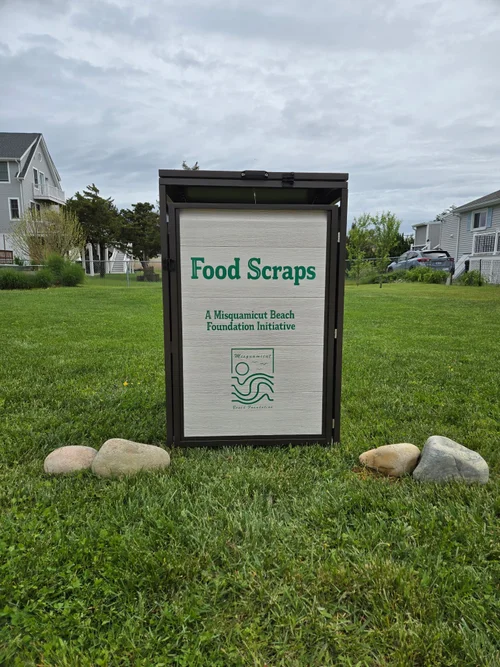
The pilot program, which will run for the summer, can handle up to 30 families.
“I do believe we’ll easily get there,” Saunders said.
The foundation provided $2,000 to cover the purchase of the bin, some small canisters for people participating in the program, and a service contract for Black Earth Compost.
David McLaughlin, sustainability coordinator for the Rhode Island Department of Environmental Management, said the state’s Central Landfill, in Johnston, is projected to reach capacity by 2046.
“Food scraps end up consuming air space [in the landfill],” McLaughlin explained. “[The landfill] is a finite resource and as it fills up the unit cost for disposal increases. If we can divert more organic material we’ll extend the life of the landfill.”
A study done in 2015 showed about 30% of what is buried in the landfill is organic material that could be put to better use, according to McLaughlin.
While the Central Landfill has an advanced gas capture system that generates enough electricity to power thousands of homes in Rhode Island, McLaughlin said discarded food scrap represents a “missed opportunity.”
“Uneaten edible food can be collected in a responsible manner and brought home to families,” he said. “Other (food scraps) can be diverted to livestock.”
Black Earth Compost turns the food scrap it collects into rich soil for farmers and homeowners.
“The main reason [for composting] is to bring nutrients back into the soil,” said Jon Laurie, who handles municipal outreach for Black Earth Compost. “We’re taking in tons of food scraps and having thousands of cubic yards of soil delivered.”
Black Earth Compost started in 2011 with “three guys and a pickup truck,” Laurie said, and now is a company with 75 employees, 43 trucks, and four compost sites — soon to be six.
“We collect from 350 schools, work with 150 municipalities, and collect from 40,000 residential customers,” he said. “Our finished compost product is in 125 garden centers, mostly in eastern Massachusetts, but also in Rhode Island, southeastern Connecticut, and southern New Hampshire.”
Black Earth is operating in 16 of the 39 municipalities in Rhode Island, according to Laurie: Barrington, Bristol, Jamestown, Newport, Westerly, Little Compton, Tiverton, Potowomut, East Greenwich, Middletown, Narragansett, North and South Kingstown, Portsmouth, Charlestown, and Hopkinton.
Misquamicut Beach is Rhode Island’s largest public beach and home — or second home — to about 1,300 families, according to Vincent Scaramuzzo, president of the foundation board.
Scaramuzzo, 53, said he has been visiting Misquamicut Beach his entire life and soon will be moving there full time from his home in Glastonbury, Conn.
“The majority are vacation homes, but that has changed dramatically over the last 10 years with an increasing amount of full-time residents,” Scaramuzzo said.
The Misquamicut Beach Foundation plans to double the size of its composting program next year, hopefully with a bin on a public site.
“We’d like to have a centralized location,” Scaramuzzo said. “The firehouse would be ideal, but they’re in the middle of building a new firehouse. There’s a local church across the street from the firehouse that might be great. We don’t want to put it on the beach. We could never keep the garbage out of it.”