
Naturally, Rhode Island Has Failed to Act
State’s “environmentally sensitive natural areas” need protection
May 13, 2026
Share


Three decades ago the General Assembly passed a law that allowed Rhode Island to designate both public and privately owned lands of “critical environmental concern” as natural area preserves.
The main point behind the Natural Areas Protection Act of 1993 was to provide the “highest level of protection to the state’s most environmentally sensitive natural areas.” This legislative tool also was supposed to “promote the health and welfare of the people of Rhode Island by promoting the preservation of areas of unique natural interest.”
It was an excellent idea. But … there’s always a but in Rhode Island.
Like the vast majority of Ocean State law designed to protect the environment, once the Statehouse performance concluded the act was quickly forgotten. This Smith Hill play is performed annually.
The law, now 33 years old, called for the Department of Environmental Management director to establish a system of preserves and ensure these areas are maintained in as natural and wild a state as is consistent with educational, scientific, biological, geological, and scenic purposes.
Since 1993, nine DEM heads, including two acting directors, have had the chance to create a natural area preserve. They all passed. I’d wager the law was never discussed once by any of them.
The Natural Areas Protection Act recognized the Natural Heritage Preservation Commission, which was created in the 1980s, as the appropriate entity to review nominations for natural area preserves.
In early 2023, an agency spokesperson told me “No one currently at DEM recalls the genesis of this” law. Welcome to Rhode Island, where environmental law is nothing but political theater. Currently, the General Assembly has ramped up scrutiny on Act on Climate mandates, and lawmakers are considering trashing the state’s plastic straw ban.
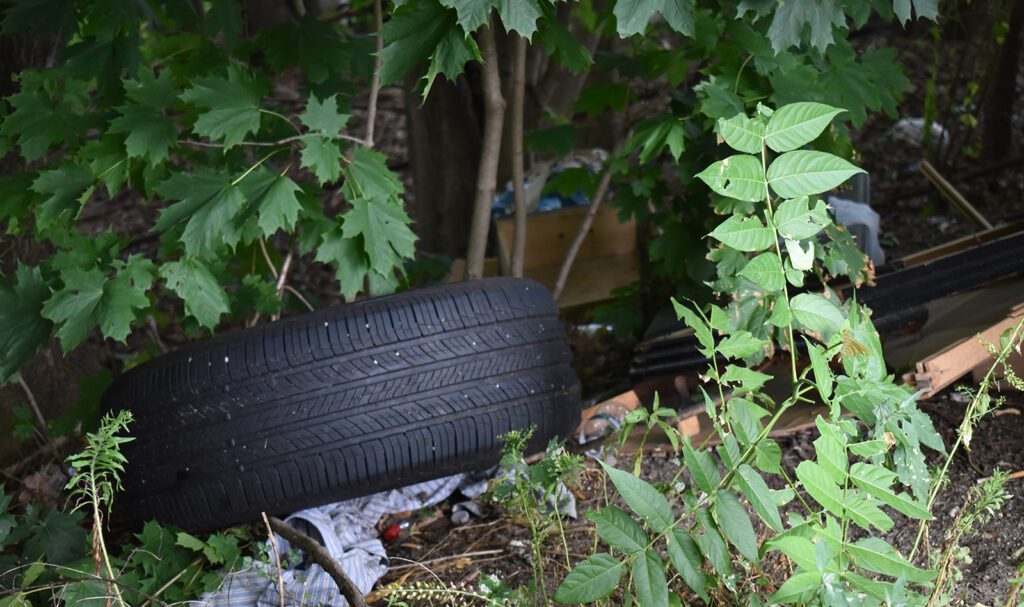
Despite its well-known moniker, the Ocean State contains impressive tracts of forest. The latest Forest Action Plan estimated Rhode Island has some 366,960 acres of forest, about 53% of the state’s total land area.
Much of Rhode Island’s forested land, however, is fragmented and within reach of ruinous human touch. To protect our future, the future of other life we share this space with, and to help mitigate the climate crisis, we need to leave a bigger chunk of our forests alone. After all, they managed to thrive for megaannums without our interference.
They need to be better protected here and everywhere. But let’s begin in our own backyard.
DEM manages 35 management areas/properties of various sizes and habitats that total some 70,000 acres of forest. These public properties are logged (for profit), cut to make way for early successional habitat (for hunting), torn up by all-terrain vehicles (illegally), run over by both dirt and mountain bikes (legally, sometimes illegally), and/or trampled on (for hiking, hunting, fishing, and birdwatching).
Since 1995, DEM has done logging — what the agency calls “active management” — on 1,875 acres of public forest, according to Tee Jay Boudreau, deputy chief of DEM’s Division of Agriculture and Forest Environment.
While only 0.03% of Rhode Island’s public forestland has been touched by logging equipment in the past three decades, there is no guarantee that percentage doesn’t increase, because there are no legal protections in place. No natural area preserves designated, just management areas where illegal ATVs roar and humans play.
About 70% of forestland in Rhode Island, however, is privately owned, and constantly under threat.
Since 2010, private forestland has been bulldozed to build a 420,000-square-foot, 2,400-parking-spot corporate banking campus on nearly 60 acres of recovering woodlands in Johnston; a 77,500-square-foot casino with more than 1,100 parking spots on a 48-acre wooded wetland site in Tiverton; and numerous ground-mounted solar arrays. A 2024 study by the Narragansett Bay Estuary Program estimated the state had lost nearly 4,000 acres of undeveloped forestland to solar development.
It is imperative for planetary health, which includes our own, that there is green spaces where human intrusion is kept at a minimum.
I reached out to the Rhode Island chapter of The Nature Conservancy, the Audubon Society of Rhode Island, and the Rhode Island Land Trust Council to ask them how many acres of protected space do they own in the state and how many of those acres are closed to the public? I asked the three nonprofits those two questions to get a better idea of how much human-free territory may exist in Rhode Island.
“We don’t track if properties are open or closed to the public, and that would vary based on individual land trust, but it’s my understanding that many more properties are open to the public than closed,” Kate Sayles, executive director of the Rhode Island Land Trust Council, responded.
She noted the total amount of green space conserved by local land trusts, the Audubon Society, and The Nature Conservancy is about 61,000 acres.
“Around 21,000 acres are protected with conservation easements and/or deed restrictions,” she wrote in an email, “so there is also variation there, especially around protected farmland.”
Sayles also noted “it’s very frustrating that the 1993 law hasn’t been implemented, especially when the procedures for designation are straightforward.”
In Rhode Island, The Nature Conservancy owns 8,900 acres, and of that 7,100 “have sufficient infrastructure (parking, trails) to make them available to the public,” according to Tim Mooney, TNC’s marketing and communications director.
He noted the remaining 1,800 acres “are not ready for public use at this time.”
The Audubon Society of Rhode Island owns 113 properties in almost every municipality in the state, according to Hope Foley, the organization’s media relationship coordinator.
“We offer 30 miles of trails on almost 10,000 acres of permanently protected habitat,” she wrote in a email. “Fourteen of the properties are open to the public consisting of 3,350 acres for the public to access and enjoy. All land is privately owned.”
The native flora and fauna that make Rhode Island special need more space to spread their wings and adapt to climate change, and forests are not solely a human playground. We would be wise to let more of the natural world exist in peace.
For instance, the caulosphere — the above-ground microhabitat consisting of the surface of bark and plant stems — has a surface area of 55.2 million square miles. The total land surface area of Earth is about 57 million square miles. Some trees have 6 trillion bacteria living in or on each square meter (10.7 square feet) of bark.
Forests and trees support a lot of life.
If only Rhode Island could remember a law that protects green spaces deemed to be of “critical environmental concern” from future development and human intrusion.
Note: To be designated a natural area preserve, a private property owner must voluntarily grant to the state of Rhode Island a conservation easement. No one’s land would be taken by state government to create such an area.
Frank Carini can be reached at [email protected]. His opinions don’t reflect those of ecoRI News.
Actually Frank, the Natural Heritage Preservation Commission had already been created in the 80s to conduct the selection process for the Open Space Grant program. The Natural Areas Act recognized the NHPC as the appropriate body to review nominations for natural area preserves.
Thanks, Rick. Correction made.
I agree with everything in this article and would like to add that we as a society need to stop settling for the non-native hybrid plants force fed us at modern American garden centers, and seek out those businesses propagating and selling native, open-pollenated, ecotypic (ecoregion 59 for RI) plants. No back yard will replace broad expanses of less-disturbed habitat, but native plant gardens of any size do have value for our native fauna.