Providence Port Day Brings Reminders of City’s Polluting Past, and Present
May 19, 2025
Share


PROVIDENCE — More than 100 people attended tours, talks, and workshops about the city’s port district Saturday for Providence Port Day at Johnson & Wales Harborside Campus.
Organized by The Providence Eye, a nonprofit newsroom and a publishing partner of ecoRI News, the event was meant to highlight the history, struggles, and strengths of the neighborhood.
Attendees had the option of taking tours of the various landmarks, including ProvPort facilities, public access points, and even the sewer overflow tunnel.
Barnaby Evans, who founded the popular WaterFire event in the 1990s, led a tour of Collier Park, which is owned by the company that operates the Manchester Street Power Station and is one of only two waterfront public access points in the neighborhood. Last summer, the company closed the park temporarily, citing vandalism.
Evans took the group through the industrial history of the area, pointing to remnants of coal fires in the buildings and equipment that the park kept and preserved.
“The major thing that was brought into this harbor over its whole history was coal,” he said, pointing to a piece of machinery that once crushed coal into a fine dust so it could be switched out with natural gas, depending on which option was cheaper. “Their decisions were made on bottom line, not health.”
The Manchester Street Power Station, which looks over Collier Park, stopped burning coal in 1996 when it switched to natural gas. It remains one of Rhode Island’s biggest polluters.
The tour passed under Interstate 195 to a dike where the Fox Point Hurricane Barrier sits. Evans explained how the barrier works, using a series of gates and pumps that can be employed during a severe storm to prevent flooding in Providence.
The gate has been closed several times and is tested regularly, Evans said, but it’s actually never been put to the test for a big storm.
“So, what about everything south of that gate? No protection for that community?” someone in the tour group asked.
Parts of the port, especially along low-lying Allens Avenue, are not protected by the barrier, which would largely prevent downtown flooding.
After the tours met back at JWU for lunch, Mayor Brett Smiley and Waterson Terminal Services CEO Chris Waterson spoke to the group about ProvPort, the public-private partnership between the city and Waterson that manages city-owned land along the waterfront.
“The port here in Providence is a vital part of our local economy,” Smiley said, “and we have worked through its evolution over the years and over the decades.”
Smiley explained that millions of tons of cargo come through the port annually, generating billions of dollars for the local economy.
“It is a unique economic asset that we have here in Providence, and that while we certainly try to balance environmental impact and try to continue to evolve us to forward-thinking industries,” he said, “it is critical to the economic growth of the region and is an asset that can’t be replaced again.”
The city planning department is currently working with Waterson on a ProvPort master plan that will determine its future for the next 30 years. Smiley said the city also recently negotiated its agreement with Waterson and that ProvPort now operates on a profit-sharing model.
“So, the better they do, the better we do as a city and the better this area does,” the mayor said.
The planning process will have “robust community engagement and ample opportunities for community involvement,” he added.
Waterson said he was glad to open up 140-acre ProvPort facility for tours, a suggestion he had initially heard from a community member at a public meeting.
Encouraging attendees to engage in the master plan process, Waterson described how, over the 20-plus years he has been working with ProvPort, there have been several positive changes at the facility.
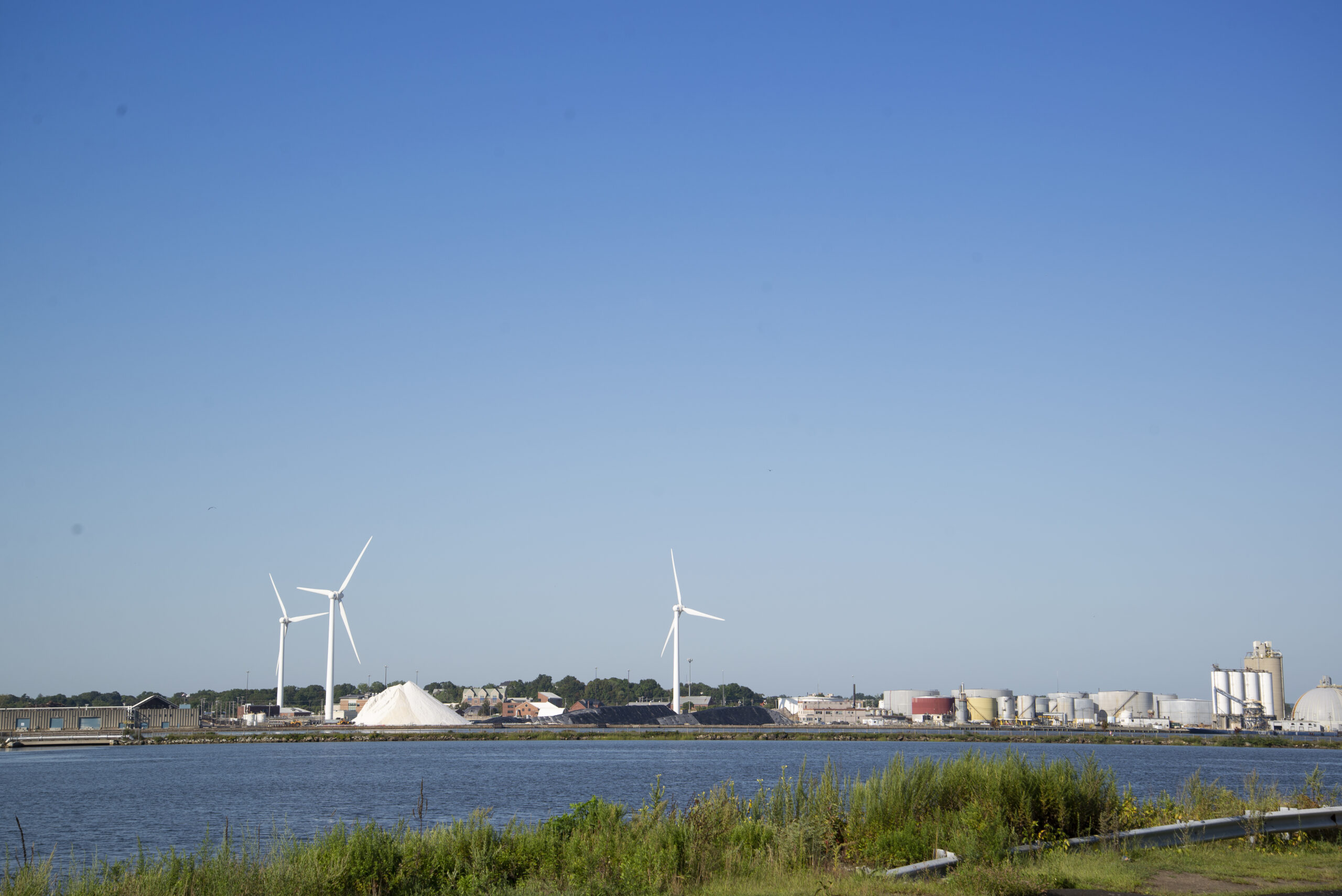
“At the start of my career, millions of tons of coal used to be imported here. That business is completely gone, and it’s been replaced with cleaner cargo, such as the lumber, automobiles, and offshore wind components that you saw today,” he said.
But some in attendance didn’t see enough changes for the better in the area, which includes the neighborhoods of South Providence and Washington Park, whose residents have expressed concern, and deep exasperation, over the city and port’s inability to bring bad-faith actors and polluting industries, on and off ProvPort property, into compliance. For years, abutting neighborhoods to portside properties have dealt with the state’s ground zero of environmental injustice.
“We’re very concerned about the health impacts on our children, on our neighbors, on the laborers in the port,” said Ellen Tuzzolo, a member of The People’s Port Authority.
Tuzzolo thanked Waterson for the changes to the port that he mentioned, but noted there was more work to be done.
“Our feeling is that often we get engaged, you know, when there’s an explosion, when there’s a fire. We come, we bare our souls. We talk about our children. We talk about spending nights in the ER with asthma attacks, and then nothing actually really happens,” she said.
Asthma rates are higher in the Port of Providence than in other parts of the city and state, something that scientists and officials have been calling out for years.
Tuzzolo asked Waterson if he would commit to putting two community members on the ProvPort board.
“All I’ll say is, ‘Stay engaged.’ We’re going through a process. I’m not committing one way or the other,” he replied. “I would like to think that there will be continued engagement and hearing all the concerns, and we’re doing the absolute best that we can to mitigate those where possible. So, that’s what I can say, and I appreciate you standing up.”