Providence Mayoral Hopefuls Face Questions about Port Pollution, Recycling at South Side Forum
June 26, 2026
Share


PROVIDENCE — South Providence struggles with low voter turnout, but that hasn’t stopped organizations from bringing residents face to face with the people hoping to lead their city for the next four years.
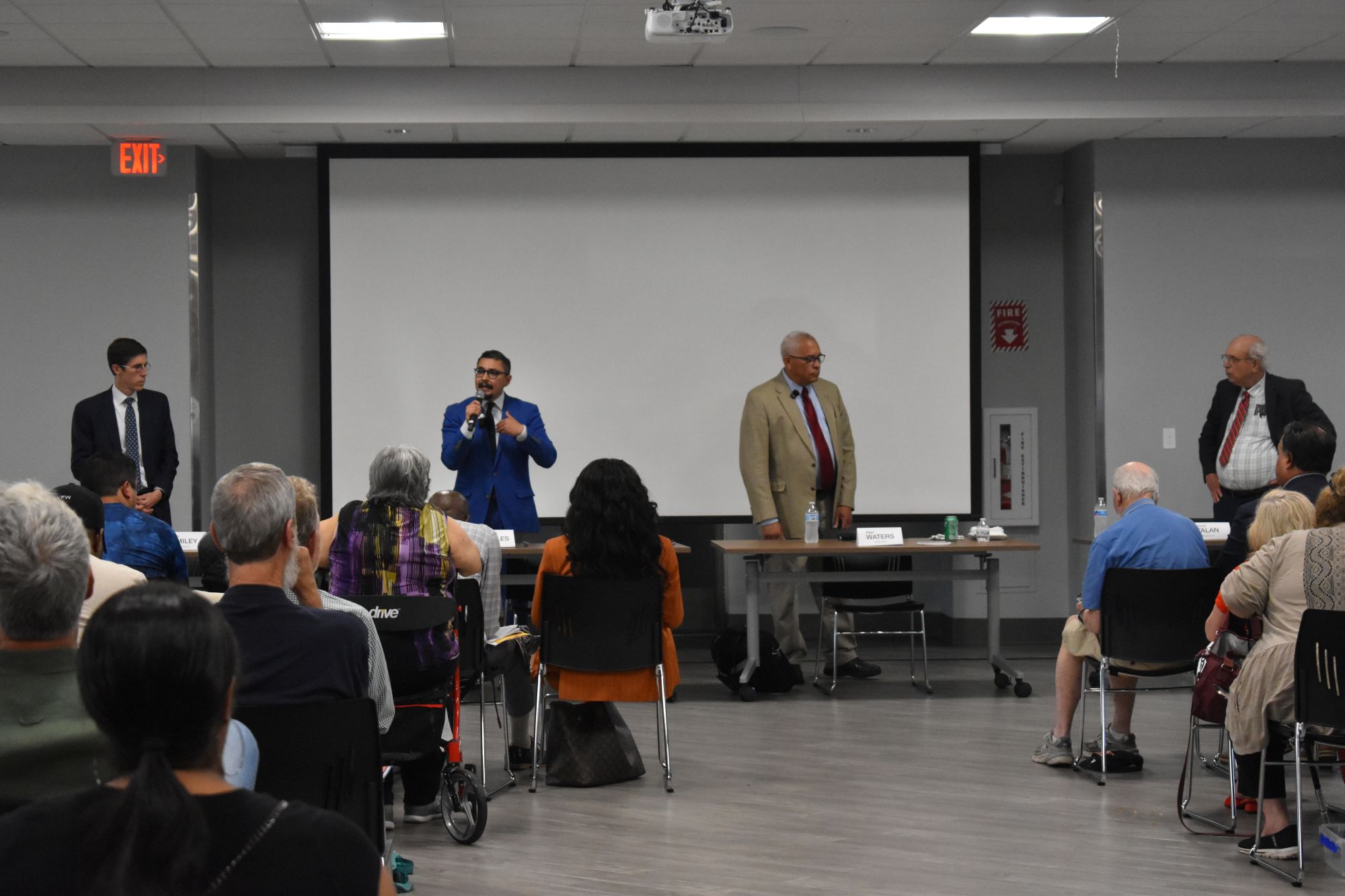
Mayor Brett Smiley, a Democrat seeking reelection; Democratic state Rep. David Morales; Allen Waters, an independent; and Dave Talan, a Republican, took questions June 24 during a forum organized by eight community-led organizations.
One by one, Lanre Ajakaiye, a South Side developer, pulled questions from a hat and asked candidates where they stood on issues ranging from housing and education to neighborhood investment.
Several questions touched on environmental concerns that have shaped life in the four wards that make up South Providence.
Here are a few that stood out to ecoRI News. The answers were edited for clarity.
Question: For candidates proposing additional taxes on corporate polluters in the Port of Providence, how do you plan to legally enforce these measures while ensuring businesses remain in the city?
Waters: “We only have a handful of corporate polluters because they’re basically in one section of the city. I believe in free enterprise, in capitalism, and in low taxes on businesses because that is the financial engine of this city, and it requires the people who most need this work. Therefore, putting taxes and penalties on polluters is fine. That’s like getting a ticket for going too fast. But we need to promote the rest of these businesses in the city and not chase them away. They have to believe in Providence, not flee Providence.”
Morales: “For decades, our neighbors in South Providence have had to suffer from excessive pollution coming down from the Port of Providence because of the large industrial facilities that operate there. My campaign is proudly proposing a new commercial tax that would be applied to industrial facilities operating near the Port of Providence. We want to ensure that Shell Terminal Station and Rhode Island Recycled Metals contribute more back to our city services and our schools.
“This is about making sure we maintain the same commercial tax rate for our traditional small businesses, while requiring more from these industrial facilities that benefit from being close to our waterfront. The way we would do this legally is through zoning, based on a respected industrial zone designation. We’re going to ensure that we’re able to apply this tax without any legal issues, and I have the political courage to take on this initiative because, unlike the current mayor, I do not take money from the owners of Rhode Island Recycled Metals.
“My commitment is about making sure that when the People’s Port Authority is reaching out with behavior and the concerns around ongoing pollution related to soil contamination and air contamination, we take action. That’s why we’re also focused on working with the Department of Environmental Management, so we have consistent air quality standards. When those businesses are breaking the law, they will be held accountable because our health is not negotiable.”
Smiley: “My opponent is good at sound bites, but they don’t actually work. It is illegal to tax individual businesses at a different rate. That’s an inconvenient fact that he continues to ignore — you can’t pick and choose how much you want to charge someone in taxes. That’s not how taxes work.
“The reality is that we have a tax system that is based on classifications. For every bad actor at the waterfront, which we have and which I have taken action against, we have a small, family-owned manufacturing business that is not polluting and is employing our neighbors. You cannot pick and choose, in some corrupt way, who you want to charge more taxes to hold bad actors accountable.
“Most notably, Rhode Island Recycled Metals, which has a host of DEM violations. My administration has been in and out of court for the last two years trying to shut them down. For any frustration that you’re feeling, we’re feeling it too because it is the Rhode Island court system that is holding us back. We continue to go back to court. We continue to use all of our lawyers to try to shut that organization down because they are a bad actor.
“That’s how you take action against a bad neighbor in a legal way. That’s what I’ll continue to do to protect the health and safety of this neighborhood, while doing it in an equitable way that doesn’t hurt local small businesses that are doing nothing more than employing our neighbors.”
Talan: “I have to agree with the mayor that the answer is not to tax money from these polluters, so I don’t want more money. I want them shut down completely, and I want them gone, or at the very least to clean up their act and do whatever it takes environmentally to make them clean up their act. That’s worth more to me than just getting a few thousand dollars more from them.
“I don’t think we have a lot of polluters. But the ones like the scrap metal yard, which is certainly what we all talk about, we’d be much better off without them entirely.”
Question for Smiley: The recycling failure in Providence is costing us, taxpayers, $1.5 million in fines and tipping fees. How can this effectively be resolved? Is there or will there be periodic hard evidence presented to Providence residents that the purchase of new trash bins, the $7.4 million, was a supportive investment?
Smiley: “Neighbors, we are terrible recyclers, and it costs us all money. The city of Providence is the worst recycler in the state of Rhode Island, and it has been a problem for years. So we have a multipronged approach to try to do better to save you tax dollars. But also better to preserve our planet and preserve the life of the landfill.
“You all received new barrels. Most of that money was not city tax dollars. We received grants to buy the new barrels. It has already increased our recycling rates, and we will be making regular reports to the City Council and to the community.
“But it’s not just the new barrels. Many of you have also hopefully seen that we have education going out with it. We actually have community partners who are flipping the lid and looking inside to see if people recycle properly. You’re getting a hanger, a red, yellow or green hanger, because we need to educate folks about what is and is not recyclable.
“Then we issue violations after the warning period and after the education, because it is not sustainable. What we’re spending on contaminated recycling is not sustainable, and in just a few years, the Central Landfill in Johnston is going to fill up. Then all of us are going to have to pay to truck away our waste to another state, which will cause our trash fees to go up even higher.
“We all need to do better, and we are taking a thoughtful, evidence-informed approach to do so. We will be reporting regularly on our progress.”
Question for other candidates: Would you take the same approach? Different approach? What are your plans for this issue?
Morales: “As mayor, I will not lecture you. I am going to take a collaborative approach to making sure that together we’re able to diagnose the issue, which clearly here is low recycling rates. But these are the moments where the mayor has to demonstrate leadership and partner with our neighborhood associations and our community organizations, so we can actually hear the evidence on the ground as to what the struggles of our neighbors are, because most of the time a lot of it’s due to a lack of communication.
“Whether it’s based on multilingualism or a lack of formal training or education, there are steps the city can take to be a better partner. One of the themes that I found here in South Providence over the last several years as a legislator, and now as a candidate for mayor, is how disconnected so many of our organizations and neighbors feel from City Hall when they share a concern. It is not being elevated or taken with the sense of urgency that one wants to see.
“I believe that when it comes to something as simple as recycling, we need to be thoughtful about having community gatherings so we can walk through these steps together. As a state legislator, I’ve hosted over 50 community meetings, and I’d be proud to do so because I think it’s important for your neighbors to see their elected officials firsthand, get their questions answered, and ensure that it doesn’t get to a point where fees and penalties have to be assessed.
“There’s certainly work to do, and as your next mayor, I’m going to guarantee that the organizations hosting this forum tonight have an open door where they can reach their mayor.”
Waters: “Mayor Smiley, thank you for the new bins. The streets look a lot better because a lot of the bins in my neighborhood were pretty torn up. So, I think the timing was great, and hopefully we will continue to improve. I think the mayor has a good plan in place.”
Talan: “I also support what the mayor did with the new bins. One of the worst ideas ever was the thought that making the garbage cans smaller than the recycling cans would increase recycling. What it really did was that there wasn’t enough room in the garbage cans, so the garbage went in the recycling bin and cost millions of dollars. So, congratulations on fixing that, and I support it completely.”
Question: Given that Rhode Island has some of the highest asthma rates in the country, and we know South Providence and Washington Park are asthma hot spots. How do you plan to increase accountability for polluting businesses in the Port of Providence?
Smiley: “Accountability starts with information, with reporting, with real data to make sure that we know the sources of pollution, and then we hold them accountable.
“Secondly, we need to evolve the industries at the Port of Providence and along the Providence waterfront. We had a start in the wind energy business that took a significant step back because of the horrors of the Trump administration, but there is still long-term potential to make that port a hub of commercial activity for offshore wind, and we should continue to do that. Those are great jobs that are powering our clean energy future.
“We need to continue to look for other opportunities at the waterfront for a new decarbonized future, for which Providence continues to lead the way. My administration has made a real, actionable, detailed plan on how we’re going to decarbonize all city buildings, and we’re going to be the first community in Rhode Island to get it done. Some of that work will be assembled, manufactured or built at the Providence waterfront.
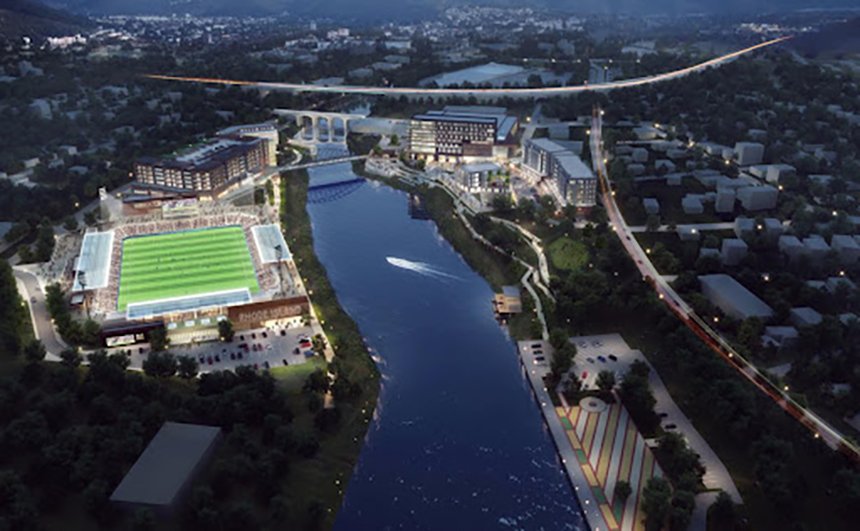
“Finally, we need to make sure that it is not just industrial activity at the waterfront, but there is also public access, which is what my team has been working hand in hand with the community to ensure that the dream of Public Street as a public access point comes to reality. We are making progress on that. We are honoring the intentions of the community, and it will get done.”
Morales: “It is not a coincidence that South Providence has some of the highest asthma rates in the state and in the entire country. It is because we have allowed industrial polluters to continue operating without any form of consistent accountability.
“We should not have to wait for a scrapyard fire to take action. That is why my administration will enter a cost-sharing agreement with the Department of Environmental Management. We’re going to guarantee that we have regular air quality monitoring to ensure that when air quality standards are violated, DEM is empowered to issue fines and penalties. If and when an industrial facility is breaking the law, they need to be held accountable, and that is not happening right now because it has not been a priority for this administration to actually engage with DEM and enforce accountability.
“That is just one of the ways we’re going to improve what is actively happening on the waterfront right now. There is an ongoing process around ProvPort. ProvPort has essentially over 30% down the waterfront on Allens Avenue, and I’ve heard from community members who are frustrated by the process because they do not feel their voices are being heard when it comes to zoning decisions.
“We need to ensure that the People’s Port Authority, the Washington Park Neighborhood Association, and community organizations authentically have their voices heard and that we’re not just bringing them in for a photo op to say we brought the community in. I want to make sure that their recommendations are implemented in the final plan.”
Waters: “Asthma has a lot to do with genetics, and of course, environmental pollution. But we also have to make sure that our children in the city are getting the proper exercise and the proper diet so that their bodies can defend against the attack of asthma.
“We can talk about all of these different carbonizations and things like that, but most of this is a white liberal lie. We need to educate people, educate our children, and make sure that families understand that if their children are not getting enough exercise or not eating well, that is also part of the blame.
“We have to get kids moving and make sure that their lungs are in great shape.”
Talan: “I want to get rid of anything in the port area that’s really putting pollutants out in the air. That starts with the scrapyard. We all agree that it doesn’t need to be there. I would want to control them and get them out.
“I’d like to talk a little bit about the Public Street park, which is the one part that would be available to the public. A lot of people in this room are working on that. The problem is these big trucks are driving right by where people are walking into the park. They’re polluting the air and creating a public safety hazard.
“One of the things I’d like to see is to force the people that are using those trucks, at their own expense, to put in another traffic light on Allens Avenue, much farther south. So trucks would enter where they don’t have to go anywhere near the Public Street park, and that would make that a whole lot cleaner by itself.”