Management of Rhode Island’s Forests, Wildlife Areas Needs Reboot
June 11, 2026
Share


The program Rick Enser helped build was trashed in 2007. The explanation, as it always is, was budget woes. There’s seldom money available to protect the natural world, or so we are repeatedly told.
There is money to be made, however, plundering the natural world.
Rhode Island’s modern-day assault on Mother Nature began in the 1960s. It hasn’t relented. Many of the initiatives designed to slow the destruction have been terminated or diluted.
Since 2000, when a Green Bond first appeared on a statewide ballot, Rhode Island voters have overwhelmingly approved every one of these general obligation bonds, to the tune of hundreds of millions of dollars for Narragansett Bay restoration, farmland preservation, brownfield remediation, and open space protections.
As the years progress, however, the bond’s greenness is slowly turning gray. Smith Hill power brokers have learned how to dull the shade of green featured on the ballot to authorize the state to borrow money that is, at best, color adjacent.
The Green Bond began to fade in 2022, when voters were asked to approve $12 million for Roger Williams Park Zoo, to build a carbon-neutral education center and event pavilion. Voters were told the project would improve access and further enhance the zoo’s “positive economic impact on Roger Williams Park, the city of Providence, and all of Rhode Island.”
Economic growth isn’t compatible with environmental protection. It’s insulting to suggest otherwise in a Green Bond. The zoo ask needed to be a separate ballot question.
The 2024 Green Bond led with an ask of $15 million for the Port of Davisville in North Kingstown for the “continued growth and modernization of Rhode Island’s only public port.”
Money from the voter-approved bond is earmarked to finance new berthing spaces, port access roads, cargo laydown area improvements, and security upgrades for the Terminal 5 Pier and Blue Economy Support Docks. State officials noted all this grayness with blue concealer will accommodate offshore wind projects. The Quonset Development Corp. port is also one of the top auto importers in North America.
This year, Gov. Dan McKee, as he did in 2024, left Green Bond funding for open space conservation and farmland preservation out of his budget proposal.
Rhode Island’s environmental successes are largely accomplished by voters spurred on by nongovernmental organizations. Elected officials count on free lobbying from nonprofits, both large and small, to get approval for essential climate crisis and environment-related funding that they routinely leave out of the budget process.
In fact, it’s quite remarkable that two of the most important areas that will determine our future success — environmental protections and public education — are so easily overlooked when it comes time to craft a budget.
The General Assembly does pass and governors do sign environmental laws, but most end up being unenforced, underfunded, ignored, or forgotten. Now, a cluster of color-blind politicians is forcing port berths, roads, and a carbon-neutral zoo pavilion into a bond that is supposed to be green.
Enser likely saw the state’s surrender to economic growth coming before most of us. The resulting apathy to the health of the Ocean State’s natural world has led to a stunning loss of biodiversity. Enser has been railing against Rhode Island’s disrespect of Mother Nature for two decades.
The ecologist and botanist coordinated Rhode Island’s Natural Heritage Program for nearly 30 years. The office within the Department of Environmental Management documented the state’s biodiversity and provided guidance for the preservation of rare, endangered, and threatened species, both plant and animal.
A year after he left DEM, in 2008, the Rhode Island Natural History Survey honored Enser, a founding member and past president of the organization, with its Distinguished Naturalist Award.
Since the Natural Heritage Program was scrapped, Rhode Island has largely abandoned mapping habitat and cataloguing biodiversity. Land-use management all but ignores non-human life and its needs. Forests continue to be clear-cut and fragmented and wetlands encroached upon and silted. Meadows are mowed over by careless city workers. The natural world is ruthlessly taken for granted.
The state’s natural world is chiefly seen through the lens of economic growth and how people can use — and abuse — it. This limited view field disregards the countless free ecological services Mother Nature provides. She offers more, way more, than places to hunt, fish, shoot, mountain bike, dirt bike, and illegally ride all-terrain vehicles.
For Enser, the most important issue facing the loss of biodiversity is the management of public land, especially public involvement, or lack of it, in management planning.
He believes DEM and much of the state’s conservation community has lost interest in the protection of biodiversity. When the Natural Heritage Program was disbanded, the number of native plants extirpated from Rhode Island stood at 82, and another 80 were only known from single locations.
Also lost during the past six decades or so are at least two butterfly species, several moth species, more than 30 beetles, at least three native bumblebees, a freshwater mussel, and the eelgrass limpet. Many other species are threatened or endangered.
“It should be a well-understood concept by now that keeping forests standing is the most appropriate response to addressing the climate and biodiversity crises,” according to Enser. “Forests sequester and store carbon (more than 50% of it in the undisturbed soils), and support increasing species diversity as they mature. And let’s remember that forests also filter the air, recycle nutrients, lower the temperature, collect water, prevent erosion, and where spacious enough provide emotional respite from the stress of living in a rapidly urbanizing place.”
He is particularly perturbed by the state’s handling of the Great Swamp Wildlife Management Area. DEM, since 1995, has approved a series of timber harvests to “increase diversity of forest age classes and tree species” in the 3,350-acre management area.
Timber harvests in 1995, 2007, 2012, and 2017 created about 80 acres of shrubland. More cuts were executed in 2024 and 2025. Proponents of this practice, such as the Young Forest Initiative, a nonprofit wildlife industry support group, claim early successional habitat breaks up sameness.
The Young Forest Initiative has also noted birds “can quickly access areas of regrowing young trees through their flight.”
I had to read that sentence several times, and it still reads like something you would find in a sixth-grade essay about birdwatching.
The Young Forest Initiative was created by the Wildlife Management Institute (WMI), which was founded in 1911 by conservation- and business-minded people alarmed by declining wildlife populations — especially those species preferred by hunters.
Enser has noted the Young Forest Initiative provides, by contract, the wildlife biologists headquartered at the Great Swamp’s DEM headquarters — jobs formerly held by state employees — who “manage wildlife.”
“They are there to plan and conduct the early successional projects/young forest projects with guidance from the WMI,” according to Enser. “They would probably say the ‘plan’ laid out on their Projects page is all the management planning needed for the Great Swamp, after all, the rest is just swamp.”
He takes exception to those who claim early successional shrubland is one of the rarest habitats in Rhode Island. “Early successional shrubland habitat is the most common habitat in Rhode Island, period,” he responds.
Private groups, such as the Young Forest Initiative and The Nature Conservancy, planning and conducting management of state lands rubs him the wrong way. He’s upset that forest tracts are being cut to create open habitats that aren’t grasslands.
He calls the Great Swamp “one of most significant natural ecosystems in New England, and has noted it is a “significant place for Indigenous people of New England.”
“While in Vermont, I witnessed the respect given to Indigenous views in management planning for both federal and state lands because managers understand that Indigenous people have long experience in managing forests,” said Enser, who moved back to Rhode Island last year after about a decade in the Green Mountain State. “Of course, Indigenous uses did not include harvesting trees for profit, so anything these people have to offer is essentially ignored” in the Ocean State.
Should Rhode Island decide to create a forest plan that is actually followed, he said the Narragansett Indian Tribe should be included. In fact, he believes the tribe should be involved in long-range planning on all state lands, but at the Great Swamp “they should have access to conduct studies, apply traditional practices, and provide for public recognition of this sacred location.”
Enser finds the state’s management of one of southern New England’s largest freshwater wetland ecosystems unconscionable. The former longtime DEM staffer noted the 32-acre logging project proposed in 2025 and completed this year was “just one more of the dozens of such projects conducted” at the Great Swamp Wildlife Management Area over the past six decades.
“That history is unfamiliar to most people, and it should be understood before making judgements on the validity of any additional management activities,” he said.
State officials have said the logging of the 32 acres was largely done to create habitat for the New England cottontail, the only rabbit species native to New England. They are considered vulnerable because of their decreasing population. In Rhode Island, the rabbit is listed as a “species of greatest conservation need.”
Enser noted the topographic map below shows the boundary of the Great Swamp area in black. The wetland complex extends beyond the reservation property lines — the several hundred acres above the northwest corner of Worden Pond and south of the Pawcatuck River is primarily old-growth red maple swamp, according to Enser.
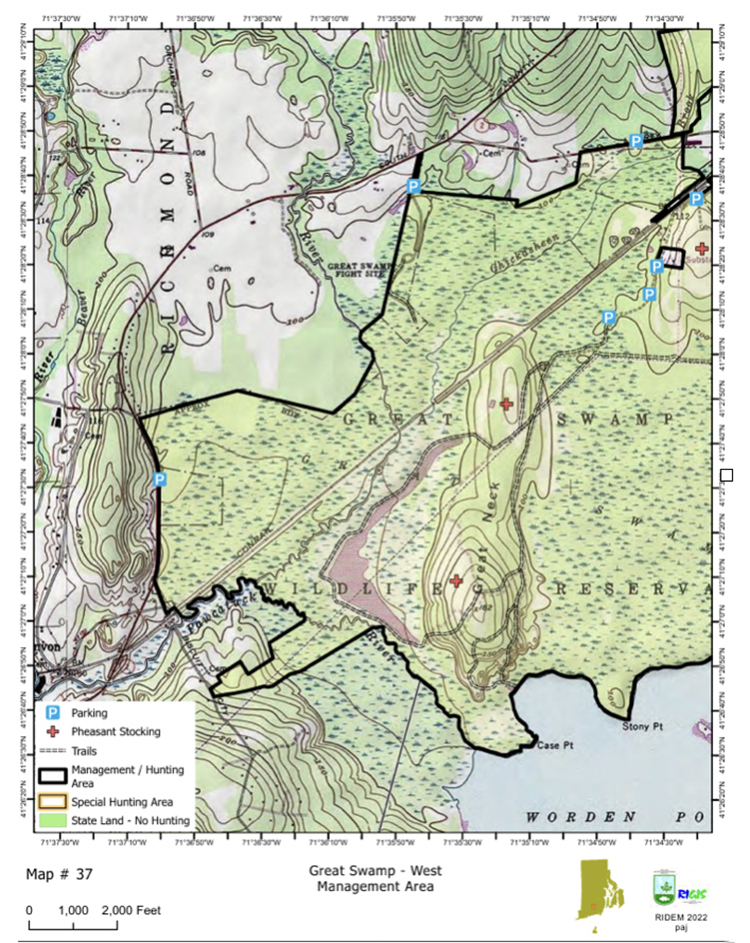
Wildlife management has been conducted at the Great Swamp since circa 1960, with one of the most significant projects being a mile-long dike to create a waterfowl impoundment. This feature is evident on the map above as the large purple L-shaped area west of Great Neck, an island of dry upland in the middle of the Great Swamp where most of the management for upland game species occurs, according to Enser.
The 32-acre project Esner was concerned about is in the center-right section of Great Neck.
“The question is, why are folks objecting to a logging project that is proposed in an area that has been repeatedly subjected to multiple logging projects over the past 60-plus years?” Enser asked. “The simple answer is, after 60 years we should know better. Today, we understand that creating habitats for a few select species requires the destruction of natural ecosystems that contain thousands of species. We know from aerial photos taken before 1960 that the portion of the Great Swamp where the dike and impoundment would be built was forested, much of it part of the same old-growth red maple forest that exists today south of the dike.”
He noted Great Neck “represents a relatively small but significant tract of upland in the midst of a great wetland complex, enhancing biodiversity with unique habitats at the interface of upland and wetland.”
“It is likely that forest clearing by humans occurred at Great Neck before European colonization, and some might argue that creating fields for wildlife is simply a continuation of past practices,” he said. “However, we must not overestimate the impact wildlife managers have had in facilitating the introduction of invasive species into the Great Swamp. In the 1960s many plants recognized as invasive today, including multiflora rose and autumn olive, were commonly planted in wildlife management areas. At the Great Swamp, fields become so overgrown with invasives that bulldozing is needed to clear them.”
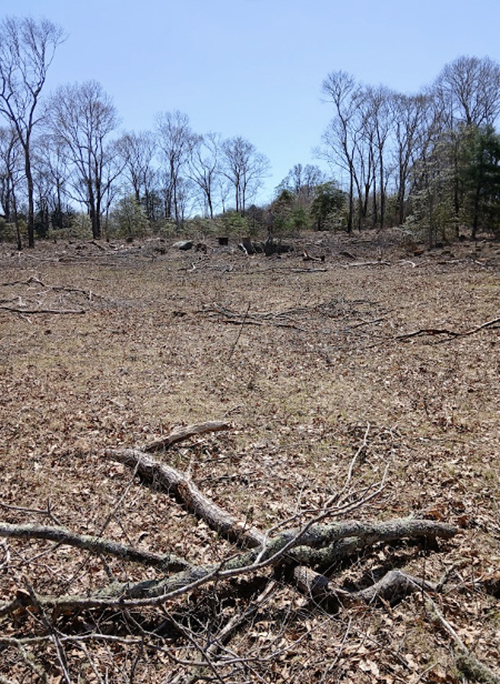
He believes the state is continuing to make shortsighted decisions when it comes to “managing” the natural world.
Upland forests don’t have the same legal protections afforded wetlands — a discrepancy Enser is pushing to change.
“Wetland laws explain to us the values of wetlands that need to be protected. Flood control, groundwater recharge, wildlife habitat,” he said. “Because there are no similar laws protecting forests people assume there is less value to retaining forests, especially in comparison to the value of lumber.”
As for the 32-acre clear-cut, Enser believes DEM should have conducted an environmental assessment to provide a cost-benefit analysis. He noted there was “absolutely no urgency to the Great Swamp project, and plenty of time to get it right.”
“None of these impacts were addressed in an environmental assessment for public review and comment,” Enser said. “There were no opportunities for the public to learn about the project, no process for soliciting comments.”
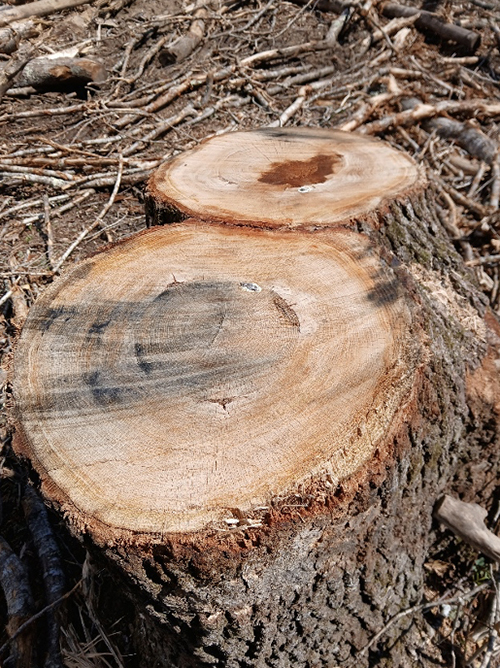
Earlier this spring, Enser visited the clear-cut site and took photos. He said Rhode Island shouldn’t be proud of what it has done.
“The public is continually outraged by instances of trees being cut for dubious reasons. Solar arrays, data centers, urban woodlands needlessly cut,” Enser said. “But when the logging is done on public land the public is duped into believing that such projects are ‘good for wildlife’ and ‘helps the forest be more resilient to climate change and invasive pests.’”
What the project did, he said, was weaken carbon sequestration; disrupted soil, which released more carbon dioxide; and created “ideal conditions for proliferation of invasive plants.”
Enser said logging a 32-acre chunk of forest for a single wildlife species was a misguided decision. He noted the clear-cut again brought to light the need for long-term management planning of Rhode Island management areas.
“When the Great Swamp Wildlife Reservation was created in the 1960s there was little thought given to the detrimental impacts of management activities. There were no concerns about climate change, biodiversity loss, ecosystem services, or Indigenous people’s values,” he said. “Today, more people are seeking answers to these critical issues, but natural resource managers continue to ignore them. Even worse, projects are greenwashed with absurd claims that logging can ameliorate climate change and improve biodiversity.”
During his tenure at DEM, Enser was responsible for reviewing management plans that were required of all grant recipients. To improve the management of Rhode Island’s 35 wildlife areas, he recommends: promulgate rules for preparing management plans; write individual plans that would require public review and at least one public hearing; writing management plans for public land should be a rigorous and open process.
In that vein, Enser supports rebuilding the Natural Heritage Program.
“What wildlife managers and foresters are not interested in is the forest as an ecosystem that supports thousands of other non-commodity species,” Enser said. “The commodities of biodiversity demand and get the attention, while the communities, the forests and other ecosystems, are manipulated for the maximum yield of the commodities.”
Note: This column was cobbled together using interviews with Rick Enser over the years, email correspondences, an opinion piece he submitted to ecoRI News that wasn’t published, a May 7 letter he sent to DEM director Terry Gray, and his testimony of the Natural Forest Protection Act (H7914).
Frank Carini can be reached at [email protected]. His opinions don’t reflect those of ecoRI News.