Night Of The Horseshoe Crab Takeover: Rhode Island’s Unofficial Holiday
June 8, 2026
Share


WARWICK, R.I. — As the full moon rose above the shoreline near Conimicut Point Park, about 100 people gathered along the estuary and belted out “crabaoke,” a crab-themed twist on karaoke. The crowd sang in unison: “She said, shut up and spawn with me!”
Scientists, doctors, artists, community organizers, teachers, and students from preschool through college knew they would meet near the park, rain or shine. What they didn’t know was whether the guest of honor would show up.
One of Earth’s oldest living fossils comes out of the Atlantic and onto beaches to mate at high tide during the full and new moons of late spring. One year, the group found a single horseshoe crab as if he hadn’t been given the address to the orgy.
Rhode Islanders gathered May 31 to celebrate Atlantic horseshoe crabs, which have survived five mass extinctions and have been pushed to the brink by humans, prompting conservation groups to call for federal protection before these spawning events vanish. But those groups and federal government agencies are clashing on how the species should be managed and protected.
“They’re magical,” Danny Waltz, senior attorney at the Center for Biological Diversity, said. “They’re hidden for the majority of the year, and they come up for their spawning events once a year; it just makes the world a magical place.”
The crab that’s not a crab
Alex Hornstein had never thought about where horseshoe crabs went after arriving on the beach until the pandemic, when he dove 40 feet into Narragansett Bay and spotted one.
He followed the species’ movements for an hour and then spent a month reading scientific articles about them.
Articles note that despite the name, the horseshoe crab isn’t a crab at all but a marine arthropod that is more closely related to spiders and scorpions. With an armor-like, horseshoe-shaped shell, 10 eyes, 12 legs, and a pointed tail, its lineage dates back 450 million years.
The creature crawled the seafloor before dinosaurs existed. Most of its relatives disappeared, but four sister species remain: Limulus polyphemus, found along the Atlantic and Gulf coasts, and three others in Southeast Asia.
The earliest recorded mention of Limulus polyphemus dates to 1590, when English biologist Thomas Harriot described “Seekanuk,” the Indigenous name for the horseshoe crab, as a crusty shellfish with a tail, crab-like legs, eyes on its back, and good meat.
Gary Kreamer and Stewart Michels, who wrote the “History of Horseshoe Crab Harvest on Delaware Bay,” have noted there are still questions about how Indigenous communities traditionally used horseshoe crabs.
But they do know that Indigenous people around Delaware Bay used the crabs to fertilize corn crops, because by the 1800s, farmers were hauling dead horseshoe crabs away in wagons to use as manure and livestock feed.
As farmland expanded, so did demand. More than a million horseshoe crabs were harvested annually for more than half a century. Alternative fertilizers eased pressure on the species by the 1970s, after its population had declined as costs climbed.
Then demand surged again in the 1990s.
Horseshoe crabs became the primary bait for commercial fishers. The biomedical industry also recognized their value and uses their blue blood to detect toxins in medical equipment.
Few regulations existed to limit the harvest, which caused the population to plummet, according to the Horseshoe Crab Recovery Coalition.
What followed were steps to recover the population, including a fishery management framework, harvest quotas, annual stock assessments, bans on the harvest of female horseshoe crabs, and statewide moratoriums. But the Horseshoe Crab Recovery Coalition notes the crabs have never fully recovered and remain at one-third of their pre-1990s numbers.
I’m scared that the sixth extinction is the one that ultimately gets them, Waltz said.
“That’s not a thing we humans want to have on our resumes — killing off a species that is a living fossil that has outlived the dinosaurs,” he said. “But there is hope.”
The recovery of the crab
The coalition, a group of conservation organizations and businesses that formed in 2020, works to manage horseshoe crab bait fisheries, reform the biomedical bleeding industry, and raise awareness of the species’ ecological importance.
The group wrote in a letter to the Atlantic States Marine Fisheries Commission that more than 20 years after management began, horseshoe crab restoration remains out of reach. They added that while current policies have helped stabilize the population’s decline, a stronger restoration strategy is needed.
The Horseshoe Crab Recovery Coalition aims to fully restore the crabs by 2030. It has called for overhauling the Atlantic States Marine Fisheries Commission’s framework, which an analysis showed overestimated population numbers, undervalued the species, overlooked egg density data, and failed to address the harvest of crabs for their blood.
It has also called on commercial fishers to monitor and reduce bycatch mortality. It has urged biomedical companies to adopt best management practices to eliminate crab deaths and for states to provide regulatory oversight.
It is also pushing the biopharmaceutical industry to move away from horseshoe crab blood entirely in favor of synthetic alternatives for testing and detecting endotoxins in drugs and equipment.
Horseshoe crabs have also lost habitat as coastal development, pollution, erosion, climate change, and sea level rise have scarred beaches. Debris washing ashore poses another threat, trapping the crabs and causing them to die, according to the coalition.
The crabs are considered a keystone species that plays a critical role in the ecosystem. Their absence would put a strain on the bird, fish, and reptile species that depend on them, especially the red knot, a medium-sized shorebird.
The bird, but not the crab
The rufa red knot feeds on the horseshoe crab’s eggs each spring. Its population declined about 75% between the 1980s and 2000s, according to the American Bird Conservancy.
The U.S. Fish and Wildlife Service concluded that commercial horseshoe crab harvesting was a “primary causal factor” in the red knot’s decline, which led it to list the bird under the Endangered Species Act in 2014.
But protection for the species it depends on remains contested.
The Center for Biological Diversity petitioned the National Marine Fisheries Service in 2024, arguing that, despite the horseshoe crab population decline, the Atlantic States Marine Fisheries Commission proposes increasing bait-harvest quotas and lifting restrictions on the harvest of females.
The petition also noted that the National Marine Fisheries Service ranked the horseshoe crab’s vulnerability to climate change as “very high.”
Nearly a million crabs were harvested for biomedical bleeding in 2022, according to the petition, which added that most states allow harvesting year-round.
The center also argued that the Atlantic States Marine Fisheries Commission has repeatedly failed to act on a bleeding mortality threshold of 57,500 that has been exceeded every year since 2007. It contends that the commission was never intended to manage horseshoe crabs and operates without federal oversight.
“Without legal oversight, (the commission) has been able to promulgate policies and quotas without using the best available science or independent peer review,” according to center representatives.
The center also sued the fisheries service for failing to issue a finding by the deadline. When the finding did come out, the National Marine Fisheries Service, National Oceanic and Atmospheric Administration, and the Department of Commerce said they found that the petition didn’t “present substantial scientific or commercial information indicating that petitioned actions may be warranted.”
The center filed a lawsuit in May, alleging the agency’s negative 90-day finding is unlawful because it applied an improperly heightened standard, dismissed credible evidence, relied on information outside the scope of the petitions, and arbitrarily concluded there was no significant portion of the horseshoe crab’s range where listing may be warranted.
Waltz noted that officials are focusing on data that portrays the population as doing well while dismissing evidence that it is suffering and needs Endangered Species Act protections.
He argued that granting those protections would require industries to change their business practices, especially the biomedical industry, which has received Food and Drug Administration clearance to use synthetic alternatives.
“The industry is ready to make the change and should make the change, not only because of the protection of the horseshoe crab but also because it’s a supply chain threat for them,” Waltz said. “One big storm comes through and decimates the population, or a big oil spill in Delaware Bay. All of a sudden, horseshoe crab blood is not available for really important life-saving uses.”
Horseshoe crab populations along the Yucatán Peninsula in Mexico have been listed as endangered since 1994.
Alex, Eli, and the crab
During the early days of the pandemic, as conservation groups worked to raise awareness of horseshoe crabs, Hornstein and local artist Eli Nixon were separately drawing people toward the species.
Hornstein, who has a knack for inventing things, saw the crabs as a chance to bring his Wild Lives class into a natural spectacle that returned each year and began organizing an annual event around it.
Nixon had grown uneasy with holidays that celebrated violence. They found the horseshoe crab, which had survived catastrophes that wiped out countless species and endured after humans placed bounties on its head over fears it threatened clam harvests, was worth celebrating.
Nixon proposed a new holiday, Bloodtide,” which pays homage to horseshoe crabs as a way to remember our responsibility to collective welfare, to each other and to our ancestors of all kinds,” they wrote in Bloodtide: A New Holiday in Homage to Horseshoe Crabs.
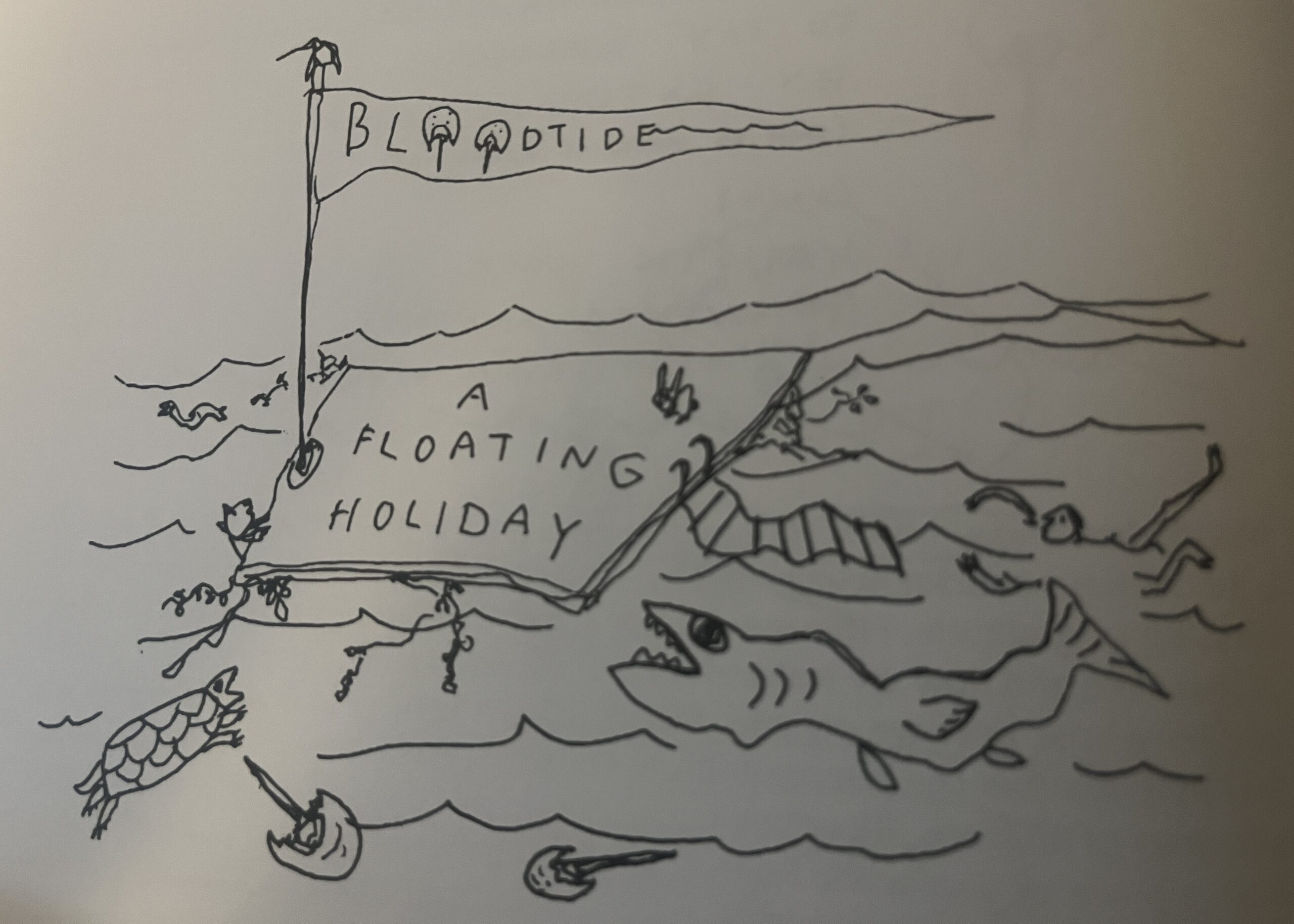
Nixon added that the holiday could be invoked anytime people need reminding “that we are in charge of when and how we mark meaning, whose lives are worth memorializing, and what new/primordial civic culture we can lift up from the silt.”
Hornstein and Nixon talked about the crabs so much that people wondered if they knew each other.
Eventually, the two began bringing people to the beach together during spawning season under a shared belief that the threats facing horseshoe crabs can feel “abstract” and not relevant until you show up with “your pizza and your family” and realize you are standing in the crab’s home, Nixon said.
Watching the annual spawning, Nixon added, would make people “more invested” in the organism’s survival.
The holiday is popping off all over the world, especially in Rhode Island, Nixon told last month’s crowd, while wearing a cardboard horseshoe crab strapped to their clothes.
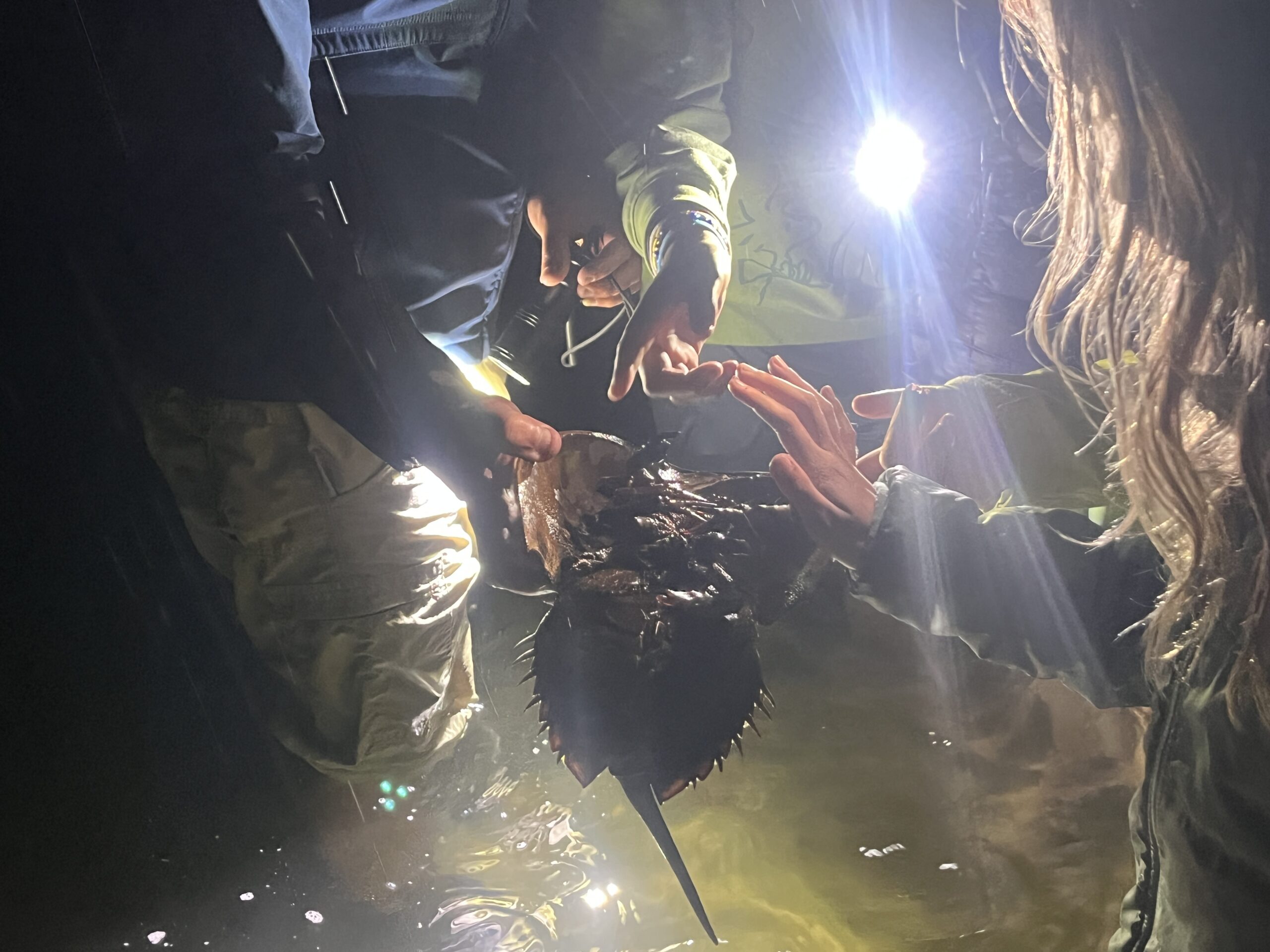
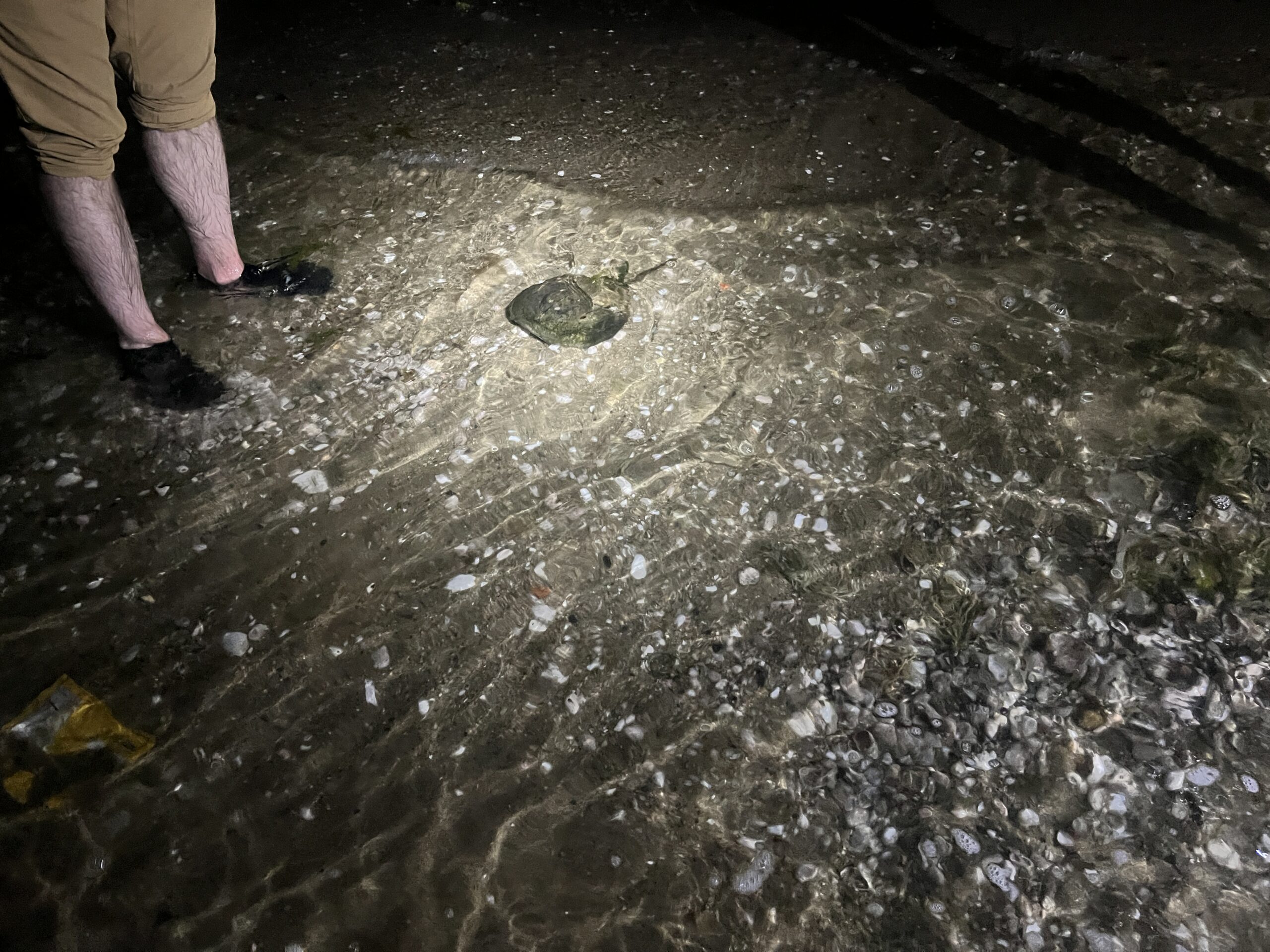
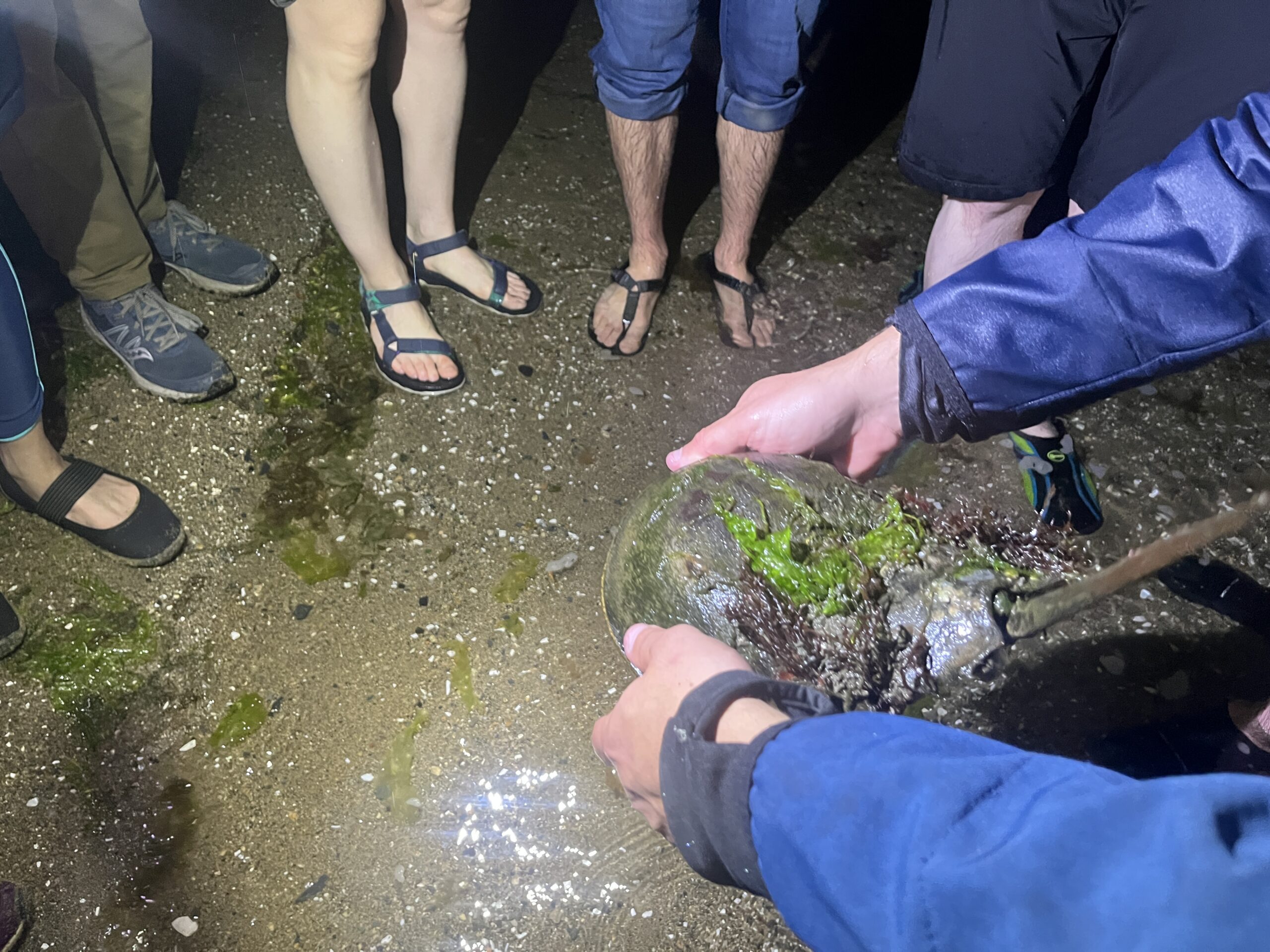
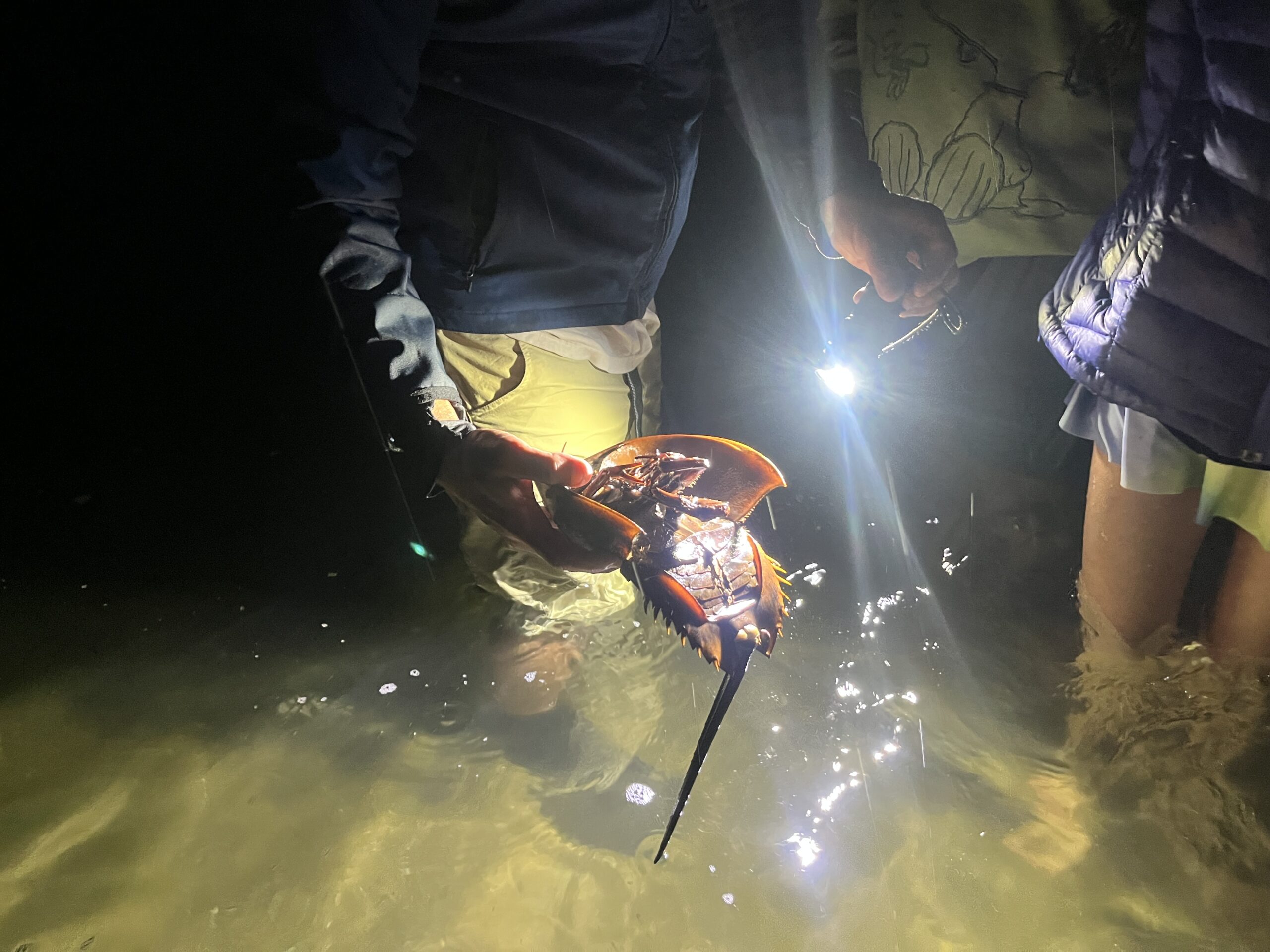
When the sun set, flashlights lit up the water, and some people followed Hornstein into the ocean for a lesson on horseshoe crabs. The group watched males patrol the shoreline in search of females, which are about one-third larger than their counterparts.
Hornstein lifted one from the water and pointed to his hooks, which are used to grab onto the back of the female’s shell, he said. “Does anybody know where the mouth is? Can anybody point to the mouth?”