
Supporters, Opponents of Offshore Wind Both Look for Hopeful Signs in Trump Administration
November 11, 2024
Share


On the day after the elections last week — and even before — the airwaves were crammed with speculation about how this, that, and the other sectors of American life and the economy would fare under a Trump administration.
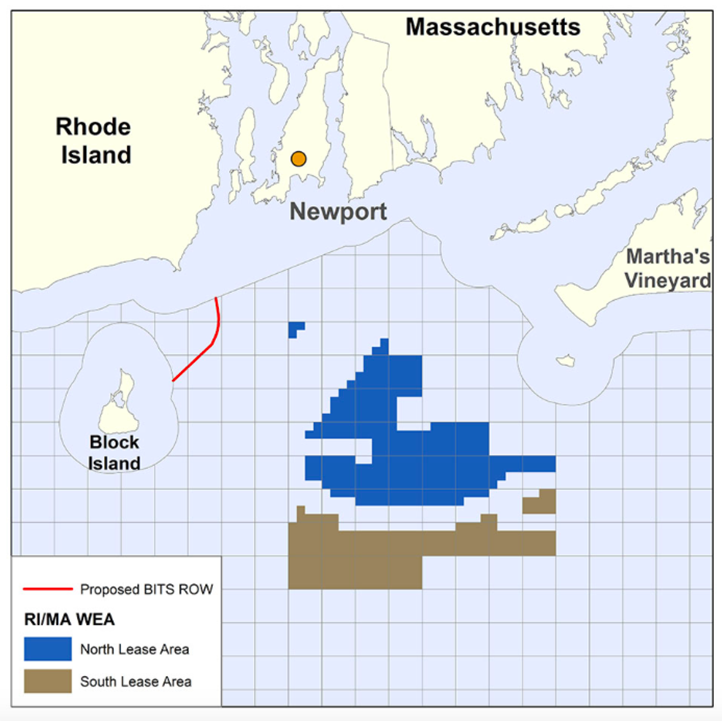
The chatter included the future of offshore wind, which was born in the United States in 2016 off the coast of Block Island and continues to generate heavy support and heavy opposition.
President-elect Donald Trump has expressed hostility toward offshore wind and has said he would put an end to the industry “on day one” of his administration. Trump-supporting Republicans have vowed to put an end to President Joe Biden’s 2022 Inflation Reduction Act, including tax credits for big projects such as offshore wind. A large share of the IRA’s $891 billion price tag is targeted toward renewable energy and related technologies.
Stock prices for offshore wind developers took a tumble the day after the election and Trump’s win. Ørsted, developer of the Block Island Wind Farm and Revolution Wind, saw its share price drop by as much as 14% the day after the election. First Solar Inc. and other renewable energy businesses saw similar declines in stock prices that day.
Supporters of offshore wind as an essential source of electricity in New England’s future said the industry now has roots so deep in the seafloor — and, notably, in manufacturing facilities in several red states — that Trump would be hard-pressed to kill it.
Green Oceans, a Little Compton-based citizens group that opposes offshore wind, said in a prepared statement, “We have opposed offshore wind since January 2023 because offshore wind does more harm than good. Offshore wind is bad for Rhode Island, for the country, and especially for the environment.”
Some Rhode Island fishing industry leaders loved the idea of putting an end to future offshore wind development; one of them added, however, that irreversible damage already has been done with the siting of Revolution Wind on part of Cox’s Ledge, a rich fishing habitat on the Outer Banks.
At present, offshore wind projects in the United States consist of the Block Island Wind Farm and the South Fork project off Long Island, N.Y., which is generating power as the first commercial-scale offshore wind facility. Under construction are Vineyard Wind, based in New Bedford, Mass.; Ørsted’s Revolution Wind, based in Rhode Island; and Dominion Energy’s Coastal Virginia Wind project. In early October, the Bureau of Ocean Energy Management (BOEM) gave final approvals for Atlantic Shores South off the coast of Atlantic City, N.J.
People who support offshore wind say, broadly, that projects that have already received federal approvals and contracts such as Vineyard Wind and Revolution Wind are probably pretty safe from Trump’s axe, if it even gets raised. They think Trump could impose a slowdown by BOEM on permissions for the many offshore wind projects that have not yet received federal approvals. These include SouthCoast Wind, off the coast of Massachusetts and Rhode Island, which won a bid to provide 200 megawatts of power to Rhode Island, is now negotiating a power-purchase agreement with Rhode Island Energy, and received its final environmental impact statement from BOEM earlier this month.
Richard Soule, who runs a Rhode Island-based offshore wind consulting firm, called himself “guardedly optimistic” about the future of offshore wind. “Trump is full of bluster,” he said. “Everyone questions how much of a priority [gutting the offshore wind industry] is for him.” It is notable that some of Trump’s most-quoted anti-wind comments were made in front of an anti-wind crowd last May in New Jersey.
Soule said a lot of renewable energy work — encompassing land-based wind farms, production of solar panels, and other components of these industries — is happening in states that voted Trump into the presidency.
“Three-quarters of all clean energy initiatives during the Biden administration were in the red states,” he said. “Texas is the No. 1 renewable energy state” in terms of land-based wind, and boats specific to the offshore wind industry are being built on the Gulf of Mexico, in Texas and Louisiana.
“They are going full speed ahead [building] offshore wind vessels,” Soule said. “Trump is not going to pull the rug out from under the red states.”
Other factors that Soule believes strengthen offshore wind are strong support by states for this form of energy to reach emissions-reduction goals; lots of cooperation among states in building-related manufacturing and supply chains; and support from pragmatic conservatives.
“Maine Gov. [Janet] Mills is conservative, and she is all in for offshore wind,” he said.
Soule said the country needs more electricity, period, especially with the expanded sales of electric vehicles and artificial intelligence. AI data centers are enormous consumers of energy. Soule noted that Elon Musk, creator of the Tesla and promoter of Trump, “has said that AI [energy] needs cannot be met” with current resources.
Kris Ohleth, executive director of the Special Initiative on Offshore Wind, agreed that the country simply needs more electricity. “Offshore wind is not just a clean energy solution, it is an energy solution,” she said. “There is growth in AI data centers and the electrification of the transportation sector and buildings. Meanwhile, supply is coming offline with the retiring of power plants. Nuclear? I cannot see it within a decade. There is no other shovel-ready technology” than wind power.
If or when Trump directs BOEM to slow-walk offshore wind projects, Ohleth said there is plenty of related work that states can focus on during long permitting delays. For example, the Special Initiative on Offshore Wind is leading the effort to create a rational and fair regional compensation fund for fishing people and industries harmed by offshore wind. Those compensation packages, so far, have been created erratically, on a project-by-project basis.
Ohleth also questioned Trump’s commitment to killing offshore wind. “I am guessing that offshore wind is not among his highest priorities,” she said. “But the states are very strident. They continue to show extreme leadership.”
Further, Ohleth said, offshore wind supports two of Trump’s stated priorities: energy independence and U.S. manufacturing.
Similarly, Kelt Wilska, one of three team leaders of New England for Offshore Wind, said, “Offshore wind is aligned with the Trump vision that prioritizes American jobs and American manufacturing. It is certainly not in the Trump Administration interest to destroy a rapidly growing industry.”
Biden has set a highly publicized goal of created 30 gigawatts of new offshore wind energy by 2030. The American Clean Power Association’s 2024 Offshore Wind Market Report says the renewable power industry is projected to invest $65 billion in offshore wind projects by 2030, which will support 56,000 jobs. There are currently 12 gigawatts (GW) of projects with active offtake agreements. Across 37 offshore leases in the U.S., there are now 56 GW of capacity under development.
The report discusses the economic impact of offshore wind on domestic U.S. shipbuilding, port infrastructure, and the U.S. supply chain. It says there are more than 40 new offshore wind vessels currently on order or under construction.
The U.S. Department of Energy says offshore wind investments announced under the Biden administration include more than $6.9 billion manufacturing and port investments so far; more than 70 investments in 19 manufacturing facilities (nine states), and 15 ports (nine states); 25 new vessels being built in eight states; one substation in one state; and thousands of new jobs.
The U.S. Department of Energy offers an online map of offshore wind-related activities across the country. It includes port development in Rhode Island, Massachusetts, Connecticut, New York, New Jersey, Maryland, and northern California; manufacturing in Texas, North Carolina, Virginia, Delaware, and New Jersey; boat building in Rhode Island, Connecticut, Washington, Louisiana, Florida, Michigan, and Wisconsin.
Among the boat builders are Senesco Marine in North Kingstown and Blount Boats & Shipyard in Warren, under contract to build a total of five multimillion-dollar crew transfer vessels for Ørsted and Eversource Energy for their Northeast offshore projects.
Blount built its first offshore wind vessel, the Atlantic Pioneer, in 2016 for the Block Island Wind Farm. It has since delivered three more boats. The third and fourth boats, the Gripper and the Guarder, were finished this year; they were the only two boat projects by Blount that qualified for a 10% tax credit under the IRA.
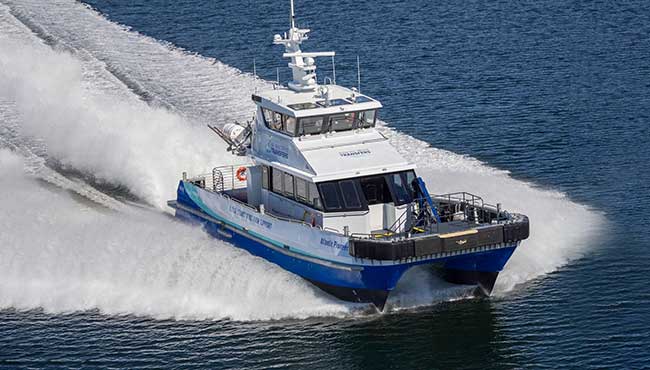
Marcia Blount, president of the company, said she is proud of the “beautiful boats” Blount produced, but has been disappointed in the relationship with the offshore wind industry. Her company, and others, were slammed by escalating costs of materials during high inflation. Also, she said, it has been hard just to file for the tax credit, which will come to the company long after the construction phase, when cash is sorely needed.
“I don’t know of any boat builder that has made any money,” Blount said. “I have been disappointed in what I had hoped was an opportunity for us as a small shipyard in the Northeast.”
Looking to the future, Blount said, “I don’t see the IRA being repealed, but there might be a change in emphasis … to other types of innovation. I don’t foresee anything ending; there are so many people doing jobs in green energy, even in states that Trump won.”
Green Oceans opposes offshore wind for a number of reasons and has said it would keep up the fight against it. “We think it’s so bad, we’ve gone to court — at our own expense — to stop it. Our state and federal lawsuits continue and we are closely watching the ACK4 Whales petition to the Supreme Court,” Green Oceans said in a statement.
The group claims that “offshore wind was sold under false pretenses. It is supposed to delay climate change, create scores of great new jobs — and cut power bills — without harming the environment. None of these promises have come true. The wave of new jobs hasn’t materialized here or in Europe.”
Green Oceans quoted Ørsted CEO Mads Nipper’s comment to Bloomberg News in September 2023 that it was “inevitable” that consumers will have to pay more for renewable energy. “And if they don’t, neither we nor any of our colleagues are going to build more offshore. It’s very simple,” Nipper said. At that time, the industry was reeling from high construction costs and interest rates; some wind projects were postponed or canceled.
Green Oceans said BOEM’s final environmental impact statement for Vineyard Wind states that “offshore wind will have no real impact on slowing climate change.”
The full paragraph in BOEM’s statement on Vineyard Wind said: “Overall, it is anticipated that there would be no collective impact on global warming as a result of offshore wind projects, including the proposed action [Revolution Wind] alone, though they may beneficially contribute to a broader combination of actions to reduce future impacts from climate change.”
Green Oceans concluded, “Three years ago, they sold offshore wind castles in the air. Reality — and a record — has brought OSW crashing to the ground. Offshore wind has to end.”
Another vocal opponent of offshore wind are Rhode Island fishermen, who see the turbines as an existential threat to their industry. Fred Mattera is executive director of the Commercial Fisheries Center of Rhode Island, a lifelong fisherman, and a fisheries consultant to the offshore wind industry. He sees the possibility of a Trump-led BOEM slowing down permitting for future offshore wind projects, and he likes that vision.
“What I like is using good, sound science to make decisions,” Mattera said. “We have been impetuous. It is human nature to build things first and face the consequences later.”
Mattera said he will be watching Trump’s actions in his first 100 days in office. “Some developers may just pack up and say it is over. When it comes to investments, the worst word is ‘uncertain.’”
He said most of the offshore wind work is happening off the East Coast, not in red states. “I don’t think [Trump] is going to have a lot of empathy for the Northeast and the East Coast.” As for industry-specific vessels being built in red states like Louisiana and Texas, “Once they build those ships they can go anywhere in the world,” he said.
Mattera would like to see a slowing of the whole federal process and a shakeup at BOEM. Like other opponents of offshore wind, he believes BOEM listened to opponents, checked all the boxes about public input, and went ahead and approved wind projects anyway, as it had intended to do from the start.
“I actually wish [wind farms] would just go away and we start to build nuclear plants,” Mattera said. “Industrializing the ocean is not the way to manage an ecosystem.”
Not surprisingly, organized labor in Rhode Island is a big supporter of offshore wind. Patrick Crowley, president of the AFL-CIO in Rhode Island, reacted with truculence when asked about Trump’s threat to offshore wind, saying, “Supporting offshore wind is a new front in resistance to Trump and Trumpism. We have to make the case for supporting offshore wind. We have got to leverage our power at the state level. We will use state regulators to move forward.
“This industry is about jobs and the environment. If Trump comes after offshore wind, it means they are cutting jobs. Trump can bring it on because we are ready to fight.”
One tactic, which has precedents, of the Trump-era resistance to offshore wind may be lawsuits against BOEM and the Department of the Interior. The Sabin Center at Columbia University, watching the march of anti-wind lawsuits, said they haven’t moved the needle against the ndustry:
“Over the past few years, opponents of offshore wind energy have filed at least 15 lawsuits against five projects in federal court. … To date, federal courts have been reluctant to grant this type of extraordinary relief in challenges to offshore wind projects. In recent years, federal courts have denied motions for preliminary injunction in litigation pertaining to the South Fork Wind, Vineyard Wind, and Coastal Virginia Offshore Wind projects.”
Anti-wind litigants in Rhode Island have been busy since 2023, so far with little success. In April a Newport County Superior Court judge ruled against Green Oceans in the group’s civil lawsuit that sought to overturn a May 2023 vote by the Coastal Resources Management Council in favor of Revolution Wind.
In June, the federal district court for the District of Columbia denied a lawsuit filed by Green Oceans and 35 co-plaintiffs, filed in January. The lawsuit had sought a stay of the approvals or a preliminary injunction against Revolution Wind. The court found that Green Oceans failed to show likelihood of violation of the Clean Water Act or Endangered Species Act.
In November 2023, The Preservation Society of Newport County and the Southeast Lighthouse Foundation on Block Island filed appeals against BOEM’S approval of the South Fork Wind Farm and Revolution Wind.
Developers and government officials were careful in their prepared public statements on the topic of a Trump administration and offshore wind. None agreed to interviews. Among the observations was this from Rhode Island Secretary of Commerce Elizabeth Tanner: Predicting federal policy shifts under a new administration is hard to do with any degree of certainty. … The industry progress depends heavily on the ease of federal permitting of projects and federal funding to support infrastructure and incentives. That said, states also play a significant role in offshore wind development and drive much of the demand for renewable energy through their own policies, targets, and incentives. Rhode Island remains committed to achieving our clean energy goals.”


Rhode Island politicians are concealing that after the Block Island Wind Farm was erected, they let ISO New England raise the New England Regional electric Power Grid to high to enable an investment company in the Block Island Wind Farm to double their investors’ money. Before the Regional Grid historically had been at its safe lowest level, rather than high. A Middletown electrician noted that the raised Regional Power Grid, has caused exploding equipment everywhere and fires, even in homes. He added, “but it’s all kept hush, hush.”
Plus the raised grid has caused 23 hour a day noises, some with vibrations, from all equipment, including gas lines, that at same location are tied into the New England Regional electric Power Grid.
This raised power grid issue is kept quiet because it makes Wind Turbines the opposite of “Environmentally Correct.”
My advice to investors is sell.
https://www.mvtimes.com/2024/11/12/canada-station-reports-falsification-scheme-turbine-plant/?fbclid=IwY2xjawGg59lleHRuA2FlbQIxMAABHQbr9Norpf4neYhqLY1WnaZ8YrRTy2eB1A7KA3ImPhtq5udBXCCt8W9sOA_aem_WDV-IVC-pmQZFSNKN5MsnQ
I hope Trump pulls the TAX CUTs in the Inflation Reproducing ACT, that are funding the UNreliable, $cam Wind and Solar, paving over our Farm land and Cutting our Forests and Industrializing our Ocean, and killing our fishing Industry and WHALES. $CAM! Enviro Disaster!
We heard plenty from conspiracy theorists in this article,, but not climate activists. There are thousands of supporters of climate action here in Rhode Island, including in coastal communities. We are strongly in favor of offshore wind, and are making our voices heard through Climate Action Rhode Island’s Yes to Wind campaign. Join us in the fight for a future where the oceans are still healthy and not dead zones destroyed by acidification and deoxygenation.