
RIPTA Bus Service Cuts Could Disproportionately Affect Affordable Housing Residents
October 16, 2025
Share


Earlier this year, for the first time ever, the state awarded nearly $30 million in low-income housing tax credits to six affordable housing projects in Rhode Island.
Many of the 500 new units will house some of the state’s lowest-income residents, households making at or about 30% of the area median income, which is about $27,000 in Rhode Island.
The investment in affordable housing comes at a time when residents find themselves spending more and more of their paychecks on housing. Some 140,000 people, or nearly 35% of Rhode Island households, are “cost burdened,” meaning they spend more than one-third of their income on housing.
And, because affordable housing projects are often sited and funded with access to public transit in mind, the recent service cuts the Rhode Island Public Transit Authority was forced to make to fill in a $5 million budget gap mean that people already struggling to get by could be further impacted.
Advocates and stakeholders who spoke to ecoRI News said they worry the cuts and lack of investment in transit are already a detriment to those living on tight incomes and in affordable developments and could hamper the state’s housing goals.
All six housing projects that received funding through the tax credit — in Central Falls, Cumberland, East Providence, Providence, West Warwick, and Westerly — will be sited on public transit routes that are seeing some form of reduced service.
‘Every point matters’
The state’s scoring system to evaluate which projects receive State Low-Income Housing Tax Credits takes into account a development’s proximity to public transit when awarding points.
Projects within a half-mile of a bus stop receive one point; two points if they’re sited within a quarter of a mile. “Alternative transit options — other no or low-cost transportation services available to all residents which can be documented with a letter or agreement with the provider” receive half a point, according to the scoring document.
Transit points can give a small edge to a project, stakeholders told ecoRI News.
“That might put a project over the top, but it’s not the only deciding factor,” HousingWorks RI executive director Brenda Clement said.
Charlie Thomas-Davison, director of real estate development for the Women’s Development Corporation, a nonprofit developer that oversees the design, development, construction, and management of housing for low- and moderate-income families, said because the funding process is competitive, those extra points can make a difference.
“Given how competitive it is, most definitely every point matters,” she said. “So, even if it might be two points out of a possible 100, that could be the two points that makes the difference.”
The six projects funded earlier this year were already scored, and because most of the RIPTA service cuts don’t involve taking away bus stops, they likely wouldn’t affect the transit scoring as it stands.
“The McKee administration is committed to ensuring Rhode Islanders have access to the housing they need to support stability, opportunity, and long-term success,” Emily Marshall, a spokesperson for the state Executive Office of Housing, told ecoRI News in an emailed statement. “The recent RIPTA service changes do not affect the State’s housing goals or the progress of projects that have already received funding.”
From a cost perspective, Clement said the larger issue caused by transit cuts is how it could affect residents’ need for cars and thus the need to include more parking in development.
“If you suddenly do not have public transit and somebody needs two cars rather than one car, then public parking and the allowable parking on a site becomes another kind of interesting challenge, and that pulls us in the wrong direction,” she said.
Thomas-Davison, who has been involved in developing affordable units and complexes around the state, said parking can be a huge barrier to development both because of the cost it adds per unit to a development and because of the increased acreage it takes up.
“We’ve always said, you know, housing, not cars. We want [to] get more units and less parking spots,” she said. “That doesn’t mean we don’t have any, we do, but we regularly go in front of [a town’s] planning board to request that they consider less parking.”
The push for parking reductions was made under the assumption that public transit could make up the difference.
“I don’t think we’re at that tipping point on that front, but it is kind of something to keep our eye on moving forward,” Clement said.
‘Chicken or the egg’
If a Rhode Islander can’t afford market rent, which is now hovering around $2,000 a month, it’s likely that a car is another unaffordable expense.
Like housing itself, automobile costs are increasing. Nerd Wallet estimates that it costs about $1,000 a month to own a used car, including loan payments, insurance, and gas.
Housing Network of Rhode Island executive director Melina Lodge told ecoRI News that all those increasing costs — housing, automobiles, food, child care, insurance — are adding to a feeling of major financial pressure for low-income residents.
“Not to say it’s not bad enough that people are spending more on housing, if that was the only thing, right, you could kind of say, ‘OK, you can adjust to other things,’ but people are actually spending more for everything across the board, including transportation,” Lodge said.
And many Rhode Islanders need a car, she said, because historically the state has invested in single-family housing, which promotes driving, rather than in denser housing complexes.
“That doesn’t leave a lot of room for massaging budgets. Things get tight because those are really expensive forms of housing and transportation,” Lodge said.
All of these things really factor into people’s stability in their entirety. So, something happens with their car, can they afford to pay their rent? If their rent goes up, can they afford to keep their car running well in order to get to jobs?”
— Melina Lodge
A likely solution would be to use public transit which, even without subsidies, is much less expensive than owning a car. An unlimited RIPTA transit pass costs $70 a month.
But in part because of those historic development patterns, public transit outside the state’s urban corridor was limited even before RIPTA implemented the widespread cuts that most impacted low-ridership routes in more rural areas of Rhode Island.
The problem becomes circular, Lodge explained. Opponents to housing developments outside urban areas argue they shouldn’t be built there because there isn’t great transit access. But if the people who would need the bus don’t live in that area, the demand and ridership for any public transit will likely be low.
“It’s a little difficult sometimes to tell what’s the chicken or the egg,” Lodge said.
She said she is concerned that a lack of transit investment hurts many state goals, not just housing, but workforce development and environmental goals, too.
Lodge recognized that state budgets are hard to square but said she believes there can and should be investment in both.
“My position on this is we can care about multiple things at the same time, and we don’t constantly have to choose just the one thing,” she said. “We need to really think strategically as a state: What are the things we’re investing in that get us the most, the biggest bang for our buck?”
Limited access to services
Thomas-Davison said because the RIPTA cuts took effect in September, it’s hard to tell yet exactly how residents helped by her agency will be impacted, though she is sure they will be.
Most of the residents in Women Development Corporation housing sites outside the urban corridor only have one car even though they often have multiple working people in a home, she said.
Before the cuts, Thomas-Davison already saw how challenging it was for families to access the resources they need, such as after-school programs and other services provided by schools.

“Obviously, if you’re not going to have a car, you have to have another way to have access,” Thomas-Davison said. “Cuts to that [access] quite clearly could eliminate their ability to be employed or to continue with some education opportunities.”
The Women Development Corporation builds developments with transit in mind — transit that runs at certain frequencies and to certain destinations — and residents move to those complexes believing that taking the bus is an option.
“Folks moved there with the assumption and the belief and the understanding that they had access,” Thomas-Davison said. “So, what happens when you’ve been living there and at this point you’re raising a family there, and your access just to your job or your kids’ school or your doctor is eliminated, or it’s reduced to once a day? That could be devastating for our families.”
At a bus stop a 5-minute walk down the street from where a new housing development is underway at the former Lippitt Mill in West Warwick, one of the projects funded by the state affordable housing tax credit, Koryn Rugg knew why an ecoRI News reporter was approaching her, even before she was asked a question.
“You want to talk about the 23?” she said, explaining that she took the line from West Warwick to her job waitressing in Coventry. But because RIPTA cut weekend service on the line, she’d had to Uber to work the weekend before.
“We do have a lot of low-income [residents] in West Warwick and Coventry,” she said. “There’s parents that have children that don’t have vehicles like those that frequent the bus. So, on the weekends, it was a struggle to get laundry done. You know, it’s not easy to walk an hour down the road with a laundry basket.”
Rugg learned about the RIPTA service cuts from other passengers and a kind driver on the 23 who she said was disappointed to be taken off the weekend route. Rugg wished she could have attended the hearings to argue for keeping the service, but she has a tough schedule and heard about the hearings too late.
“You know, people that take the bus don’t know stuff like that,” she said.
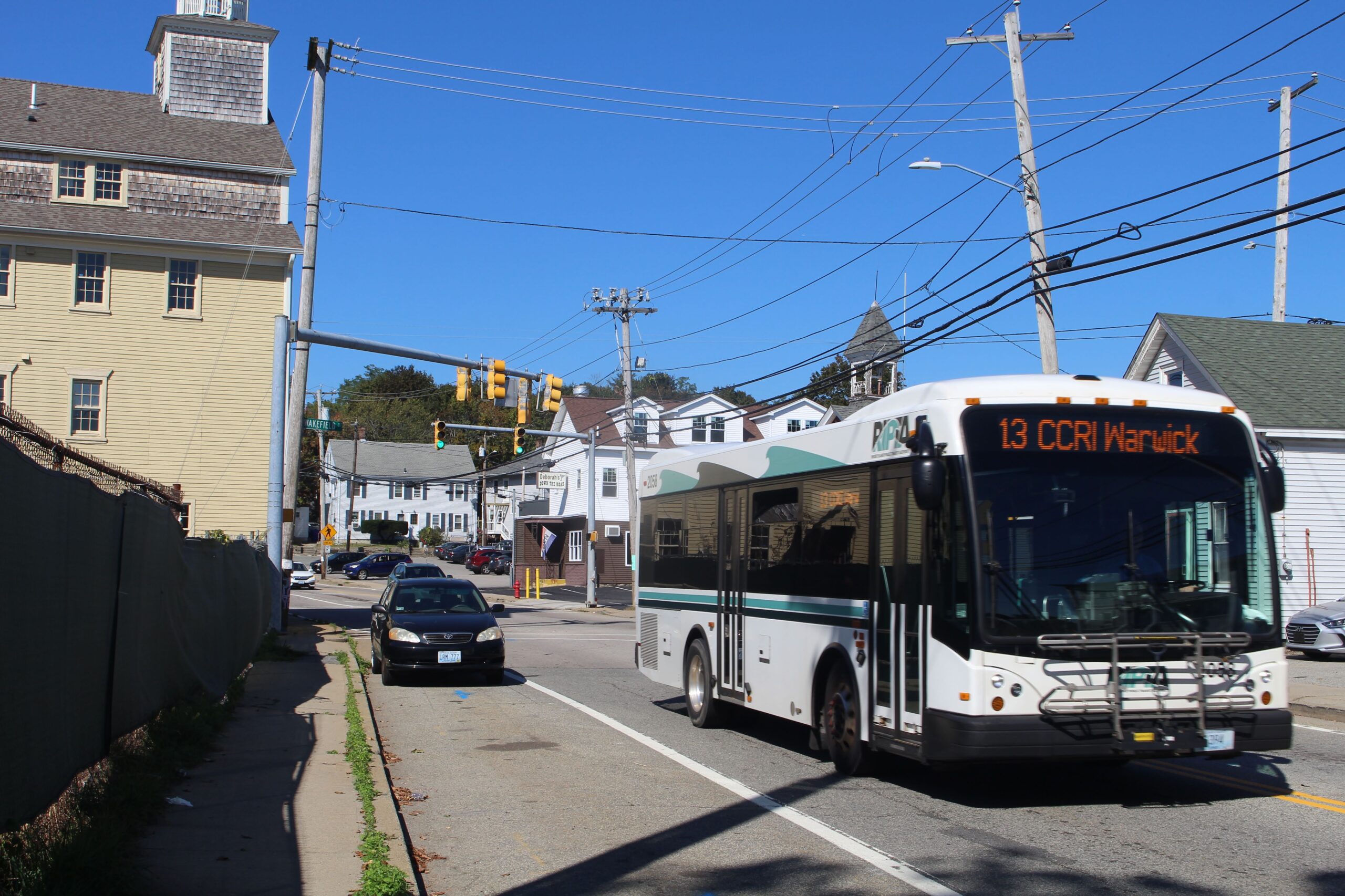
Living just down the street from the RIPTA stop and the soon-to-be-built apartments at the Lippitt Mill, Rugg said, she can still take the 13, but with that route reduced from every 60 minutes to every 90 minutes, she’ll have to get to work an hour early or be late.
“I’m glad to talk to you,” she told ecoRI News. “Anything we could do to possibly get it back, so they know that it’s impacting everybody you know.”
Thanks to the RIPTA cuts I have to pay $50. A week now to get to work, cutting 2 runs before 7:14 a. Route 22. Outbound. Many students were also on that route (6:34a) that are now missing 1/2 period classes. I was told that if I continued to be 30-45minutes late my manager would or might let me go. So I had no option but to use ride service or unemployment. Worse the bus cannot arrive on time with the cuts. $4.00 per day vs 12.00 per day or unemployment at $270. a week?
Fire Alviti and make McKee ride the bus for a month. If he does he will see how stu[pid and inhumane his bidget is. McKee is a criminal, harming people becauase he is afraid to tax the rich. Pass the millionaires tax and fiund RIPTA.
We SaveRIPTA volunteers know that many of our electeds in the General Assembly understand & support the housing transit connection that Coleen describes so well in this article.
When state leaders like Governor McKee refuse to properly fund transit, I smell outside influence. We need campaign finance scrutiny during the 2026 election. We have the tools to do that.