
Rhode Island Could Follow Austria’s Lead When It Comes to Composting
But state doesn’t even enforce laws that ban food scrap from being landfilled
April 21, 2025
Share



JOHNSTON, R.I. — Compostable materials, such as food scrap, newspaper, cardboard, and leaves, make up about a third of the total trash sent to the Central Landfill every year, about 100,000 tons total, according to a 2015 waste characterization study by the Rhode Island Resource Recovery Corporation, which operates the landfill.
In light of predictions that the landfill will be full in about 20 years, the need to divert food scrap and compostable materials is pressing. That 100,000 tons of material entering the landfill could be reduced dramatically if Rhode Island’s municipalities offered composting programs.
But there are a number of obstacles that prevent cities and towns from implementing such programs, including the initial costs of starting them; finding a facility that will accept the material; and getting residents on board.
“I think a lot of it is education about how much of an impact it makes,” said Jayne Merner, the owner and operator of Earth Care Farm in Charlestown, the state’s oldest farm composter and only commercial food-scrap composter.
Merner, who is the daughter of Earth Care Farm’s founder, Michael Merner, said a recent trip to Austria she took with her son to observe that country’s recycling and compost efforts was eye-opening.
“Food scraps there were banned from landfills in 1992,” she said. “They have 92 different streams of recycling, from candle wax to K-cups, kitchen grease, types of fabric.” The result, Merner said, is that everything that is recycled or composted in Austria is more valuable because it’s been cleanly separated.
“The value [in Rhode Island] is decreased” because the state has single-stream recycling, she said. “It’s harder to get clean streams of compost.”
Austrians “understand that compost has to be food scraps, not trash, and why. It has to be things that are going to be great for the soil. Anything that you can put in your body, you can put in your compost,” she said.
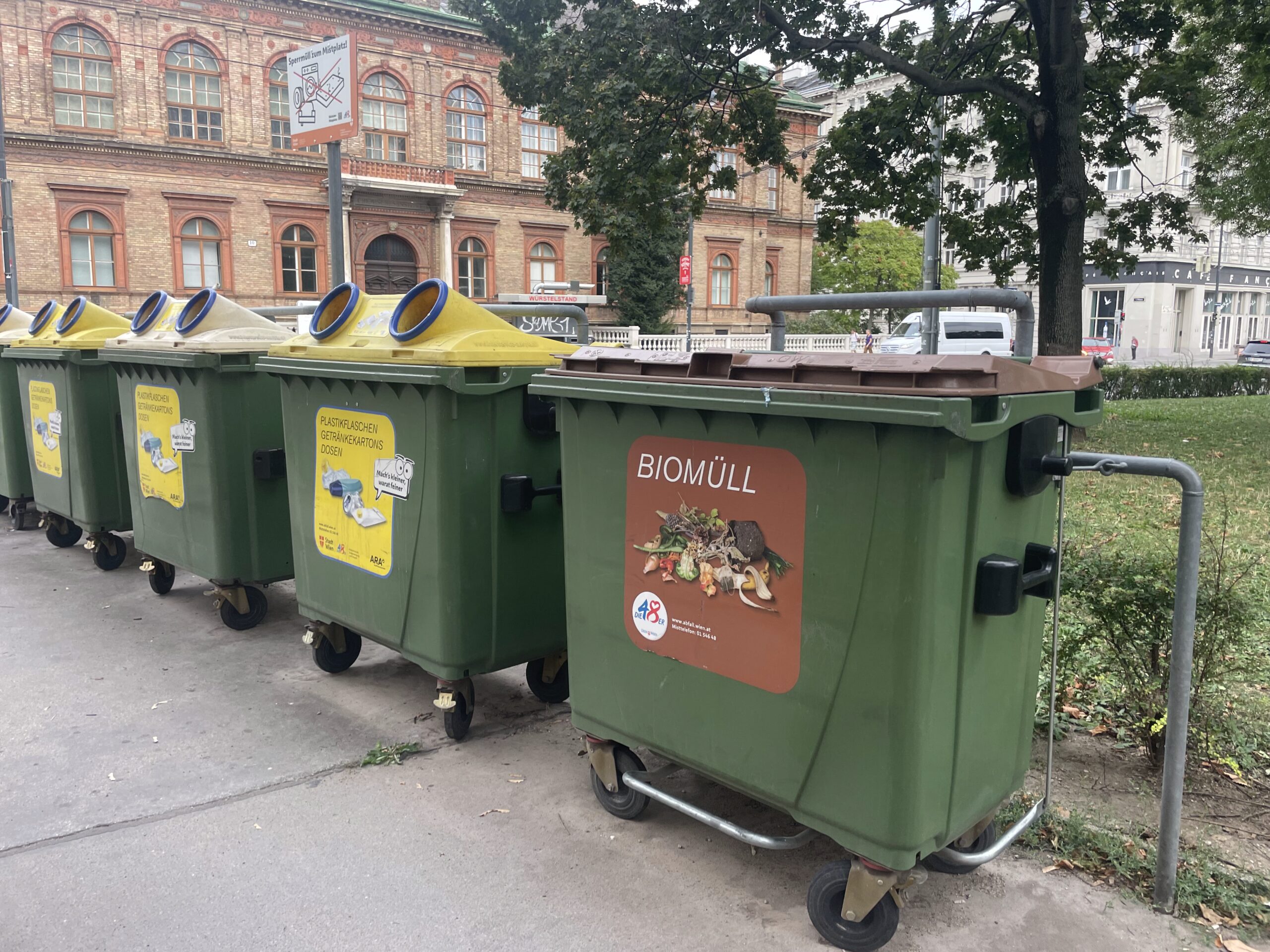
Austria’s composting and recycling efforts are so successful, she said, because it’s a “great public-private partnership. It works because the composter is not the municipalities, but the towns work with the composter, providing trucking, pickup, and education.”
And that’s where it gets tricky in Rhode Island, said Kevin Proft, Providence’s deputy director of sustainability.
“One of the main things is the cost of the initial change” to start a municipal composting program, Proft said. Municipalities would have to pay someone to haul the food scrap away, plus pay for composting bins. “You’d need a pretty sizeable number of residents [to compost] to start to make a difference in the tip fees so that it overcomes the cost of the hauling contract.”
Although the state has had a ban on commercial food waste in the landfill since 2016, that isn’t often enforced, he said. The law requires facilities that generate large volumes of food scrap to divert, donate or compost their leftovers, but because there are only a couple of facilities in the state that can handle high volumes of food scraps — Earth Care Farm and the Rhode Island Bioenergy Facility anaerobic digester near the Central Landfill — most institutions don’t comply.
“I don’t see that being enforced,” Proft said.
“That’s one of the real challenges, and a barrier to food waste diversion for municipalities,” said Leo Pollock, co-founder of Remix Organics and long an advocate in the battle against food waste in Rhode Island. “It’s like the chicken and the egg. Do you need the facility to exist to start a [composting] program, or does the program need to be there to justify the facility?”
The most logical place for food waste to go is to the anaerobic digester near the Central Landfill, which currently handles 100,000 tons of organic waste annually in its two 2.5-million gallon tanks. “There’s capacity there,” Pollock said, plus “an ability to handle small amounts of contamination” in the materials, such as plastics, which other composting facilities may not be able to remove. The digester works by taking organic matter and breaking it down in the absence of oxygen to turn it into gas that can be used to generate electricity.
Rhode Island’s small size and population density make it challenging to site large-scale composting facilities, Pollock said. “We have one in Charlestown [Earth Care Farm], but I think it would be a challenge to site another one anywhere else in the state,” he said. Residents often don’t want a composting facility as a neighbor. “They want the aesthetic, but not the noise and odors,” he said.

Two recent proposed composting facilities, in Warren and North Smithfield, were rejected by the towns, he said.
But, Pollock said, the discussions around municipal composting have changed over the years. “It used to be a difficult conversation,” he said. “The economics are starting to shift, and municipal composting is starting to make more sense. In neighboring states, municipalities are trying to figure it out too.”
He cited Boston, where, he said, about 10% of city residents, or about 30,000 households, are participating in a municipal composting program. “The city is paying for it, so there’s no residential cost,” he said. “Boston is paying slightly more than the equivalent of solid waste disposal and trying to get it up to scale.”
Proft said part of thinking about municipal composting must include a cost-benefit analysis. “When you bring recycling to the Materials Recycling Facility at the landfill, the tipping fee is zero. But there is a tipping fee to bring food scrap to a compost facility,” he said.
Merner is fervent when describing the many benefits of composting, which creates a healthy habitat for microorganisms and increases drainage, aeration, and water-holding capacity of soil — all factors that help the environment better withstand weather extremes and disease. She said there’s been an increased interest in compost recently.
“There’s more demand for the finished product,” she said. “Since the pandemic, the concern about prices and food have spiked demand for good quality compost.”
She pointed out the difference in the way municipalities and farmers think about compost. “Farmers think about soil health, they think long-term,” she said. “Municipalities think about separating waste. Towns don’t care about where [compost] goes or how it’s used.”
In lieu of municipal composting programs, there are a number of ways state residents can dispose of their food scrap and yard waste besides throwing it in the trash.
The Rhode Island Resource Recovery Corporation promotes do-it-yourself composting efforts, offers compost bins for sale to state residents, and maintains a list of about 14 municipalities that offer composting alternatives through their public works departments. The corporation also offers municipal grants that cities and towns can apply for to boost composting.
Providence last year distributed a $255,850 U.S. Department of Agriculture grant to a number of programs to promote food waste diversion and composting efforts, including:
Providence GardenWorks received $54,200 to provide compost bins, supplies, and mentorship to the community.
Zero Waste Providence received $84,540 to educate and engage the community on the benefits of composting and waste reduction.
Groundwork Rhode Island received $27,715 to add five new sites to Providence’s compost drop-off network, repair existing ones, improve bilingual signage, and increase composting capacity.
There are also a number of private composting companies in Rhode Island, including Black Earth Compost, Bootstrap Compost, and Epic Renewal.
This story is part of a series “Black Gold Rush: The Race to Reduce Food Waste and Save Soil.” The series is sponsored by 11th Hour Racing.

RI needs a comprehensive rethink. It needs to raise tip fees, institute a program to help municiplaities get into composting (using the higher tip fees to finance it) and really do recycling right. A bottle bill and a compost surcharge on landfilling are just a small start., but a necessary one. the state should also convene all the municipalities and work with them to figure this out to keep the landfill at Johnston from overfilling too fast.
It looks like Block Island was left out of the discussion again. The Block Island Conservancy is in its third year I believe of composting on the Island. Perhaps you could look into in.
I could not agree more.