
Low-Income Rhode Islanders Pushed to Brink with Utility Increases
September 15, 2025
Share


WARWICK, R.I. — For the fourth winter in a row, Rhode Islanders are bracing themselves for higher energy prices.
The crowd was a little smaller inside the Public Utilities Commission recently when state regulators heard public comment on this year’s proposed rate hike, but the outrage, anger, and exhaustion expressed by residents was undeterred.
Nearly a dozen speakers told commissioners that low-income residents, as well as the state’s people of color, struggled to pay the higher electric rates seen in Rhode Island over the past few years. They warned of utility shutoffs, threats to public health, and the continued immiseration brought on by the electric rates.
Melissa Bubble, a community health worker, said she understood firsthand the struggle to afford high energy bills.
“When utility rates go up, it directly affects whether I can put food on the table for my kids,” she said. “No parent should ever have to wonder if keeping the lights on means going without groceries. That’s the reality families like mine are facing.”
Bubble said policymakers needed to adopt a percentage income payment plan (PIPP), a program that allows eligible ratepayers to pay a set percentage of their income to satisfy their utility bills, instead of the current system where rates fluctuate year to year.
Current programs, Bubble said, are inadequate. Her family makes just enough money to exceed the income cap in the Low Income Home Energy Assistance Program (LIHEAP), the federal program that provides assistance to reduce the cost of energy bills for low-income residents.
“These are not people looking for a handout, they are working, contributing, and doing everything right, and the system leaves families like them behind, like mine,” she said.
A petition organized and submitted by the George Wiley Center, a Pawtucket-based nonprofit dedicated to utility justice and other causes, asked the PUC to reject the rates proposed by Rhode Island Energy and protect the state’s vulnerable residents from utility shutoffs. The petition was signed by 206 people.
“Countless Rhode Islanders are being pushed to the brink by unaffordable rates, even as utility company profits reach new highs,” read the petition. “We refuse to stand by while our neighbors suffer. It is time for the Rhode Island Public Utilities Commission to take decisive action to protect residents and ensure access to these vital services.”
Some advocates expect Rhode Island Energy to eat the cost of rate hikes themselves. The company doesn’t earn a profit off the supply costs of energy charged to ratepayers on their utility bills every month; rather, the company’s profits stem from the construction of new infrastructure, such as new substations, transmission lines, or new natural gas hookups or pipe expansions.
This year’s winter rate hike marks the fourth consecutive year where utility justice advocates have raised the alarm that higher utility rates punish Rhode Island’s working poor most of all.
“Rhode Island Energy does not keep the money collected from customers’ supply costs nor does it benefit in any way financially from those supply costs,” said Brian Schuster, director of external affairs for Rhode Island Energy.
Starting Oct.1, the average family in Rhode Island using around 500 kilowatt-hours (kWh) of electricity can expect to pay an additional $24.49 every month this winter.
Seventy-six percent of state residents source their electricity from Rhode Island Energy, with the remaining portion sourcing it from smaller utility districts, such as the Clear River Electric and Water in Burrillville, or through community aggregation programs, where certain municipalities buy electricity for residents in bulk.
In a release, Rhode Island Energy noted this year’s hike was 9% less than last year’s winter rate hike. The same household using 500 kWh a month would have paid an additional $31.30 per month last year.
“Unfortunately, the New England region remains in the cycle where winter electric supply costs are higher than those during the summer months, but it is good news for customers that we have been able to procure supply for the upcoming winter at lower prices than we have seen over the last several winters,” Greg Cornett, president of Rhode Island Energy, said.
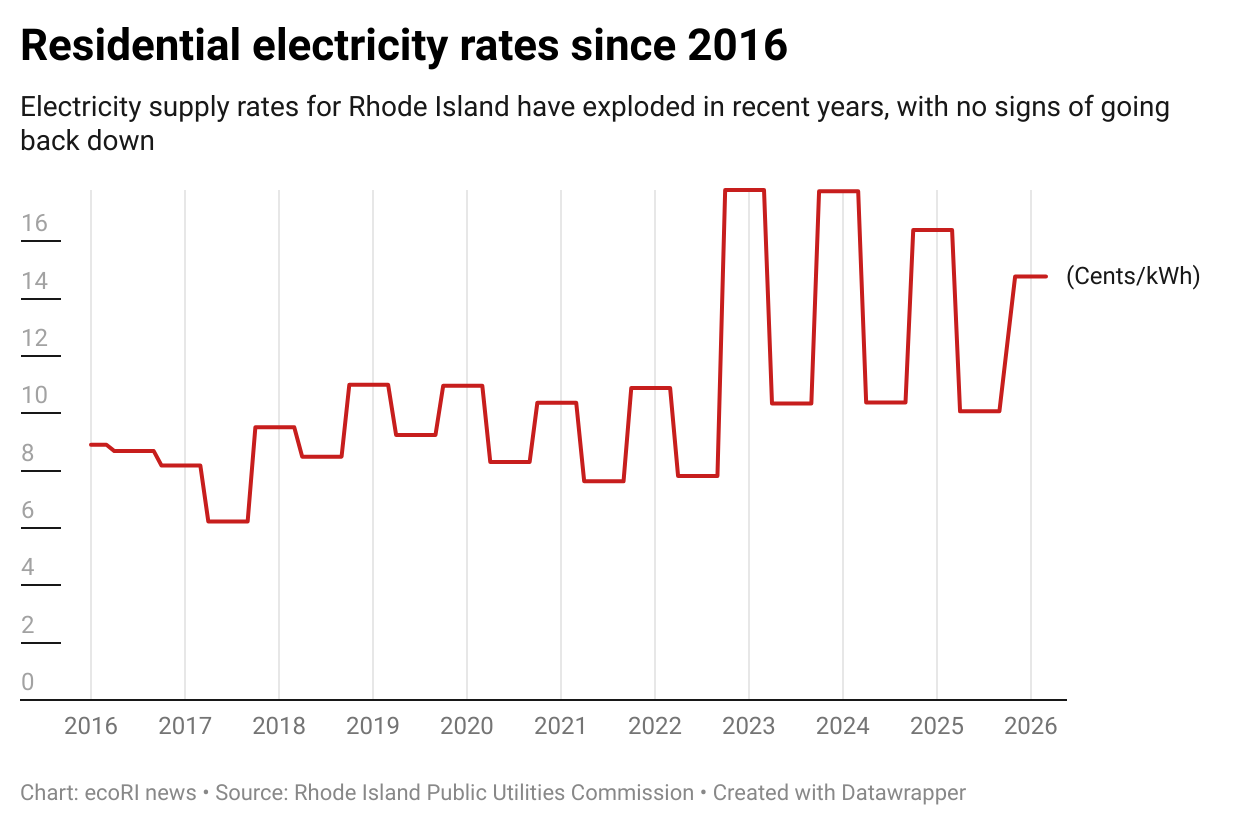
Despite the slight decline compared to last year’s rates, Rhode Islanders are still paying more for electricity than they were prior to the COVID-19 pandemic. Prior to 2022, the year when state regulators approved a historic rate hike, winter rates frequently topped out around 10.9 cents per kWh, around 2 cents per kWh more than the summer rate.
But starting in 2022, thanks to a surge in global demand for natural gas, and the Russian war with Ukraine, the recent record winter rates became the new floor for the summer ones. Starting in 2022, winter electric rates surged to 17.79 cents per kWh for residents, with summer rates rising to 10.34 cents per kWh.
The number of households in federal assistance programs has only risen slightly. In 2021, the year before historic electric rate hikes were approved, about 26,000 households received LIHEAP benefits. Last year the federal program served some 28,000 households.

The amount of households eligible to receive LIHEAP benefits in Rhode Island has actually declined. About 129,000 households were eligible for LIHEAP benefits in 2021, and last year only 114,000 households were eligible under the program.
Some relief may be in sight. On Wednesday, Rhode Island Energy announced the Division of Public Utilities and Carriers (DPUC) approved a $155 million settlement agreement with the company to give Rhode Island customers bill credits this winter.
Funding for the bill credits come from adjustments to rate filings over several decades, with Rhode Island Energy pledging to give $20 to $30 bill credits to electric ratepayers, and gas ratepayers $40 to $50 bill credits per month in the first three months of 2026 and 2027.
Gov. Dan McKee also chose to allocate $5 million from Regional Greenhouse Gas Initiative proceeds to help pay for additional bill credits this winter season for 36,649 income-eligible households. Those households will receive a bill reduction of around $45 dollars per month for three months.
The announcement adds to the $20 million rate relief approved by the PUC in June as a result of adjustments related to interstate electric service.
“We know that energy costs are putting real pressure on families and businesses in Rhode Island and across the country, especially during the winter months,” McKee said. “That’s why we are taking action with a package that delivers direct, meaningful relief. By leveraging several different resources, we’re putting money back in people’s pockets.”
naturally nobody likes paying utility bills, but as the graph shows, this winter will be the lowest of the last 4 years so it could be worse. One way to got is to for “lifeline” rates where a basic amount of electricity is at low cost, but prices are higher for units of power over that amount. That way basic needs can be met while everybody has a strong incentive to conserve, the best way to lower bills and environmental impact. Finally, we are going to be making more demands on the grid to electrify transportation and heating, so it is important not to have lower bills now at the expense of maintaining and bolstering the grid
First, let me say that I am disappointed in the ridiculous shutdown of the near-complete Revolution Wind by President Trump.
That said, I wonder if he is using it as a bargaining chip. I wonder if Trump is saying “Hey Rhode Island, you’ll get your wind power when you get out of the way of the Constitution (natural gas) Pipeline through New York.”
Trump did the same with New York and Gov. Hochul when he temporarily shut down Empire Wind. Supposedly, Hochul is now trying to expedite the pipeline.
When RI Energy visited the Cumberland Library last spring, hosted by legislators, I asked their representative “Would RI electricity costs be lower if the Constitution Pipeline was built?” And there was no equivocation. The answer was, and is, “Yes.” Yet RI politicians at all levels work to prevent this. They certainly aren’t representing the poor who spoke in this story to the PUC.
Adjusted for inflation, this is actually pretty comparable to pre-covid. Inflation adjusted, 2019-2020 was $0.1377 and this winter is going to be $0.1477. Of course, wages haven’t kept up with inflation for most.
Bonnie, I thought your presentation on the plight of low-income ratepayers was well written and I agree that something should be done. However, I would propose a different solution:
Ease the requirements for low income eligibility for LIHEAP benefits and increase the allowance.
Rather than implement yet another administrative program (PIPP) we should just withdraw from the Regional Greenhouse Gas Initiative which has outlived its usefulness. This would help all Rhode Island ratepayers, including businesses. If we want to make Rhode Island an attractive place to live and work this would be a great start.
My issue with PIPP is that the majority of the ratepayers end up subsidizing the low income ratepayers. The size of the pie will be the same. PIPP won’t address the core problem of much higher than average energy prices in this state. Withdrawing from RGGI, and reaping significant energy power price reductions, will help Rhode Island attract more people and businesses (or fewer to leave, as the case might be).
Is it just me or has anyone else noticed that while there is an increase in so-called “cheaper” solar and wind derived energy the cost to consumers has increased dramatically? There is also a very definite move to get us all off petroleum-based energy sources ie; #2 fuel oil and gas and onto all electric. Once and if that is accomplished see what happens to the cost of electricity! And as for subsidizing other consumers, I live near a family that is most definitely a beneficiary and the result is lights on all night, yard lights on all night and day, doors and windows open in winter. Subsidies should start with a base line usage amount based on family size. Any usage above that should be at the prevailing rate with an added fee for excessive use.